GUIDE

2-Year-Old (24 Month) Toddler Development

Your baby is officially not a baby anymore. They'd like to confirm this by doing everything themselves.

The 'terrible twos' miss what's actually happening: your child is developing a sense of self, testing independence, and learning to function as a separate person. That's not terrible. That's necessary.

Physical and Motor Development

Running is second nature with good coordination. Most two-year-olds can jump with both feet off the floor. Climbing is ambitious and fearless — playground ladders, furniture, stairs holding the railing. According to the WHO Motor Development Study, gross motor skills at 2 years reflect the culmination of two years of progressive development.

Fine motor skills are precise: building towers of 6+ blocks, scribbling in circular patterns, stringing beads, turning pages one at a time. According to Pathways.org, they might start drawing recognizable shapes — vertical lines, horizontal lines, and circles are usually first. Dressing skills are emerging: pulling off socks, attempting simple clothing.

Milestones to Watch For

  • Running well, jumping with both feet, kicking a ball with accuracy
  • Climbing playground structures, walking up stairs with railing
  • Building towers of 6+ blocks, scribbling in circular patterns, using scissors (with help)
  • 50–200+ words with two-word phrases (minimum expectation)
  • Asks 'what's that?' and 'where?' constantly
  • Complex pretend play — cooking for stuffed animals, being a doctor
  • Shows empathy — tries to comfort others, names some emotions

The CDC's 24-month milestones include playing with more than one toy at a time, kicking a ball, running, walking up stairs, and eating with a spoon.

Cognitive, Sensory, and Social Development

Pretend play is complex and imaginative — elaborate scenarios with different voices and characters. According to Zero to Three, this reflects mature symbolic thinking. They understand colors (might name 1–3), sizes, quantities, and positions. Sorting and matching are developing. Memory is detailed and lasting — they remember specific events from days or weeks ago.

Tantrums peak around 2–3 years. What helps: staying calm, validating feelings, setting firm limits on behavior, and giving comfort when the storm passes. Empathy is real but imperfect — they might comfort a crying friend, then take their toy five minutes later. They understand and test rules to confirm boundaries are real and consistent.

Vocabulary is typically 50–200+ words. The CDC expects at least two-word phrases. Some speak in sentences of 3–5 words. They ask "what's that?" and "where?" constantly. Pronunciation is imperfect — strangers understand about 50%, you understand 80–90%. Certain sounds won't be clear until 3–5 years.


Feeding and Sleep

Feeding looks mostly like family meals — three meals plus snacks with utensils. Picky eating is common and usually peaks between 2–3 years. The AAP recommends transitioning to low-fat milk after age 2. Milk intake: 16–20 ounces per day.

Sleep at 2 years is typically 11–14 hours total with one nap. Bedtime resistance is common and responds to consistent routines. The crib-to-bed transition may be happening — childproofing the bedroom is essential once they can get out of bed freely.

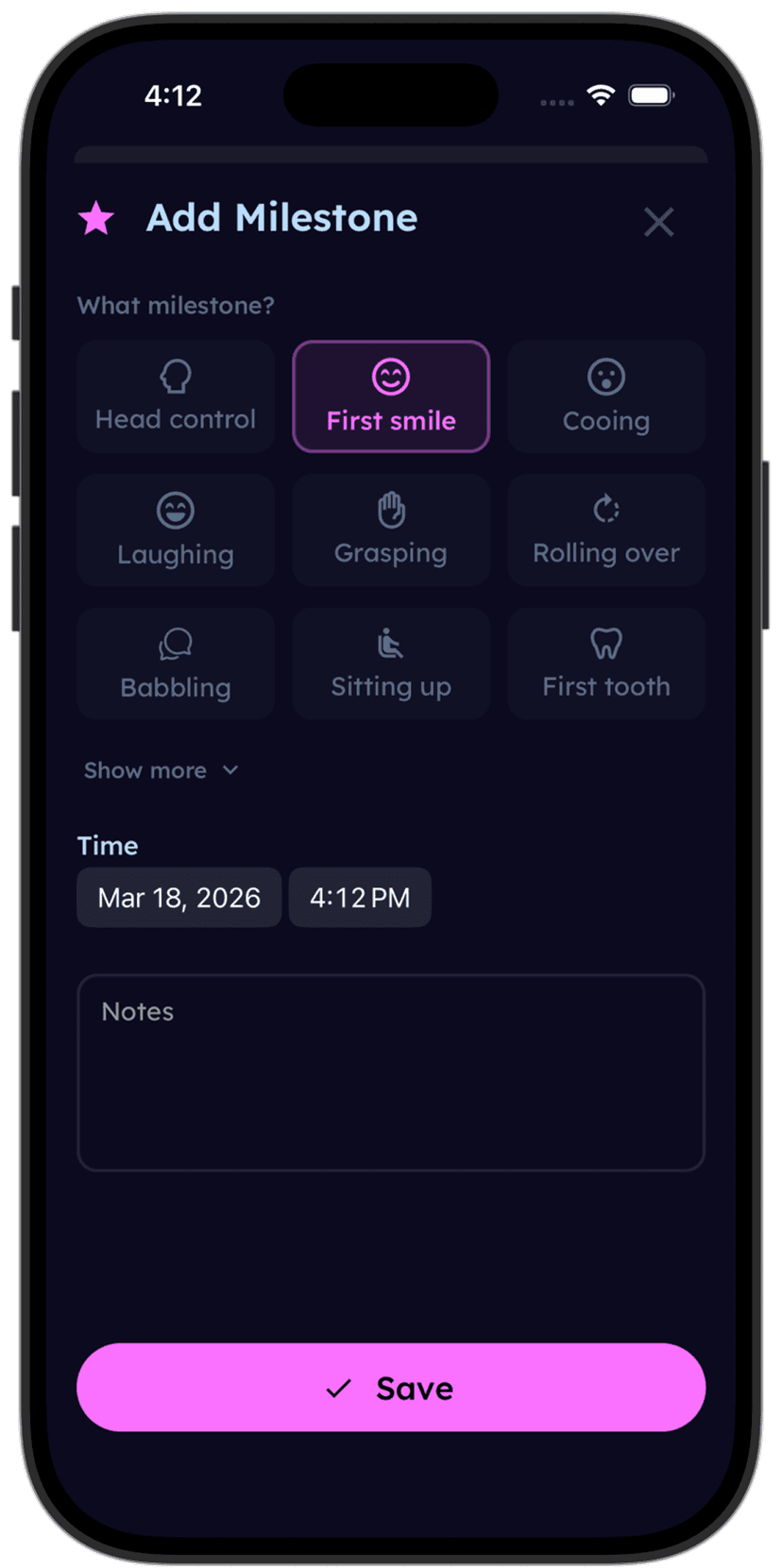
tinylog milestone tracking showing two years of developmental progress

Two years of tracking tells a story bigger than any single milestone.

tinylog helps you look back at two years of growth — every feed logged, every sleep tracked, every milestone captured — and see how far you've both come.

Download on the App StoreGet It On Google Play

What You Might Not Expect

The 'terrible twos' might actually be the 'terrific twos'

Yes, there are tantrums. But there's also real humor — your child tells jokes and does things to make you laugh. There's creativity, spontaneous hugs, 'I love you,' and wanting to help with everything. The terrific parts are the real story.

Potty training readiness varies wildly

Some two-year-olds are ready; others won't be for months. Signs: staying dry longer, awareness of when they're going, interest in the toilet, ability to follow instructions. Don't rush it — training before readiness leads to frustration for everyone.

Your child might develop new fears

The dark, dogs, loud sounds, certain characters. Fears at 2 reflect growing imagination and memory — they can imagine bad things happening. Acknowledge the fear, provide comfort, and avoid forcing exposure.

When to Talk to Your Pediatrician

  • Doesn't use two-word phrases (not imitating or repeating)
  • Doesn't know what to do with common objects (brush, phone, fork)
  • Doesn't copy actions and words
  • Doesn't follow simple instructions
  • Doesn't walk steadily
  • Has lost skills they used to have

The 2-year well-child visit includes developmental screening, often with specific autism screening tools. Early intervention produces significantly better outcomes than waiting.

Related Guides

Get this guide before the 2-year checkup.
We'll send it so you can prepare for the comprehensive 2-year well-child visit.
Two years of you. Look at what you've built together.
Download tinylog free — track the milestones and memories of toddlerhood so you can look back and remember.
Download on the App StoreGet It On Google Play