


GUIDE
Baby Growth Chart
Wondering if your baby's on track? Plug in their measurements and see for yourself.
Supports both WHO and Fenton growth charts — totally free, and your data stays right here in your browser.
Optional — lets us calculate age from checkup dates.
Plotted on WHO Child Growth Standards
For term babies, 0–60 months
OK so what do these charts actually mean?
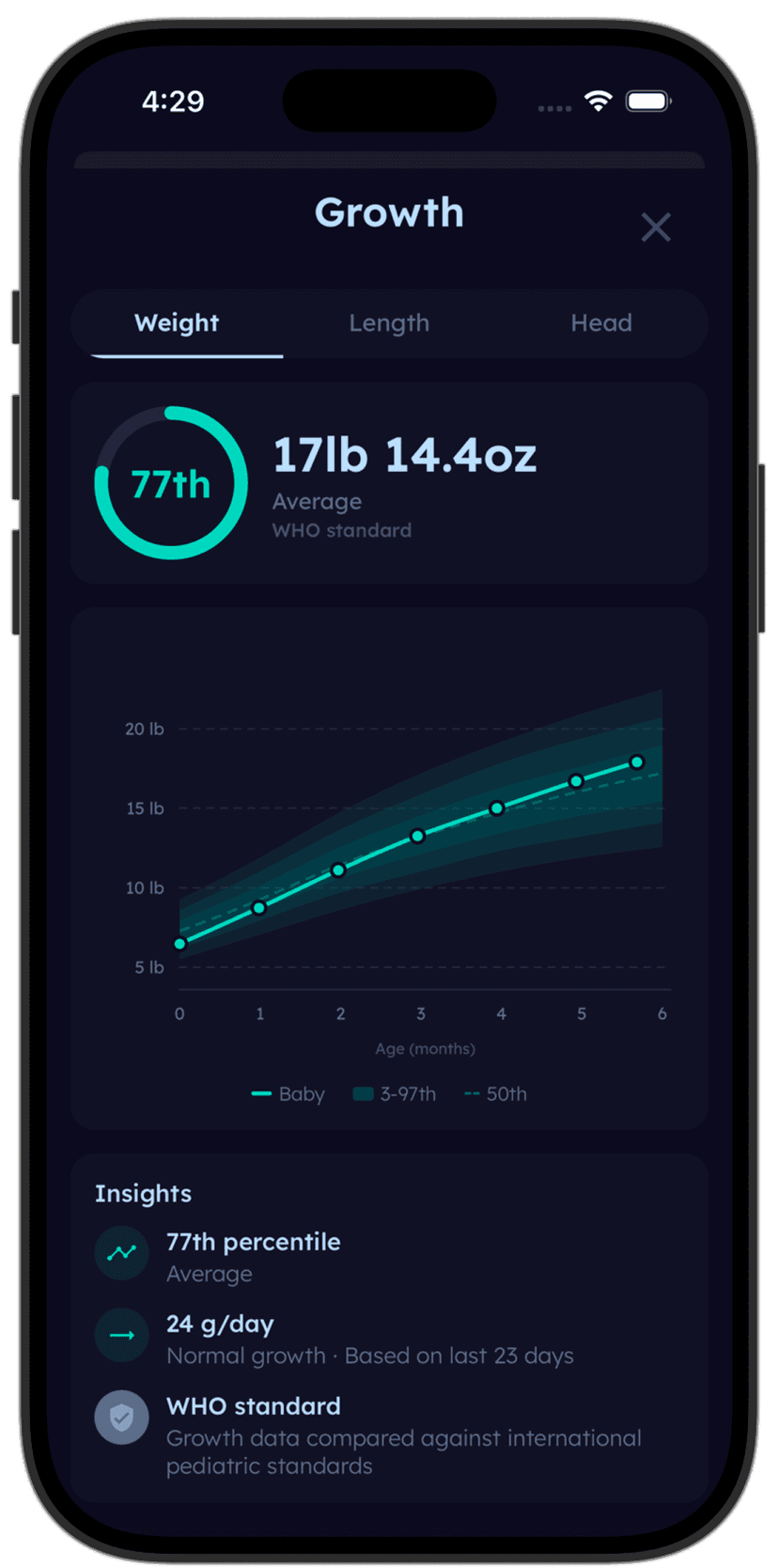
Growth charts compare your baby's size to thousands of other healthy kids the same age and sex. There's no single "normal" number — instead, you get percentile curves, which are just smooth lines showing how children at each percentage rank tend to grow over time.
So if your baby is at the 40th percentile for weight, that means 40% of babies their age weigh less and 60% weigh more. There is no single "right" percentile. What really matters is that your baby follows their own curve over time — not where that curve happens to be.
WHO or Fenton — which one do I pick?
WHO Growth Standards
Go with this for term babies (born at 37+ weeks). WHO charts cover birth to 5 years and are based on a huge global study of healthy, breastfed kids. This is what most pediatricians pull up at your regular checkups.
Fenton 2025 Growth Charts
This one's for preterm babies (born before 37 weeks). Fenton charts track growth by gestational age from 22 to 50 weeks, so NICUs and parents can follow catch-up growth properly. The 2025 third-generation update excluded infants with abnormal fetal growth, making the benchmarks even more accurate.
Tracking preemie growth with the right chart
If your baby was born before 37 weeks, standard WHO percentiles can be misleading — even alarming. A preemie plotted on a full-term chart will almost always look small, because the chart wasn't designed for them. That's not a growth problem. It's a chart problem.
Fenton growth charts solve this by using preterm-specific data, tracking weight, length, and head circumference by gestational age from 22 to 50 weeks. tinylog supports both WHO and Fenton charts in the app, so you can plot your baby's growth on the right curve — whether they were born at 28 weeks or 40. For more on what preemie parents should look for in a tracker, see our guide to preemie-friendly baby trackers.
What your results actually tell you
One measurement is just a snapshot — it tells you where your baby is today. But when you plot measurements over time, that's where the real story is. Percentiles are a screening tool, not a diagnosis.
Your pediatrician is looking at two things: (1) is your baby within the normal range (3rd-97th percentile), and (2) are they following their own curve without big jumps up or down. Crossing a percentile line here and there — especially during a growth spurt or after being sick — is totally normal.
Good signs your baby is growing great
- Gaining weight steadily — roughly 5-7 oz per week in those first few months.
- Getting longer and their head is getting bigger at each checkup.
- Hitting milestones like lifting their head, rolling over, and sitting up.
- At least 6 wet diapers a day after the first week.
- Bright-eyed and active when they're awake.
When to give your pediatrician a call
- Weight, length, or head circumference drops across two or more percentile lines.
- They're consistently below the 3rd or above the 97th percentile.
- A sudden shift in their growth pattern after a stretch of consistency.
- Trouble feeding, a lot of spitting up, or signs of dehydration.
- Your gut says something feels off — seriously, trust that feeling.
Growth charts are helpful, but they're not a substitute for real medical advice. If something worries you, reach out to your pediatrician.
Related Guides
- Baby Growth Percentiles — What the numbers on the chart mean
- Baby Dropped Percentiles — When to worry about percentile changes
- Should You Track Growth at Home? — Pros, cons, and how to do it right

