GUIDE

Best Baby Tracker for Preemies

Most trackers assume your baby was born at 40 weeks. If yours wasn't, you need different tools.

Standard WHO growth charts can make preemie parents panic unnecessarily. A tracker built for premature babies uses Fenton charts and adjusted age — so your baby's progress is measured against the right benchmarks.

Why standard percentiles mislead preemie parents

When your baby is born early, the first thing most parents do is Google growth charts. The problem is that nearly every chart you'll find online — and the ones most apps use — are WHO growth standards built for full-term babies. Plot a 34-weeker on a WHO chart at 2 months old and they'll look like they're falling behind. They're not. The chart just isn't designed for them.

This leads to a cycle of unnecessary worry. You see a low percentile, you panic, you start over-feeding or supplementing when it isn't needed. Your pediatrician might not catch the issue either if their office software defaults to WHO charts. The fix isn't feeding more — it's using the right chart.

What Fenton growth charts are (and why they matter)

Fenton growth charts were developed specifically for preterm infants. They track weight, length, and head circumference by gestational age from 22 to 50 weeks — covering both the NICU period and the early months after discharge.

The 2025 third-generation Fenton charts are the most accurate yet. They excluded infants with abnormal fetal growth from the dataset, so the benchmarks reflect healthy preterm growth patterns. NICUs worldwide use Fenton charts as the standard — and your baby tracker should too.

For more on how growth charts work and when to use which one, see our growth tracking guide.

Adjusted age vs. actual age

Adjusted age (also called corrected age) is the age your baby would be if they had been born on their due date. A baby born at 28 weeks who is now 4 months old has an adjusted age of about 1 month. This isn't just a technicality — it changes how you interpret everything: feeding amounts, sleep expectations, developmental milestones, and growth percentiles.

Most pediatricians use adjusted age until age 2 or 3. A good baby tracker should calculate it automatically once you enter your baby's gestational age at birth, so you don't have to do the mental math every time you check a feeding chart or wonder if a milestone is "late."

For adjusted-age feeding amounts and expectations, check our preemie feeding chart.

What to look for in a preemie baby tracker

Fenton growth charts

The single most important feature for preemie parents. Fenton charts are built from preterm infant data and track growth by gestational age from 22 to 50 weeks. Without them, your baby's growth will look alarming on WHO charts — not because anything is wrong, but because the comparison isn't fair.

Adjusted age calculations

A good preemie tracker should let you enter your baby's gestational age at birth and automatically calculate their adjusted (corrected) age. This matters for feeding expectations, developmental milestones, and sleep patterns — not just growth charts.

Feeding tracking that handles complexity

Preemie feeding is rarely straightforward. You might be nursing, bottle feeding pumped milk, supplementing with formula, or doing all three in the same day. Your tracker should handle combo feeding without making you jump through hoops.

Caregiver sync

NICU follow-up appointments, pediatrician visits, feeding therapy sessions — there are a lot of people involved in a preemie's care. Being able to share your tracking data with your partner or medical team saves everyone time and reduces miscommunication.

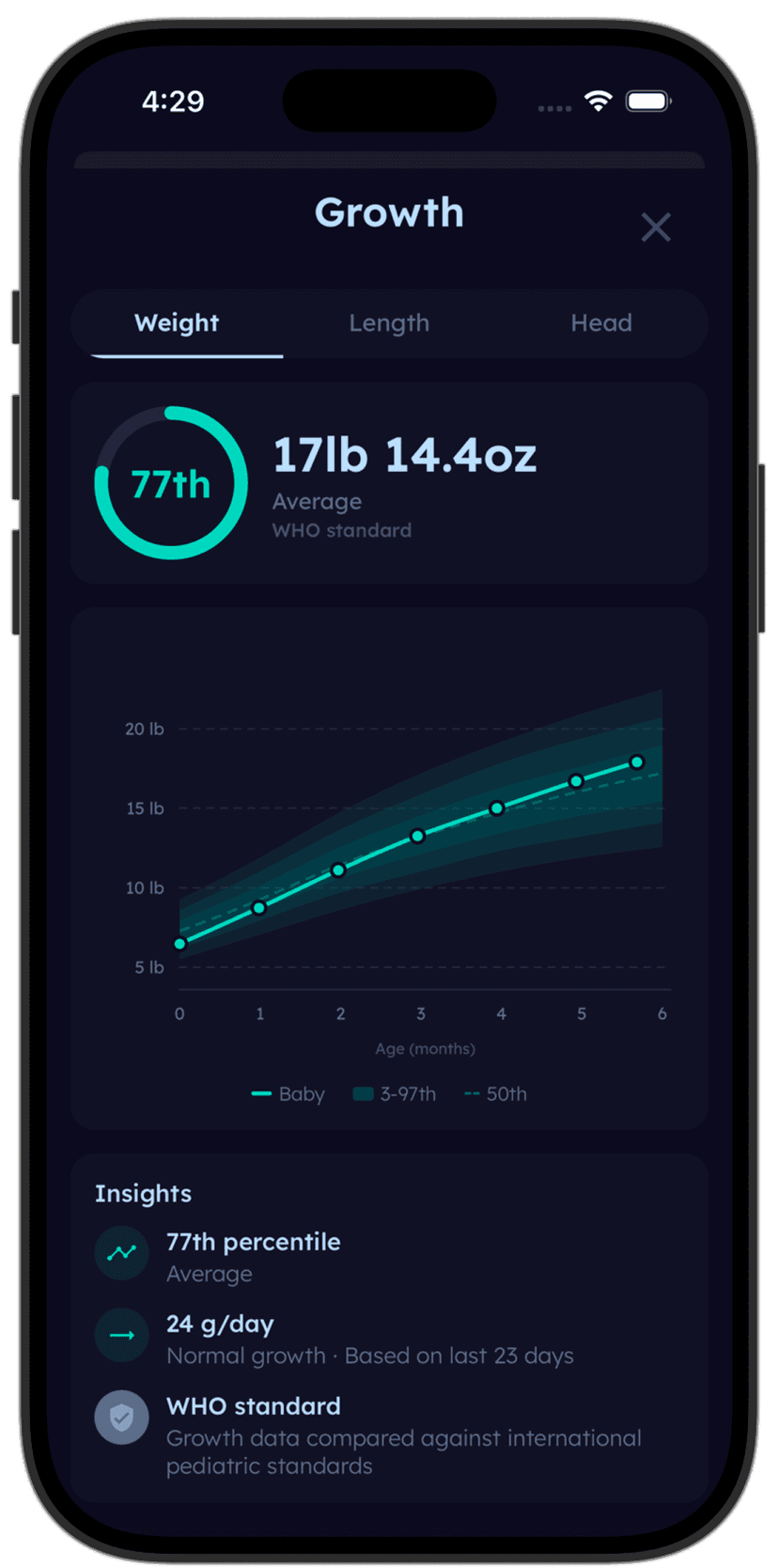
tinylog growth tracking screen showing Fenton preemie growth chart with percentile curves

tinylog is one of the few baby trackers with Fenton growth charts built in.

Plot your preemie's weight, length, and head circumference on Fenton charts designed for their gestational age. See real percentiles, track adjusted age automatically, and log every feeding type — nursing, pumping, formula, or all three.

Download on the App StoreGet It On Google Play

Signs you've found the right preemie tracker

  • Fenton growth charts are available — not just WHO
  • Adjusted age is calculated automatically from gestational age at birth
  • You can log breast, bottle, and formula feeds without workarounds
  • Growth data can be shared with your partner or medical team
  • The app doesn't make you feel like your baby is behind when they're not

Red flags in a baby tracker for preemies

  • Only WHO growth charts — no Fenton option at all
  • No way to enter gestational age or track adjusted age
  • Growth alerts based on full-term percentiles that don't apply to your baby
  • No support for combo feeding (nursing + pumped milk + formula)
  • Can't share data with caregivers or export for medical appointments

A tracker that doesn't account for prematurity can create more anxiety than it solves. The right tool should make you feel more informed, not more worried.

Getting ready for life after the NICU?

If you're preparing to bring your preemie home — or you just did — our preemie care readiness checklist covers discharge criteria, home prep, feeding at home, RSV prevention, and the follow-up appointments you'll need to schedule. For adjusted-age feeding amounts, check the preemie feeding chart.

Related Guides

Send this to my inbox.
We'll send you this reference so you know exactly what to look for in a preemie-friendly tracker — plus tips for NICU follow-up visits.
Built for preemie parents, not adapted from a full-term app.
Download tinylog free — with Fenton growth charts and adjusted age tracking from day one.
Download on the App StoreGet It On Google Play