


GUIDE

Newborn Feeding Schedule

Every 2–3 hours, 8–12 times a day. Yes, really. Here's what that looks like in practice.

A week-by-week breakdown for the first 3 months — whether you're breastfeeding, formula feeding, or doing both.

What to Expect Each Week
Week 1
Formula1–2 oz every 2–3 hrs
Breastfeeding8–12 sessions, 10–20 min/side
NotesColostrum is liquid gold — and it's plenty. Baby's stomach is the size of a marble.
Week 2
Formula2–3 oz every 3 hrs
Breastfeeding8–12 sessions, 15–20 min/side
NotesShould be back to birth weight. Your milk is officially in.
Weeks 3–4
Formula3–4 oz every 3 hrs
Breastfeeding8–10 sessions, 15–20 min/side
NotesGrowth spurt time — baby might eat nonstop for a day or two. Totally normal.
Weeks 5–6
Formula3–4 oz every 3–4 hrs
Breastfeeding7–9 sessions, 10–15 min/side
NotesSurprise, another growth spurt around 6 weeks. Hang in there.
Weeks 7–8
Formula4–5 oz every 3–4 hrs
Breastfeeding7–8 sessions
NotesBaby's getting faster at eating — finally.
Month 2–3
Formula4–5 oz every 3–4 hrs
Breastfeeding6–8 sessions
NotesYou might get a 3–5 hour stretch at night. Sweet, sweet progress.

You'll notice growth spurts pop up a few times in those early weeks. Our baby growth spurt guide covers every window and what to expect when your baby's appetite suddenly goes into overdrive.

Breast vs. Formula: How They Compare

Breastfeeding

  • Feedings happen more often — breast milk digests faster than formula
  • Evening cluster feeding is real and it's relentless (but temporary)
  • You can't see how much they're getting, so watch for hunger cues instead
  • Your supply adapts to what baby needs — the more they eat, the more you make
Formula

  • A bit more time between feeds (usually 3–4 hours)
  • You can see exactly how much baby ate, which is reassuring
  • Some babies start sleeping longer stretches a little sooner
  • If baby stops eating, they're done — no need to push the last ounce
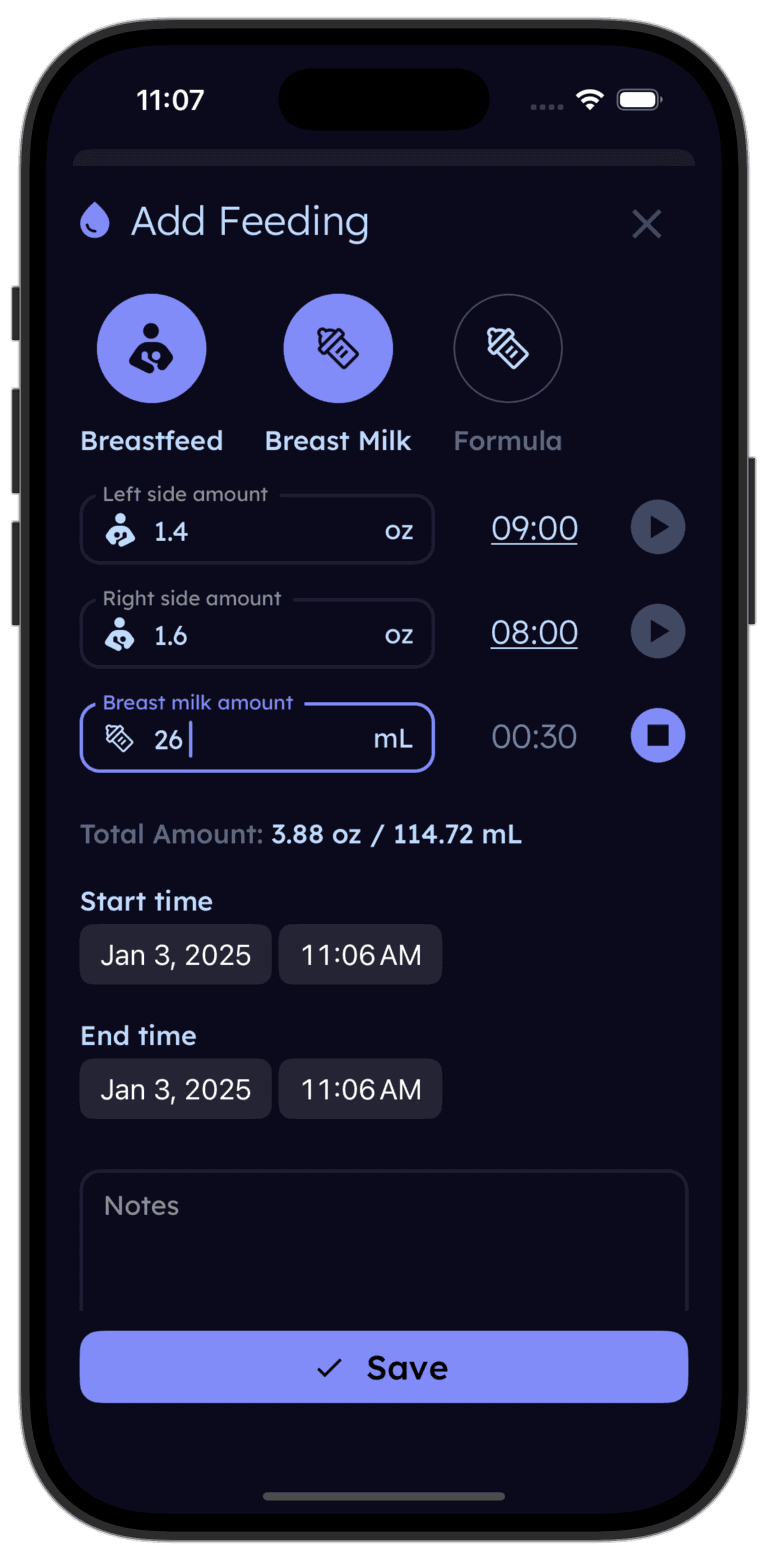
tinylog app screen for logging a feeding with time, amount, and type

tinylog remembers every feeding so your sleep-deprived brain doesn't have to.

Breastfeeding, bottle, or combo — log each session in a few taps and watch your baby's daily pattern take shape on its own.

Download on the App StoreGet It On Google Play

What a Typical Day Looks Like (1–2 Month Old)

Formula-Fed Baby

  1. Wake + feed (4 oz)
  2. Feed (4 oz)
  3. Feed (4 oz)
  4. Feed (4 oz)
  5. Feed (4 oz)
  6. Feed (4 oz) → bedtime
  7. Night feed (4 oz)
  8. Night feed (4 oz)

Breastfed Baby

  1. Wake + nurse (both sides)
  2. Nurse
  3. Nurse
  4. Nurse
  5. Nurse
  6. Cluster feed begins
  7. Nurse
  8. Nurse → bedtime
  9. Dream feed
  10. Night feed

Heads up — these are rough examples, not a rulebook. Every baby is different. Follow their hunger cues, not the clock.

Related Guides

Want this schedule on hand?
We'll send it straight to your inbox so you can pull it up at 2 AM without hunting for a bookmark.
Your brain at 3 AM is not reliable.
tinylog is free — it tracks every feeding so you don't have to remember a thing.
Download on the App StoreGet It On Google Play