
GUIDE
How Much Should a Newborn Eat?
Published on
Short answer: about 1–2 oz per feeding, 8–12 times a day.
Yeah, that's roughly every 2–3 hours around the clock. Breastfed babies often eat even more often than that. The good news? The amounts go up and the frequency goes down as they grow.
Free tool • Based on AAP guidelines
“That's why we see new babies so often at the pediatrician's office. We want to make sure they're growing well, and we want to address any breastfeeding concerns you have.”
 Dr. Kristin Barrett, MD, Pediatrician, Cleveland Clinic
| Age | Amount | Frequency | Notes |
|---|---|---|---|
| 0–2 weeks | 1–2 oz | 8–12x/day | Whenever they're hungry — about every 2–3 hours |
| 2–4 weeks | 2–3 oz | 8–10x/day | Cluster feeding happens and it's totally normal |
| 1–2 months | 3–4 oz | 7–8x/day | Nighttime stretches start getting a little longer |
| 2–4 months | 4–5 oz | 6–8x/day | Things start feeling a bit more predictable |
| 4–6 months | 4–6 oz | 5–7x/day | Solids might enter the picture around 6 months |
| 6–9 months | 6–8 oz | 4–6x/day | Solids are a side dish — milk is still the main course |
| 9–12 months | 7–8 oz | 3–5x/day | More real food, a bit less milk as they grow |
How to Tell Your Baby Is Getting Enough
- 6 or more wet diapers a day after day 4 (you'll be counting)
- Gaining weight steadily — usually back to birth weight by 2 weeks
- Seems relaxed and content after feedings, not frantically rooting
- 3–4+ poopy diapers a day in the first month
- You can actually hear them swallowing while breastfeeding
When to Call Your Pediatrician
- Fewer than 6 wet diapers a day after day 4
- Not gaining weight or still losing weight after 2 weeks
- So sleepy they're really hard to wake up for feedings
- Dark urine or brick-red spots in the diaper
- Jaundice that's getting worse instead of better after week one
Trust your gut. If something feels off, call your pediatrician — that's what they're there for. Having a feeding log to share with them makes the conversation a lot easier.
Frequent check-ins in those early weeks are not a sign that something is wrong — they are how your pediatrician catches small issues before they become big ones.
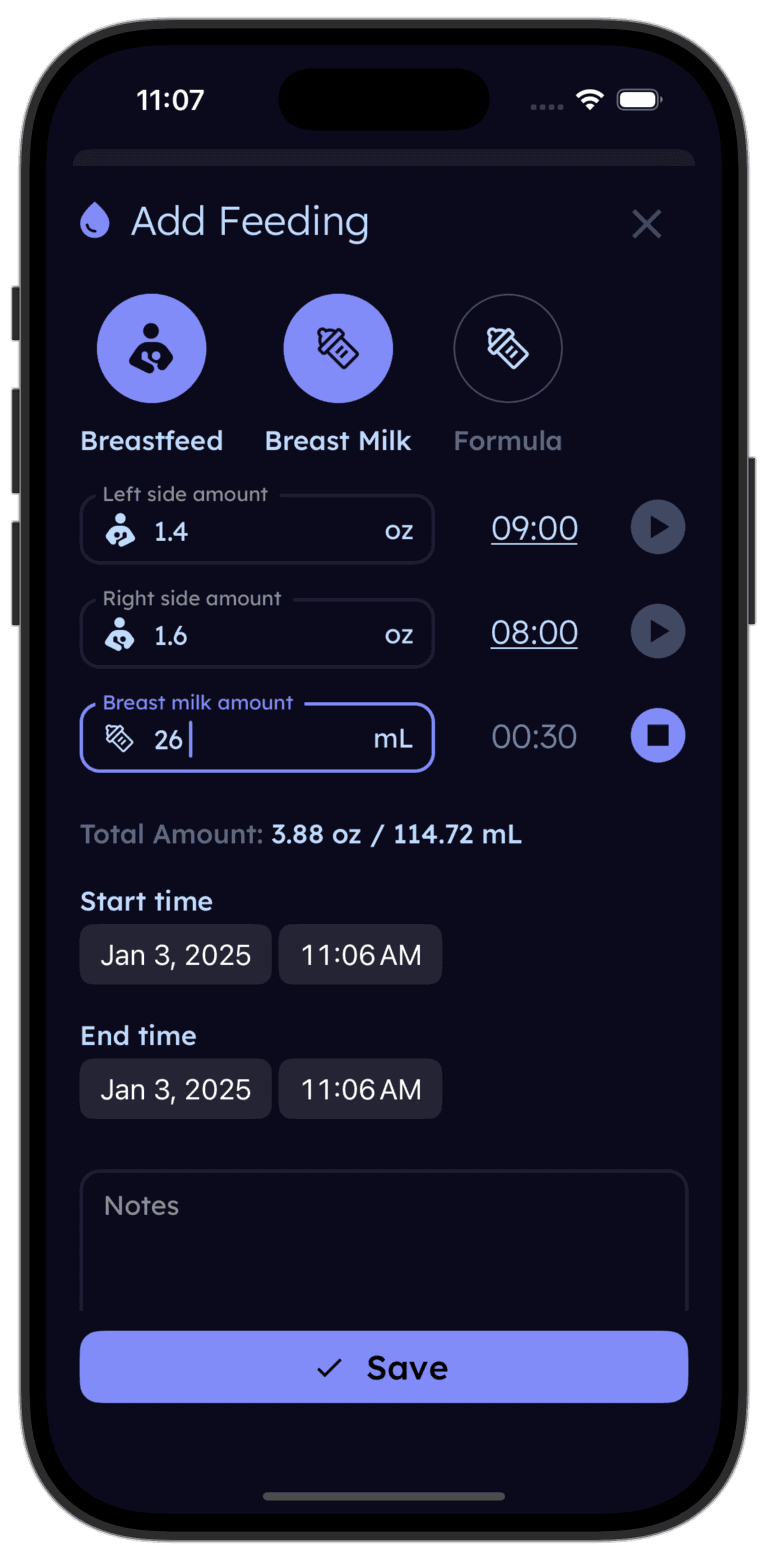
Wondering if baby is eating enough? Tinylog takes the guesswork out.
Log each feeding in a few taps and watch your daily totals add up in real time. No mental math, no forgotten feeds — just open the app and see exactly how the day is going.


Related Guides
-
Baby Feeding Chart — How much and how often by age
-
Colostrum — What it is, why it matters, and how much is enough
Sources
- American Academy of Pediatrics (AAP) — Infant nutrition and feeding guide
- Centers for Disease Control and Prevention (CDC) — Infant and toddler nutrition
- World Health Organization (WHO) — Infant and young child feeding
- La Leche League International — Breastfeeding resources
Frequently asked questions
- How much should a newborn eat per feeding?
- About 1-2 oz per feeding in the first two weeks, gradually increasing to 2-3 oz by weeks 2-4, and 3-4 oz by 1-2 months. By 6-9 months, most babies take 6-8 oz per feeding. Breastfed babies naturally adjust intake, so follow your baby's lead.
- How often should a newborn eat?
- Newborns need to eat 8-12 times per day, roughly every 2-3 hours around the clock. Breastfed babies often eat even more frequently. The frequency gradually decreases as your baby grows — by 9-12 months, most babies eat 3-5 times per day.
- How can I tell if my baby is eating enough?
- Look for 6 or more wet diapers a day after day 4, steady weight gain (usually back to birth weight by 2 weeks), 3-4+ poopy diapers a day in the first month, and a relaxed baby after feedings. You should also hear audible swallowing during breastfeeding.
- When should I call the doctor about feeding?
- Contact your pediatrician if your baby has fewer than 6 wet diapers a day after day 4, is not gaining weight or still losing weight after 2 weeks, is too sleepy to wake for feedings, has dark urine or brick-red spots in the diaper, or has jaundice that's worsening after week one.