


GUIDE

The Baby Sleep Playbook

All the stuff a sleep consultant would charge you hundreds for — schedules by age, wake windows, regression game plans, and sleep training options — right here, for free.

Bookmark this one. You're going to want it at 2 AM when your brain is mush and nothing seems to be working.

So How Much Sleep Does Your Baby Actually Need?
0–6 weeks
Total Sleep15–18 hrs
Night Sleep8–9 hrs
Day Sleep7–9 hrs
Naps4–8 (irregular)
6–12 weeks
Total Sleep14–17 hrs
Night Sleep9–10 hrs
Day Sleep4–6 hrs
Naps4–5
3–4 months
Total Sleep14–16 hrs
Night Sleep10–11 hrs
Day Sleep3–5 hrs
Naps3–4
5–6 months
Total Sleep13–15 hrs
Night Sleep10–11 hrs
Day Sleep2.5–3.5 hrs
Naps3
7–8 months
Total Sleep13–15 hrs
Night Sleep10–12 hrs
Day Sleep2–3 hrs
Naps2–3
9–12 months
Total Sleep12–14 hrs
Night Sleep10–12 hrs
Day Sleep2–3 hrs
Naps2
These ranges come from AAP and National Sleep Foundation guidelines. We break down wake windows below. And remember — your baby didn't read this chart. Go by their mood and energy, not just the numbers.
Wake Windows by Age
0–4 weeks
First Window45 min
Mid-Day Window45–60 min
Last Window45 min
Sleepy CueYawning, looking away, getting fussy
4–8 weeks
First Window45–60 min
Mid-Day Window60–75 min
Last Window45–60 min
Sleepy CueRubbing eyes, tugging ears, zoning out
2–3 months
First Window60–90 min
Mid-Day Window75–90 min
Last Window60–75 min
Sleepy CueJerky arms/legs, wanting to be held more
4–5 months
First Window1.5–2 hrs
Mid-Day Window2–2.25 hrs
Last Window1.5–2 hrs
Sleepy CueGets quiet, loses interest in toys
6–7 months
First Window2–2.5 hrs
Mid-Day Window2.25–2.75 hrs
Last Window2.25–2.5 hrs
Sleepy CueFussy, rubbing eyes, face-planting into you
8–10 months
First Window2.5–3 hrs
Mid-Day Window3–3.5 hrs
Last Window3–3.5 hrs
Sleepy CueCranky, clumsy, thousand-yard stare
11–12 months
First Window3–3.5 hrs
Mid-Day Window3.5–4 hrs
Last Window3.5–4 hrs
Sleepy CueWhiny, tripping over their own feet
First wake window of the day is almost always the shortest. The one before bed is usually the longest. Pro tip: watch your baby more than the clock — their sleepy cues are the real guide.

Sample Schedules (That Actually Work)

Think of these as rough templates, not marching orders. Adjust based on your baby's wake windows and cues. All times are just ballpark.

Newborn (0–8 weeks)

Honestly? There is no schedule right now. That's totally normal. Just follow your baby's lead.
  • Feed on demand every 2–3 hours (yes, overnight too)
  • Naps happen wherever they happen — car seat, your chest, the swing, all fair game
  • Try to get baby back to sleep after 45–60 min of awake time
  • Day/night confusion is real and annoying — let natural light in during the day to help reset their clock
3–4 Months

You might start seeing a pattern. Don't force it though — wake windows are your best friend here.
  • 7:00 AM — Wake + feed
  • 8:15 AM — Nap 1 (1–2 hrs)
  • 10:30 AM — Feed
  • 12:00 PM — Nap 2 (1–2 hrs)
  • 2:00 PM — Feed
  • 3:30 PM — Nap 3 (45–60 min)
  • 5:00 PM — Feed
  • 5:45 PM — Catnap (20–30 min, skip it if it's not happening)
  • 6:30 PM — Bedtime routine
  • 7:00 PM — Bedtime
  • Night feeds: 1–3x

6–8 Months

Things start clicking — most babies land on a 3-nap or 2-nap rhythm around now.
  • 6:30 AM — Wake + feed
  • 9:00 AM — Nap 1 (1–1.5 hrs)
  • 10:30 AM — Feed + solids
  • 12:30 PM — Nap 2 (1.5–2 hrs)
  • 2:30 PM — Feed + solids
  • 4:30 PM — Catnap (30 min, you'll probably drop this around 7–8 months)
  • 5:30 PM — Solids dinner
  • 6:30 PM — Bedtime routine + feed
  • 7:00 PM — Bedtime
  • Night feeds: 0–2x

9–12 Months

Two solid naps and a predictable bedtime. You might actually have evenings again.
  • 6:30 AM — Wake + feed
  • 7:30 AM — Breakfast (solids)
  • 9:30 AM — Nap 1 (1–1.5 hrs)
  • 11:00 AM — Feed + lunch (solids)
  • 1:30 PM — Nap 2 (1–2 hrs)
  • 3:00 PM — Snack + feed
  • 5:30 PM — Dinner (solids)
  • 6:30 PM — Bedtime routine + feed
  • 7:00 PM — Bedtime
  • Night feeds: 0–1x
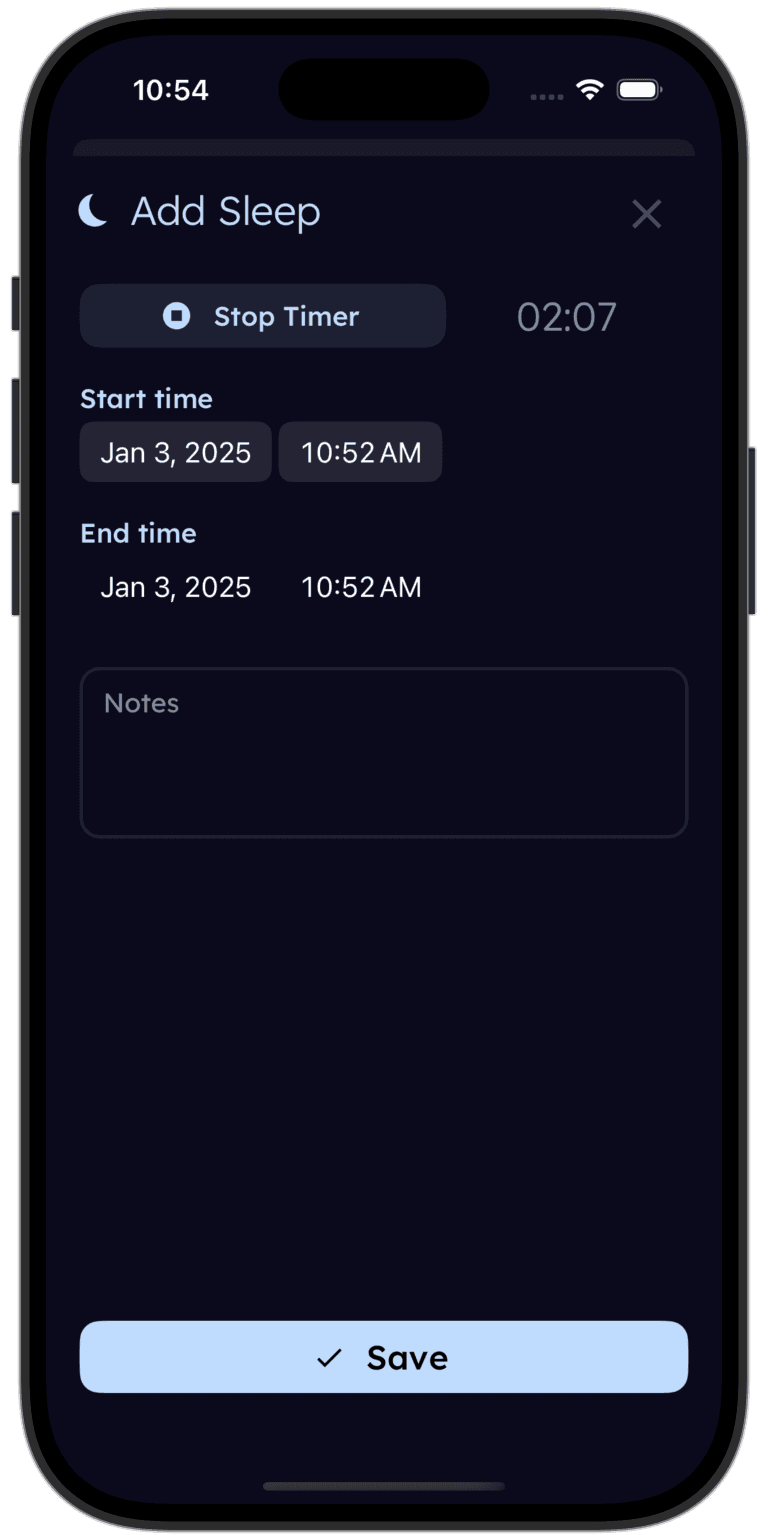
tinylog sleep timer running with one-tap start and stop

tinylog catches sleep patterns you'd totally miss on your own.

One tap to start a sleep timer, wake windows calculated for you automatically, naps and night sleep tracked over time — so you can stop guessing and start seeing what's actually helping.

Download on the App StoreGet It On Google Play

When to Drop a Nap (and How)

Dropping a nap too early is one of the most common mistakes parents make. Wait for real signs — not an age on a chart.

4 → 3 naps

4–5 months
They're ready when
Can stay awake a solid 2+ hours, that last catnap is messing with bedtime, flat-out refusing the 4th nap.
How to make the switch
Ditch the late-afternoon catnap first. Scoot bedtime 30 min earlier for a few days while everyone adjusts.

3 → 2 naps

7–9 months
They're ready when
The third nap is either tiny or straight-up refused, they can handle 3+ hour wake windows, bedtime keeps creeping later.
How to make the switch
Drop that last nap. Slowly stretch wake windows by 15 min every few days. Move bedtime a bit earlier temporarily.

2 → 1 nap

14–18 months
They're ready when
Refusing one nap consistently for 2+ weeks (not just a regression blip), seems fine with 5+ hour wake windows.
How to make the switch
Shift the single nap to around 12:00–12:30 PM. An early bedtime (6:00–6:30 PM) will save you during the transition. Budget 2–4 weeks for things to smooth out.

Sleep Regression Survival Plans

Hot take: sleep regressions are actually progressions. Your baby's brain is leveling up. That doesn't make 2 AM any less miserable though, so here's your game plan for each one.

Many regressions overlap with growth spurts — which means extra hunger on top of the sleep chaos. Knowing the growth spurt windows can help you figure out what's driving the wake-ups.

4-Month Regression

What's going on
This one is a big deal. Your baby's sleep cycles are permanently changing from that deep newborn sleep to more adult-like light/deep cycles. It's not a setback — their brain is literally upgrading. But yeah, it feels brutal.
Signs you're in it
  • Was sleeping decent stretches, now up every 1–2 hours (cool cool cool)
  • Naps that used to be easy are now a full negotiation
  • Way more fussing at bedtime than before
  • Night waking is back with a vengeance, even if they were sleeping through
Here's what to do
  • Heads up: this one is permanent brain development, not a phase you can just ride out
  • Good time to start practicing drowsy but awake — lay baby down sleepy, not fully asleep
  • Dark room + white noise. These are your best tools right now.
  • Try not to pick up new sleep habits (rocking or feeding all the way to sleep) that you'll have to undo later
  • If you don't have a bedtime routine yet, now's the time to start one
  • Give it 2–6 weeks to settle down. You will get through this.

6-Month Regression

What's going on
So many things hitting at once — growth spurt, maybe starting solids, possibly teething, plus your baby is learning to sit and roll. Their little world is exploding right now.
Signs you're in it
  • Night waking is back after weeks of solid sleep (rude)
  • Naps are suddenly shorter
  • Seems hungrier at night (hello growth spurt)
  • Would rather practice rolling and sitting in the crib than, you know, sleep
Here's what to do
  • Pack in extra feeds during the day so they're not waking up hungry at night
  • Let them practice those new skills a ton during the day — get it out of their system
  • Stick to your bedtime routine. Consistency is doing the heavy lifting here.
  • If teething is the culprit, check with your pediatrician about pain relief before bed
  • Good news: this one usually wraps up in 1–2 weeks

8–10 Month Regression

What's going on
Separation anxiety just kicked in hard, plus big motor milestones like crawling and pulling to stand. Your baby just figured out that you still exist when you leave the room — and that freaks them out.
Signs you're in it
  • Cries the second you walk out of the room (this is new and intense)
  • Pulls to standing in the crib, then gets stuck and can't figure out how to sit back down
  • Fighting the second nap or turning bedtime into a battle
  • Waking up at night calling for you specifically
Here's what to do
  • Practice sitting down from standing a bunch during the day — it's a skill they genuinely need to learn
  • Peekaboo is actually therapeutic right now — short separation games build their confidence
  • Keep your goodnight ritual calm and predictable. Don't sneak out — they need to trust the process.
  • If they stand up in the crib, lay them down once or twice, then leave. They'll figure it out.
  • Resist bringing them into your bed as a quick fix — that habit is really hard to undo
  • Hang in there — typically 3–6 weeks and it passes

12-Month Regression

What's going on
Walking (or trying really hard to), first words, a massive brain growth spurt. They might also refuse a nap and make you think they're ready to drop one. Spoiler: they're not.
Signs you're in it
  • Skipping one of their two naps (usually the morning one)
  • Bedtime is a circus — way too excited about new skills to settle down
  • Night waking after months of sleeping through (the betrayal)
  • Energy levels before bed that make you wonder if they found your coffee
Here's what to do
  • Do NOT drop to one nap yet — seriously, most babies aren't ready until 14–18 months
  • If they skip a nap, bump bedtime up 30 minutes to avoid the overtired spiral
  • Tire them out during the day — active play is your friend
  • Keep their room boring at night — dark, white noise, nothing fun to look at
  • Stay the course with your routine. This one clears up in 2–4 weeks.

Sleep Training Methods — Honestly Compared

There's no one "right" way to do this. The best method is whichever one you can actually stick with. All of these are safe and backed by research when used at the right age.

Drowsy But Awake

Newborns, gentle start
How it works
Lay baby in the crib when they're sleepy but still have their eyes open. Hang out nearby and comfort them (shushing, patting) as needed. The idea is they start associating the crib with falling asleep.
The real deal
Super gentle and a great starting point. But on its own, it might not fix frequent night waking — think of it as building a foundation.

Pick Up / Put Down

4–8 months, parents who want hands-on
How it works
Baby cries, you pick them up, comfort them until they're calm, then back down awake. Repeat. As many times as it takes. They learn you're always coming back, but sleep happens in the crib.
The real deal
No crying alone, which feels good. But fair warning — you might be picking baby up 50+ times night one. Works great for some babies, but can actually wind others up more.

Chair Method (Sleep Lady Shuffle)

5+ months, parents who want gradual
How it works
Night 1: sit in a chair right next to the crib. Every 2–3 days, scoot the chair a little farther away until you're out the door. Talk to them soothingly but don't pick them up.
The real deal
Nice and gradual. Takes about 2–3 weeks. Some babies are comforted by seeing you there, others get frustrated that you won't pick them up. Know your kid.

Ferber (Graduated Extinction)

5+ months, parents ready for faster results
How it works
Put baby down awake and leave. Come back to check on them at longer and longer intervals (3 min, then 5, then 10, etc.). Quick check-ins only — reassure with your voice, don't pick up. Restart the intervals each night.
The real deal
Usually works in 3–7 nights, which is pretty fast. There will be some crying, but you're checking in regularly. This is the most-studied method and the evidence behind it is solid.

Safe Sleep Checklist (AAP Guidelines)

  • Firm, flat mattress with a fitted sheet — that's it, nothing else in there
  • Always on their back for every sleep — naps and nighttime, every time
  • No blankets, pillows, bumpers, stuffed animals, or positioners (bare is best)
  • Room temp 68–72°F (20–22°C) — use a sleep sack instead of blankets to keep them cozy
  • Room-sharing (but not bed-sharing) for at least the first 6 months per AAP guidelines
  • No hats or head coverings while they sleep
  • Offer a pacifier at sleep times — it actually reduces SIDS risk, and it's fine if it falls out
  • Smoke-free zone around the crib, always

Straight from the American Academy of Pediatrics. These apply for the whole first year. Not negotiable, but also not complicated.

When Sleep Goes Sideways (Troubleshooting)

Up before the sun (waking before 6 AM)

Usual suspects
Bedtime too late (overtired babies wake early, weirdly), bedtime too early, room getting bright at sunrise, hunger, or the nap schedule is off.
What to try
  • Try an earlier bedtime by 15–30 minutes — sounds backwards, but overtiredness is a common cause of early waking
  • Blackout curtains are a game changer. Even a sliver of light tells their brain it's morning.
  • Don't start the day before 6 AM no matter what. Keep things dark, quiet, and boring.
  • Make sure they're getting enough calories during the day

Micro naps (under 30 minutes)

Usual suspects
Wake window was too short or too long, they haven't learned to connect sleep cycles yet (totally normal before 5–6 months), or they're overtired.
What to try
  • Under 5 months? Short naps are just how it is developmentally. Give yourself a break on this one.
  • Try adding 10–15 minutes to the wake window — an undertired baby won't nap well
  • Dark room + white noise for every nap. Set the stage.
  • If they pop awake at 30 minutes, wait 5–10 min before going in — sometimes they surprise you and drift back off

Bedtime is a whole ordeal

Usual suspects
Not tired enough (needs more awake time), too tired (you missed the window), too much action before bed, or the routine keeps changing.
What to try
  • Lock in a 20–30 minute routine: dim lights, bath or wash, pajamas, feed, book, song, crib. Same thing every night.
  • That last wake window before bed is usually the longest — make sure they've been up long enough
  • No screens for at least an hour before bed (this one really matters)
  • Same order, same steps, every single night — the predictability is genuinely calming for them

Back to waking at night (was sleeping through before)

Usual suspects
Could be a sleep regression, hunger, teething, getting sick, learning a new milestone, or a sleep association where they need you to fall back asleep.
What to try
  • First things first: rule out hunger and illness
  • Wait 2–5 minutes before going in. They might surprise you and fall back asleep.
  • If they can put themselves to sleep at bedtime but not at 2 AM, they just need a few nights of practice
  • Double-check that daytime sleep isn't too much — extra nap sleep can steal from nighttime

Your Bedtime Routine Template

A solid 20–30 minute routine is honestly the single most powerful sleep tool you have. Same steps, same order, every night. Here's a template that works:

1
Lights down
This tells your baby's brain that sleep is on the way. Kill the overhead lights, flip on a warm nightlight.
2
Bath or warm washcloth
Doesn't have to be a full bath — a quick warm wipe-down does the trick. Skip it some nights if you want, no big deal.
3
Jammies + fresh diaper
Sleep sack instead of blankets. Pro tip: zip-up pajamas are way faster than buttons when you're half asleep.
4
Feed (breast or bottle)
Try to keep them slightly awake. If they pass out, that's fine for now — but over time, try moving the feed a bit earlier in the routine.
5
One book or one song
Keep it short and sweet. Same book or lullaby every night is great — the repetition is the whole point.
6
Into the crib
Say your line ('I love you, time for sleep') and go. Same words every night. They learn what it means fast.

Related Guides

Want this whole guide in your inbox?
We'll send you the full sleep playbook so you can pull it up at 2 AM without hunting for it. Because that's when you'll need it.
Let the app track sleep patterns for you.
Download tinylog free — log sleep in a couple taps and actually see what's working so you and your baby can sleep more.
Download on the App StoreGet It On Google Play