GUIDE

Is My Baby's Sleep Normal?

Probably yes. Normal baby sleep has a much wider range than most parents realize, and what you're experiencing is almost certainly within it.

Here's what the research says about how babies actually sleep at every age — not what the internet or other parents say.

First, Take a Breath

If you're reading this at 3 AM with a baby who just woke up for the third time tonight — take a breath. What you're experiencing is almost certainly normal.

This isn't just reassurance for the sake of reassurance. Research on infant sleep — particularly the large systematic review by Galland et al. (2012) that pooled data from over 30 studies — consistently shows that the range of normal baby sleep is enormous. Much wider than the tidy charts and confident claims you'll find on most parenting websites.

The truth is that babies are wildly different sleepers. Some sleep long stretches early. Some wake frequently well past their first birthday. Most fall somewhere in between, and all of it is normal. This guide gives you the actual data, age by age, so you can see where your baby fits — and stop worrying about where they don't.

For a complete approach to sleep schedules, wake windows, and regression plans, our baby sleep playbook covers everything from newborn through 12 months.

Normal Sleep by Age — What the Research Shows
0–6 weeks
Total Sleep14–17 hrs
Night Sleep8–9 hrs
Night Wakings3–5+
Naps4–8 (irregular)
NotesNo pattern yet — completely normal
6–12 weeks
Total Sleep14–16 hrs
Night Sleep9–10 hrs
Night Wakings2–4
Naps4–5
NotesLongest stretch may reach 3–4 hrs
3–4 months
Total Sleep13–15 hrs
Night Sleep10–11 hrs
Night Wakings2–3
Naps3–4
NotesSleep architecture changing — the 4-month shift
5–6 months
Total Sleep12–15 hrs
Night Sleep10–11 hrs
Night Wakings1–3
Naps2–3
Notes~62% sleep 6+ hrs unbroken
7–9 months
Total Sleep12–14 hrs
Night Sleep10–12 hrs
Night Wakings0–2
Naps2
NotesSome still wake 1–2x — still normal
10–12 months
Total Sleep12–14 hrs
Night Sleep10–12 hrs
Night Wakings0–2
Naps2
Notes~27% still wake at least once per night
12–18 months
Total Sleep11–14 hrs
Night Sleep10–12 hrs
Night Wakings0–1
Naps1–2
NotesTransitioning to one nap
18–24 months
Total Sleep11–14 hrs
Night Sleep10–12 hrs
Night Wakings0–1
Naps1
NotesMost on a single afternoon nap
2–3 years
Total Sleep10–13 hrs
Night Sleep10–12 hrs
Night Wakings0
Naps0–1
NotesSome drop the nap entirely by 3
Ranges compiled from Galland et al. (2012), Mindell et al. (2017), AAP guidelines, and BASIS. These are ranges, not targets — many healthy babies fall outside them. Night wakings column reflects typical frequency, not a maximum.

What 'Normal' Actually Means

The most important thing about that table is the word "range." Every number in it represents a spread, not a fixed point. Your baby can be at the high end, the low end, or somewhere in between — and all of those positions are fine.

These are ranges, not targets

A chart that says '12 to 14 hours' doesn't mean 12.5 hours is a problem. Sleep research consistently shows enormous variation between individual babies. Galland et al. reviewed thousands of babies and found that the difference between the 10th and 90th percentile for total sleep at any age was often 3 to 4 hours. Your baby's number doesn't have to match anyone else's.

Averages hide the real story

When someone says a 6-month-old 'should sleep 14 hours,' that's a midpoint. It means some healthy babies sleep 12 hours and some sleep 16 hours. Both are completely fine. The average is just the middle of a very wide bell curve — not a standard your baby needs to hit.

Day-to-day variation is normal too

Your baby won't sleep the same amount every day. A big developmental day, a short nap, teething, a growth spurt — all of these create day-to-day swings that are perfectly healthy. Looking at patterns over a week or two is far more useful than obsessing over any single day.

Nap length is wildly variable before 6 months

Short naps — 30 to 45 minutes — are biologically normal for babies under 5 to 6 months. Their brains haven't developed the ability to connect sleep cycles during the day yet. If your baby takes short naps and seems happy and well-rested, there's nothing to fix.

Understanding how baby sleep cycles work can also help put the variability in perspective — especially why naps are so unpredictable before 6 months.

Night Waking Is Biologically Normal

This is probably the single most important thing in this guide: night waking in the first year is not a problem to solve. It's a biological norm.

Hunger is real and important

Babies have tiny stomachs and fast metabolisms. Newborns genuinely need to eat every 2 to 3 hours, including overnight. Even at 6 months, many babies still need one or two night feeds. Night feeding supports growth, maintains milk supply for breastfeeding parents, and is biologically expected for most of the first year.

Sleep cycles are shorter than yours

Babies cycle through light and deep sleep every 45 to 90 minutes. At the end of each cycle, they briefly surface to near-wakefulness. Adults do this too — we just don't remember it. Babies haven't yet learned to drift back to sleep at these transition points, so they wake fully instead. This is a skill that develops gradually, not a problem to fix. For more on how this works, see our guide to baby sleep cycles.

It's protective

Pediatric sleep researchers believe that frequent waking in young babies serves a protective function. Lighter, more easily aroused sleep may reduce the risk of SIDS. Your baby waking up is their brain doing exactly what it's supposed to do.

Development disrupts sleep temporarily

Rolling, crawling, standing, walking, language — every major milestone can temporarily increase night waking. Your baby's brain is processing new information during sleep and may wake more often as a result. These disruptions pass, usually within 2 to 6 weeks.

Night waking decreases gradually over time. By 6 months, many babies are down to one or two wake-ups. By 12 months, most sleep longer stretches. But "many" and "most" aren't "all." Research from Galland et al. found that 27% of 12-month-olds were still waking at least once per night — and those babies were healthy and developing normally.

If your baby is still waking at night and they're fed, growing, and meeting milestones, you're not behind. You're normal. For more on how sleep regressions fit into this picture, see our full regression timeline.


The Comparison Trap

Nothing distorts your sense of normal faster than hearing what other babies are supposedly doing. Here's why you should take those claims with a generous grain of salt.

Other parents round up — a lot

When another parent says their baby 'sleeps through the night,' they often mean the baby sleeps from midnight to 5 AM, or sleeps a 6-hour stretch, or wakes once but goes back to sleep quickly. Very few babies under 12 months truly sleep 12 unbroken hours. People report their best nights, not their average ones.

'Sleeping through the night' has no standard definition

In research, 'sleeping through' is usually defined as a 5 or 6 consecutive hour stretch — not the 7 PM to 7 AM marathon you might picture. By that more realistic definition, many more babies are technically sleeping through the night than you'd think. The phrase itself sets unrealistic expectations.

Social media shows the highlight reel

Nobody posts about their baby waking four times at 9 months. They post the night their baby slept a 10-hour stretch. When you compare your every night to someone else's best night, you will always feel like you're behind. You're not.

Temperament is real and not your fault

Some babies are naturally longer sleepers with calmer temperaments. Some are lighter sleepers who need more support. This is innate, not a reflection of your parenting. The baby who slept through at 8 weeks didn't have a better parent — they had a different nervous system.

The next time someone tells you their baby sleeps 12 hours straight, know that they might be telling the truth — but they're describing one end of a very wide spectrum. Your baby at the other end is just as healthy. Our guide on regression vs. sleep problem can help you separate what's genuinely concerning from what's just variation.

What's Actually Worth Worrying About

  • Consistent snoring, gasping, or pauses in breathing during sleep — this could indicate obstructive sleep apnea and warrants evaluation
  • Extreme difficulty sleeping despite an age-appropriate schedule, a good sleep environment, and consistent routines — lasting more than 6 weeks with zero improvement
  • Failure to meet other developmental milestones alongside sleep disruption — sleep issues combined with feeding difficulties or developmental delays deserve medical attention
  • Your baby seems to be in pain during sleep — arching, screaming when laid flat, or inconsolable crying that doesn't respond to comfort
  • Significant weight loss or failure to gain weight — especially if night feeding has decreased or stopped
  • Your own mental health is suffering — severe sleep deprivation can trigger or worsen postpartum depression and anxiety, and that is a medical concern worth addressing

This is a short list on purpose. The vast majority of baby sleep concerns are normal variation, not red flags. If your baby is feeding well, gaining weight, meeting milestones, and generally happy during the day — their sleep is almost certainly fine, even if it doesn't look like what you expected.

What No One Tells You

12 unbroken hours is a fantasy for most of the first year

The idea that babies should sleep 12 hours straight by some specific age is not supported by research. Studies show that a significant minority of perfectly healthy, developmentally normal babies continue waking at night at 12 months and beyond. If your baby wakes once at night at 9 months, that is well within the range of normal — no matter what anyone else tells you.

Sleep needs decrease faster than you expect

A newborn needs 14 to 17 hours of sleep. A 2-year-old needs 11 to 14 hours. That's a big drop, and it happens gradually. If your toddler is fighting bedtime or waking early, they might simply need less total sleep than they used to. It's worth checking the numbers before assuming something is wrong.

Your baby's sleep will get disrupted again — and again

Even after your baby 'learns' to sleep well, illness, travel, teething, milestones, and life changes will temporarily disrupt things. This is normal and doesn't mean you've lost progress. Your baby hasn't forgotten how to sleep — they're just having a hard stretch. It comes back.

You don't have to fix anything that's working for your family

If your baby wakes once at night and you don't mind, there's nothing to fix. If you co-sleep safely and everyone sleeps well, there's nothing to fix. 'Normal' doesn't mean 'needs intervention.' The only reason to change your baby's sleep situation is if it's not working for someone in the family.

tinylog sleep tracker showing total sleep hours and night waking trends

Replace anxiety with actual data.

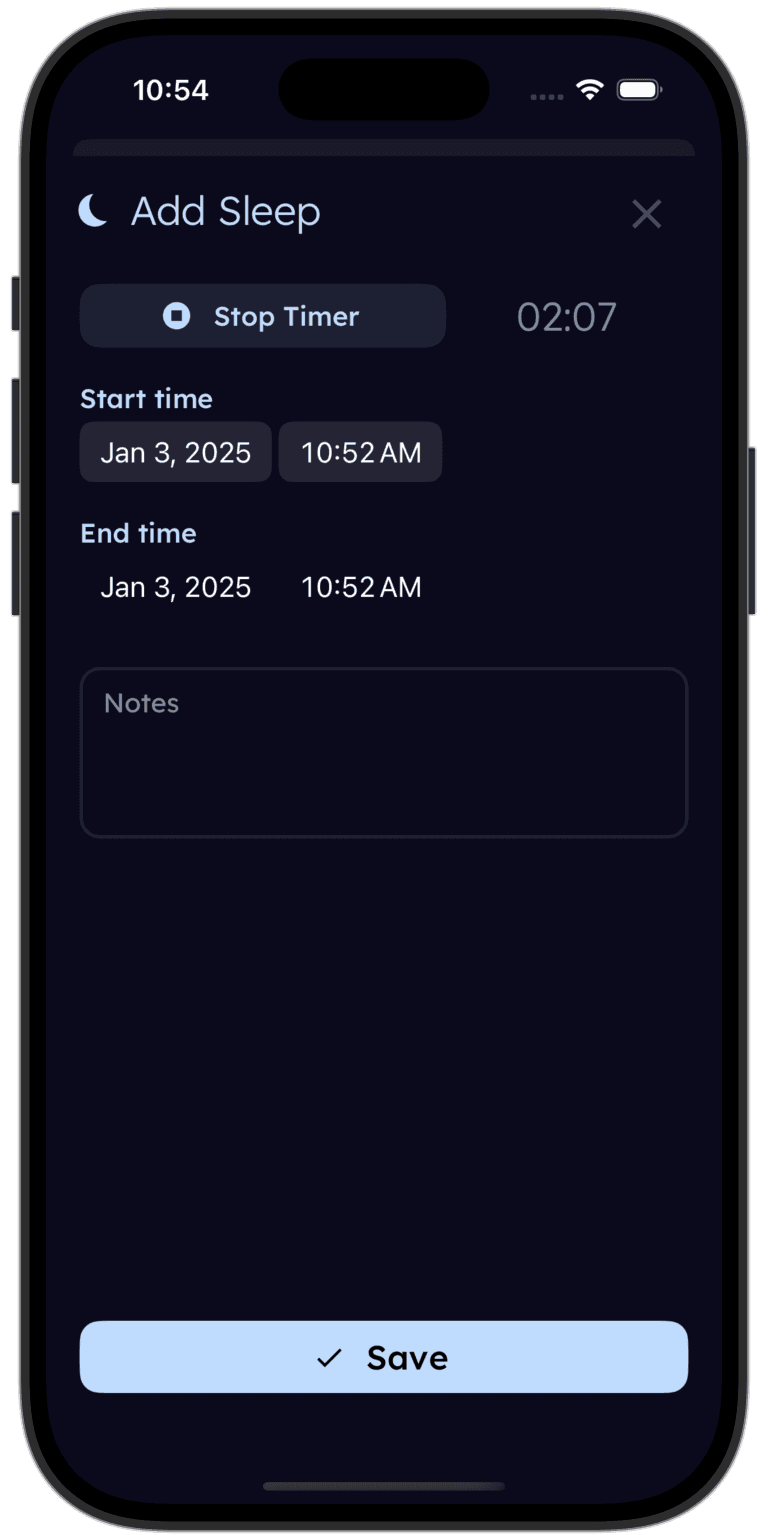
When you're worried about your baby's sleep, real numbers help more than reassuring words. Log sleep in a couple of taps with tinylog and see the actual patterns — total hours, night wakings, nap lengths, and trends over time. Bring the data to your pediatrician or just use it to reassure yourself.

Download on the App StoreGet It On Google Play

When to Talk to Your Pediatrician

  • Your baby consistently snores, gasps, or has breathing pauses during sleep
  • Sleep disruption is severe and shows no improvement after 6 or more weeks despite appropriate schedule and environment
  • Sleep issues are accompanied by poor feeding, weight loss, or developmental concerns
  • Your baby seems to be in pain when lying down — arching, screaming, or inconsolable
  • You notice persistent mouth breathing during sleep
  • Your own mental health is suffering from the sleep deprivation — this is always a valid reason to seek help

You never need a 'good enough' reason to call your pediatrician. 'I'm worried about my baby's sleep' is always sufficient. And if the sleep deprivation is affecting your mental health, that matters too — you deserve support.

Related Guides

Sources

  • Galland, B. C., Taylor, B. J., Elder, D. E., & Herbison, P. (2012). Normal sleep patterns in infants and children: A systematic review of observational studies. Sleep Medicine Reviews, 16(3), 213–222.
  • Mindell, J. A., Leichman, E. S., DuMond, C., & Sadeh, A. (2017). Sleep and Social-Emotional Development in Infants and Toddlers. Journal of Clinical Child & Adolescent Psychology, 46(2), 236–246.
  • Mindell, J. A., Kuhn, B., Lewin, D. S., Meltzer, L. J., & Sadeh, A. (2006). Behavioral Treatment of Bedtime Problems and Night Wakings in Infants and Young Children. Sleep, 29(10), 1263–1276.
  • Baby Sleep Information Source (BASIS), Durham University. Normal Infant Sleep Development. https://www.basisonline.org.uk
  • Sadeh, A., Tikotzky, L., & Scher, A. (2010). Parenting and infant sleep. Sleep Medicine Reviews, 14(2), 89–96.
  • Jenni, O. G., & Carskadon, M. A. (2007). Sleep Behavior and Sleep Regulation from Infancy through Adolescence: Normative Aspects. Sleep Medicine Clinics, 2(3), 321–329.
  • American Academy of Pediatrics (AAP). (2022). Sleep-Related Infant Deaths: Updated 2022 Recommendations for Reducing Infant Deaths in the Sleep Environment. Pediatrics, 150(1).
  • Zero to Three. Helping Your Baby Sleep. https://www.zerotothree.org

Medical Disclaimer

This guide is for informational purposes only and is not a substitute for professional medical advice. If you have concerns about your baby's sleep or health, please consult your pediatrician.

Want this reference in your inbox?
We'll send you these age-by-age sleep norms so you can check them anytime worry strikes.
Bring real data to your next pediatrician visit.
Download tinylog free — track your baby's sleep and have actual numbers to discuss instead of guesses.
Download on the App StoreGet It On Google Play