GUIDE

Baby Growth Percentiles Explained

Percentiles are about your baby's trend, not their rank. Being in the 15th percentile is not a bad grade.

Your pediatrician rattled off a number and now you're googling at midnight. Here's the thing: a percentile is just where your baby falls on a bell curve compared to other babies the same age. It is not a score. A baby who has been in the 10th percentile since birth and is still in the 10th percentile is a perfectly healthy baby following their own growth curve.

What Percentiles Actually Mean

If your baby is in the 25th percentile for weight, it means 25 out of 100 babies the same age weigh less and 75 weigh more. That's it. It's not a score. It's not a grade. It's not a ranking of how well you're feeding your child.

Percentiles exist so your pediatrician can plot your baby's growth over time and make sure they're following a consistent curve. The actual number matters way less than the pattern. A baby who is consistently at the 15th percentile is doing great. A baby who was at the 70th and dropped to the 15th in two months — that's worth a conversation.

Think of it like height in adults. Some people are tall, some are short, most are somewhere in the middle. Nobody is "failing" at being 5'3". Same thing with your baby's growth chart.

Quick Percentile Reference
5th
What It MeansSmaller than 95% of babies the same age
Should You Worry?Not by itself. Some babies are just small. If they've tracked here consistently, that's their normal.
10th
What It MeansSmaller than 90% of babies — still within the normal range
Should You Worry?No — as long as they're following their curve. Plenty of healthy babies live here.
25th
What It MeansOn the smaller side of the middle. 25 out of 100 babies weigh less.
Should You Worry?No. This is solidly normal. A quarter of all babies are below this line by definition.
50th
What It MeansExactly average — right in the middle
Should You Worry?No. But also: being above or below 50th doesn't mean better or worse. Average is just a math thing.
75th
What It MeansBigger than 75% of babies the same age
Should You Worry?No. Some babies are chunky. That's often a sign of excellent feeding, not a problem.
90th
What It MeansBigger than 90% of babies — on the larger side of normal
Should You Worry?No. Big babies are normal babies. Your pediatrician will let you know if anything needs attention.
95th
What It MeansBigger than 95% of babies the same age
Should You Worry?Usually no. If they've always been here, that's just their size. A sudden jump might be worth discussing.
Notice a pattern in that last column? Almost every answer is some version of 'no, as long as they're following their curve.' That's the whole point. The curve matters more than the number.

What Matters More Than the Number

  • Staying on a consistent curve over time — even if that curve is at the 12th percentile
  • Steady weight gain over weeks and months, not day to day
  • Meeting developmental milestones on a reasonable timeline
  • Your pediatrician is relaxed about it (they see hundreds of growth charts — trust their calm)
  • Baby is alert, active, and feeding well
  • Length, weight, and head circumference are all growing — even if at different percentiles

If you're checking most of these boxes, your baby's percentile — whatever it is — is probably exactly where it should be.

When Percentiles Actually Matter

  • Dropping two or more major percentile lines quickly (e.g., 60th to 15th over a couple of months)
  • Crossing below the 3rd percentile when they weren't tracking there before
  • Weight and length percentiles diverging significantly (weight falling while length stays steady, or vice versa)
  • Sudden change in a pattern that had been consistent for months
  • Your pediatrician expresses concern — not you reading forums at 2 AM, but your actual doctor
  • Baby is showing signs of feeding difficulties alongside the percentile drop

If any of these apply, bring it up with your pediatrician. They can look at the full picture — feeding history, development, family size — and tell you whether it's something to address or just normal variation.

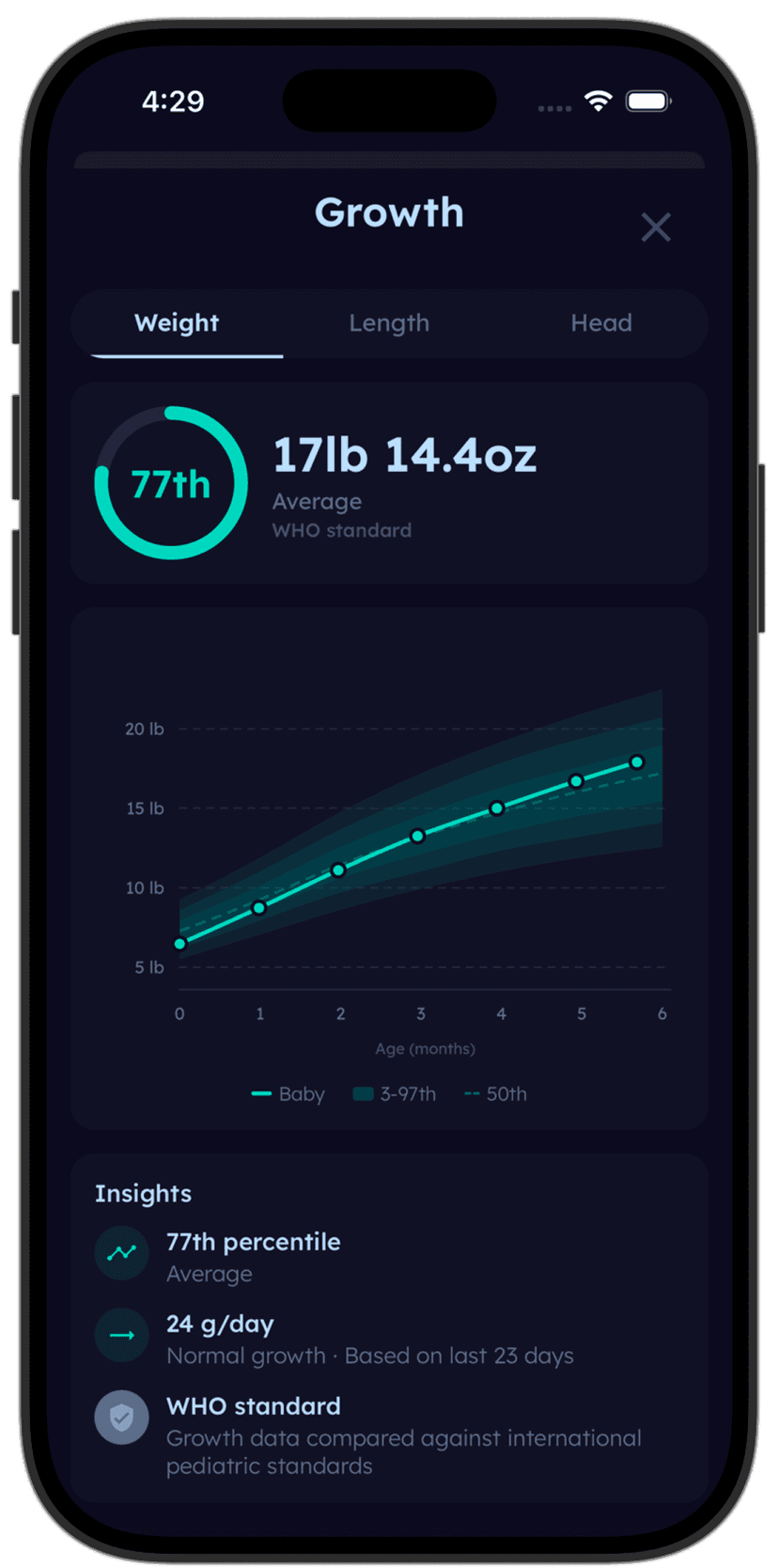
tinylog growth tracking screen showing baby weight plotted over time

One snapshot from a doctor visit doesn't tell you much. A trend over months tells you everything.

tinylog plots your baby's growth over time so you can see the curve — not just a number. Log weight, length, and head circumference after each visit and watch the pattern emerge. That's what your pediatrician is actually looking at.

Download on the App StoreGet It On Google Play

Things Worth Remembering

Breastfed and formula-fed babies grow differently

After about 4-6 months, breastfed babies tend to gain weight more slowly than formula-fed babies. This is completely normal. The WHO growth charts are based on breastfed babies, but many clinics still use CDC charts — ask your pediatrician which one they're using.

Genetics are doing a lot of the work

If you and your partner are both 5'4", your baby probably isn't going to be in the 95th percentile for length. That's not a problem — it's just genetics doing exactly what genetics does.

The WHO chart is based on breastfed babies

The World Health Organization growth standards (used for kids under 2) were built from data on breastfed babies across six countries. If your pediatrician is using CDC charts instead, the curves look slightly different. Neither is wrong — just ask which one your office uses so you're comparing apples to apples.

Stop comparing your baby to your friend's baby

Seriously. Their baby is in the 80th percentile and yours is in the 20th? Cool. Both are normal. Growth charts compare your baby to a statistical population — not to the baby at your mommy-and-me class. The only comparison that matters is your baby to their own previous measurements.

One weird measurement doesn't mean anything

Babies squirm. The nurse might have measured length slightly differently this time. One data point that looks off the curve is usually just measurement noise. It takes a pattern over multiple visits to mean anything real.

Head circumference matters too

Parents tend to fixate on weight, but your pediatrician is also tracking head circumference. The brain is growing fast in the first year. If head growth is on track, that's a really good sign — even if weight is on the lower end.


Related Guides

Get this guide in your inbox.
We'll send you this percentile reference so you can check it after your next well-child visit instead of spiraling on Google.
See your baby's growth trend — not just a single number.
Download tinylog free — log weight, length, and head circumference and watch the curve take shape.
Download on the App StoreGet It On Google Play