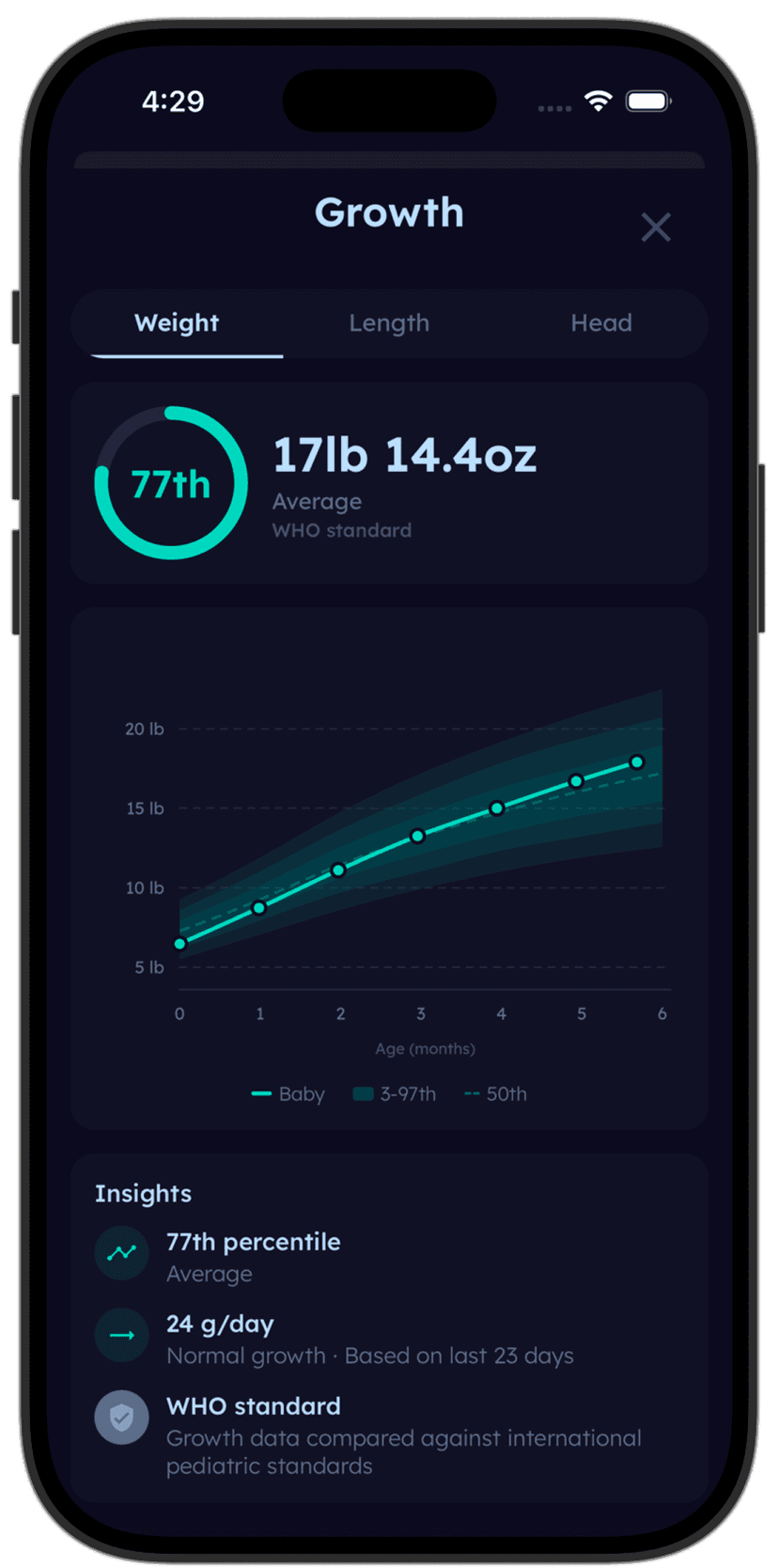
The biggest predictor of your baby's eventual height is genetics. If you and your partner are both 5'4", your baby is very unlikely to track at the 90th percentile for length — and that's completely fine. Height is one of the most heritable human traits, and your baby's growth chart is already quietly reflecting the genes they inherited.
It's also important to understand that babies don't grow in a straight line. They grow in spurts and plateaus. Your baby might barely gain any length for a few weeks and then shoot up seemingly overnight. This is normal and well-documented — growth is not a steady, linear process.
Another factor many parents don't realize: birth length doesn't necessarily predict where a baby will end up on the chart. Babies born to smaller parents are often born at an average or above-average length (because the uterine environment, not genetics, drives much of birth size), and then gradually "catch down" to their genetically determined percentile over the first 6-18 months. This adjustment is normal and expected — it's not your baby falling behind.
For more on how this percentile shifting works, see our guide on
what it means when babies drop percentiles.