GUIDE

Baby Small for Their Age

Most small babies are small because of genetics — and that's completely healthy. What matters is whether they're growing consistently on their own curve, not where that curve sits on the chart.

You're at a playgroup and your baby is noticeably smaller than every other baby there. Or a relative made a comment. Or you're just looking at the growth chart and wondering why your baby is at the bottom. Here's the most important thing: small and healthy are not mutually exclusive. Most small babies are perfectly fine.

Small vs. Problem: Two Very Different Things

Being small is not a medical condition. It's a size description. Just like some adults are 5'2" and perfectly healthy, some babies are at the 5th or 10th percentile and perfectly healthy.

The difference between a healthy small baby and a baby whose small size warrants investigation comes down to three questions:

Is the growth consistent? A baby who has always tracked at the 8th percentile is following their own curve. That's healthy. A baby who was at the 50th and has fallen to the 8th has changed trajectory — and that change deserves evaluation.

Is the baby otherwise thriving? A small baby who is active, alert, feeding well, producing diapers, and meeting milestones is a healthy baby who happens to be small. A small baby who is lethargic, feeding poorly, or missing milestones has a different picture.

Does the growth pattern make genetic sense? If you and your partner are both petite, a baby at the 10th percentile is doing exactly what genetics predict. If you're both tall and your baby is at the 3rd percentile, that's a bigger mismatch worth discussing.


Common Reasons Babies Are Small
Familial short stature
What's HappeningSmaller parents have smaller babies. This is genetics, not a problem.
OutlookBaby will likely be smaller as a child and adult — and that's perfectly healthy.
Constitutional growth delay
What's HappeningBaby grows slowly but at a consistent rate. They're 'late bloomers.'
OutlookOften catch up during puberty. Bone age may be delayed, which means more growing time.
Catch-down growth
What's HappeningBaby was born at a higher percentile and is settling to their genetic curve.
OutlookCompletely normal. Usually stabilizes by 6-18 months at their genetic percentile.
Breastfed growth pattern
What's HappeningBreastfed babies tend to be leaner after 4-6 months compared to formula-fed babies.
OutlookNormal variation. WHO charts reflect this as expected growth for breastfed babies.
Prematurity
What's HappeningPreemies often appear small on standard charts because their adjusted age is younger.
OutlookMany preemies show significant catch-up growth by age 2-3.
Small for gestational age (SGA)
What's HappeningBorn below the 10th percentile for gestational age. Can be constitutional or due to intrauterine factors.
OutlookMost SGA babies experience catch-up growth by age 2. A small percentage don't — pediatricians monitor closely.
Genetics and normal growth patterns account for the vast majority of small babies. Medical causes are less common but worth ruling out if the pattern doesn't fit.

Signs Your Small Baby Is Perfectly Healthy

  • Growing consistently along their own curve — even if that curve is at the 5th or 10th percentile
  • Producing 6+ wet diapers per day
  • Feeding well and seeming satisfied after feeds
  • Alert, active, and meeting developmental milestones
  • One or both parents are on the smaller side
  • Your pediatrician has reviewed growth and is not concerned
  • Weight, length, and head circumference are all growing — even if slowly

If most of these describe your baby, their small size is almost certainly just their natural size — healthy, genetic, and not a problem to solve.

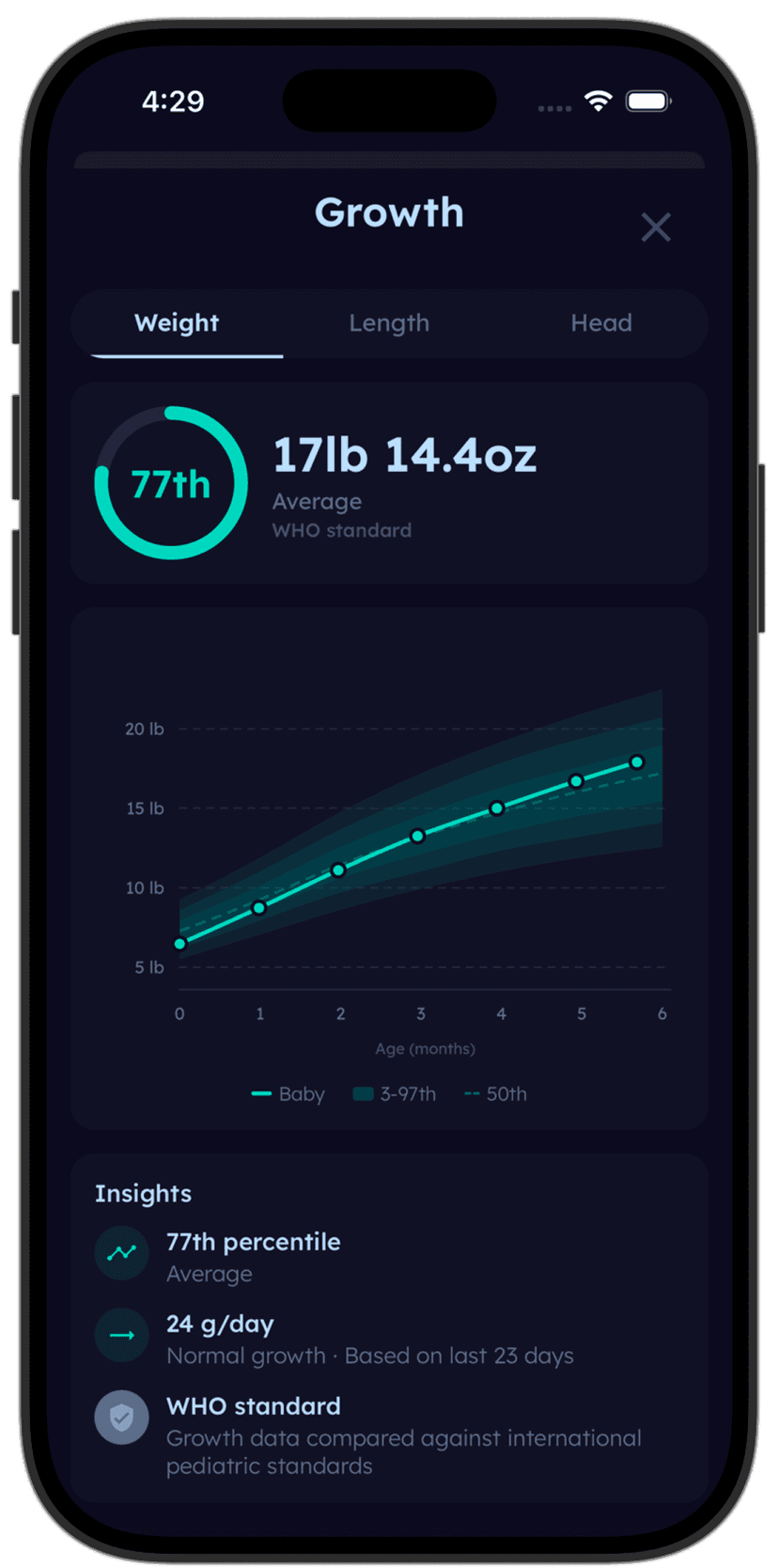
tinylog growth chart showing consistent growth at a lower percentile

When your baby is small, the growth trend is even more important.

tinylog plots your baby's weight, length, and head circumference on WHO growth charts. A consistent curve at a lower percentile tells a clear, healthy story — and that's what your pediatrician is looking at.

Download on the App StoreGet It On Google Play

What You Might Not Know

Stop comparing at playgroup

This is genuinely one of the hardest parts of having a small baby. When every other baby at your class seems bigger, it's natural to worry. But percentile comparisons between babies are meaningless. Each baby has their own genetic blueprint. The only comparison that matters is your baby to their own previous measurements.

Small babies are often the most active

Anecdotally (and some research supports this), smaller babies often hit gross motor milestones early. They have less body mass to move around, which can make rolling, crawling, and walking easier. Small doesn't mean behind — in many ways, it can mean ahead.

Your pediatrician has seen this thousands of times

If your pediatrician looks at your baby's growth chart and says 'this looks fine' — believe them. They've seen thousands of growth charts. They know the difference between a healthy small baby and a baby who needs attention. Your doctor's calm is informed by experience.

SGA, FTT, and When Labels Get Scary

If you've been Googling "small baby," you may have encountered terms like SGA (small for gestational age) and FTT (failure to thrive). These are clinical terms with specific definitions — and they don't apply to most small babies.

SGA means a baby was born below the 10th percentile for their gestational age. It's a birth description, not a diagnosis. Most SGA babies experience catch-up growth in the first 2 years and end up at normal percentiles. A subset don't catch up, and they may be evaluated by a pediatric endocrinologist — but this is the exception, not the rule.

Failure to thrive has specific clinical criteria — generally weight below the 3rd percentile, or crossing two or more major percentile lines downward, or weight-for-length below the 5th percentile. It's a finding that prompts investigation, not a diagnosis itself. A baby who has always been at the 5th percentile and is growing consistently does NOT meet FTT criteria.

For a detailed look at how FTT differs from naturally small babies, see our failure to thrive vs. small baby guide.

When to Bring It Up With Your Pediatrician

  • Baby has dropped from a higher percentile to a much lower one over a short period
  • Weight gain has stalled or reversed for several weeks
  • Baby seems lethargic, disinterested in feeding, or not meeting milestones
  • Weight is falling significantly behind length (getting thinner, not just small overall)
  • Fewer than 4 wet diapers in 24 hours
  • Family members notice that baby seems much smaller than expected given parental size
  • Baby was not premature and is consistently below the 3rd percentile

These patterns deserve a conversation. Your pediatrician can evaluate the full picture and determine whether further assessment is needed.

The Bottom Line

Most small babies are small because of genetics. They're following their own growth curve, meeting milestones, and thriving — they just happen to be smaller than most babies their age. Being small is not a failure, not a deficiency, and not a reflection of your feeding.

What matters is consistency (are they following their curve?), overall health (are they thriving?), and context (does the pattern make sense given your family's size?). Track the trend, trust your pediatrician, and try not to compare your baby to the bigger babies at playgroup. Your baby is growing their own way — and their way is probably just fine.

Related Guides

Sources

  • World Health Organization (WHO) Child Growth Standards
  • American Academy of Pediatrics (AAP) — Failure to thrive evaluation guidelines
  • Lee PA, et al. "International Small for Gestational Age Advisory Board consensus." Pediatrics, 2003.
  • Mei Z, et al. "Shifts in percentiles of growth during early childhood." Pediatrics, 2004.

This guide is for informational purposes only and is not a substitute for professional medical advice. If you have concerns about your baby's growth, please consult your pediatrician.

Get this guide in your inbox.
We'll send you this reference so you can check it with a clear head.
Track growth over time — the trend matters more than the size.
Download tinylog free — see the curve, not just the number.
Download on the App StoreGet It On Google Play