GUIDE

Baby in the 15th Percentile

The 15th percentile is well within the normal range. It is not a low score — it's simply where your baby falls on the growth curve.

If 'fifteenth percentile' sounds scary, here's some perspective: it means 15 out of 100 babies the same age weigh less than yours and 85 weigh more. Your baby is on the smaller side of normal — and smaller side of normal is still normal. What matters most is whether they're following a consistent curve over time.

What the 15th Percentile Looks Like on the Bell Curve

Growth charts are based on bell curves — statistical distributions of how thousands of healthy babies grow. The 15th percentile sits on the left side of that curve, in the "smaller side of normal" territory. Here's how the distribution works:

Where the 15th Percentile Fits
3rd–10th
What It MeansSmaller than most babies — still normal for consistent trackers
How CommonAbout 7 out of every 100 babies
10th–25th
What It MeansSmaller side of the middle range — your baby is here
How CommonAbout 15 out of every 100 babies
25th–75th
What It MeansThe broad middle — where most babies fall
How CommonAbout 50 out of every 100 babies
75th–97th
What It MeansBigger than most babies — also completely normal
How CommonAbout 22 out of every 100 babies
Notice that your baby's range — the 10th to 25th percentile — includes about 15 out of every 100 babies. That's not rare. That's a normal, common place to be.

Why Your Baby Might Be at the 15th Percentile

The most honest answer? Usually it's just who they are. But let's break down the common reasons.

Genetics are the single biggest predictor of where a baby falls on the growth chart. If you or your partner are on the smaller or leaner side, your baby is likely to be too. A 5'2" parent probably isn't going to produce a baby that tracks at the 95th percentile for length — and that's biology working exactly as expected.

Feeding method also plays a role. After about 4-6 months, breastfed babies tend to gain weight more slowly than formula-fed babies. This is well-documented and completely normal. The WHO growth charts were built from data on breastfed babies, but even on these charts, plenty of healthy breastfed babies naturally fall in the lower percentiles. For a deeper look at this, check our breastfed vs. formula-fed growth curves guide.

And here's something many parents don't realize: babies often shift percentiles in the first year. A baby born at the 50th percentile might gradually settle at the 15th as they find their genetic growth curve. This is normal and has a medical name — "catch-down growth" or the "genetic growth trajectory adjustment." It's not your baby falling behind; it's your baby finding their natural size.

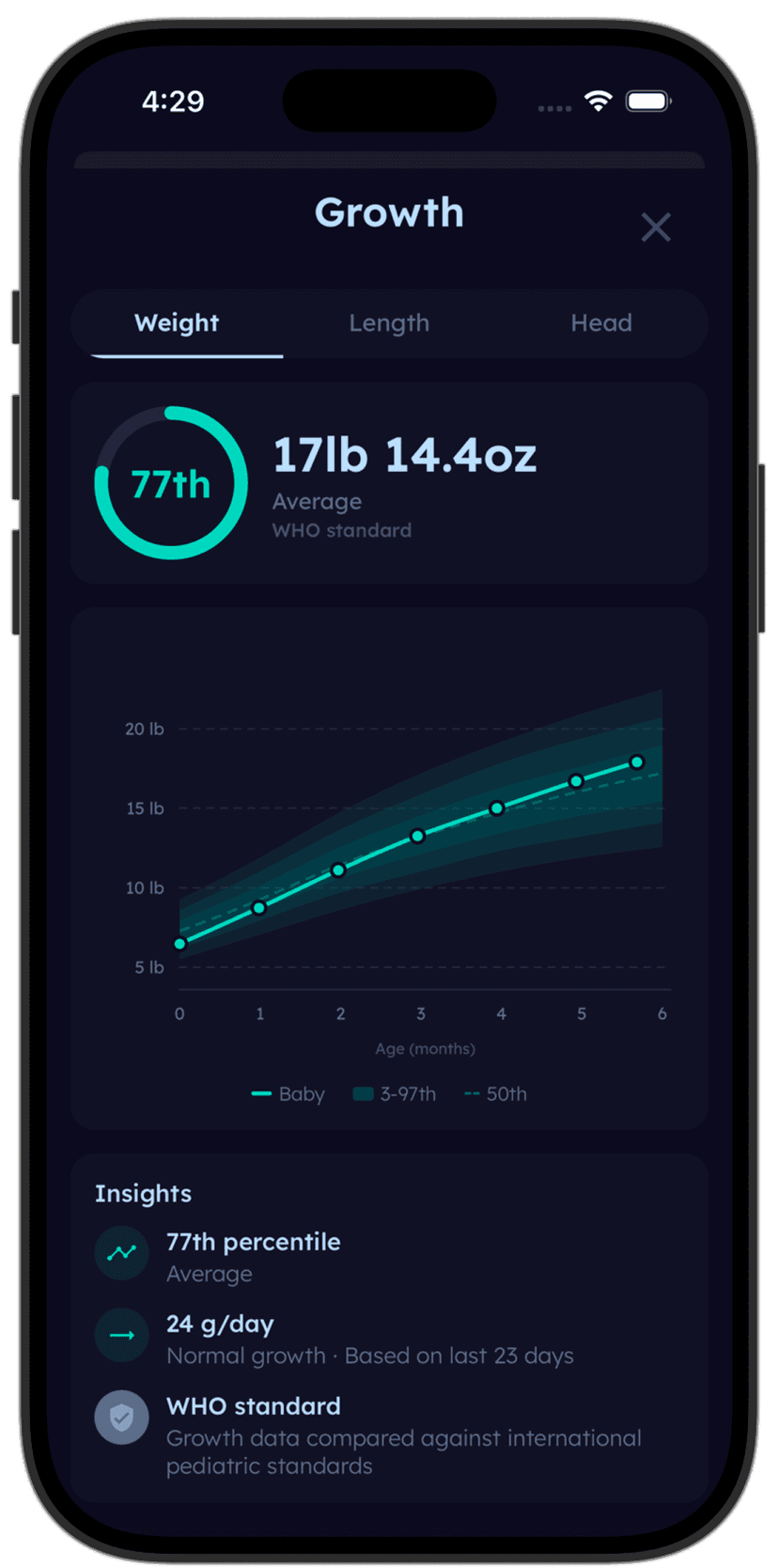
tinylog growth tracking screen showing consistent growth curve

The trend is everything. One number from one visit is just noise.

Log your baby's weight, length, and head circumference after each checkup with tinylog. Over time, you'll see the growth curve take shape — and a consistent curve at the 15th percentile looks exactly like what healthy growth looks like.

Download on the App StoreGet It On Google Play

What Actually Matters More Than the Number

  • Consistent tracking along their own growth curve — even if that curve is the 15th percentile
  • Steady weight gain over weeks and months, not day-to-day fluctuations
  • Producing 6 or more wet diapers per day
  • Meeting developmental milestones within a reasonable timeline
  • Being alert, active, and feeding well
  • Your pediatrician's assessment of the overall picture — not just the number

If you're checking most of these boxes, your baby's 15th percentile is almost certainly just their normal — not a sign that something is wrong.

What You Might Not Know

The 15th percentile is not 'almost failing'

Growth charts don't have a pass/fail line. The 15th percentile is within the normal range, and a baby who consistently tracks here is growing exactly as they should. Pediatricians don't start paying extra attention to percentile numbers alone until a baby is consistently below the 3rd percentile or crossing lines rapidly.

Your baby's percentile is not a grade on your parenting

This is worth saying directly, because parents internalize percentile numbers as feedback on their feeding. A baby at the 15th percentile is not evidence of inadequate nutrition, insufficient breast milk, or any other parenting failure. Some babies are smaller. That's genetics, not a judgment.

Percentile anxiety is a documented phenomenon

Growth chart anxiety is real enough that pediatric researchers have studied it. Parents — especially first-time parents — often interpret lower percentiles as alarming when the numbers are completely normal. If you're anxious about the 15th percentile, you're in very good company, and your worry is understandable. But the number is almost certainly fine.

Consistent 15th vs. Dropping to the 15th

There's a big difference between a baby who has always been near the 15th percentile and a baby who was recently at the 50th and has dropped. Your pediatrician treats these two situations very differently.

A consistent 15th percentile — baby has tracked near here since birth or since the first few months — is almost always fine. This is their growth curve. They're following it. No flags.

A drop to the 15th percentile from significantly higher — say your baby was at the 50th and has fallen to the 15th over 2-3 months — is worth a conversation. It doesn't necessarily mean something is wrong, but it's a change in pattern that your pediatrician will want to understand. Common causes include a growth spurt ending, an illness, or simply the natural adjustment to their genetic curve. But it's worth checking.

For more on percentile drops specifically, see our guide on what it means when babies drop percentiles.

When to Mention It to Your Pediatrician

  • Your baby was at a significantly higher percentile and has dropped to the 15th over a short time
  • Weight gain has flattened or stopped for more than a couple of weeks
  • Your baby has fewer than 4 wet diapers in 24 hours
  • They seem unusually lethargic, irritable, or uninterested in feeding
  • Weight and length are diverging — one is dropping while the other stays steady
  • You've noticed feeding difficulties like poor latch, frequent spitting up, or refusal to eat

Any of these is worth bringing up — not because the 15th percentile is inherently concerning, but because changes in growth pattern deserve a closer look. Your pediatrician will appreciate having the information.

The Bottom Line

The 15th percentile is not a warning sign. It's not "almost too low." It's a perfectly normal position on a growth chart that represents a healthy, smaller-than-average baby. By definition, 15 out of every 100 babies are at or below this line — and the vast majority of them are completely fine.

What matters is consistency: is your baby following their own curve? Are they eating well, producing wet diapers, meeting milestones, and generally thriving? If yes, the number on the chart is just that — a number. It's not a score, and it's not a reflection of how well you're doing as a parent.

Track the trend, partner with your pediatrician, and remember that your baby is more than a data point on a bell curve. For a broader look at what all the percentile ranges mean, check out our complete growth percentiles guide.

Related Guides

Sources

  • World Health Organization (WHO) Child Growth Standards — Multicentre Growth Reference Study (MGRS)
  • Centers for Disease Control and Prevention (CDC) Growth Charts
  • American Academy of Pediatrics (AAP) — Bright Futures: Guidelines for Health Supervision
  • Mei Z, et al. "Shifts in percentiles of growth during early childhood." Pediatrics, 2004.
  • Ong KK, et al. "Postnatal growth patterns in preterm infants and later health outcomes." Acta Paediatrica, 2015.

This guide is for informational purposes only and is not a substitute for professional medical advice. If you have concerns about your baby's growth, please consult your pediatrician.

Get this guide in your inbox.
We'll send you this reference so you can revisit it calmly instead of googling at 2 AM.
Percentiles are not grades. Your baby's trend is what matters.
Download tinylog free — track growth over time and see the curve, not just a number.
Download on the App StoreGet It On Google Play