GUIDE

Breastfed vs. Formula-Fed Growth

Breastfed babies tend to be leaner after 4-6 months. Formula-fed babies tend to gain weight faster. Both patterns are normal — and the growth chart your doctor uses matters.

If your breastfed baby's percentile has dipped while your friend's formula-fed baby is chunking up, you're seeing one of the most well-documented patterns in pediatrics. It's not a problem with your milk. It's not a problem at all. Here's what's actually happening.

The Core Difference: It's Real, and It's Normal

Breastfed and formula-fed babies grow at different rates. This isn't controversial — it's one of the most well-documented findings in pediatric nutrition. The WHO, AAP, and every major health organization acknowledges it.

Here's the pattern: in the first 3-4 months, breastfed babies often gain weight slightly faster than formula-fed babies. Then after 4-6 months, the pattern reverses. Formula-fed babies tend to gain weight faster, while breastfed babies' weight gain slows down. By 12-24 months, the difference narrows.

This means that if you have a breastfed baby and a formula-fed baby of the same age side by side at 8 months, the formula-fed baby will often be chubbier. This does NOT mean the breastfed baby isn't getting enough. It means they're growing at the rate that's normal for breastfed babies — which is the biologically expected pattern.

Growth Patterns by Feeding Method and Age
Birth to 3-4 months
BreastfedOften gain weight slightly faster
Formula-FedSteady gain at a consistent rate
What to KnowBreastfed babies often get a head start due to the high caloric density of early breast milk
4-6 months
BreastfedWeight gain begins to slow — this is normal
Formula-FedWeight gain continues at the same rate or accelerates slightly
What to KnowThis is where the divergence becomes visible. Breastfed babies' percentiles may dip on CDC charts.
6-12 months
BreastfedLeaner body composition, continued steady but slower gain
Formula-FedTend to be heavier with more fat mass
What to KnowIntroduction of solids affects both groups. Breastfed babies self-regulate total intake more effectively.
12-24 months
BreastfedContinued lean growth, patterns begin to converge with formula-fed peers
Formula-FedGrowth rate slows as toddler eating patterns establish
What to KnowBy age 2, the differences between the two groups narrow significantly.
These are general patterns based on research. Individual babies vary widely. What matters most for your baby is their own consistent trend over time.

Why the Growth Chart Matters

Here's something that can significantly affect how you feel about your baby's growth: which chart your pediatrician uses.

The WHO growth standards (recommended for babies 0-2 years) were built from data on healthy breastfed babies across six countries. When your breastfed baby's weight is plotted on a WHO chart, they're being compared to other breastfed babies. The percentile you see reflects where they fall among babies who were fed the same way.

The CDC growth charts (designed for ages 2-20 but sometimes used for infants) include both breastfed and formula-fed babies, with more formula-fed babies in the reference population. When your breastfed baby is plotted on a CDC chart, they're being compared to a mix that includes heavier formula-fed babies — which can make them look like they're "falling" when they're actually growing normally.

This chart difference alone can shift a baby's apparent percentile by 10-15 points. A breastfed baby at the 40th percentile on WHO charts might appear to be at the 25th on CDC charts. Same baby, same growth, different number.

Ask your pediatrician which chart they're using. If they're using CDC charts for your breastfed infant, ask if WHO charts would be more appropriate. The AAP recommends WHO charts for all babies under 2.


WHO vs. CDC Growth Charts
WHO Growth Standards (0-2 years)
Based OnHealthy breastfed babies from 6 countries
Best ForAll babies 0-2, especially breastfed
Important NoteRepresents how babies should grow under optimal conditions. Recommended by AAP for all infants.
CDC Growth Charts (2-20 years)
Based OnUS reference population (mixed feeding methods)
Best ForChildren 2-20 years old
Important NoteNot growth 'standards' but growth 'references.' Shows how US children did grow, not how they should grow.
The WHO charts are 'standards' (how babies should grow). The CDC charts are 'references' (how a specific population did grow). For babies under 2, WHO standards are recommended.
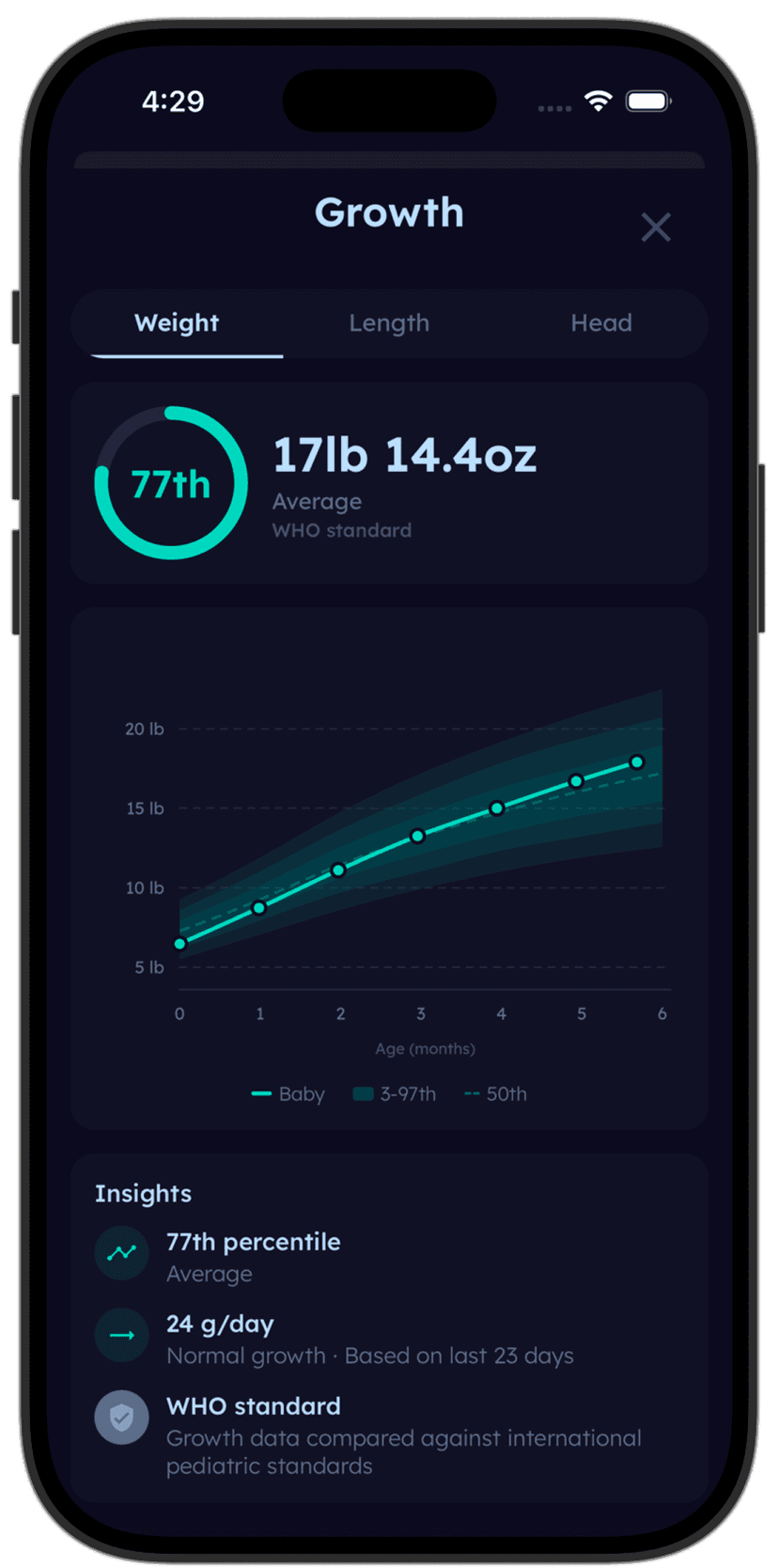
tinylog growth chart showing baby weight on WHO standards

Track your baby's growth on the right chart — and see the trend, not just the number.

tinylog lets you plot measurements on WHO growth charts — the standard designed for breastfed babies. Log weight, length, and head circumference and see your baby's growth curve in context.

Download on the App StoreGet It On Google Play

What You Might Not Know

The WHO charts are the right standard for breastfed babies

The WHO growth charts were specifically built from data on healthy breastfed babies in Brazil, Ghana, India, Norway, Oman, and the US. They represent how babies should grow under optimal feeding conditions. If your pediatrician uses WHO charts for your breastfed baby, the percentile you see is compared against other breastfed babies — which is the fairest comparison.

CDC charts can make breastfed babies look small

The CDC growth charts include both breastfed and formula-fed babies, with a heavy representation of formula-fed infants. Because formula-fed babies tend to be heavier after 6 months, a breastfed baby compared against this reference population can look like they're 'dropping percentiles' when they're actually growing normally for their feeding method.

Breast milk changes throughout the day and feed

Formula has a fixed caloric density. Breast milk doesn't. Fat content increases during each feed (hindmilk is fattier than foremilk) and varies throughout the day (evening milk is fattier). This dynamic composition means breastfed babies are constantly getting a slightly different nutritional profile — which is one reason their growth pattern differs.

Self-regulation is a feature of breastfeeding

Breastfed babies control the flow, pace, and duration of feeding. They stop when they're satisfied, not when the breast is 'empty.' This built-in self-regulation means they tend to take in precisely what they need — not more, not less. It's one of the reasons breastfed babies are often leaner.

Should You Supplement With Formula?

If your breastfed baby's percentile has dipped, you might be wondering whether to add formula. The short answer: not based on percentile alone.

A breastfed baby who is growing consistently along their own curve — even a lower one — is getting enough. The lower percentile may simply reflect the normal breastfed growth pattern, especially if you're comparing against CDC charts.

Supplementation is worth discussing with your pediatrician if your baby has truly stalled in growth (not just shifted to a lower curve), if they're not producing enough wet diapers, if feeding sessions consistently feel ineffective, or if your pediatrician has specific concerns beyond the percentile number.

For more on whether your baby is eating enough, see our guide on adequate intake signs.

Signs Your Breastfed Baby Doesn't Need Supplementation

  • Your breastfed baby is following their own growth curve consistently
  • They're producing 6+ wet diapers per day
  • They're alert, active, and meeting developmental milestones
  • They seem satisfied after most feeds
  • Your pediatrician isn't concerned about the growth pattern
  • The 'drop' is only visible because your office uses CDC charts for infants

If these describe your baby, their growth pattern is almost certainly the normal breastfed pattern — not a sign of inadequate nutrition.

The Bottom Line

Breastfed and formula-fed babies grow at different rates, and that's normal. After 4-6 months, breastfed babies tend to be leaner — not because they're not getting enough, but because that's how breastfed growth works. The growth chart your pediatrician uses can significantly affect how this looks on paper.

Ask which chart your doctor is using. Understand that the breastfed growth pattern is the biologically expected norm. And don't let a percentile comparison between your breastfed baby and someone else's formula-fed baby cause unnecessary worry. They're growing differently because they're fed differently — and both patterns are healthy.

Related Guides

Sources

  • WHO Multicentre Growth Reference Study Group. "WHO Child Growth Standards: Growth velocity based on weight, length and head circumference." Acta Paediatrica, 2006.
  • Dewey KG. "Growth characteristics of breast-fed compared to formula-fed infants." Biology of the Neonate, 1998.
  • Dewey KG, et al. "Growth of breast-fed and formula-fed infants from 0 to 18 months: the DARLING Study." Pediatrics, 1992.
  • Centers for Disease Control and Prevention — "Use of World Health Organization and CDC Growth Charts for Children Aged 0-59 Months in the United States."
  • American Academy of Pediatrics — "Breastfeeding and the Use of Human Milk." Pediatrics, 2012.

This guide is for informational purposes only and is not a substitute for professional medical advice. If you have concerns about your baby's feeding or growth, please consult your pediatrician.

Get this guide in your inbox.
We'll email you this comparison so you can share it with anyone questioning your breastfed baby's size.
Your baby's growth curve is their own. Track it and see.
Download tinylog free — log weight and see the pattern emerge.
Download on the App StoreGet It On Google Play