GUIDE

Feeding Patterns and Baby Growth

Responsive feeding — following your baby's hunger and fullness cues — is the single most important feeding practice for healthy growth, regardless of whether you breastfeed, formula feed, or combo feed.

There's a lot of noise about feeding and growth. Does breastfeeding make babies smaller? Does formula make them bigger? Does feeding frequency matter? Here's what the research actually shows — and what it means for your baby.

The Big Picture: Responsive Feeding Is What Matters Most

With all the debate about breastfeeding vs. formula, feeding schedules, and growth charts, it's easy to lose sight of the most important principle: responsive feeding.

Responsive feeding means feeding your baby when they show hunger cues (rooting, hand-to-mouth, fussiness) and stopping when they show fullness cues (turning away, slowing down, falling asleep). It means letting your baby — not the clock, not the bottle markings, and not a growth chart target — determine how much they eat.

Research consistently shows that babies who are fed responsively develop healthier eating patterns and more appropriate growth trajectories than babies who are fed on rigid schedules or pressured to finish specific amounts. This applies equally to breastfed and formula-fed babies.

Your baby came equipped with a remarkably accurate internal appetite regulator. Your job is to offer food and follow their lead — not to override their signals in pursuit of a percentile number.

What the Research Actually Shows
Breastfed babies grow differently than formula-fed babies
What It MeansAfter 4-6 months, breastfed babies tend to be leaner. This is normal and expected — the WHO growth standards are based on breastfed babies.
SourceWHO Multicentre Growth Reference Study, 2006
Responsive feeding produces healthier growth patterns
What It MeansBabies fed in response to hunger/fullness cues (vs. scheduled or pressured feeding) show more appropriate weight gain trajectories.
SourceDisantis KI, et al. Pediatrics, 2011
Paced bottle feeding reduces overfeeding risk
What It MeansLetting baby control the bottle flow (more horizontal position, frequent pauses) results in lower per-feed intake closer to breastfed volumes.
SourceLi R, et al. Pediatrics, 2012
Early introduction of solids may affect weight gain
What It MeansIntroducing solids before 4 months is associated with faster weight gain. Current guidelines recommend waiting until around 6 months.
SourceHuh SY, et al. Pediatrics, 2011
Nighttime feeding matters for growth
What It MeansNight feeds contribute significantly to total daily intake, especially for breastfed babies. Breast milk prolactin is highest at night, making nighttime nursing especially productive for supply.
SourceKent JC, et al. Pediatrics, 2006
These findings are from peer-reviewed studies and major health organizations. The consistent message: how you feed (responsively) matters more than exactly what you feed or how often.

Breastfed vs. Formula-Fed Growth: The Honest Comparison

Let's address the most common feeding-growth question head-on: do breastfed and formula-fed babies grow differently? Yes — and understanding why can save you a lot of unnecessary worry.

In the first 3-4 months, breastfed babies often gain weight faster than formula-fed babies. Then after 4-6 months, the pattern typically reverses: formula-fed babies tend to gain weight faster, making breastfed babies look "smaller" by comparison.

This happens because formula delivers a more consistent caloric density, while breast milk composition fluctuates. Breastfed babies also regulate their own intake more precisely — they stop when they're full, even if the breast isn't "empty." This self-regulation is actually a feature, not a bug.

The WHO growth charts — the standard for babies 0-2 years — were specifically built from data on healthy breastfed babies. If your pediatrician is using these charts, a breastfed baby's growth pattern should align well. If they're using CDC charts (which include formula-fed babies), your breastfed baby may appear to "drop" percentiles after 6 months — but that's the chart's reference population causing the discrepancy, not your baby's growth.

For a deep dive, see our breastfed vs. formula-fed growth curves guide.

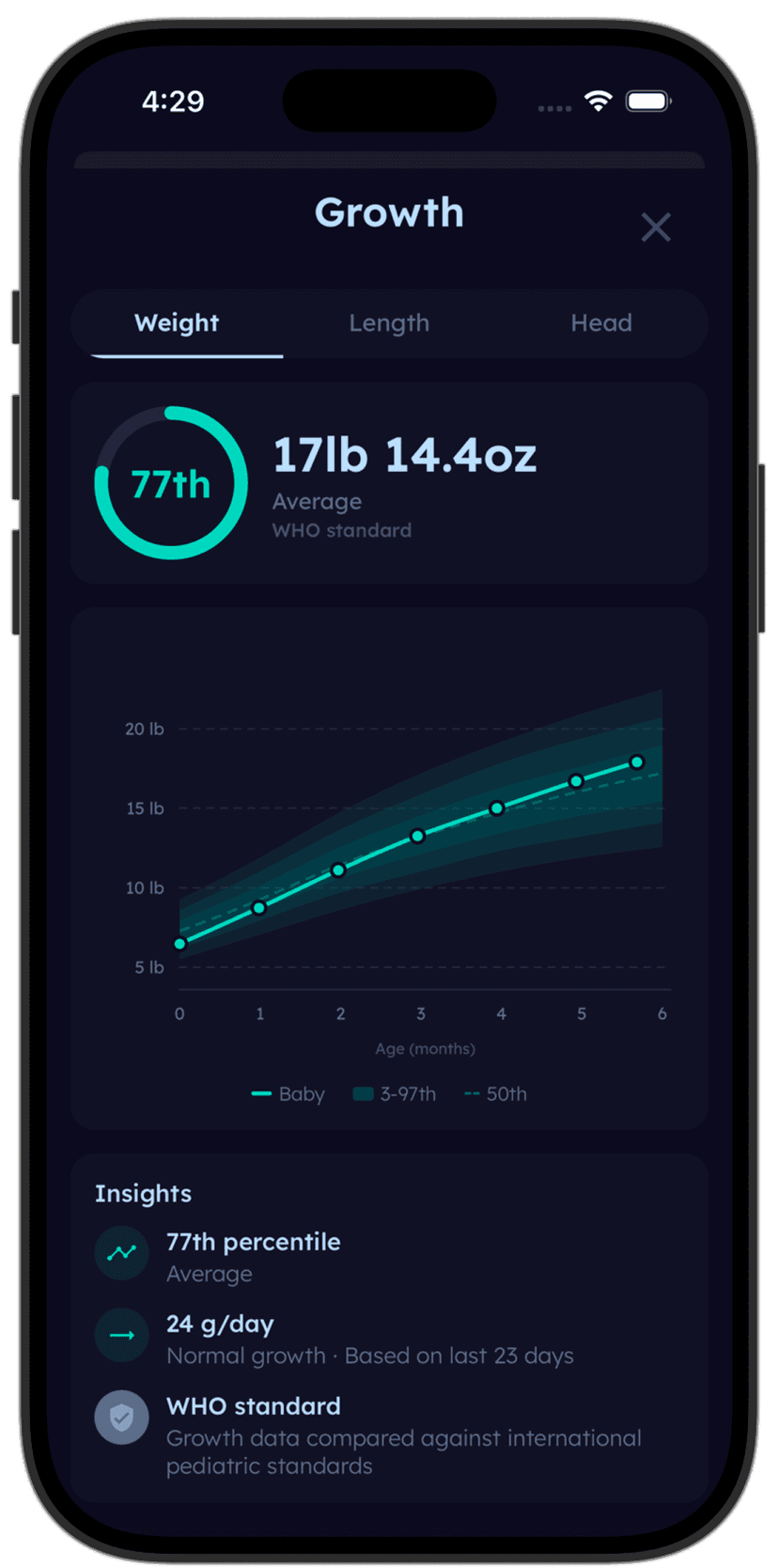
tinylog tracking feeds and growth measurements together

When you track feeds alongside growth, the connection becomes clear.

tinylog logs feeds and growth measurements in one place. Over time, you can see how feeding patterns relate to your baby's growth curve — real data that's more useful than guesswork.

Download on the App StoreGet It On Google Play

What Responsive Feeding Looks Like

  • Following baby's hunger cues: rooting, hand-to-mouth, fussiness
  • Stopping when baby shows fullness: turning away, closing mouth, slowing down
  • Not pressuring baby to finish a bottle or continue nursing
  • Feeding on demand rather than on a rigid clock schedule
  • Letting baby set the pace — especially with bottles (paced feeding)
  • Not using food to soothe every fuss (offering comfort without feeding when appropriate)

If you're doing most of these, you're feeding responsively — which is the single best thing you can do for your baby's healthy growth pattern.

What You Might Not Know

Responsive feeding is the gold standard

The AAP, WHO, and virtually every pediatric organization recommends responsive feeding — feeding in response to your baby's hunger and fullness cues. This applies to breastfeeding, bottle-feeding, and eventually solid foods. Babies who are fed responsively learn to regulate their own intake, which supports healthy growth patterns.

The breast milk composition changes through the day

Morning breast milk tends to be higher in volume. Evening breast milk is higher in fat and sleep-promoting hormones (melatonin). This dynamic composition means breastfed babies get different nutritional profiles at different times — which may partially explain why breastfed growth patterns differ from formula-fed patterns.

Feeding frequency matters less than you think

Whether your baby eats 8 times or 12 times per day, what matters is that they're eating enough total and that feeds are responsive. Some babies prefer frequent smaller meals; others prefer fewer larger ones. Both patterns are normal as long as overall intake and growth are adequate.

Night feeds are important for growth

Night feeds contribute 20-30% of a breastfed baby's total daily intake. Dropping night feeds too early can affect both growth and milk supply. Most pediatricians advise against eliminating night feeds before 6 months unless baby is gaining well and there's a medical reason to do so.

Solids and Growth

When your baby starts solid foods around 6 months, there's often a temporary blip in growth as they adjust. Some babies temporarily take in fewer total calories because they're eating less milk while they figure out solid food. Others take to solids enthusiastically and their calorie intake jumps.

Both patterns are normal and typically stabilize within a few weeks. The key is to continue offering breast milk or formula as the primary nutrition source until 12 months — solids are complementary (supplementing milk), not replacing it.

For more on feeding at each age, see our baby feeding chart.

The Bottom Line

The feeding-growth connection comes down to one principle: responsive feeding supports healthy growth. Feed your baby when they're hungry, stop when they're full, and let them lead the way. Whether you breastfeed, formula-feed, or combo-feed, responsive feeding is the common denominator in healthy growth outcomes.

Growth charts and percentiles are tools for tracking trends — not targets to hit through feeding manipulation. Your baby's appetite regulator is smarter than any app or schedule. Trust it.

Related Guides

Sources

  • WHO Multicentre Growth Reference Study Group. "Breastfeeding in the WHO Multicentre Growth Reference Study." Acta Paediatrica, 2006.
  • Disantis KI, et al. "Do infants fed directly from the breast have improved appetite regulation?" International Journal of Behavioral Nutrition, 2011.
  • Li R, et al. "Do infants fed from bottles lack self-regulation of milk intake?" Pediatrics, 2010.
  • Kent JC, et al. "Volume and frequency of breastfeedings and fat content of breast milk." Pediatrics, 2006.
  • American Academy of Pediatrics. "Infant feeding and nutrition guidelines." Bright Futures, 2017.

This guide is for informational purposes only and is not a substitute for professional medical advice. If you have concerns about your baby's feeding or growth, please consult your pediatrician.

Get this guide in your inbox.
We'll send you this research-backed reference to check whenever feeding questions come up.
See how feeding patterns connect to growth trends.
Download tinylog free — track feeds and growth in one place.
Download on the App StoreGet It On Google Play