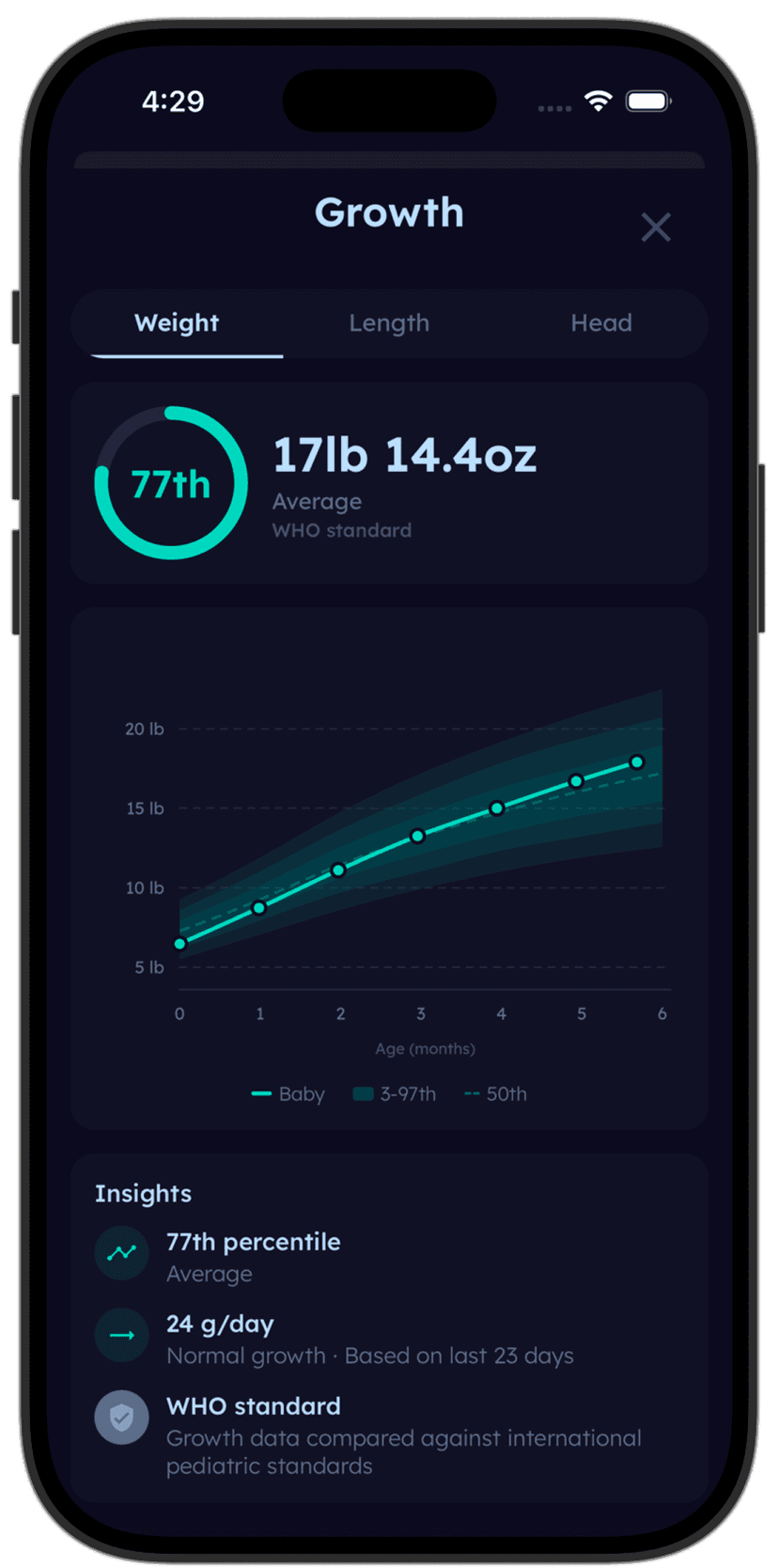
- Is it normal for babies to drop percentiles?
- Yes, it's common. About 20% of babies change weight percentile channels in the first 6-18 months as they transition from their birth size to their genetic growth trajectory. A gradual shift of one percentile channel (e.g., from the 50th to the 25th over several months) is usually completely normal.
- My baby dropped from the 97th percentile to the 50th — is that bad?
- A 97th-to-50th percentile shift in the first year is an example of catch-down growth. Babies born at the 97th percentile were often pushed there by uterine factors (maternal nutrition, gestational diabetes, extra time in utero) rather than by their own genetics. Once born, they gradually settle toward the percentile their genes actually call for. If the shift was gradual and your baby is feeding well, producing 3+ wet diapers, and meeting milestones, the 50th percentile is almost certainly their real growth curve — not a red flag.
- My baby dropped from the 50th to the 25th percentile — is that bad?
- Moving from the 50th to the 25th crosses one major percentile line, which falls within the range of normal variation — especially if it happened gradually over several months. Some babies shift one channel in the first year as they settle into their genetic growth curve. If your baby is still eating well, meeting milestones, and producing 3+ wet diapers a day, this shift is typically fine.
- My baby is gaining weight but still dropping percentiles. What does that mean?
- It means your baby is growing, just not as fast as the average baby on the chart. Percentile lines are drawn against the reference population's pace of growth. If your baby gains weight steadily but at a slower rate than that average, they'll gradually slide to a lower percentile — even though nothing is wrong. Pediatricians call this a mismatch between growth velocity and percentile position. A baby who's steadily gaining weight, feeding well, and hitting milestones is usually fine, even if the percentile number is ticking down.
- Will my baby catch back up after dropping percentiles?
- It depends on why they dropped. If your baby was born larger than their genetic size and settled to a lower percentile (catch-down growth), they likely won't 'catch back up' — the lower percentile is their actual growth curve, and that's healthy. If the drop was caused by illness or a temporary feeding issue, most babies recover within a few weeks once the cause is resolved. Your pediatrician can help identify which situation applies to your baby.
- Do breastfed babies drop percentiles more than formula-fed babies?
- Yes, and it's usually not a problem. Breastfed babies often grow faster than formula-fed babies in the first 3-4 months, then slower after 4-6 months. Compared against CDC growth charts (which include many formula-fed babies), this normal pattern can look like a 'drop' when it's actually biologically expected. The WHO growth charts, built from breastfed babies, show this pattern more accurately.
- Can starting solids cause a percentile drop?
- Sometimes, temporarily. When babies start solids around 6 months, they may take in fewer milk calories while they're learning to eat — and solids in the early months are more practice than nutrition. A small, short-term shift is normal. Milk or formula should still be the primary calorie source until 12 months. If the drop is sustained or significant, talk to your pediatrician.
- How many percentile lines dropping is concerning?
- Crossing two or more major percentile lines (e.g., from the 75th to the 25th) over a relatively short period is generally considered worth investigating. But context matters, how quickly it happened, whether it's weight only or weight and length, and how your baby is doing overall all factor in. Your pediatrician will assess the full picture.
- What is catch-down growth?
- Catch-down growth is a medical term for the normal process where a baby who was born larger than their genetic potential gradually settles to a lower percentile. This commonly happens when a baby born at the 50th-75th percentile (influenced by the uterine environment) adjusts to the 25th-35th percentile (their genetic curve). It's a normal, expected adjustment.
- When should I call the doctor about dropping percentiles?
- Contact your pediatrician if your baby has crossed two or more major percentile lines quickly, has fallen below the 3rd percentile, is showing signs of feeding difficulty, has fewer than 3 wet diapers in 24 hours, or seems lethargic or unwell alongside the percentile drop.