GUIDE

Baby Head Circumference Percentile

A high head circumference percentile is usually genetic — big heads run in families. It's the most important growth measurement in the first year, and it's usually the least worrisome.

Head circumference gets measured at every well-child visit, but most parents barely think about it — until the percentile comes back high. If that just happened to you, here's the quick version: a big head is overwhelmingly likely to be a normal, genetic trait. It's so common that pediatricians have a term for it: familial macrocephaly. Fancy words for 'big heads run in the family.'

Why Head Circumference Gets Measured

At every well-child visit, your pediatrician wraps a tape measure around your baby's head. It might seem routine — and it is — but there's an important reason behind it.

Head circumference is the simplest, most reliable way to track brain growth. The brain is the fastest-growing organ in your baby's first year, roughly doubling in size by 6 months and tripling by age 3. As the brain grows, the skull expands to accommodate it. A head that's growing consistently along its curve indicates that brain development is on track.

This is why pediatricians often care more about head circumference than weight in the first year. Weight fluctuates with feeding, illness, and activity level. Head circumference is steadier and more directly connected to the most critical organ in your baby's body.

Head circumference tracks brain growth

The brain is the fastest-growing organ in the first year of life. It roughly doubles in size by 6 months and triples by age 3. Head circumference is the simplest way to track this growth — a consistently growing head indicates healthy brain development.

It's the most important percentile in the first year

Parents tend to fixate on weight, but pediatricians often care more about head circumference in the first 12 months. Healthy brain growth is a strong indicator of overall neurological development. A head that's growing well is a very good sign — even if weight is lower.

High is usually better than stalling

In the world of head circumference, a high percentile is far less concerning than a flattening curve. A head that stops growing (or slows dramatically) can indicate problems. A head that's big and growing steadily is almost always just a big, healthy head.

What a High Head Circumference Percentile Usually Means

In the vast majority of cases, a high head circumference percentile means one thing: your baby inherited a big head from their parents. This is called familial macrocephaly, and it's the most common explanation for head circumference at the 90th, 95th, or even 97th+ percentile.

Here's a simple test: look at your own head. Look at your partner's head. If either of you has trouble finding hats that fit, your baby's big head percentile is almost certainly genetic. Pediatricians sometimes confirm this by literally measuring a parent's head during the visit.

Familial macrocephaly is not a medical condition. It's a normal anatomical variant — like having big feet or long fingers. The head is big because the family makes big heads. The brain inside is developing normally. The baby is fine.

It's also worth noting that head circumference, body weight, and length don't have to be at the same percentile. A baby with a head at the 95th percentile and weight at the 40th percentile is just a baby with a proportionally larger head — which is extremely common and usually meaningless.


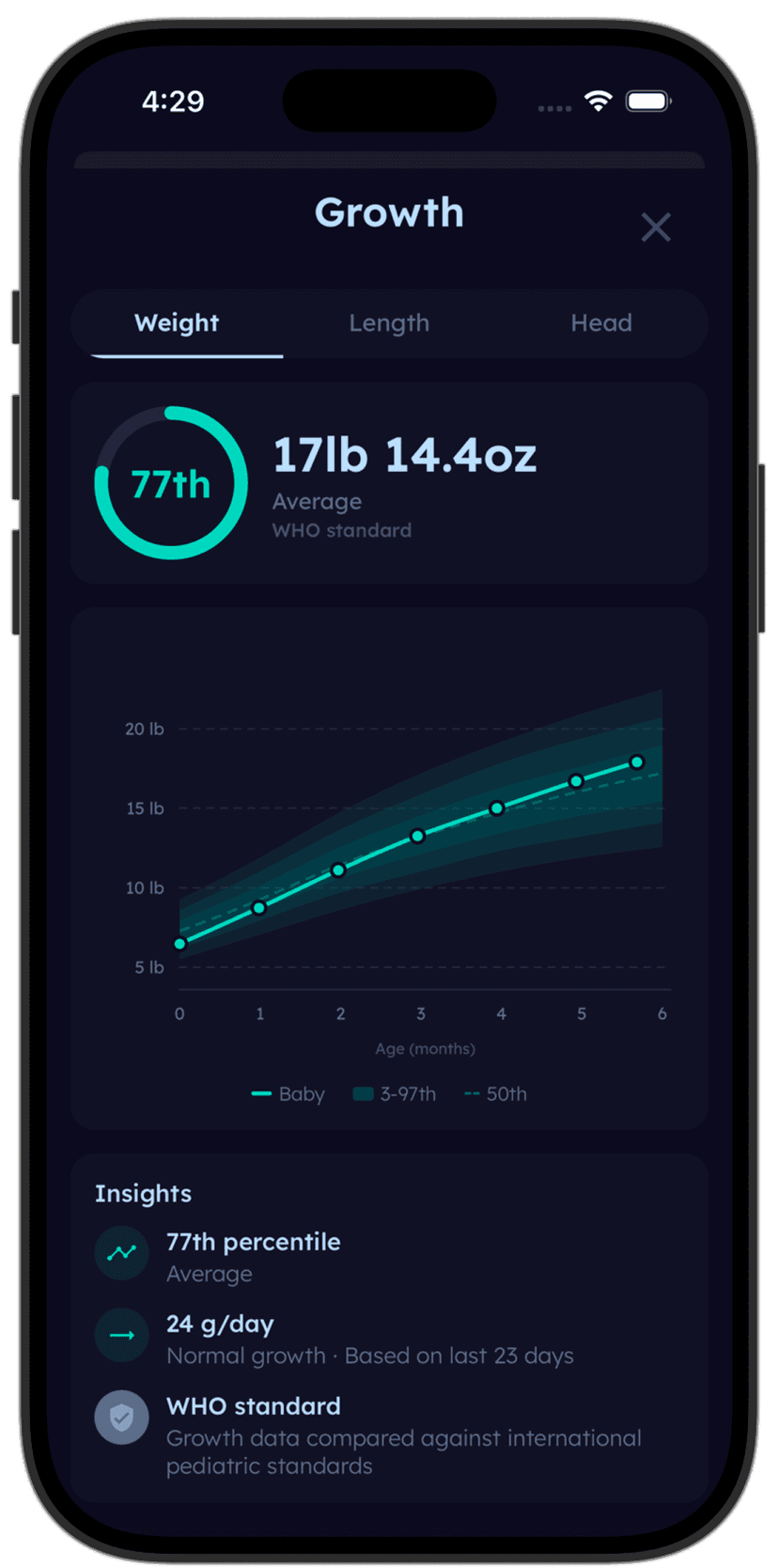
tinylog growth tracking screen showing multiple growth measurements

Weight, length, and head circumference together tell the full story.

tinylog lets you log all three measurements after each well-child visit. Seeing how they relate to each other over time gives you (and your pediatrician) the context that a single number never can.

Download on the App StoreGet It On Google Play

Signs a High Head Circumference Is Just Genetics

  • One or both parents have larger-than-average heads (measure your own!)
  • Head circumference has tracked at a high percentile since birth or the first few months
  • The percentile has been stable — not rapidly accelerating
  • Baby is meeting developmental milestones normally
  • The fontanelle (soft spot) feels flat and normal, not bulging or tense
  • Weight and length may be at different percentiles, but head has always been higher — this is common

If most of these describe your baby, their big head is almost certainly inherited — a normal trait, not a medical concern.

What You Might Not Know

Familial macrocephaly is incredibly common

If you have a big head, your baby probably will too. It's so common that many pediatricians will simply measure a parent's head circumference to confirm the genetic link. If mom or dad also has a large head, the case is essentially closed — it's inherited.

Head and body percentiles don't have to match

It's completely normal for a baby to be at the 90th percentile for head circumference but the 40th for weight. Different body parts grow at different rates and are influenced by different genetic factors. Disproportionate percentiles between head and body are very common and usually meaningless.

The fontanelle is informative

The soft spot (fontanelle) on top of your baby's head is a window into what's happening inside. A flat, slightly pulsating fontanelle that you can press gently is normal. A bulging, tense fontanelle that doesn't indent is something to mention to your doctor right away.

Head circumference is surprisingly hard to measure accurately

Like infant length, head circumference has a margin of error. The tape measure can sit slightly differently each time, the baby moves, and different measurers get slightly different results. One unexpectedly high or low measurement is probably just measurement variability. The trend over multiple visits is much more reliable.

The Key Distinction: Stable High vs. Rapidly Rising

Just like with weight percentiles, the critical difference isn't where your baby's head circumference is — it's whether the pattern is stable or changing.

Stable high — baby has always been at the 90th+ percentile for head circumference, and they're tracking along that curve consistently — is overwhelmingly likely to be genetic. This is the pattern of familial macrocephaly, and it's completely benign.

Rapidly rising — baby was at the 50th percentile for head circumference and has jumped to the 90th in a couple of months — is a different pattern. A head that's growing faster than expected can sometimes indicate increased intracranial pressure, which can have various causes. This is rare, but it's the reason pediatricians track the measurement over time.

The curve shape matters more than the number. A smooth, consistent curve near the top of the chart is reassuring. A curve that's suddenly accelerating upward deserves prompt evaluation.

When to Talk to Your Pediatrician

  • Head circumference has jumped dramatically — crossing two or more percentile lines upward quickly
  • The fontanelle (soft spot) seems bulging, tense, or doesn't pulse normally
  • Baby is showing developmental delays or regression
  • Persistent vomiting (especially forceful or in the morning)
  • Unusual irritability, especially with position changes
  • The head size is dramatically out of proportion to both weight and length
  • Sunset sign — baby's eyes seem to gaze downward with white visible above the iris
  • Veins on the scalp seem more prominent than before

These signs are rare but important. If any apply, contact your pediatrician — they can do a thorough evaluation and determine whether further investigation is needed.

What Happens if Your Doctor Wants to Investigate

If your pediatrician is concerned about head circumference, here's what typically happens:

They'll first check the parental head sizes. If a parent has a large head, that often resolves the question immediately.

If the pattern warrants further evaluation, they might order an ultrasound (which can be done through the fontanelle while it's still open) to look at the brain's structure and check for excess fluid. This is painless and non-invasive.

In rare cases, they might refer to a pediatric neurologist for a more detailed evaluation. But the vast majority of babies with large heads never need this step — because the vast majority of large heads are simply genetic.

For a broader look at how all percentile measurements work, see our complete growth percentiles guide. To plot your baby's measurements yourself, try our free growth chart tool.

The Bottom Line

A high head circumference percentile is, in the overwhelming majority of cases, a genetic trait — big heads run in families. It's called familial macrocephaly, and it's one of the most common "findings" in pediatric growth tracking. It's not a condition. It's just a big head.

What matters is the trend: a head that's been at the 90th+ percentile consistently and is growing smoothly along its curve is a healthy head. A head that's suddenly accelerating beyond its established pattern deserves attention. And head circumference is actually the most important growth measurement in the first year — it's tracking your baby's brain development, which is the most critical thing happening in their tiny body.

Track all three measurements, know your own head size, and trust your pediatrician's assessment. Your baby's big head is probably just their big, beautiful, perfectly healthy head.

Related Guides

Sources

  • World Health Organization (WHO) Child Growth Standards
  • American Academy of Pediatrics (AAP) — Bright Futures: Guidelines for Head Circumference Monitoring
  • Rollins JD, et al. "United States head circumference growth reference charts: birth to 21 years." Journal of Pediatrics, 2010.
  • Tan AP, Schierlitz L. "Macrocephaly: A practical approach." Pediatric Radiology, 2018.
  • Nellhaus G. "Head circumference from birth to eighteen years: practical composite international and interracial graphs." Pediatrics, 1968.

This guide is for informational purposes only and is not a substitute for professional medical advice. If you have concerns about your baby's growth, please consult your pediatrician.

Get this guide in your inbox.
We'll email you this reference so you can check it calmly after your next visit.
Track all three measurements — weight, length, and head circumference.
Download tinylog free — log growth data and see the complete picture.
Download on the App StoreGet It On Google Play