
95th percentile = 1 in 20 babies
About 5 out of every 100 babies are at or above the 95th percentile. That means in a playground with 40 babies, two of them are likely here. It's not as rare as it sounds — it's just the right edge of the bell curve.
GUIDE
Published on ·Updated on
A baby consistently at or above the 95th percentile is almost always there because of genetics, not pathology. Pediatricians watch for rapid upward jumps (e.g., 25th to 95th in a few months), not steady tracking at the high end. Weight plus length plus head circumference together tell the real story.
Seeing a number like '95th percentile' or '97th percentile' on your baby's growth chart can feel alarming. But here's what pediatricians know: babies who consistently track at the very top of the chart are almost always there because of genetics. They're big, they're healthy, and they're exactly where they're supposed to be.
Save measurements over time
“In the first two years of life, it's hard to predict what a child's growth chart will look like. Babies hit many growth spurts. After age 2, we have a better sense of how they are trending in their growth and where they may eventually settle.”
 Dr. Minh-Y Canh, DO, Pediatrician, Cleveland Clinic
The 95th percentile means your baby is bigger than 95% of babies the same age. About 5 out of every 100 babies are at or above this line — so it's not vanishingly rare, even if the number sounds extreme.
At the highest percentiles, genetics are doing most of the work. If you or your partner are on the larger side — tall, big-framed, or just generally bigger people — your baby's high percentile is almost certainly a direct reflection of the genes they inherited. This isn't a problem to solve. It's biology operating exactly as designed.
What matters to your pediatrician is the same thing that matters at any percentile: the trend. A baby who has always been at the 95th percentile and continues to track there is following a consistent, healthy growth curve. The fact that the curve happens to be near the top of the chart is unremarkable — it just means you have a big baby.
There's an important distinction between a baby who has always been at the 95th+ percentile and a baby who has recently arrived there from a much lower position.
Consistent high tracking — your baby was born big and has stayed big, or they climbed to the 95th in the first few months and have tracked there since — is almost always genetic and perfectly fine. This is just who your baby is.
Rapid climbing — your baby was at the 40th percentile at 2 months and is now at the 95th at 6 months — is a bigger shift that your pediatrician will want to understand. It might be catch-up growth (baby was smaller at birth than their genetic potential), a feeding pattern change, or sometimes just a growth spurt. But rapid percentile jumps deserve a look.
The key word is "rapid." A baby who gradually climbs from the 70th to the 90th over 6 months is probably just finding their genetic curve. A baby who jumps from the 30th to the 97th in a couple of months has a more unusual pattern worth investigating.
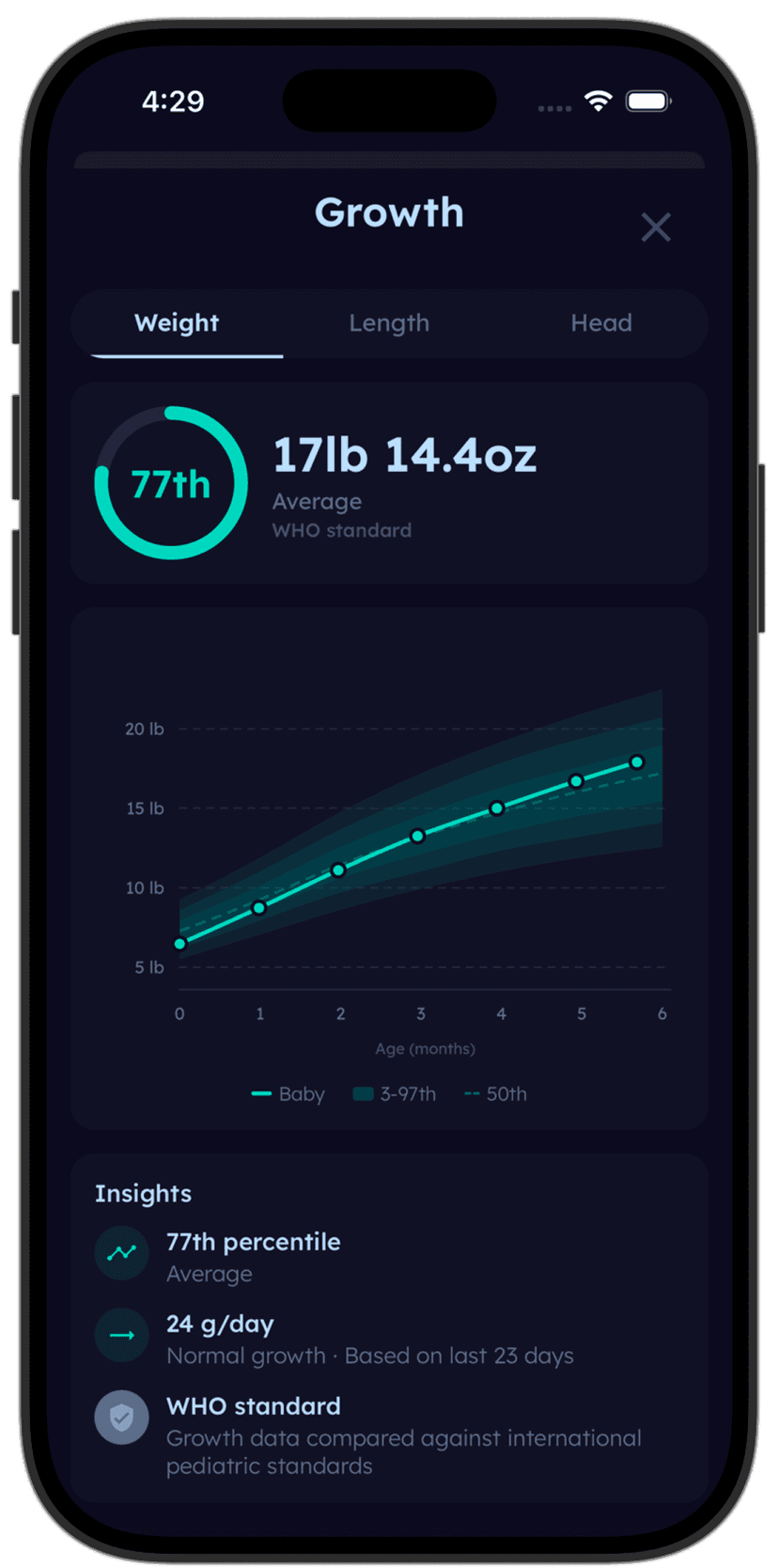
Log your baby's measurements after each checkup with Tinylog and watch the growth curve take shape. Whether it's at the 30th or the 95th, a steady curve is what your pediatrician wants to see.


If most of these describe your baby, their 95th percentile is just their size. Big babies with big parents who've always been big are growing exactly as expected.
About 5 out of every 100 babies are at or above the 95th percentile. That means in a playground with 40 babies, two of them are likely here. It's not as rare as it sounds — it's just the right edge of the bell curve.
At the very high (and very low) ends of the growth chart, genetics play an even bigger role than in the middle. If you or your partner are tall, big-boned, or simply large people, your baby's 95th+ percentile is genetics doing exactly what genetics does.
Some babies who were smaller at birth experience catch-up growth, where they gain weight and length rapidly in the first months to reach their genetic potential. A baby who was born at the 40th percentile but has larger parents might climb to the 90th+ as their genetic programming kicks in.
A baby who is at the 95th percentile for both weight and length is a proportionally large baby — which is the most reassuring pattern. A baby at the 95th for weight but the 40th for length has more disproportionate growth, which your pediatrician may want to monitor more closely.
At the very high percentiles, WHO and CDC growth charts can give somewhat different readings. The WHO charts (used 0-2 years) tend to show higher weight percentiles because they're based on breastfed babies who are leaner. Ask your pediatrician which chart they're using.
One thing your pediatrician looks at closely for babies at very high percentiles is proportionality — how weight relates to length and head circumference.
A baby at the 95th percentile for weight and the 90th for length is a proportionally large baby. This is the most reassuring pattern and is almost always purely genetic.
A baby at the 95th percentile for weight but the 30th for length has more disproportionate growth. This doesn't necessarily mean something is wrong, but it's a pattern your pediatrician may want to track over a few visits. Disproportionate weight gain can sometimes reflect overfeeding (with bottle-feeding specifically) or, rarely, an underlying condition — but genetics and normal variation are still the most common explanations.
Head circumference is also important at the extremes. For more on what head circumference means, see our guide on head circumference percentiles.
If your baby is at the 95th percentile, you've heard it all. "That baby is huge!" "What a chunk!" "Are you sure they're only 5 months old?" "You must have great milk!"
These comments can be amusing, annoying, or genuinely stressful depending on the day and your headspace. Some parents of very big babies report feeling judged, as though they're somehow responsible for their baby's size. You're not. Your baby's size is genetic, and no one's opinion about it matters except your pediatrician's.
When someone comments on your baby's size, the simplest response is also the truest: "Yeah, they're a big, healthy baby!" No further explanation needed.
For the full picture on how all percentiles work, see our complete growth percentiles guide.
Any of these patterns is worth mentioning at your next visit. Your pediatrician can evaluate the full picture and determine whether this is normal variation or something that warrants further investigation.
A baby at the 95th percentile or above is, in the vast majority of cases, a healthy baby who happens to be very big. Their size is driven by genetics, and it falls within the range that growth charts are designed to capture. Being at the top of the chart is not inherently more concerning than being in the middle — what matters is the consistency of the curve.
Don't restrict feeds, don't stress about the number, and don't let anyone make you feel like your baby's size is a problem. Track the trend, trust your pediatrician, and enjoy your big, healthy baby.
Baby Growth Percentiles — What percentiles actually mean
90th Percentile for Weight — Understanding nearby growth ranges
Head Circumference Percentile — When head size percentiles matter
This guide is for informational purposes only and is not a substitute for professional medical advice. If you have concerns about your baby's growth, please consult your pediatrician.