GUIDE

90th Percentile for Baby Weight

The 90th percentile is within the normal range. Big babies are normal babies, and you almost certainly don't need to change anything about how you're feeding.

Maybe your mother-in-law said something. Maybe you've been comparing notes with other parents. Maybe you just saw the number on the growth chart and thought 'that seems high.' Here's what your pediatrician knows: a baby at the 90th percentile for weight is a big, healthy baby. Full stop.

Why the 90th Percentile Is Normal

The 90th percentile for weight means that out of 100 babies the same age, about 90 weigh less and 10 weigh more. Your baby is on the bigger side of the growth chart — and the bigger side of the growth chart is absolutely, unambiguously normal.

Here's the thing: growth charts are designed to show the full range of healthy growth, from the 3rd percentile all the way to the 97th. The 90th percentile is well within this range. It's not "borderline high" or "close to a problem." It's just... big. Some babies are big. Some adults are tall. Neither is a medical issue.

The vast majority of babies at the 90th percentile are there because of genetics. Bigger parents make bigger babies. If you or your partner are on the taller or heavier side, your baby's growth chart is reflecting that — exactly as it should.

The Overfeeding Myth

Let's tackle this directly, because it's the worry that brings most parents to this page: you are almost certainly not overfeeding your baby.

If you're breastfeeding, it's physiologically impossible to overfeed. Your baby controls the latch, the pace, and when they unlatch. They eat until they're done and stop. A breastfed baby at the 90th percentile is eating exactly what their body needs. Their size comes from genetics, not from too much milk.

If you're formula-feeding, overfeeding is theoretically possible because bottle flow is easier to push, but it's also much rarer than people think. As long as you're following your baby's hunger cues (feeding when hungry, stopping when they turn away or slow down), you're doing it right. Paced bottle feeding — holding the bottle more horizontally and pausing to let your baby set the pace — can help ensure they're not taking in more than they want.

The AAP is clear: responsive feeding (feeding based on baby's cues, not on a schedule or target amount) is the gold standard for infant nutrition. A baby at the 90th percentile who is responsively fed is getting exactly what they need.


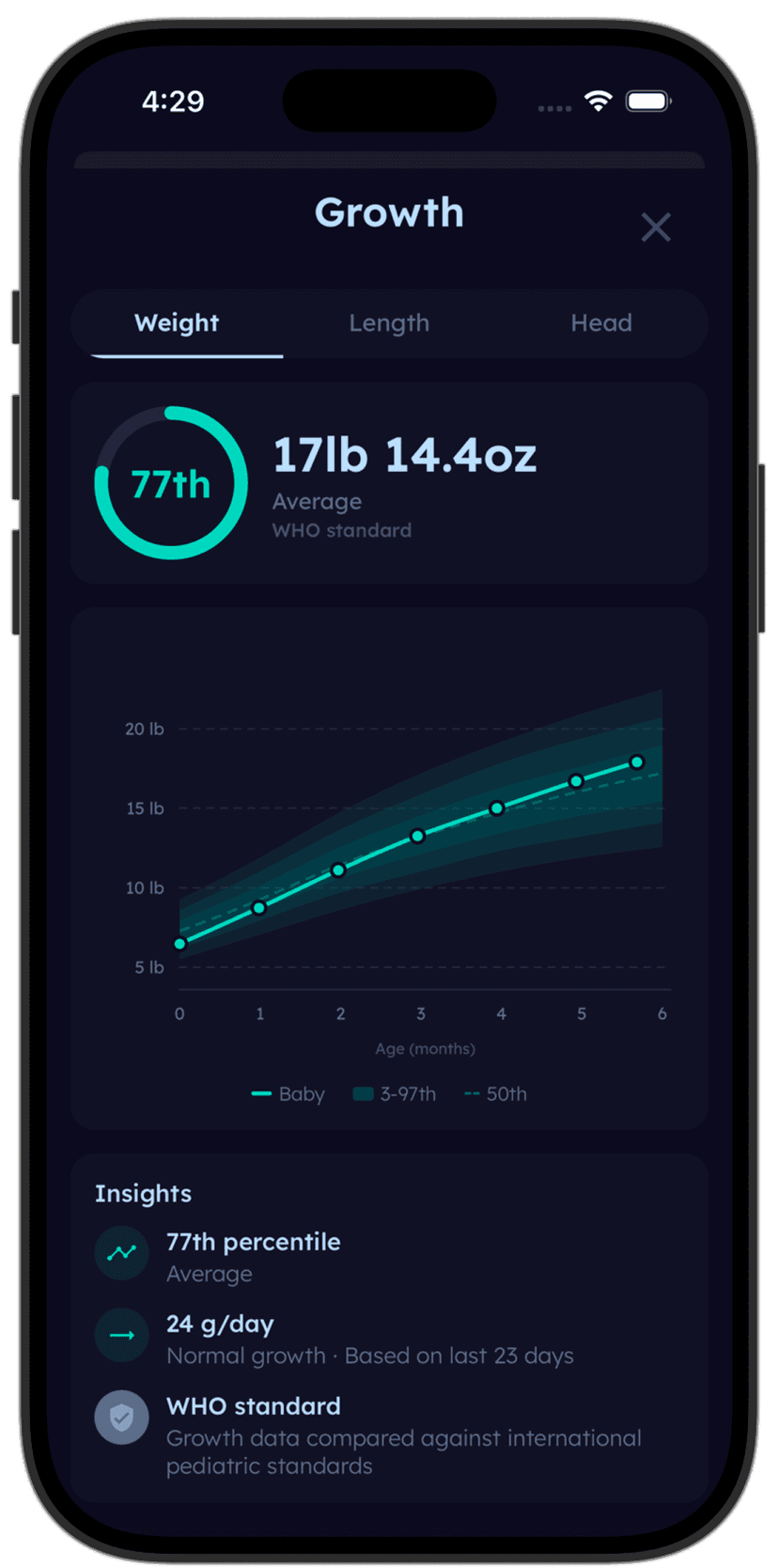
tinylog growth tracking screen showing baby weight plotted over time

Growth trends tell the real story — whether your baby is at the 20th or the 90th.

tinylog lets you log weight, length, and head circumference after each checkup. Over time, you'll see a consistent curve — and that consistent curve is what healthy growth looks like, at any percentile.

Download on the App StoreGet It On Google Play

Big Baby ≠ Overweight Child

One of the most persistent myths in parenting is that big babies become overweight adults. Research doesn't support this.

Studies have consistently shown that infant weight percentile is a poor predictor of childhood or adult weight. Many babies who are at the 90th percentile in their first year lean out dramatically once they become mobile. Crawling, cruising, and walking burn significantly more energy than lying on a blanket — and the chubby cheeks and rolls tend to thin out as activity increases.

Baby fat is biologically different from adult fat. It serves specific purposes: energy reserves for brain development and growth spurts, insulation for temperature regulation, and cushioning for the inevitable falls that come with learning to move. It's supposed to be there, and it's supposed to go away eventually.

If you're worried about the long-term, the best things you can do are practice responsive feeding now and model healthy eating habits as your child grows. The percentile number in infancy has very little bearing on what happens later.

Signs Your Baby's 90th Percentile Is Just Their Size

  • Baby has been tracking near the 90th percentile consistently
  • Weight, length, and head circumference are growing proportionally
  • Baby is fed on demand — not being forced extra feeds
  • Active, alert, and meeting developmental milestones
  • One or both parents are on the bigger side
  • Your pediatrician is not concerned about the growth pattern

If these describe your baby, their size is just their size — healthy, genetic, and nothing to change.

What You Might Not Know

You can't overfeed a breastfed baby

Breastfed babies control the flow and pace of feeding. They eat until they're satisfied and stop. If your breastfed baby is at the 90th percentile, they're eating exactly what they need — not a drop more. Their size is genetic, not a sign of overfeeding.

Infant chubbiness is not childhood obesity

Research consistently shows that infant weight is a poor predictor of childhood or adult weight. Baby fat serves important biological purposes — energy reserves for growth, insulation, and cushioning as they learn to move. Most of it disappears with increased mobility.

Paced bottle feeding can help with formula

If you're bottle-feeding (formula or pumped milk), paced feeding lets your baby control intake better. Hold the bottle more horizontally, pause frequently, and let your baby set the pace. This isn't about restricting — it's about matching the natural rhythm of breastfeeding.

Genetics are doing the heavy lifting

Bigger parents tend to have bigger babies. This is one of the most predictable things in pediatrics. If you or your partner are on the larger side, your baby's 90th percentile is just their DNA expressing itself.

The growth chart goes to 97th and beyond

The 90th percentile might sound dramatic, but the normal range on growth charts extends to the 97th percentile. Your baby is well within the expected range — they're just on the bigger side of it.

Dealing With Comments About Your Baby's Size

If you have a big baby, you've heard it. "Wow, that's a big baby!" "What are you feeding that child?" "Are they really only 4 months old?"

These comments can range from mildly annoying to genuinely distressing, especially if they trigger worry about whether you're doing something wrong. Here's what to remember:

People commenting on your baby's size are not making a medical assessment. They're making conversation — often cluelessly. Your baby's growth chart is between you, your baby, and your pediatrician. Random opinions from relatives and strangers carry zero medical weight.

If you want a response, try: "Yep, they're big and healthy! Our pediatrician is really happy with their growth." Then change the subject. You don't owe anyone an explanation for your baby's size.

For more on what all the percentile ranges mean, see our complete growth percentiles guide.

When to Mention It to Your Pediatrician

  • Your baby has jumped rapidly from a much lower percentile (e.g., 40th to 90th in a few months)
  • Weight percentile is significantly higher than length percentile and the gap is growing
  • There are other medical concerns or symptoms alongside rapid weight gain
  • You're being pressured to change feeding practices and want professional guidance
  • Weight has suddenly accelerated after being stable for months

These patterns are worth a conversation — not because the 90th percentile is inherently concerning, but because changes in growth trajectory deserve a closer look.

The Bottom Line

A baby at the 90th percentile for weight is a big, healthy baby. They're not overfed, they're not heading for childhood obesity, and there's nothing you need to change about how you're feeding them. Their size is primarily genetic, and it falls well within the normal range on any growth chart.

Don't let comments, comparisons, or Google searches convince you otherwise. Track the trend, trust your pediatrician, and enjoy your chunky, healthy baby.

Related Guides

Sources

  • World Health Organization (WHO) Child Growth Standards
  • American Academy of Pediatrics (AAP) — Responsive feeding guidelines
  • Stettler N, et al. "Rapid weight gain during infancy and obesity in young adulthood." Obesity Research, 2005.
  • Dewey KG. "Growth characteristics of breast-fed compared to formula-fed infants." Biology of the Neonate, 1998.
  • Taveras EM, et al. "Weight status in the first 6 months of life and obesity at 3 years of age." Pediatrics, 2009.

This guide is for informational purposes only and is not a substitute for professional medical advice. If you have concerns about your baby's growth, please consult your pediatrician.

Get this guide in your inbox.
We'll send you this reference so you can share it with anyone who comments on your baby's size.
Track the trend — at any percentile.
Download tinylog free — log growth data and see the curve, not just a number.
Download on the App StoreGet It On Google Play