GUIDE

Baby in the 75th Percentile

The 75th percentile means your baby is bigger than 75% of babies their age. That's a normal, healthy size — not a warning sign.

If someone has commented on how 'big' your baby is and it made you wonder whether that's a problem — it's not. The 75th percentile is squarely in the normal range, and a bigger-than-average baby is just that: a baby who happens to be bigger than average.

What the 75th Percentile Actually Means

If your baby is at the 75th percentile for weight, it means that out of 100 babies the same age, about 75 weigh less and 25 weigh more. Your baby is on the bigger side of the middle — and the bigger side of the middle is a perfectly healthy, normal place to be.

The 75th percentile sits comfortably within the normal range on any growth chart. Pediatricians don't consider it "high" or concerning. In fact, the normal range extends all the way to the 97th percentile before anyone starts paying closer attention. Your baby at the 75th is well within the broad middle of healthy growth.

If you're here because someone made a comment about your baby being "big" and it worried you — that comment wasn't medical advice. People love to remark on baby size, but size is not a problem. A bigger-than-average baby is not an overfed baby, an unhealthy baby, or a baby headed for weight problems. They're just a baby who happens to be bigger than most babies their age.

Big Baby Myths vs. Reality
Big babies become overweight children
The RealityInfant chubbiness and childhood obesity are not well correlated. Most big babies lean out significantly with increased mobility.
You're overfeeding if your baby is above the 50th percentile
The RealityYou cannot overfeed a breastfed baby. For formula-fed babies, following hunger cues is the right approach — not restricting based on percentile.
You should try to slow your baby's growth
The RealityNever restrict a baby's food intake to change their percentile. Babies need adequate nutrition for brain development and physical growth.
75th percentile is 'too high'
The RealityThe normal range on growth charts extends from the 3rd to the 97th percentile. The 75th is squarely in the middle-upper range — completely unremarkable.
The cultural anxiety around 'big babies' doesn't match the medical reality. Being at the 75th percentile is unremarkable from a health perspective.

Why Your Baby Might Be at the 75th Percentile

The most common answer is genetics. Bigger parents tend to have bigger babies — it's one of the most straightforward predictions in pediatrics. If you or your partner are on the taller or heavier side, your baby is likely to be too.

Feeding method can also play a role. Formula-fed babies sometimes gain weight slightly faster than breastfed babies after about 4-6 months. This is well-documented and doesn't mean formula-fed babies are "too big" — it's just a normal difference in growth patterns between the two feeding methods.

And sometimes, a baby is just big. Growth charts are bell curves, and by definition, 25% of all babies are at or above the 75th percentile. That's a lot of babies. It's not unusual or remarkable — it's just the right side of the curve. For more on how feeding method affects growth patterns, check out our breastfed vs. formula-fed growth curves guide.

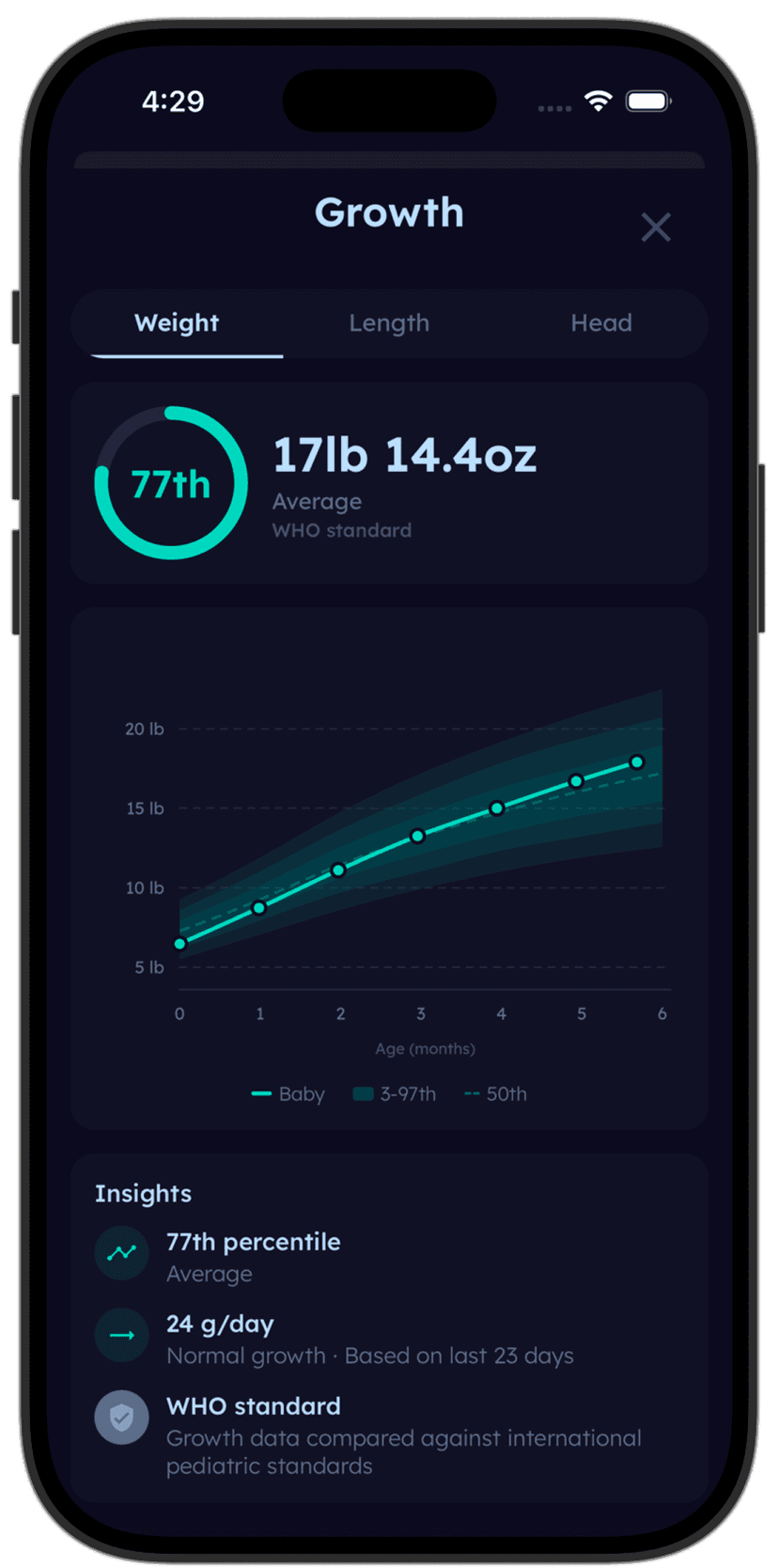
tinylog growth tracking screen showing baby growth measurements

The trend matters more than the number — whether it's the 25th or the 75th.

Log your baby's weight, length, and head circumference after each visit with tinylog. A consistent curve at the 75th percentile tells a clear, healthy story.

Download on the App StoreGet It On Google Play

Signs Your Big Baby Is Perfectly Healthy

  • Consistently tracking near the 75th percentile over multiple visits
  • Weight, length, and head circumference are growing proportionally
  • Baby is feeding on demand — not being force-fed extra
  • Active and meeting developmental milestones
  • Producing plenty of wet and dirty diapers
  • Your pediatrician describes their growth as appropriate

If these describe your baby, their 75th percentile is just their size — nothing more.

Addressing the 'Should I Feed Less?' Question

Let's be direct about this: no. You should not feed your baby less because of their percentile.

If you're breastfeeding, your baby self-regulates their intake. You literally cannot overfeed a breastfed baby — they eat what they need and stop. A breastfed baby at the 75th percentile is eating exactly the right amount for their body.

If you're formula-feeding, follow your baby's hunger cues. Offer the bottle and let them decide when they're done. The AAP recommends responsive feeding — feeding in response to hunger signals — not restricting feeds to hit a percentile target.

Restricting a baby's food intake to try to lower their percentile is not recommended by any pediatric organization. Babies need adequate nutrition for brain development, immune function, and physical growth. A bigger baby who is fed on demand is a well-nourished baby.

If you have specific concerns about your baby's weight gain, talk to your pediatrician. They can help you understand whether the growth pattern is typical or whether something else is going on.


What You Might Not Know

Don't let comments get to you

Relatives, strangers, and even other parents love to comment on big babies. 'That's a big baby!' is not medical advice. Your pediatrician tracks your baby's growth professionally — random comments from people at the grocery store mean nothing.

Never restrict a baby's food

It might be tempting to cut back on feeds to 'control' your baby's weight, but this is harmful. Babies need adequate nutrition for brain development and physical growth. Follow hunger cues and let your baby eat when they're hungry.

Baby fat is not adult fat

Those chunky thighs and chubby cheeks are not a health problem. Baby fat serves important purposes — insulation, energy reserves for growth, and cushioning for falls. Most of it disappears once your baby becomes mobile.

Breastfed big babies are especially fine

If you're breastfeeding and your baby is at the 75th percentile, they're eating exactly what they need. Breastfed babies self-regulate their intake — you truly cannot overfeed them. Their size is just their size.

When to Talk to Your Pediatrician

The 75th percentile is rarely a concern. But here are patterns worth discussing:

If your baby has jumped rapidly from a much lower percentile — say from the 30th to the 75th in a couple of months — that's a change in growth pattern your pediatrician will want to understand. It's probably fine (catch-up growth, growth spurt, etc.), but rapid jumps deserve a look.

If your baby's weight percentile is significantly higher than their length percentile — for example, 90th for weight but 25th for length — that disproportion might be worth monitoring over a few visits.

If you're being pressured by family members to change feeding practices based on your baby's size, your pediatrician can be a helpful ally in confirming that your baby's growth is healthy and that feeding changes aren't needed.

For a comprehensive look at growth percentiles across the entire range, see our complete growth percentiles guide.

The Bottom Line

A baby at the 75th percentile is a healthy, bigger-than-average baby. They're not overfed, they're not headed for weight problems, and they're not growing "too fast." They're growing exactly as their genetics intend.

Don't let comments from well-meaning (or not-so-well-meaning) people make you second-guess your feeding. Don't restrict your baby's intake to try to change a number on a chart. Track the trend, trust your pediatrician, and enjoy your baby — whatever size they happen to be.

Related Guides

Sources

  • World Health Organization (WHO) Child Growth Standards — Multicentre Growth Reference Study (MGRS)
  • Centers for Disease Control and Prevention (CDC) Growth Charts
  • American Academy of Pediatrics (AAP) — Guidelines on responsive feeding and growth monitoring
  • Stettler N, et al. "Rapid weight gain during infancy and obesity in young adulthood." Obesity Research, 2005.
  • Dewey KG. "Growth characteristics of breast-fed compared to formula-fed infants." Biology of the Neonate, 1998.

This guide is for informational purposes only and is not a substitute for professional medical advice. If you have concerns about your baby's growth, please consult your pediatrician.

Get this guide in your inbox.
We'll send you this percentile reference to check after your next well-child visit.
Track growth trends, not just numbers.
Download tinylog free — log your baby's measurements and see the pattern over time.
Download on the App StoreGet It On Google Play