
They're looking at the shape of the curve
Your pediatrician isn't staring at the number — they're looking at whether the curve is rising steadily, flattening, or dropping. A smooth, consistent curve at any percentile is what they want to see.
GUIDE
Published on ·Updated on
The 50th percentile is the statistical middle — not the 'ideal.' Being above or below it doesn't make your baby more or less healthy.
Here's something nobody tells new parents: the 50th percentile is not a goal. It's just the mathematical midpoint of a distribution. A baby at the 50th percentile is not 'better' than one at the 25th — they're just a different size. And if your baby was at the 50th and has shifted, that's usually completely normal.
Save measurements over time
“In the first two years of life, it's hard to predict what a child's growth chart will look like. Babies hit many growth spurts. After age 2, we have a better sense of how they are trending in their growth and where they may eventually settle.”
 Dr. Minh-Y Canh, DO, Pediatrician, Cleveland Clinic
Let's address the elephant in the room: the 50th percentile is not the goal. It's not the "ideal." It's not where your baby "should" be. It's simply the mathematical midpoint of a bell curve — the line where half the babies are bigger and half are smaller.
Somewhere along the way, "50th percentile" became synonymous with "doing great," and anything else became a source of worry. But that's a misunderstanding of how growth charts work. A baby at the 25th percentile is not "25% healthy." A baby at the 75th is not "doing 25% better" than one at the 50th. These are size descriptions, not performance ratings.
Your baby's ideal percentile is whatever percentile they consistently track at. If they've been at the 30th for months, that's their curve, and it's a perfectly healthy one. If they've been at the 70th, same thing. The number only becomes meaningful when the pattern changes — and even then, change is often normal.
| The Myth | The Reality |
|---|---|
| The 50th percentile is the target | It's just the mathematical middle. A baby at the 25th or 75th is equally healthy. |
| Higher percentile = healthier baby | Higher percentile = bigger baby. Size and health are not the same thing. |
| Dropping from the 50th means something is wrong | Gradual shifts in the first year are normal as babies find their genetic growth curve. |
| My baby should stay at the same percentile forever | Some percentile movement is expected, especially in the first 6-18 months. Stability comes later. |
| If both parents are average height, baby should be at the 50th | Growth depends on many genetic factors. Parental size is a guide, not a guarantee. |
One of the most common concerns parents bring to their pediatrician is: "My baby was at the 50th percentile and now they're at the 35th. What happened?"
The short answer: probably nothing. Percentile shifts in the first 6-18 months are extremely common and usually represent your baby's natural transition from their birth size to their genetically determined growth curve.
Here's why. Birth weight is influenced heavily by the uterine environment — things like maternal nutrition, placenta function, and how long the pregnancy lasted. Once your baby is born, genetics start to take over. A baby born to smaller parents might be born at an average size and gradually settle into a smaller percentile as their DNA expresses itself. This process, sometimes called "catch-down growth" or "growth trajectory adjustment," is well-documented and completely normal.
The reverse happens too. A baby born small to larger parents might gradually climb to a higher percentile. This "catch-up growth" is the same process in the opposite direction.
For a more detailed look at what it means when percentiles shift, see our guide on babies who drop percentiles.
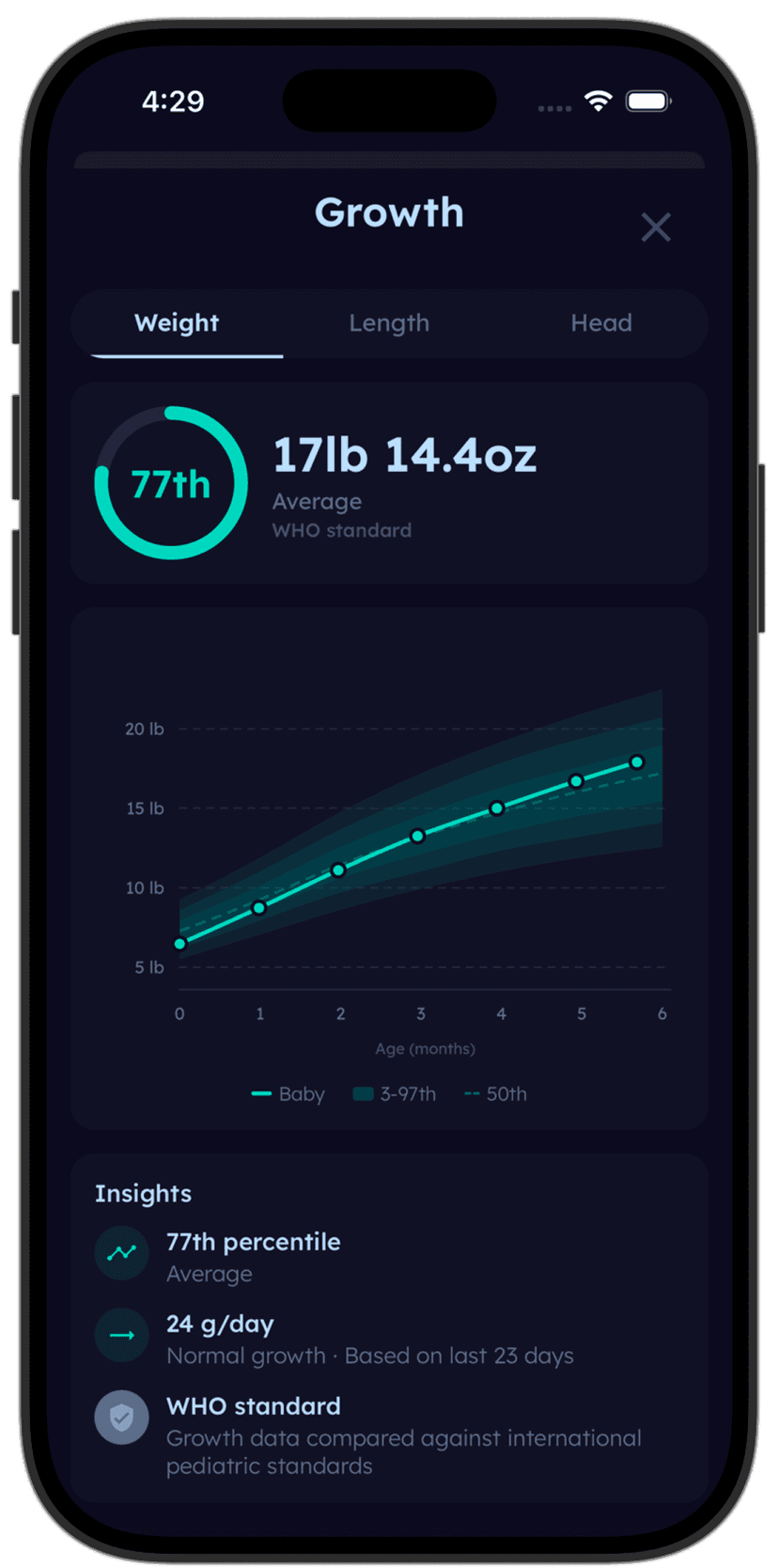
Tinylog lets you log your baby's measurements after each visit and see the trend over time. Whether your baby tracks at the 30th, 50th, or 70th, the curve is what tells the real story.


Most of these are completely normal parts of infant growth. Percentile shifts in the first year are the rule, not the exception.
When your doctor pulls up your baby's growth chart, they're not checking whether the dot lands on the 50th percentile line. Here's what they're actually doing:
Your pediatrician isn't staring at the number — they're looking at whether the curve is rising steadily, flattening, or dropping. A smooth, consistent curve at any percentile is what they want to see.
Weight, length, and head circumference together tell a story. If all three are tracking proportionally — whether at the 30th, 50th, or 70th — that's a healthy, proportional baby.
A good pediatrician considers parental size, birth history, feeding method, and developmental milestones when interpreting the growth chart. The percentile is just one data point in a much larger assessment.
These signs of healthy growth are the same whether your baby is at the 20th or the 80th percentile. The number doesn't determine health — the overall pattern does.
This scenario comes up constantly, and it almost always goes like this:
Parent comes to the 4-month or 6-month visit. Baby was at the 50th percentile for weight at birth or the 2-month visit. Now they're at the 30th or 35th. Parent is worried.
In the vast majority of cases, what happened is simple: the baby is settling into their genetic growth curve. Birth weight was influenced by uterine factors. Now genetics are driving growth, and this baby's genetic blueprint says "smaller side of the middle." The baby is healthy, feeding well, and meeting milestones. They just aren't as big as their birth percentile suggested they would be.
Your pediatrician has seen this pattern thousands of times. If they're not concerned, take that seriously. They know what a healthy growth chart looks like, even when the dots don't fall on the 50th percentile line.
For more context on what percentiles mean across the entire range, see our complete growth percentiles guide.
The 50th percentile (or a shift away from it) is rarely a concern on its own. But here are situations worth discussing:
A rapid drop — your baby falling from the 50th to the 15th or lower in just a few weeks — is a more significant change than a gradual shift. Fast changes in weight can reflect an underlying issue worth investigating.
Weight and length diverging significantly — if weight is dropping but length is stable, or weight is climbing but length has stalled, your pediatrician may want to look more closely.
Other symptoms alongside a shift — if your baby's percentile has changed and they're also feeding poorly, seem lethargic, have fewer wet diapers, or aren't meeting milestones, the combination of factors gives your doctor more to work with.
But a healthy baby who has shifted from the 50th to the 35th percentile while still eating well, growing steadily, and hitting milestones? That's almost certainly just their body finding its natural size.
The 50th percentile is not special. It's not the goal. It's not "ideal." It's simply the mathematical middle of a distribution — and being above or below it says nothing about your baby's health.
What matters is consistency: is your baby following a stable growth curve? Are they feeding well, producing wet diapers, and meeting milestones? If yes, their percentile — whether it's the 25th, the 50th, or the 80th — is just a description of their size. And their size is not a measure of their health, your feeding, or your parenting.
Baby Growth Percentiles — What percentiles actually mean
25th Percentile — Understanding nearby growth ranges
75th Percentile — Above-average growth explained
This guide is for informational purposes only and is not a substitute for professional medical advice. If you have concerns about your baby's growth, please consult your pediatrician.