GUIDE

Baby in the 25th Percentile

The 25th percentile is completely, unambiguously normal. A quarter of all healthy babies are below this line — by definition.

If your baby's percentile came back at the 25th and it feels low to you, here's some quick math: 25% of all babies are at or below this line. That's not unusual. That's not even uncommon. It's just the left side of the middle — and the middle is a very healthy place to be.

Why the 25th Percentile Is Solidly Normal

Let's start with the most important thing: the 25th percentile is not "low." It's not even close to low. It's the lower-middle of the normal range — a perfectly healthy, unremarkable position on a growth chart.

Here's a way to think about it. If you lined up 100 babies the same age by weight, your baby would have 24 babies lighter than them and 75 babies heavier. Your baby is in the first quarter of the group. By definition, a quarter of all healthy, thriving babies are at or below this line. Someone has to be here, and there's nothing wrong with being here.

Growth charts are designed to show the full range of normal — from the 3rd percentile to the 97th. Your pediatrician doesn't consider any percentile within that range to be concerning on its own. What they care about is the pattern: is your baby following their own curve consistently? If yes, the number itself is just a description, not a diagnosis.

What Different 25th Percentile Scenarios Mean
Baby has always been around the 25th percentile
What It Likely MeansThis is their growth curve. They're on the smaller side of the middle and that's perfectly healthy.
What to DoNothing needed — keep doing what you're doing
Baby was higher (40th-50th) and gradually settled at the 25th
What It Likely MeansVery common in the first 6-18 months as babies find their genetic growth trajectory
What to DoMention it at your next well-child visit, but this is usually normal adjustment
Baby dropped from 75th+ to 25th in a few months
What It Likely MeansA bigger shift that's worth discussing with your pediatrician
What to DoSchedule a check-in to review the growth pattern and feeding
Baby has been bouncing between 20th and 30th
What It Likely MeansNormal fluctuation — measurements have some natural variation each visit
What to DoNothing to worry about — this is typical measurement variability
The takeaway: context matters more than the number. How your baby got to the 25th percentile and how long they've been there tells a much more complete story than the percentile alone.

The 50th Percentile Isn't the Goal

One of the biggest misconceptions about growth charts is that the 50th percentile is the "target" and anything below it is a problem. This isn't how percentiles work.

The 50th percentile is just the mathematical middle. It's not "ideal" or "optimal." A baby at the 25th percentile is not underperforming compared to a baby at the 50th — they're just a different size. Both are normal. Both can be perfectly healthy.

Think about adult height again. An adult who is 5'5" is shorter than average but not unhealthy. An adult who is 6'1" is taller than average but not healthier. The same logic applies to your baby. There's an enormous range of normal, and the 25th percentile is comfortably inside it.

If your baby started at the 50th and has gradually moved to the 25th, that might feel like "falling behind." But in many cases, it's simply your baby settling into their genetically determined growth curve — a completely normal process that happens in the first 6-18 months of life. For more on this, see our guide on babies who drop percentiles.

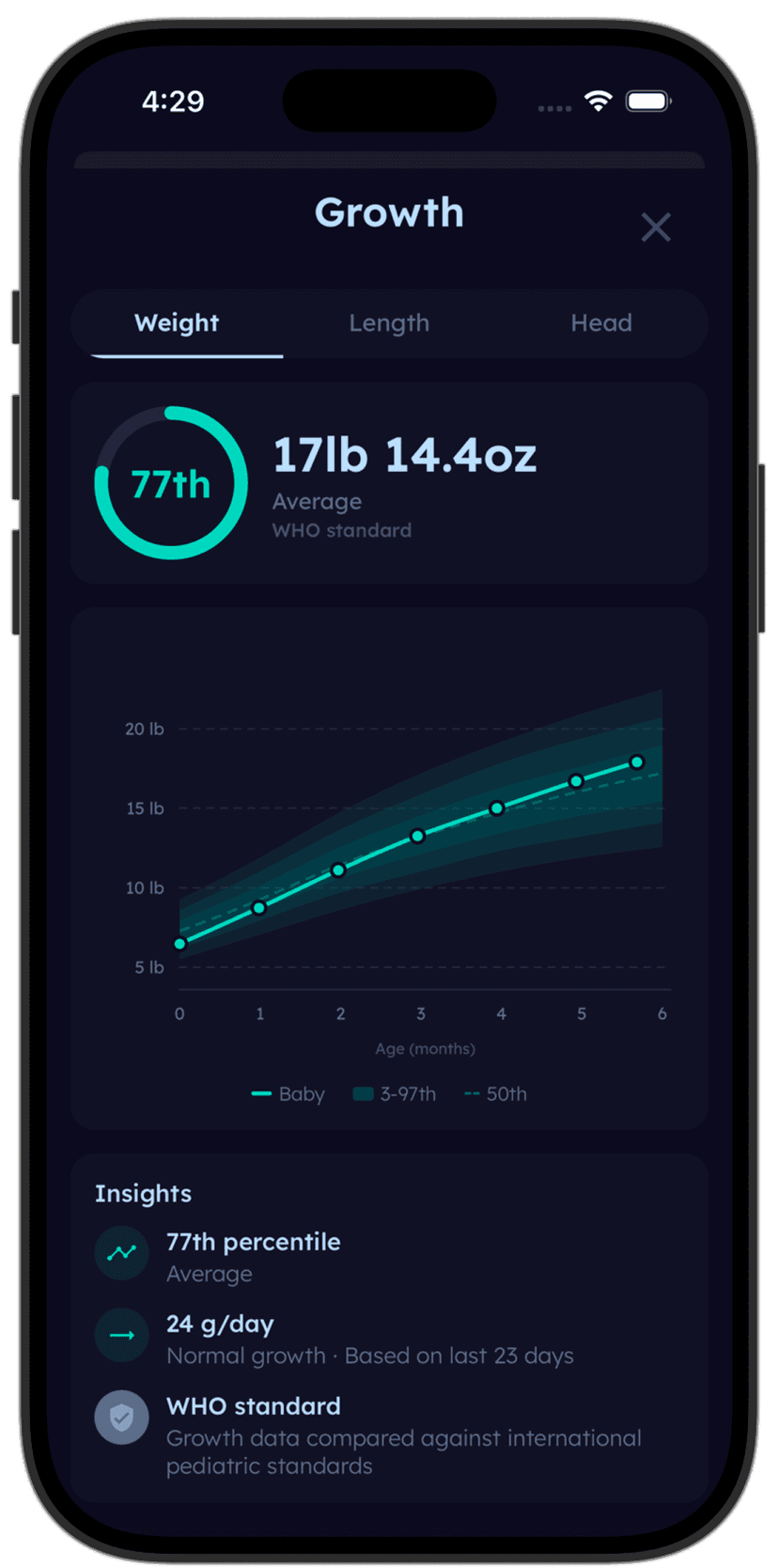
tinylog growth chart showing a consistent growth curve

Watching the curve over time is more valuable than any single number.

tinylog makes it easy to log your baby's measurements after each well-child visit. Over time, you'll see their growth curve emerge — and a steady curve at the 25th percentile is exactly what healthy growth looks like.

Download on the App StoreGet It On Google Play

Signs Your Baby Is Growing Exactly as They Should

  • Your baby has tracked near the 25th percentile for multiple consecutive visits
  • Weight, length, and head circumference are all growing proportionally
  • Your baby is producing 6+ wet diapers per day
  • They're meeting developmental milestones within expected windows
  • They seem satisfied after feeds and have good energy during wake times
  • Your pediatrician describes their growth as 'on track' or 'following their curve'

If most of these describe your baby, take a breath. The 25th percentile is just their size — it's not a problem to solve.

What You Might Not Know

25th percentile means 1 in 4 — that's a lot of babies

It can help to think about it in concrete terms. If there are 20 babies in your mommy-and-me class, about 5 of them are at or below the 25th percentile. It's not rare or unusual — it's just the smaller side of the middle.

The growth curve concept is key

Your baby's growth chart is like a road they're traveling on. The 25th percentile isn't a worse road than the 50th — it's just a different lane. What matters is whether your baby stays on their road consistently, not which lane they're in.

Don't compare your baby to other babies

This is harder than it sounds, especially when your friend's baby is at the 80th percentile and yours is at the 25th. But percentile comparisons between babies are meaningless. Every baby has their own genetic blueprint. The only comparison that matters is your baby to their own previous measurements.

Percentiles shift in the first year — that's expected

Birth weight is influenced by the uterine environment (maternal health, placenta function, gestational length) as much as genetics. In the first 6-18 months, many babies transition from their birth-influenced percentile to their genetically determined one. A baby born at the 50th who settles at the 25th is finding their natural lane.

When to Bring It Up With Your Pediatrician

The 25th percentile on its own is not a reason for concern. But context matters. Here are situations where it's worth mentioning:

If your baby has dropped significantly — say from the 60th to the 25th in a couple of months — that's a change in pattern that your pediatrician will want to understand. Gradual shifts over many months are often normal; rapid drops over weeks are worth checking.

If your baby's weight and length are diverging — for example, weight at the 25th but length at the 60th, or vice versa — that gap can sometimes be informative. It's not always a problem, but it's something your pediatrician may want to monitor.

If your baby is showing other signs alongside low growth — fewer wet diapers, feeding difficulties, missed milestones, low energy — those combined with a lower percentile create a fuller picture that your doctor should see.

But if your baby is simply at the 25th percentile and otherwise thriving? That's just their size. For a complete reference on what different percentiles mean, check out our growth percentiles guide.

The Bottom Line

The 25th percentile is a perfectly normal, healthy position on a growth chart. One in four babies is at or below this line — that's not unusual, it's just math. Your baby isn't behind, struggling, or underfed. They're growing on their own curve, at their own pace, and that's exactly what they're supposed to do.

Track the trend over time, follow your baby's hunger cues, and trust your pediatrician's assessment of the big picture. The 25th percentile isn't a problem to fix — it's simply where your baby is on the map.

Related Guides

Sources

  • World Health Organization (WHO) Child Growth Standards — Multicentre Growth Reference Study (MGRS)
  • Centers for Disease Control and Prevention (CDC) Growth Charts
  • American Academy of Pediatrics (AAP) — Bright Futures: Guidelines for Health Supervision
  • Mei Z, et al. "Shifts in percentiles of growth during early childhood." Pediatrics, 2004.

This guide is for informational purposes only and is not a substitute for professional medical advice. If you have concerns about your baby's growth, please consult your pediatrician.

Get this guide in your inbox.
We'll email you this reference so you have it handy after your next pediatrician visit.
Track the curve, not just the number.
Download tinylog free — log growth data and see how your baby's trend looks over time.
Download on the App StoreGet It On Google Play