GUIDE

Baby Weight Gain Slowed Down

Weight gain naturally slows after 4-6 months — this is one of the most normal things in pediatrics. Babies gain weight fastest in the first 3-4 months, then the rate decreases as activity increases.

If you've noticed that your baby isn't gaining weight as fast as they used to, you're probably seeing one of the most predictable patterns in infant growth. Weight gain slows down in the second half of the first year for almost every baby. Here's why it happens and when it actually warrants a conversation with your pediatrician.

Why Weight Gain Slows (And Why It's Supposed To)

Here's the most reassuring thing about slowed weight gain: it's supposed to happen. The rate of weight gain in infancy follows a predictable curve that peaks in the first 3-4 months and gradually decreases throughout the first year and beyond.

In the first 3 months, your baby was gaining 5-7 ounces per week — a rapid pace fueled by frequent feeding and minimal energy expenditure (lying around is not a calorie burner). By 6-9 months, that rate drops to 2-4 ounces per week. By the second year, it's just a few ounces per month.

This deceleration is built into the growth chart. The percentile curves on your baby's chart already account for this slowdown. If your baby is following their curve — even as the absolute weight gain per week decreases — they're growing exactly as expected.

The most common time for parents to notice (and worry about) slowed weight gain is around 4-6 months. This is when the transition from rapid newborn growth to more moderate infant growth is most visible. It also often coincides with increased activity, which magnifies the effect.

Expected Weight Gain by Age
0-3 months
Typical Weekly Gain5-7 oz (150-200g) per week
What's HappeningFastest weight gain period. Baby may double birth weight by 4-5 months.
3-6 months
Typical Weekly Gain3-5 oz (100-150g) per week
What's HappeningWeight gain naturally slows. This is the phase that worries parents most.
6-9 months
Typical Weekly Gain2-4 oz (60-120g) per week
What's HappeningActivity increases (rolling, sitting, crawling). Solids being introduced.
9-12 months
Typical Weekly Gain1.5-3 oz (45-90g) per week
What's HappeningSignificant slowing. Baby may triple birth weight by 12 months.
12-24 months
Typical Weekly Gain3-5 oz (80-150g) per MONTH
What's HappeningGrowth rate drops dramatically. Toddler appetite is unpredictable. This is all normal.
These are averages from WHO growth standards. Your baby may gain more or less in any given week. The overall trend is what matters — not any single week's gain.

Common Reasons Weight Gain Slows

  • Natural growth deceleration — weight gain rate is supposed to slow after 3-4 months
  • Increased activity — rolling, crawling, cruising, and walking burn significantly more calories
  • Settling into genetic curve — baby may be adjusting from birth percentile to genetic percentile
  • Breastfed growth pattern — breastfed babies gain more slowly after 4-6 months compared to formula-fed babies
  • Starting solids — temporary calorie adjustment as baby learns to eat new foods
  • Post-illness recovery — weight gain often slows during and briefly after an illness
  • Growth spurt ending — the intense gain during a spurt may be followed by a plateau

Almost all of these are normal parts of infant development. If your baby's slow weight gain coincides with one of these explanations, it's very likely nothing to worry about.

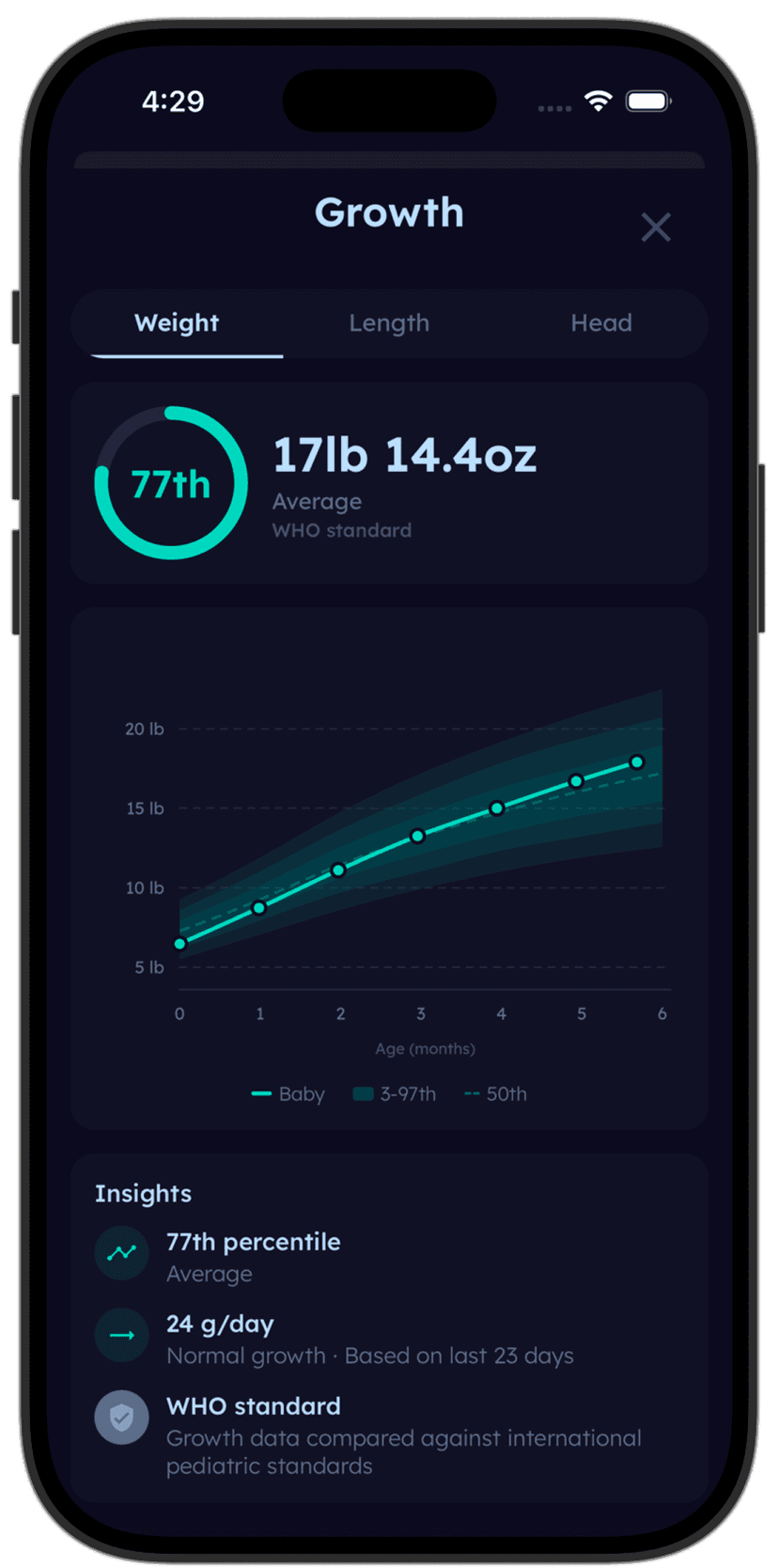
tinylog growth chart showing normal weight gain deceleration

Slowing weight gain looks worrying as a number. On a growth curve, it usually looks perfectly normal.

tinylog plots your baby's weight on WHO growth charts. A curve that's climbing steadily — even if the weekly gain is smaller — tells a clear, healthy story. Log after each checkup and let the trend reassure you.

Download on the App StoreGet It On Google Play

What You Might Not Know

The math of weight gain changes dramatically

A newborn who gains 6 oz/week is adding about 10% of their body weight each week. A 6-month-old who gains 3 oz/week is adding about 2% of their body weight. The absolute number drops, but the proportional gain is still appropriate. Your baby isn't gaining 'less' — they're gaining at the right rate for their size.

Activity is a calorie sink

Once your baby starts rolling, sitting, crawling, and especially cruising or walking, they're burning far more calories than they did while lying on a mat. Some of the 'slowed' weight gain is simply energy being redirected from fat storage to movement. This is healthy and expected.

Growth happens in bursts, not steady lines

Research shows that babies grow in spurts and plateaus — sometimes gaining rapidly for days, then seemingly stalling for a week or two before the next burst. A few slow weeks between spurts is completely normal and doesn't mean growth has stopped.

The second year is dramatically slower

After age 1, weight gain drops to just 3-5 ounces per month. Toddlers may barely gain any weight some months. This is normal. Combined with picky toddler eating, it can look alarming — but growth rate at this age is supposed to be slow.

Slow Gain vs. No Gain vs. Weight Loss

There's an important distinction between these three patterns:

Slower weight gain — baby is still gaining, just at a reduced rate. This is normal after 3-4 months and is the situation most parents are dealing with.

Weight plateau — baby hasn't gained any weight for 2-3 weeks. This can be normal (between growth spurts) or worth monitoring (if it persists beyond 3 weeks). A brief plateau is common; a prolonged one deserves a check-in.

Weight loss — baby has actually lost weight. Outside the normal newborn weight loss in the first few days, weight loss is always worth discussing with your pediatrician. It doesn't necessarily mean something is seriously wrong (illness, for example, can cause temporary weight loss), but it needs evaluation.

If you're not sure which category your baby falls into, look at the trend over 2-4 weeks, not day to day. Weekly weighing gives a much clearer picture than daily fluctuations.


When to Talk to Your Pediatrician

  • No weight gain at all for 3+ weeks (not just slower gain, but zero gain)
  • Weight has crossed two or more major percentile lines downward
  • Baby seems lethargic, disinterested in feeding, or not meeting milestones
  • Fewer than 4 wet diapers in 24 hours
  • Baby is losing weight (not just gaining slowly)
  • Feeding difficulties — refusing feeds, vomiting frequently, seeming in pain while eating
  • Weight is dropping but length continues to increase (baby is getting thinner)

These patterns warrant a conversation with your doctor. They don't necessarily mean something is wrong, but they deserve professional evaluation.

What Your Pediatrician Considers

When you bring up slow weight gain, your pediatrician looks at the big picture:

The growth curve shape — is your baby's curve still climbing (just more slowly), flattening, or declining? Slow climbing is usually normal. Flattening or declining warrants investigation.

Growth velocity vs. age norms — they compare your baby's rate of gain against what's expected for their age. Gaining 3 oz/week at 5 months is perfectly normal, even though it would have been concerning at 5 weeks.

The complete picture — feeding, activity level, milestones, diaper output, energy, and how your baby looks and acts. A baby whose weight gain has slowed but who is otherwise thriving is in a very different situation than one who is also feeding poorly and lethargic.

For more on understanding growth patterns, see our growth percentiles guide and our guide on what it means when babies drop percentiles.

The Bottom Line

Weight gain is supposed to slow down after the first few months. It's one of the most predictable patterns in pediatrics, and it's built right into the growth charts your doctor uses. A baby who was gaining 6 ounces per week and is now gaining 3 ounces per week is not "falling behind" — they're growing at exactly the right rate for their age.

Focus on the trend, not the weekly number. A growth curve that's climbing steadily — even at a slower rate — is what healthy growth looks like in the second half of the first year. If you're concerned, bring your data to your pediatrician and let them put it in context. But in the vast majority of cases, slowed weight gain is the most normal thing in the world.

Related Guides

Sources

  • World Health Organization (WHO) Child Growth Standards — Weight velocity references
  • American Academy of Pediatrics (AAP) — Bright Futures: Growth monitoring guidelines
  • Dewey KG, et al. "Growth of breast-fed and formula-fed infants from 0 to 18 months: the DARLING Study." Pediatrics, 1992.
  • Lampl M, et al. "Saltation and stasis: a model of human growth." Science, 1992.

This guide is for informational purposes only and is not a substitute for professional medical advice. If you have concerns about your baby's growth, please consult your pediatrician.

Get this guide in your inbox.
We'll email you this reference so you can check it the next time weight gain feels slow.
See the growth trend over time — slowing and spurting are both normal.
Download tinylog free — track weight and watch the curve take shape.
Download on the App StoreGet It On Google Play