GUIDE

Tracking Baby Growth at Home

Home growth tracking can be reassuring and useful — if you do it right and don't do it too often. Weigh no more than once a week, and always compare to the trend, not a single number.

You can buy an infant scale for less than a dinner out. The question isn't whether you can track growth at home — it's whether you should. For some families it's genuinely helpful. For others it becomes a source of obsessive worry. Here's how to tell the difference.

The Honest Answer: It Depends

Should you track your baby's growth at home? The honest answer is: it depends on you, your baby, and your relationship with data.

For some parents, home growth tracking is genuinely helpful. It provides data between pediatrician visits, catches trends earlier, and gives you something concrete to bring to appointments. If your baby has feeding challenges, was premature, or your doctor is monitoring growth — home tracking can be a real tool.

For other parents, home tracking becomes a source of anxiety. The scale becomes an obsession. Daily weighing leads to panic over normal fluctuations. Every dip sends you spiraling. If this is you, the scale is doing more harm than good.

The key question to ask yourself: Is the data making me feel more informed or more anxious? If it's the former, keep going. If it's the latter, step back.


Pros and Cons of Home Growth Tracking
Pro
The PointPeace of mind between visits
DetailsIf you worry about growth between well-child visits (every 2-3 months), having data points in between can be reassuring.
Pro
The PointData for your pediatrician
DetailsHome measurements give your doctor more data points to work with, which is especially useful if there are growth concerns.
Pro
The PointCatching trends early
DetailsIf growth is slowing, having weekly data means you'll notice sooner than waiting months between checkups.
Pro
The PointUseful for medical situations
DetailsIf your baby has feeding challenges, was premature, or your doctor is monitoring growth closely, home tracking is genuinely helpful.
Con
The PointAnxiety amplification
DetailsFor some parents, having a scale at home leads to daily weighing, obsessive checking, and anxiety over normal fluctuations.
Con
The PointMeasurement error
DetailsHome measurements — especially length — are less accurate than clinical ones. Slight differences in technique can produce misleading results.
Con
The PointOverreacting to normal variation
DetailsBaby weight fluctuates daily due to feeds, diapers, and hydration. A 'bad' day on the scale doesn't mean anything — but it's hard not to react.
Con
The PointFalse reassurance or false alarm
DetailsAn inaccurate measurement might make things look fine when they're not, or look concerning when they are fine. Clinical measurements are more reliable.
The same tool can be helpful or harmful depending on your situation. There's no universal right answer.

How to Measure Correctly

If you decide to track at home, accuracy matters. Here's how to do each measurement well:

Weight: Use an infant scale

A dedicated infant scale ($40-80) measures in ounces or grams, which is the precision you need. Weigh baby naked or in just a diaper, at the same time of day, on the same scale. Don't use an adult bathroom scale — they're not precise enough for small changes.

Length: Accept some imprecision

Lay baby on a flat, firm surface. Gently extend their legs (they won't cooperate). Mark the top of the head and the heel, then measure between the marks with a tape measure. Expect +/- 1cm variability. Even in clinics, length is the least reliable measurement.

Head circumference: Use a flexible tape measure

Wrap a soft measuring tape around the widest part of the head — just above the ears and eyebrows, around the most prominent part of the back of the head. Measure 2-3 times and use the largest number. This is actually one of the easier measurements to do at home.

Timing: Same time, same conditions

For the most consistent results, measure at the same time of day, with baby in the same state (before or after a feed — pick one and stick with it). Morning before the first feed is ideal for weight.

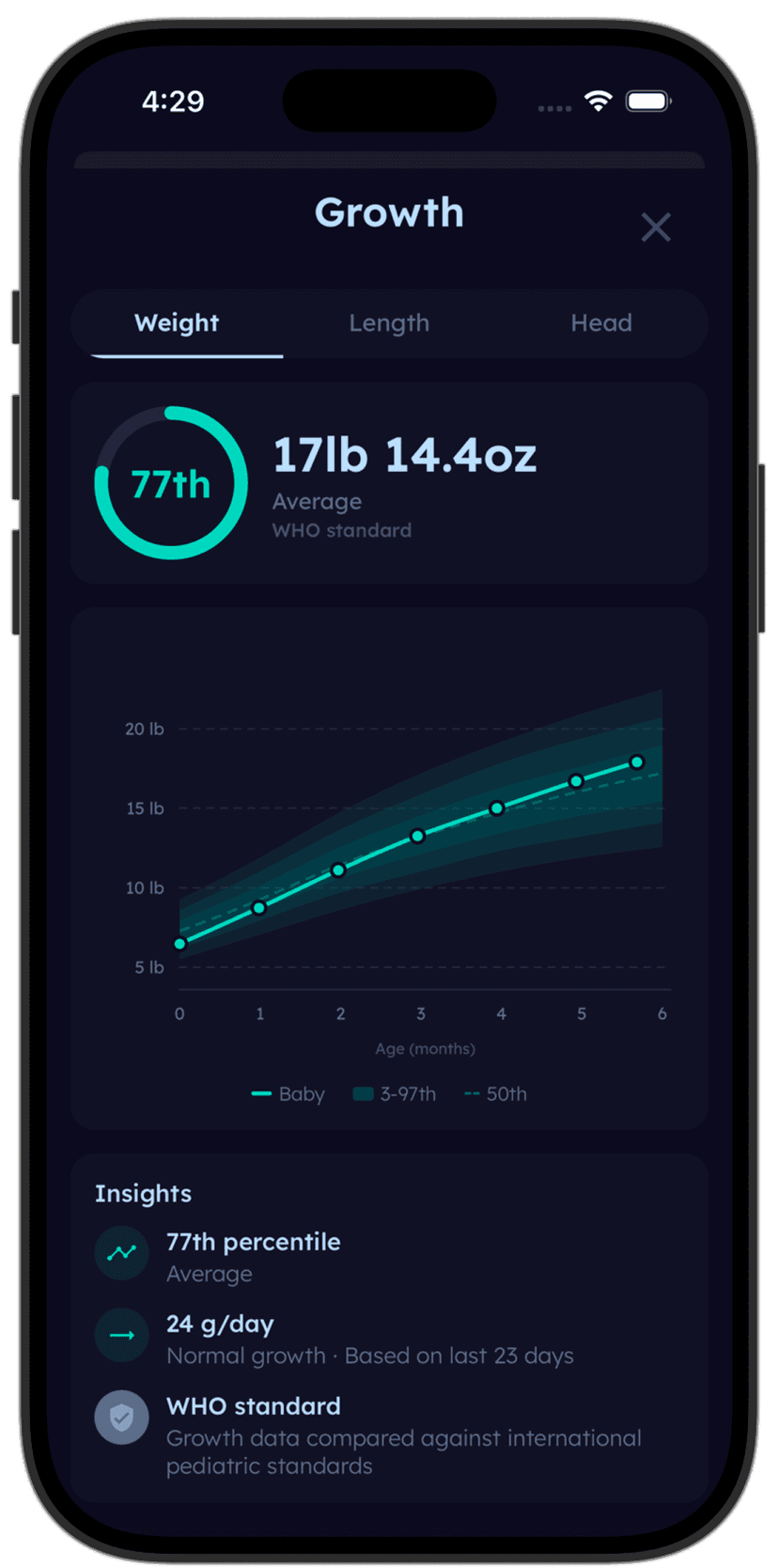
tinylog growth chart showing measurements plotted over time

The numbers only matter if you can see the trend.

tinylog plots your home measurements on WHO growth charts so you can see the curve, not just isolated numbers. Log weight, length, and head circumference, and watch the trend emerge — that's what your pediatrician is looking at too.

Download on the App StoreGet It On Google Play

How Often to Measure

  • Weight: No more than once per week. Weekly gives you trend data without daily noise.
  • Length: Once per month is sufficient. Length changes slowly and is hard to measure accurately.
  • Head circumference: Once per month, or just at well-child visits. Changes slowly.
  • Don't weigh daily — normal fluid fluctuations can cause alarming-looking changes that mean nothing.
  • The exception: if your pediatrician asks you to weigh more frequently for a specific medical reason, follow their guidance.

Less is more with home measuring. Weekly weight is the sweet spot — enough data to see trends, not enough to create anxiety over daily noise.

When Home Tracking Genuinely Helps

There are specific situations where home growth tracking is clearly beneficial:

If your baby was premature and you're monitoring catch-up growth between NICU follow-ups, having regular weight data is valuable. Plot on Fenton charts until your baby reaches term-equivalent age.

If your pediatrician has flagged a growth concern and asked you to monitor between visits, home weighing gives them the data points they need. This is medical monitoring, not optional tracking.

If your baby has feeding challenges — tongue tie, reflux, milk allergy — tracking weight helps you see whether interventions are working. Data is more useful than guessing.

If you're breastfeeding and worried about supply, weekly weights can confirm that your baby is gaining appropriately — which is far more reassuring than trying to guess intake from feeding behavior alone.

For more on understanding your baby's growth data, see our growth percentiles guide or try our free growth chart plotter.

When Home Tracking Hurts

Be honest with yourself about these warning signs:

You're weighing daily and reacting to every fluctuation. Daily weight changes in babies are mostly water and the timing of the last feed/diaper. They mean nothing. If you can't resist daily weighing, the scale should go.

You feel worse after measuring than before. If stepping on the scale creates a wave of anxiety every time, the data isn't helping you — it's feeding your worry.

You're changing feeding behavior based on home measurements. If a single "low" weight makes you push extra feeds, you've crossed from tracking into intervention — and that should be guided by your pediatrician, not a home scale.

You're comparing to other babies. If home tracking leads you to compare your baby's numbers to your friend's baby, it's doing the opposite of what it should. The only comparison that matters is your baby to their own previous measurements.

The Bottom Line

Home growth tracking is a tool — and like any tool, it can be used well or poorly. Done right (weekly, consistent technique, looking at trends not single points), it provides useful data. Done poorly (daily, obsessive, anxiety-driven), it creates problems.

If you track at home, plot the data on a proper growth chart so you see the curve, not just numbers. Share the data with your pediatrician. And if the data is making you more anxious rather than more informed, give yourself permission to stop. Your pediatrician monitors growth at every visit — you don't have to duplicate their work.

Related Guides

Sources

  • American Academy of Pediatrics (AAP) — Bright Futures well-child visit guidelines
  • WHO — Growth monitoring and promotion: Technical guidelines
  • Rifas-Shiman SL, et al. "Changes in length/height measurements in early childhood." Pediatrics, 2005.

This guide is for informational purposes only and is not a substitute for professional medical advice. If you have concerns about your baby's growth, please consult your pediatrician.

Get this guide in your inbox.
We'll send you measurement tips and a tracking schedule so you can do this right.
Log measurements and see the curve — not just isolated numbers.
Download tinylog free — plot growth on WHO charts and track the trend.
Download on the App StoreGet It On Google Play