
GUIDE
Lovevery The Play Gym vs. Baby Einstein 4-in-1 Kickin' Tunes
Published on
Lovevery is a premium, Montessori-inspired gym with organic materials and a curated sensory experience. Baby Einstein is a budget-friendly multitasker with music, lights, and four play modes that lasts up to age 3. Your pick depends on your philosophy, budget, and how long you want it to last.
Activity gyms are one of the first big purchases parents make — and one of the few toys that actually buys you 15 minutes of hands-free coffee drinking. These two sit at opposite ends of the market: Lovevery is the minimalist, research-backed splurge, and Baby Einstein is the cheerful, music-filled workhorse. Both are genuinely good. Here's how to decide.
Log developmental milestones and tummy time
Two Gyms, Two Completely Different Vibes
OK so here's the deal. Lovevery The Play Gym and the Baby Einstein 4-in-1 Kickin' Tunes are both activity gyms, but they have about as much in common as a library and a dance club. Both are places your baby can hang out and grow. The experience is just wildly different.
Lovevery is the one your friend with the perfectly organized nursery owns. Organic cotton. Sustainably sourced wood arches. Five developmental zones designed by child development researchers. A play guide that tells you exactly which activities to try at 2 months vs. 6 months. It's calm, intentional, and extremely well-made. It also costs $140.
Baby Einstein is the one that makes your baby lose their entire mind with joy. A kick piano with 70+ sounds. Lights. Music. Four different configurations that carry your kid from newborn to age 3. It costs about $45 and it runs on AA batteries and pure chaos energy.
Both are legit. Both support development. The question is which kind of play environment you want for your baby — and honestly, for your own sanity.
| Feature | Lovevery The Play Gym | Baby Einstein Kickin' Tunes | What It Means |
|---|---|---|---|
| Price | ~$140 | ~$45 | Baby Einstein is roughly one-third the cost. That's a real difference. |
| Age range | 0–12 months | 0–36 months | Baby Einstein grows with your kid through toddlerhood. Lovevery focuses on the first year. |
| Play modes | 5 developmental zones on one mat | 4 modes: lay & play, tummy time, sit & play, take-along | Baby Einstein physically reconfigures. Lovevery stays flat but offers different sensory zones. |
| Materials | Organic cotton, sustainably sourced wood, BPA-free plastic | Polyester fabric, BPA-free plastic | Lovevery wins on material quality. If organic and sustainable matter to you, it's not close. |
| Music & sounds | None — intentionally low-stimulation | 70+ sounds, songs, and melodies with kick piano | Totally different philosophy. Lovevery is quiet discovery. Baby Einstein is a party. |
| Developmental approach | Montessori-inspired, research-backed zones for focused exploration | Cause-and-effect learning through music, lights, and interaction | Both support development — just through different lenses. |
| Included guide | Stage-based play guide with specific activities by age | No parent guide included | Lovevery's play guide is genuinely useful, especially for first-time parents. |
| Portability | Mat folds; not super portable | Take-along mode with detachable piano | Baby Einstein's detachable piano goes anywhere. Lovevery stays home. |
| Language features | None | Multilingual mode (English, Spanish, French) | Baby Einstein adds early language exposure as a bonus. |
| Batteries required | No | Yes (3 AA batteries) | Lovevery never runs out of batteries. One less thing to remember. |
| Aesthetic | Minimalist, neutral tones, Instagram-friendly | Bright colors, playful animal theme | Lovevery looks like it belongs in a design blog. Baby Einstein looks like a toy. Both are fine. |
The Philosophy Gap Is the Real Story
Forget features for a second. The actual difference between these two gyms is philosophy.
Lovevery follows a Montessori-inspired approach. The idea is that babies learn best through focused, uncluttered sensory exploration. Each of the five zones on the mat targets a different sense — high-contrast cards for vision, wooden batting ring for reaching, organic teether for mouthing, crinkle sounds for hearing, and a mirror for self-recognition. Nothing lights up. Nothing beeps. That's the point.
Baby Einstein follows a stimulation-through-interaction approach. Baby kicks the piano, piano makes noise, baby figures out "wait, I did that." It's cause-and-effect learning with immediate feedback. The 70+ sounds include melodies, animal noises, and words in three languages. It's busy and bright and babies genuinely love it.
Neither approach is wrong. Research supports both sensory exploration and cause-and-effect learning as critical developmental pathways in the first year. The question is whether your baby (and you) thrive more in a calm environment or an interactive one.
Some babies are overstimulated by lights and sounds. Others are bored stiff by a quiet mat. You know your kid better than any product designer does.
Materials: Where That $100 Difference Lives
If you're wondering where the price gap comes from, it's mostly materials.
Lovevery uses GOTS-certified organic cotton for the mat, sustainably sourced wood for the arches, and BPA-free, food-grade silicone for the teething accessories. The batting ring is solid wood. The cards are printed with soy-based inks. It feels expensive because it is.
Baby Einstein uses standard polyester fabric and BPA-free plastic. It's well-constructed for the price and meets all safety standards. But you can feel the difference if you put them side by side. The Baby Einstein fabric is thinner, the components are lighter, and the overall build is what you'd expect at the $45 price point.
Here's the thing though — your baby does not care about organic cotton certification. Babies care about whether something is interesting to look at, fun to bat, and satisfying to put in their mouth. Both gyms deliver on that front.
The materials question is really about your values as a parent. If organic and sustainable sourcing is important to your family, Lovevery aligns with that. If you'd rather put that $100 toward something else, the Baby Einstein materials are perfectly safe and functional.
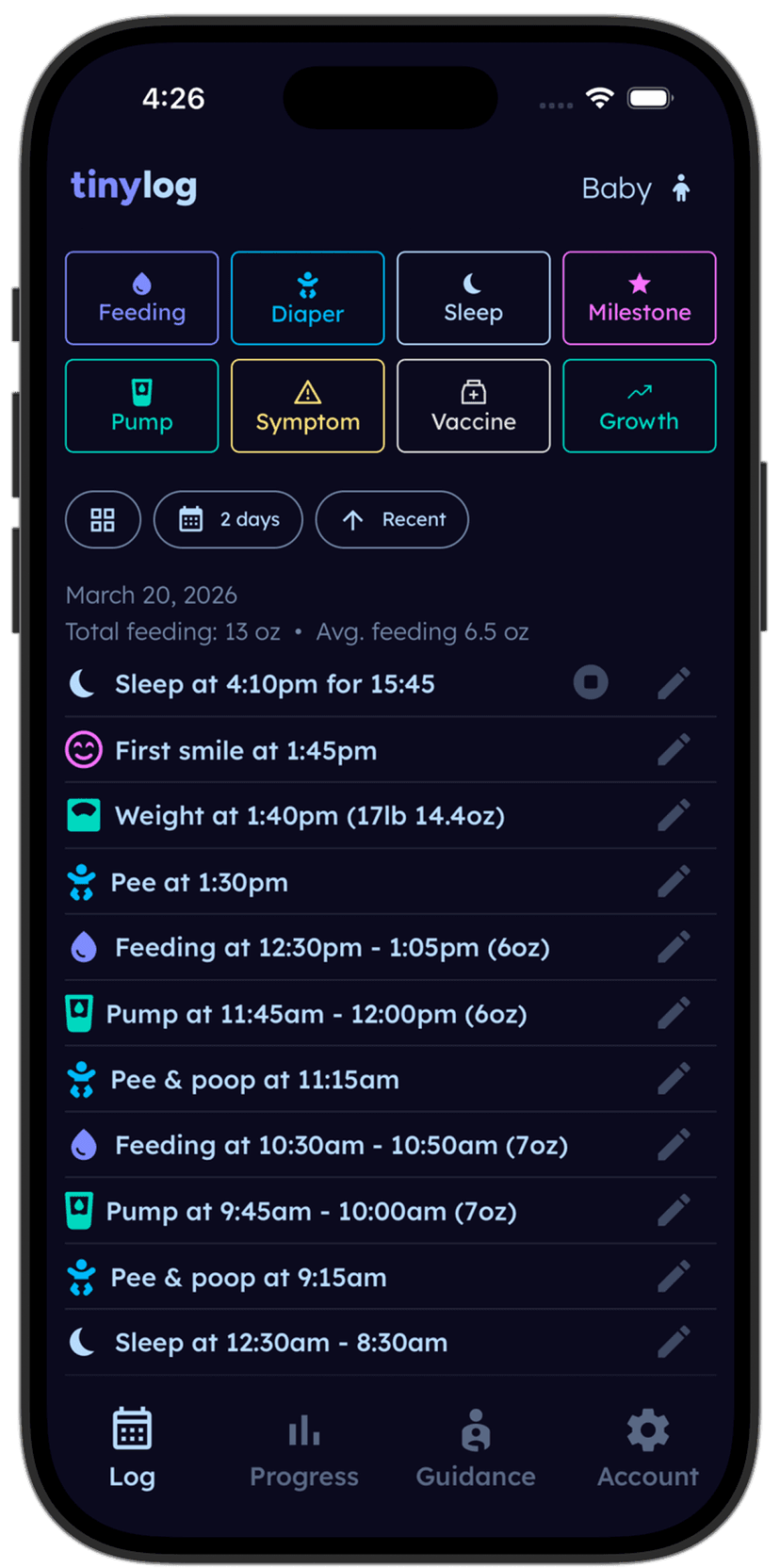
Tinylog tracks milestones so you can spot patterns.
Log tummy time, track reaching and batting milestones, and see your baby's developmental progress over weeks and months. Bring the data to your next pediatrician visit.


Longevity: Baby Einstein Runs Laps Here
This is where the Baby Einstein really shines.
Lovevery is designed for 0–12 months. The five developmental zones are most engaging during the first year, and by the time your baby is pulling to stand, the play gym has mostly served its purpose. Some parents repurpose the mat as a general play surface, but the arches and accessories get retired.
Baby Einstein has four distinct configurations:
- Lay and play (0–6 months) — classic gym setup with overhead toys
- Tummy time (3–6 months) — prop pillow with the piano at eye level
- Sit and play (6–12 months) — piano repositioned for seated playing
- Take-along (12–36 months) — detachable piano goes wherever you go
That detachable kick piano is the real MVP. It clips onto strollers, car seats, and cribs. Toddlers still bang on it at age 2. For a $45 product, getting three years of use is remarkable value.
If cost-per-month-of-use matters to you, Baby Einstein wins by a landslide.
| Product | Typical Price | Daily Cost (Amortized) | Monthly Cost (Amortized) |
|---|---|---|---|
| Lovevery The Play Gym | $130–$150 | ~$0.38–$0.41/day over 12 months | ~$11–$13 (amortized) |
| Baby Einstein 4-in-1 Kickin' Tunes | $40–$55 | ~$0.04–$0.05/day over 36 months | ~$1.25–$1.50 (amortized) |
Real Talk on Price
Look, $140 is a lot of money for something that sits on the floor. But amortized over 12 months of daily use, it works out to about $0.38/day. That's less than your coffee. And if you sell it on Facebook Marketplace afterward (they hold resale value surprisingly well), your actual cost drops even further.
Baby Einstein at $45 is one of those rare baby products where you think "wait, that's it?" Three years of use for less than dinner out. Even if your baby only uses it for a year, it's a solid deal.
Here's how to think about it:
- Tight budget? Baby Einstein. Not even a debate. It's a third of the price with triple the lifespan.
- Want the premium experience? Lovevery. The materials, the play guide, and the curated design are genuinely special.
- Can't decide? Buy the Baby Einstein now and add Lovevery to your registry. Let someone else buy you the splurge.
Choose Lovevery The Play Gym If
- You want premium, organic materials against your baby's skin
- A Montessori-inspired, low-stimulation environment appeals to you
- You like having a play guide that tells you exactly what to do each stage
- Aesthetics matter — you want something that looks clean in your living room
- You're focused on the first year and okay investing more in a shorter-use product
Choose Baby Einstein 4-in-1 Kickin' Tunes If
- Your budget is under $50 and you want maximum value
- You want a gym that grows with your baby well past the first birthday
- Your baby lights up around music and sounds
- Portability matters — you need something that travels to grandma's house
- You like the idea of multilingual exposure from day one
- You'd rather not spend $140 on something that lives on the floor
Where to Buy
If you want the premium route, the Lovevery The Play Gym (~$140) is one of the most thoughtfully designed baby products on the market — organic cotton, sustainably sourced wood, and a research-backed play guide that makes you feel like you actually know what you're doing. Buy directly from Lovevery or check Amazon for occasional bundle deals.
If you want maximum bang for your buck, the Baby Einstein 4-in-1 Kickin' Tunes (~$45) gives your baby three years of play with a kick piano that genuinely brings joy. The multilingual mode is a nice bonus. Widely available at Target, Walmart, and Amazon — and it goes on sale all the time.
Real talk: you cannot go wrong with either one. Your baby will develop just fine batting at objects on a $45 gym or a $140 gym. Get the one that fits your budget and your vibe.
Tinylog earns a small commission on purchases made through these links, at no cost to you.
Before you buy, it's worth checking promo.new for a deal. It doesn't cover everything, but we've had good luck with it.
The Bottom Line
Lovevery The Play Gym and Baby Einstein 4-in-1 Kickin' Tunes are both genuinely good activity gyms that support your baby's development. The differences are real but come down to priorities:
Lovevery The Play Gym is for parents who want premium materials, a Montessori-inspired sensory experience, and a curated play guide. It's beautiful, intentional, and built to last — within a focused 0–12 month window.
Baby Einstein 4-in-1 Kickin' Tunes is for parents who want value, versatility, and longevity. Four play modes, 70+ sounds, multilingual features, and a detachable piano that keeps going until age 3. All for about a third of the price.
Your baby will be happy on either one. They're going to bat at the dangly things, try to eat whatever they can reach, and eventually flip over and crawl away from both. That's the real milestone — and if you're tracking those milestones, Tinylog makes it easy to log tummy time, track developmental progress, and share updates with your pediatrician.
Related Guides
- Baby Tummy Time — How much, when to start, and what to do when baby hates it
- Baby Milestones — Month-by-month developmental milestones to watch for
- Baby Feeding Chart — How much your baby should eat by age
- Best Baby Toys by Age — What toys actually matter at each stage
Sources
- Lovevery.com. "The Play Gym — Product Information and Research." 2026.
- BabyEinstein.com. "4-in-1 Kickin' Tunes Activity Gym — Product Information." 2026.
- American Academy of Pediatrics. "Choosing Appropriate Toys for Young Children." HealthyChildren.org, 2025.
- Lillard, A.S. "Montessori: The Science Behind the Genius." Oxford University Press, 2017.
- What to Expect. "Best Baby Play Gyms and Activity Mats of 2026." whattoexpect.com.
- BabyGearLab. "Best Baby Play Gym Review." babygearlab.com, 2026.
- Consumer Reports. "Best Baby Play Mats and Gyms." consumerreports.org, 2026.
This guide is for informational purposes only. Product choice is a personal preference based on your baby's individual needs and your family's values. Always supervise your baby during play gym use and follow manufacturer safety guidelines.
Frequently asked questions
- Is Lovevery The Play Gym worth $140?
- It depends on what you value. Lovevery uses organic cotton, sustainably sourced wood, and research-backed developmental zones. The included play guide walks you through stage-appropriate activities from 0–12 months. If you want a curated, low-stimulation sensory experience with premium materials, it's worth it. If you just need something to keep baby entertained, cheaper gyms do that too.
- Can the Baby Einstein kick piano actually teach music?
- It introduces cause and effect — baby kicks the piano keys, sounds happen. It won't produce a concert pianist, but the 70+ sounds and melodies do build early auditory connections. The multilingual mode exposes babies to words in English, Spanish, and French, which is a nice bonus.
- Which activity gym lasts longer?
- Baby Einstein wins on longevity. Its four play modes (lay and play, tummy time, sit and play, take-along) keep it relevant from birth through age 3. Lovevery is designed for 0–12 months, though some parents repurpose the mat and accessories beyond that.
- Are activity gyms safe for newborns?
- Yes. Both gyms are designed for use from birth. Always place the gym on a flat surface, supervise your baby during use, and follow the manufacturer's weight and age guidelines. Remove any detachable parts that could become choking hazards as your baby becomes more mobile.
- Do I really need an activity gym?
- Need? No. But activity gyms give babies a dedicated space for tummy time, reaching, batting, and kicking — all critical for motor development. They also give you a safe spot to put baby down for a few minutes. Most parents consider them one of the more useful early purchases.
- Can I use both gyms together?
- Absolutely. Some parents use the Lovevery mat for calm, focused play and the Baby Einstein for upbeat music time. If your budget allows it, they complement each other well since they stimulate different senses.