
GUIDE
Lovevery The Play Gym vs. Fisher-Price Kick & Play Piano Gym
Published on
Both are solid activity gyms that babies genuinely love. Lovevery wins on materials, developmental intentionality, and aesthetics. Fisher-Price wins on versatility, longevity, and price. The price gap is significant — $140 vs. $45.
Activity gyms are one of the first 'toys' your baby actually uses, and they get a surprising amount of mileage in those early months. Lovevery and Fisher-Price take wildly different approaches — one is Montessori-inspired minimalism, the other is a full sensory party with a kick piano. Both work. Your call depends on your priorities and your budget.
Log development and play activities
Two Very Different Philosophies on Baby Play
OK so here's the thing. Lovevery and Fisher-Price are basically the two opposite ends of the activity gym spectrum, and somehow both are wildly popular. One costs three times the other. Both have loyal fans who will tell you theirs is the only correct choice.
The Lovevery Play Gym is Montessori-inspired minimalism — organic cotton, sustainably sourced wood, high-contrast cards, and a play guide that tells you exactly which activities to do at each developmental stage. No batteries, no lights, no sounds. It looks gorgeous in your living room.
The Fisher-Price Deluxe Kick & Play Piano Gym is a full sensory experience — a kick-activated piano with lights and music, dangling toys overhead, a mirror, and four different play positions that take your baby from newborn through toddlerhood. It runs on batteries and it's unapologetically colorful.
Neither approach is wrong. Babies develop perfectly well with either one. The question is what fits your priorities, your space, and honestly, your budget.
| Feature | Lovevery The Play Gym | Fisher-Price Kick & Play Piano | What It Means |
|---|---|---|---|
| Manufacturer | Lovevery | Fisher-Price (Mattel) | Lovevery is a DTC developmental toy company. Fisher-Price has been making baby gear since 1930. |
| Price | ~$140 | ~$45 | Fisher-Price is roughly one-third the cost. That's a real difference. |
| Age range | 0–12 months | 0–36 months | Fisher-Price lasts significantly longer thanks to the detachable piano and multiple play positions. |
| Play zones / positions | 5 developmental zones on the mat | 4 play positions (lay & play, tummy time, sit & play, take-along) | Different approaches. Lovevery organizes by developmental stage. Fisher-Price organizes by physical position. |
| Materials | Organic cotton batting, sustainably sourced wood arches | Polyester mat, plastic arches and piano | Lovevery wins here decisively. Organic cotton and real wood vs. standard plastic and polyester. |
| Sensory stimulation | High-contrast cards, textured fabrics, wooden batting ring, silicone teether | Lights, music, 4 animal toys, mirror, kick piano with sounds | Lovevery is intentionally minimal. Fisher-Price goes all-in on multi-sensory stimulation. |
| Batteries required | No — completely battery-free | Yes — 3 AA batteries for the piano | Lovevery never runs out of batteries. Fisher-Price piano needs periodic battery changes. |
| Play guide included | Yes — stage-based activity guide by child development experts | No | The Lovevery play guide is genuinely useful, especially for first-time parents. |
| Machine washable mat | Spot clean only | Machine washable | Fisher-Price wins on practical cleanup. Babies are messy. This matters. |
| Portability | Bulky — wooden arches don't collapse flat | Folds more compactly, piano detaches | Fisher-Price is easier to move, store, and travel with. |
| Aesthetic | Neutral tones, minimalist, living-room friendly | Bright primary colors, typical baby toy look | Lovevery looks like it belongs in an interior design blog. Fisher-Price looks like a baby toy. Both are fine. |
The Materials Gap Is Real
This is where the price difference shows up most clearly.
Lovevery uses organic cotton batting for the play mat, sustainably sourced wooden arches, and thoughtfully designed sensory accessories — a wooden batting ring, a silicone teether, high-contrast cards printed with soy-based inks. Everything feels intentional and premium. If you pick it up in a store, you immediately understand why it costs what it costs.
Fisher-Price uses standard polyester for the mat and plastic for the arches and piano. The materials are perfectly safe — Fisher-Price has been doing this for nearly a century and their safety testing is rigorous. But the tactile difference is obvious. The mat is thinner. The plastic is lightweight.
Does your baby care about organic cotton vs. polyester? Honestly, probably not. But if material quality and sustainability are priorities for you, Lovevery is in a different league.
The Piano Is Kind of a Big Deal
The Fisher-Price gym's secret weapon is that kick piano at the foot of the mat. Your baby lies on their back, kicks the piano keys, and gets rewarded with lights, music, and sounds. This is cause-and-effect learning and it is genuinely compelling for babies.
Here's what makes it clever: as your baby grows, the piano detaches. It stands upright for tummy time play, sits on a table for seated play, and eventually becomes a portable keyboard your toddler carries around the house. One accessory, four stages, lasting well past the first birthday.
Lovevery doesn't have anything equivalent. Its accessories are simpler — high-contrast cards, fabric flaps, textured zones. They're developmentally appropriate and well-designed, but they don't have that same "wow my baby just made music with their feet" moment.
Some parents see the piano as overstimulation. Others see it as the single toy that bought them 20 minutes of independent play. You know your baby better than any product review does.
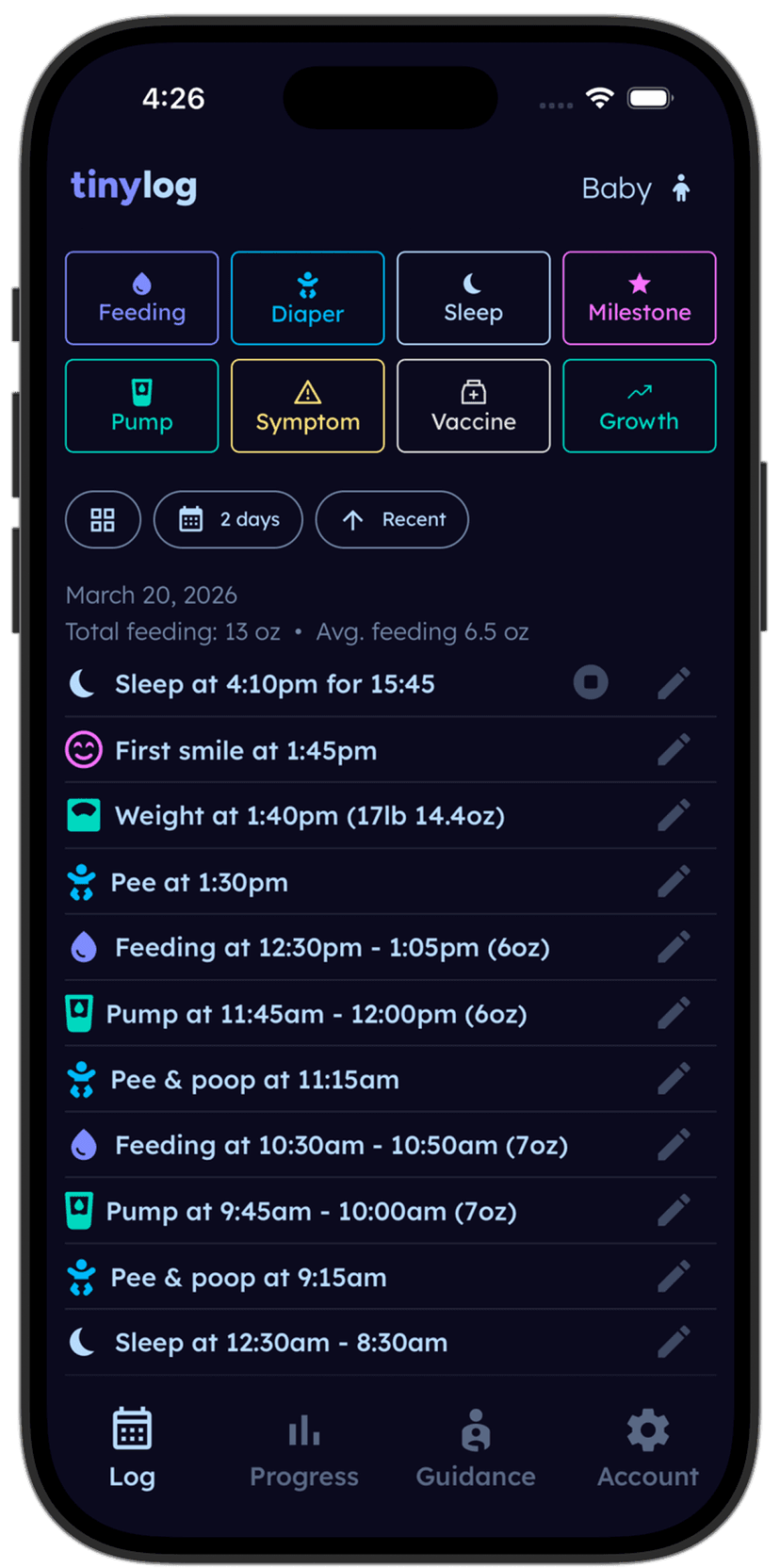
Tinylog tracks milestones so you can spot patterns.
Log developmental milestones, tummy time sessions, and play activities. See what your baby is working on and share progress with your pediatrician.


The Developmental Philosophy Question
Lovevery includes a play guide written by child development experts that maps activities to your baby's current stage. At 0–3 months, you use the black-and-white cards and the batting ring. At 3–6 months, you introduce the teether and textured zones. At 6–9 months, you add the ball drop and more complex manipulation activities.
This is genuinely useful, especially if you're a first-time parent wondering "what am I even supposed to do with a newborn on a mat." The guide gives you specific, research-backed activities for each stage. It turns an activity gym into a developmental tool with a curriculum.
Fisher-Price doesn't include anything like this. The gym is intuitive enough — put baby down, let them kick and grab — but there's no roadmap for how to adapt play over time. You can absolutely find that information online, but you're doing the research yourself.
If structured developmental guidance is something you value (and would actually use), that's a real point for Lovevery. If you're the type to figure things out as you go, you won't miss it.
One more thing worth mentioning: the Lovevery gym is designed around the idea that babies don't need constant stimulation. The zones are intentionally simple so your baby focuses on one thing at a time — batting, grasping, looking. Fisher-Price takes the opposite approach: more stimuli means more engagement. Both philosophies have research behind them. Neither is going to make or break your kid's development.
| Product | Typical Price | Purchase Type | Amortized Monthly Cost |
|---|---|---|---|
| Lovevery The Play Gym | $130–$150 | One-time purchase | ~$12–$15/month if used 10+ months |
| Fisher-Price Deluxe Kick & Play Piano Gym | $40–$55 | One-time purchase + batteries | ~$2–$5/month if used 12+ months |
The Price Conversation
Let's be real about this. The Lovevery Play Gym costs roughly three times what the Fisher-Price gym costs. That's $95 more. For some families, that's nothing. For others, that's a week of groceries.
The Fisher-Price gym gives you more months of use (0–36 months vs. 0–12 months), a machine-washable mat, and a detachable piano that becomes its own toy. On pure value-per-dollar, Fisher-Price wins by a wide margin.
But value isn't just about dollars. If organic materials, Montessori alignment, and a curated developmental experience matter to you, the Lovevery gym delivers something the Fisher-Price gym genuinely doesn't. You're paying for intentionality, and that has real value too.
A few ways to make either work for your budget:
- Lovevery occasionally runs promotions and is available on resale sites (it holds value well). Check for bundles if you're also eyeing their play kits.
- Fisher-Price goes on sale frequently at Target, Amazon, and Walmart. Black Friday and Prime Day deals often drop it below $35.
- Both make great registry items. Let someone else buy the expensive one for you.
- Consider resale. Activity gyms have a finite use window. You can often find gently used Lovevery gyms for $80–$100 on Facebook Marketplace or Mercari. Fisher-Price gyms show up at consignment sales for $10–$15.
The bottom line on cost: if $140 doesn't make you blink, Lovevery is a beautiful product. If you'd rather put that $95 difference toward diapers or sleep sacks or literally anything else, Fisher-Price delivers a genuinely great play experience at a fraction of the cost.
Choose Lovevery The Play Gym If
- You want high-quality, organic materials against your baby's skin
- Montessori-style open-ended play resonates with your parenting approach
- You prefer a battery-free, screen-free, minimal-stimulation environment
- Aesthetics matter — you want something that doesn't scream 'baby toy' in your living room
- You value having a developmental play guide to know what to do with your baby at each stage
Choose Fisher-Price Kick & Play Piano Gym If
- Budget is a real factor and you'd rather spend that $100 difference elsewhere
- You want something that lasts beyond the first year — the detachable piano grows with your kid
- Your baby loves lights, music, and cause-and-effect toys (some babies genuinely do)
- You need a machine-washable mat because your baby is a champion spit-upper
- Portability matters — you move the gym between rooms or bring it to grandma's house
- You want multiple play positions built into one product without buying accessories
Where to Buy
The Lovevery The Play Gym (~$140) is available direct from Lovevery and on Amazon. Organic cotton, sustainably sourced wood, five developmental zones, and a stage-based play guide that actually tells you what to do with your baby. If you want the premium, Montessori-aligned option and the budget allows, this is the one.
The Fisher-Price Deluxe Kick & Play Piano Gym (~$45) is available at pretty much every retailer that sells baby gear — Amazon, Target, Walmart, Buy Buy Baby. Four play positions, a kick piano that detaches and grows with your kid, and a machine-washable mat. If you want the best value or your baby is the type who lights up at lights and music, go with this one.
Real talk: your baby will be happy on either of these. They don't know what things cost. Pick the one that fits your life.
Tinylog earns a small commission on purchases made through these links, at no cost to you.
Looking for a discount? Try checking promo.new. It doesn't always find what you're looking for, but when it does, it works like a charm.
The Bottom Line
The Lovevery Play Gym and the Fisher-Price Deluxe Kick & Play Piano Gym are both excellent activity gyms that babies genuinely enjoy. They just come at the problem from completely different angles.
Lovevery The Play Gym wins on materials (organic cotton, real wood), developmental intentionality (play guide, Montessori principles), and aesthetics (your living room will thank you). It's battery-free and beautifully designed. It also costs $140 and only lasts through 12 months.
Fisher-Price Kick & Play Piano Gym wins on value ($45), longevity (0–36 months), versatility (four play positions plus detachable piano), and practicality (machine-washable mat, portable). It's bright, it's stimulating, and babies go absolutely wild for that kick piano.
There is no wrong choice. If someone gifted you either one, you'd be happy with it. If you're buying it yourself, let your budget and your values guide you.
If you're tracking your baby's developmental milestones — which is especially fun during the play gym months when new skills seem to pop up weekly — Tinylog makes it easy to log activities and see patterns over time.
Related Guides
- Baby Tummy Time — When to start, how long, and what to do when your baby hates it
- Baby Milestones — Month-by-month developmental milestones for the first year
- Baby Toys by Age — What toys actually matter at each stage
- Baby Play Ideas — Simple activities for every age and stage
Sources
- Lovevery.com. "The Play Gym — Product Information." 2026.
- Fisher-Price.com. "Deluxe Kick & Play Piano Gym — Product Information." 2026.
- Mommyhood101. "Best Baby Play Gyms of 2026, Tested & Reviewed." mommyhood101.com.
- What to Expect. "Best Baby Play Mats and Activity Gyms." whattoexpect.com, 2026.
- BabyGearLab. "Best Baby Play Mats." babygearlab.com, 2026.
- American Academy of Pediatrics. "Back to Sleep, Tummy to Play." aap.org.
This guide is for informational purposes only. Activity gym choice is a personal preference based on your family's priorities and budget. Always supervise your baby during play gym time and follow the manufacturer's safety guidelines.
Frequently asked questions
- Is the Lovevery Play Gym worth $140?
- It depends on what you value. The Lovevery Play Gym uses organic cotton batting, sustainably sourced wood, and includes a developmental play guide with stage-based activities. If high-quality materials, Montessori alignment, and aesthetics matter to you, it can be worth it. If you just need a functional play gym, Fisher-Price delivers at a third of the price.
- How long can a baby use the Fisher-Price Kick & Play Piano Gym?
- Fisher-Price rates it for 0–36 months across four play positions: lay and play, tummy time, sit and play, and take-along piano. Most kids use the gym portion through 10–12 months and the detachable piano well into toddlerhood.
- Can babies do tummy time on both gyms?
- Yes. Both gyms support tummy time. The Lovevery Play Gym includes a tummy time setup with a specific zone and high-contrast cards at baby's eye level. The Fisher-Price gym flips the piano upright and places the arch overhead for tummy time play.
- Does the Lovevery Play Gym need batteries?
- No. The Lovevery Play Gym is entirely battery-free with no lights, sounds, or electronic components. All stimulation comes from textures, high-contrast visuals, and physical manipulation. The Fisher-Price gym requires 3 AA batteries for the kick piano's lights, music, and sounds.
- Which play gym is better for small spaces?
- The Fisher-Price gym folds more compactly when not in use. The Lovevery Play Gym mat is larger and the wooden arches don't collapse flat. If floor space is tight, Fisher-Price is more practical.
- Can you wash both play gym mats?
- The Lovevery Play Gym mat is spot-clean only — the organic cotton and attached activity zones make machine washing impractical. The Fisher-Price mat is machine washable, which is a real advantage when spit-up happens.