
GUIDE
Pampers Pure Protection vs. Target Up & Up Diapers
Published on
These two diapers serve very different purposes. Pampers Pure Protection is a premium plant-based option with cleaner ingredients and fragrance-free construction. Up & Up is a reliable budget diaper at roughly one-third the price. Both work well — the question is what matters more to you: ingredient quality or cost savings.
This is a cross-tier comparison. Pampers Pure Protection sits in the premium 'clean ingredients' category with plant-based materials and no fragrance. Target's Up & Up is a budget store-brand diaper built for value. Comparing them head to head helps you figure out whether the premium price tag buys something your baby actually needs — or whether the store brand covers everything that matters.
Log changes, blowouts, and rashes
A Premium Diaper vs. a Budget Diaper — And That's OK
This is not a comparison between two diapers in the same category. Pampers Pure Protection is a premium plant-based diaper that costs $0.32–$0.50 per change. Target's Up & Up is a budget store-brand diaper that costs $0.13–$0.24 per change. They are built for different priorities.
The honest question here is simple: does your baby actually need the premium materials, or will the store brand do the job just fine?
For some families, the answer is clearly Pampers Pure — maybe your baby has reactive skin, maybe you want fewer synthetic chemicals, maybe it just makes you feel better. All of those are valid reasons. For other families, Up & Up keeps their baby dry, happy, and rash-free at a fraction of the cost. That is also a perfectly good answer.
We laid out the real differences so you can decide based on facts, not marketing.
For more on how many diapers to expect per day, see our baby feeding chart.
| Feature | Pampers Pure Protection | Up & Up (Target) | What It Means |
|---|---|---|---|
| Manufacturer | Procter & Gamble | Target (store brand) | P&G is a global diaper giant. Up & Up is Target's in-house brand, manufactured by third-party contractors to Target's specs. |
| Price tier | Premium (~$0.32–$0.45/diaper) | Budget (~$0.13–$0.17/diaper) | Up & Up costs roughly one-third of Pampers Pure per diaper. This is the biggest difference between these two. |
| Fragrance | Fragrance-free | Fragrance-free | Tie. Neither contains added fragrance, lotions, or scented liners. |
| Chlorine processing | Elemental chlorine-free (ECF) | Elemental chlorine-free (ECF) | Tie. Both avoid elemental chlorine gas. Neither uses the stricter TCF (totally chlorine-free) process. |
| Plant-based materials | Yes — plant-based outer cover, cotton-enhanced liner with shea butter | No — standard polypropylene and polyethylene materials | Pampers Pure uses renewable plant-based materials in the shell and liner. Up & Up uses conventional synthetic materials. |
| Absorbent core | Superabsorbent polymer (SAP) + wood pulp, P&G-engineered | Superabsorbent polymer (SAP) + wood pulp, thicker core | Pampers Pure absorbs faster and keeps the surface drier. Up & Up packs more volume into the core but distributes moisture more slowly. |
| Inner liner | Soft plant-based liner with shea butter | Quilted soft polypropylene liner | Pampers Pure's liner is plant-derived with skin-conditioning shea butter. Up & Up's quilted liner is soft but synthetic. |
| Wetness indicator | Yes — color-changing line | Yes — color-changing line | Tie. Both change color when wet. |
| Fit and elastics | Slightly longer and narrower, secure tabs, snug cuffs | Stretchy elastic waistband, triple-layer leak guard | Both fit well. Pampers Pure runs a bit narrower. Up & Up has stretchier sides that accommodate chunky thighs. |
| Size range | Newborn through Size 6 | Newborn through Size 6 | Tie. Same full range. |
| Hypoallergenic | Yes — dermatologist-tested, free of parabens, latex, EU 26 allergens | Yes — free of latex, parabens, elemental chlorine | Both are hypoallergenic. Pampers Pure goes further with additional allergen exclusions and dermatologist testing. |
| Availability | Widely available — Target, Walmart, Amazon, CVS, grocery stores | Target stores and Target.com only | Pampers Pure is available everywhere. Up & Up is a Target exclusive. |
Ingredients: The Real Reason Pampers Pure Costs More
The core difference between these two diapers is what they are made of.
Pampers Pure Protection uses a plant-based outer cover, a cotton-enhanced inner liner infused with shea butter, and FSC-certified wood pulp. The diaper is free of fragrance, parabens, latex, and the EU 26 allergens. The bleaching process is elemental chlorine-free. P&G specifically designed this line for parents who want cleaner materials without sacrificing the absorbency Pampers is known for.
Up & Up uses conventional diaper materials — polypropylene liner, polyethylene outer shell, superabsorbent polymer core. It is also free of fragrance, latex, and parabens, and it is hypoallergenic. But it does not use plant-based materials, does not include skin-conditioning ingredients, and does not carry the same allergen exclusion claims.
Does the ingredient difference matter for your baby? If your baby has normal skin and no sensitivities, probably not in a way you would notice day to day. If your baby has eczema, persistent rash, or very reactive skin, the plant-based liner and absence of additional synthetic compounds in Pampers Pure may make a real difference. The only way to know for sure is to test both.
Absorbency: P&G's Engineering vs. Store-Brand Volume
Procter & Gamble has been engineering diaper absorbency for decades, and their SAP core technology shows up in Pampers Pure. Liquid gets absorbed faster, the surface stays drier longer, and moisture distribution through the core is more even. For overnight use or heavy wetters, this translates to fewer middle-of-the-night changes.
Up & Up uses a slightly thicker core that holds good total volume but absorbs more slowly on first contact. For regular daytime use with changes every 2–3 hours, you will not notice a meaningful difference. But stretch that to a 10-hour overnight window, and Pampers Pure keeps skin drier.
That said, Up & Up's absorbency is genuinely good for a store-brand diaper. It outperforms many budget competitors and holds its own against some mid-tier name brands. The gap between premium and store-brand absorbency has narrowed a lot in the past few years.
If your baby is an average wetter and you change diapers regularly throughout the day, Up & Up handles the job without issues.
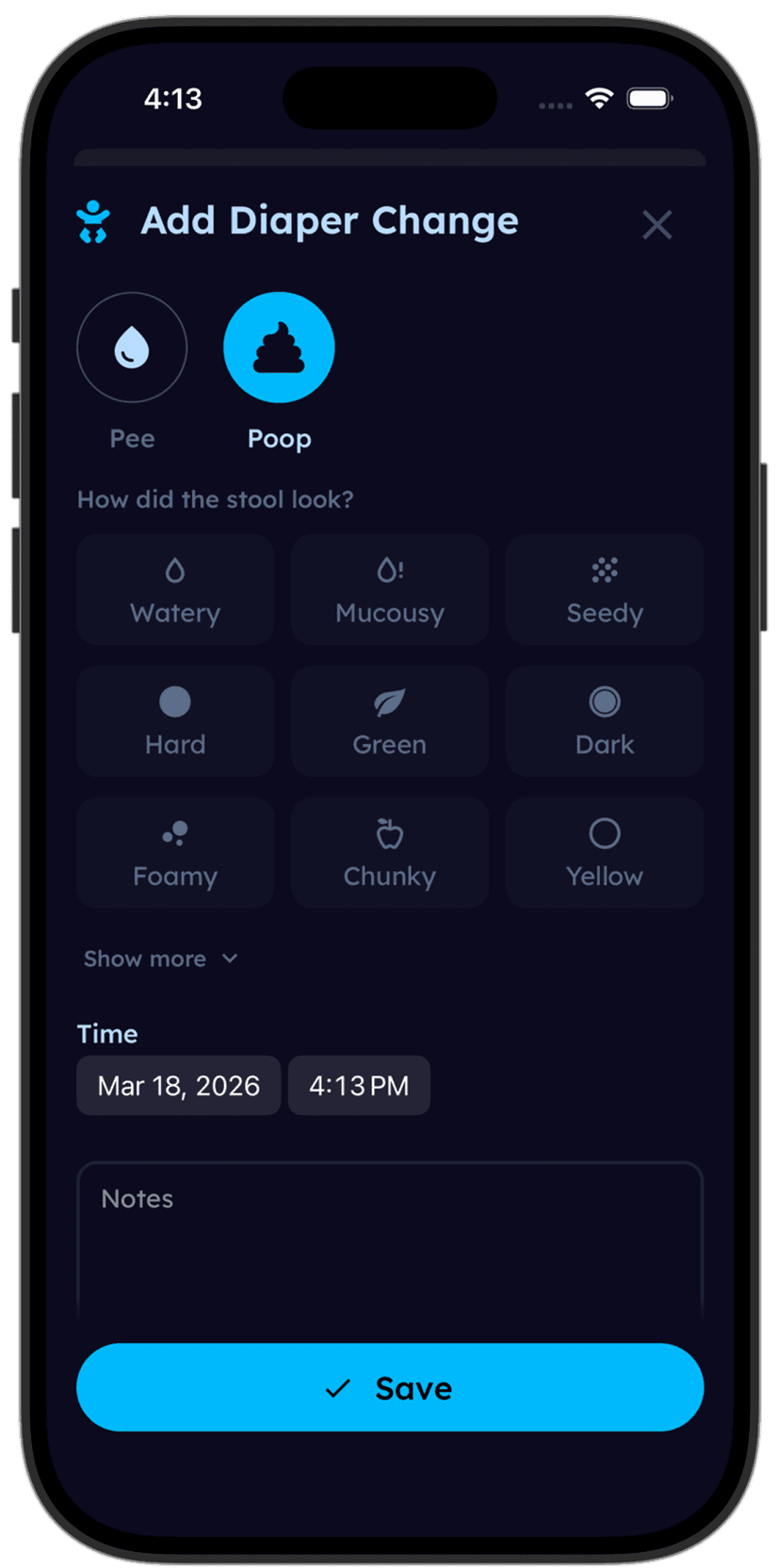
Tinylog tracks diapers so you can spot patterns.
Log wet and dirty diapers, note blowouts and rashes, track output over days and weeks. Bring the data to your next pediatrician visit.


Fit and Comfort: Different Builds for Different Babies
Pampers Pure Protection fits similarly to other Pampers diapers — slightly longer and narrower through the body. The tabs are secure, the leg cuffs are snug, and the plant-based outer cover has a soft, cloth-like feel. The shea butter liner adds a subtle skin-conditioning layer that some parents swear by for sensitive bottoms.
Up & Up has a stretchier elastic waistband and wider leg openings. It fits more like Huggies — accommodating for chunky thighs and rounder bellies. The quilted inner liner is soft for a store-brand diaper, though it does not match the plant-based feel of Pampers Pure.
For skinnier babies, Pampers Pure's narrower cut tends to fit better with fewer gaps. For chunkier babies, Up & Up's stretch sides and wider openings give a more comfortable, less restrictive fit. Neither diaper is one-size-fits-all in terms of body type, so try both if you are unsure.
| Product | Typical Price | Cost Per Diaper | Monthly Estimate |
|---|---|---|---|
| Pampers Pure Protection (Size 1, 132-ct box) | $42–$50 | ~$0.32–$0.38 | ~$77–$114 |
| Up & Up (Size 1, 168-ct box) | $21–$26 | ~$0.13–$0.15 | ~$33–$45 |
| Pampers Pure Protection (Size 3, 92-ct box) | $38–$46 | ~$0.41–$0.50 | ~$82–$120 |
| Up & Up (Size 3, 112-ct box) | $21–$27 | ~$0.19–$0.24 | ~$38–$58 |
Price: The Elephant in the Room
There is no getting around this: Up & Up costs roughly one-third of what Pampers Pure costs per diaper. That is not a small difference.
At Size 1, you are looking at approximately $0.13 per diaper for Up & Up versus $0.35 for Pampers Pure. Over a month of newborn-level diaper usage, that is a difference of $40–$70. Over a full year of diapering, you could save $500–$900 by using Up & Up instead of Pampers Pure.
That is real money. For some families, it is a car payment or a month of groceries. There is zero shame in choosing the budget option — your baby does not know what brand they are wearing.
Ways to bring costs down on either side:
- Target Circle regularly offers 10–15% off Up & Up diapers, sometimes stacking with other deals.
- Pampers Pure on Amazon Subscribe & Save knocks 5–15% off, and bulk boxes reduce the per-diaper cost.
- The mix-and-match approach: Use Pampers Pure at night for better absorbency and Up & Up during the day for frequent changes. This cuts your monthly spend significantly while still getting premium performance when it matters most.
Choose Pampers Pure Protection If
- Your baby has sensitive or eczema-prone skin and you want plant-based materials against their body
- Ingredient quality matters to you — fewer synthetic chemicals, shea butter liner, no fragrance
- You want a diaper that absorbs fast and keeps the surface dry, especially for overnight
- You shop at multiple stores and want a diaper you can find anywhere in a pinch
- You already use Pampers and want a cleaner version of a brand you trust
- You are willing to pay a premium for the peace of mind that comes with plant-based construction
Choose Up & Up If
- Budget is your top priority and you want a solid diaper at one-third the premium price
- Your baby has normal skin and does fine in standard diapers without needing plant-based materials
- You shop at Target regularly and use Target Circle for additional savings
- You want a fragrance-free, hypoallergenic diaper without paying premium prices
- Your baby has chunky thighs and benefits from Up & Up's stretchier waistband and sides
- You go through a lot of diapers and the monthly cost difference of $40–$75 matters to your family
Where to Buy
For cleaner ingredients and premium absorbency, Pampers Pure Protection (~$0.35/diaper in bulk) gives you plant-based materials, a shea butter liner, and P&G's proven core technology. Available at Target, Walmart, Amazon, CVS, and most grocery stores — you will never have trouble finding them.
For a reliable budget diaper that gets the job done, Target Up & Up Diapers (~$0.14/diaper in bulk) deliver solid absorbency, fragrance-free construction, and a stretchy fit at roughly one-third the price. Available at Target stores and Target.com, with frequent Target Circle discounts.
If you are torn, try the mix-and-match approach: Pampers Pure for overnight and Up & Up for daytime. You get premium protection when it counts and budget savings when frequent changes make the premium less necessary.
Tinylog earns a small commission on purchases made through these links, at no cost to you.
We've found promo.new handy for finding discounts on baby gear. Doesn't always have what you need, but it's worth a shot.
The Bottom Line
This comparison comes down to a simple trade-off: ingredient quality versus cost savings.
Pampers Pure Protection is the better diaper on paper — plant-based materials, shea butter liner, faster absorbency, broader allergen exclusions, and availability everywhere. It is a genuinely well-made diaper that justifies its premium for families who prioritize cleaner ingredients or have babies with sensitive skin.
Target Up & Up is a genuinely good store-brand diaper that keeps babies dry, fits well, and costs dramatically less. For the majority of babies with normal skin, it does everything they need a diaper to do.
Neither choice is wrong. The best approach is to try both, see how your baby's skin responds, and make the call based on what you actually observe — not what the packaging promises.
If you are tracking diaper output to watch for feeding or hydration patterns, Tinylog makes it easy to log every change and share the data with your pediatrician.
Related Guides
- Pampers Swaddlers vs. Pampers Pure Protection — Standard Pampers vs. the plant-based upgrade
- Parent's Choice vs. Up & Up Diapers — The two biggest store-brand diapers compared
- Baby Diaper Rash — Causes, treatment, and when to call your doctor
- Baby Feeding Chart — How much your baby should eat by age
Sources
- Pampers.com. "Pampers Pure Protection Diapers — Product Information." Procter & Gamble, 2026.
- Target.com. "Up & Up Diapers — Product Information." 2026.
- Consumer Reports. "19 Best Diapers From Our Tests." consumerreports.org, 2026.
- Mommyhood101. "The Best Diapers of 2026, Tested & Reviewed." mommyhood101.com.
- BabyGearLab. "Best Disposable Diapers." babygearlab.com, 2026.
- ShoeStringBaby.com. "Store Brand Diaper Comparison: Walmart vs. Target vs. Amazon." 2025.
- Korin Miller. "The 12 Best Diapers for Babies, According to Experts." Parents.com, 2025.
This guide is for informational purposes only. Diaper choice is a personal preference based on your baby's individual needs. If your baby develops persistent rash or skin irritation with any diaper brand, consult your pediatrician.
Frequently asked questions
- Is Pampers Pure Protection worth the extra cost over Up & Up?
- It depends on your priorities. Pampers Pure Protection uses plant-based materials, is fragrance-free, and avoids chlorine bleaching. If your baby has sensitive skin or you want fewer synthetic chemicals, the premium may be worth it. If your baby does fine in standard diapers and budget matters, Up & Up delivers solid performance at roughly one-third the per-diaper cost.
- Are Up & Up diapers safe for sensitive skin?
- Up & Up diapers are hypoallergenic and free of latex, parabens, and elemental chlorine. They are fragrance-free across all sizes. Many babies with mild sensitivity do perfectly fine in them. However, they do not use plant-based materials or avoid all chlorine compounds the way Pampers Pure does. If your baby has eczema or very reactive skin, test a small pack first.
- Do Pampers Pure Protection diapers have fragrance?
- No. Unlike standard Pampers Swaddlers, Pampers Pure Protection is completely fragrance-free. Up & Up diapers are also fragrance-free, so both options work for parents who want to avoid scented diapers.
- How much do you save per month with Up & Up over Pampers Pure?
- Depending on your baby's size and diaper usage, switching from Pampers Pure to Up & Up can save you roughly $40–$75 per month. Over a full year, that adds up to $500–$900 in savings. The per-diaper cost difference is approximately $0.18–$0.25.
- Which diaper is more absorbent, Pampers Pure or Up & Up?
- Pampers Pure Protection absorbs liquid slightly faster thanks to its P&G-engineered superabsorbent polymer core. Up & Up uses a thicker core that holds good volume but distributes moisture a bit more slowly. For regular daytime changes, both perform well. For heavy wetters or overnight, Pampers Pure has a slight edge in keeping the surface dry.
- Can I mix and match Pampers Pure and Up & Up diapers?
- Absolutely. Many parents use a premium diaper like Pampers Pure at night for better absorbency and a budget option like Up & Up during the day when changes are more frequent. This is a practical way to get the benefits of both without paying premium prices around the clock.