
GUIDE
Parent's Choice vs. Up & Up Diapers
Published on
Both are solid store-brand diapers at roughly half the cost of name brands. Up & Up edges out on softness and fit. Parent's Choice wins on price and size range. For most babies, either works great.
Store-brand diapers have gotten shockingly good. Walmart's Parent's Choice and Target's Up & Up together cover a huge chunk of the budget diaper market, and both consistently score well in independent absorbency tests. The real differences come down to fit, material feel, and which store you already shop at.
Log changes, blowouts, and rashes
Store-Brand Diapers Are Better Than You Think
Here's something the name brands don't want you to know: store-brand diapers have gotten really, really good. Both Walmart's Parent's Choice and Target's Up & Up use the same core materials — superabsorbent polymer and wood pulp — as Pampers and Huggies. The main difference? You're not paying for the marketing budget.
Both of these diapers work. Your baby will not know the difference between a diaper that costs $0.12 and one that costs $0.28. But there are real differences between these two store brands in softness, fit, leak protection, and price that are worth knowing about.
We broke down the specs, checked the pricing, and compared notes from thousands of parent reviews so you don't have to do it at 2 AM in the Walmart app.
For more on how many diapers your baby actually goes through per day, see our baby feeding chart.
| Feature | Parent's Choice (Walmart) | Up & Up (Target) | What It Means |
|---|---|---|---|
| Retailer | Walmart | Target | Your shopping habits may be the biggest factor here. |
| Fragrance | Available in scented and unscented | Fragrance-free (all sizes) | Up & Up keeps it simple — no fragrance across the board. |
| Absorbent core | Superabsorbent polymer + wood pulp | Superabsorbent polymer + wood pulp, slightly thicker core | Both use similar materials. Up & Up packs a bit more into the core. |
| Inner liner | Soft polypropylene liner | Quilted soft liner | Up & Up's quilted texture feels slightly softer against skin. |
| Leak protection | Dual leg cuffs | Triple-layer leak guard with stretch sides | Up & Up's triple-layer design provides marginally better leg-leak protection. |
| Waistband | Flexible waistband, less elastic | Stretchy elastic waistband | Up & Up has a more flexible waistband that accommodates chunky thighs better. |
| Softness | Good — slightly stiffer outer shell | Very good — softer outer material | Up & Up wins on feel. Parent's Choice is functional but a touch rougher. |
| Wetness indicator | Yes — color-changing line | Yes — color-changing line | Tie. Both change from yellow to blue when wet. |
| Size range | Newborn through Size 7 | Newborn through Size 6 | Parent's Choice goes up to Size 7 — useful for bigger toddlers. |
| Hypoallergenic | Yes — free of latex, parabens, chlorine | Yes — free of latex, parabens, chlorine | Tie. Both meet the same safety and sensitivity standards. |
| Overnight performance | Decent — may leak for heavy wetters | Better — thicker core holds more | Up & Up holds up better through the night for most babies. |
| Blowout protection | Basic leg cuffs, no back pocket | Better leg cuffs, slightly higher back rise | Neither is great at blowouts compared to name brands, but Up & Up does a bit better. |
The Softness Gap Is Real
Pick up a Parent's Choice diaper and an Up & Up diaper side by side, and you will notice a difference. It's not dramatic, but it's there.
Up & Up diapers have a quilted inner liner and a softer outer shell. The elastic around the legs is more pliable. The overall feel is closer to what you'd expect from a Huggies or Luvs diaper. If you squeezed a bunch of diapers blindfolded, Up & Up would land in the middle of the pack.
Parent's Choice diapers are a bit stiffer. The outer material feels more like paper, and the leg cuffs are firmer. They get the job done, but "plush" is not the word you'd use. Some parents don't notice or care. Others — especially parents of babies with sensitive skin who get red marks from tight elastic — find it matters.
The softness difference does not affect absorbency. It's purely a comfort and skin-irritation consideration.
Fit: Where Store Brands Get Tricky
Fit is where store-brand diapers tend to fall short compared to name brands, and it's also where Parent's Choice and Up & Up differ from each other.
Parent's Choice runs slightly larger in each size and has a less stretchy waistband. This works fine for average-sized babies, but can mean gaps around the legs on skinnier babies — and gaps mean leaks. On the plus side, the generous sizing means you may stay in a size longer before needing to move up.
Up & Up has a more elastic, contoured fit. The stretchy sides and better leg cuffs conform more closely to your baby's body. This generally results in fewer leaks, especially for babies with chunkier thighs. The fit is noticeably closer to what you'd get from Huggies Little Snugglers.
The universal truth with all diapers: if it's leaking, try a different size before you try a different brand. Sizing up or down one size fixes the problem more often than switching brands does.
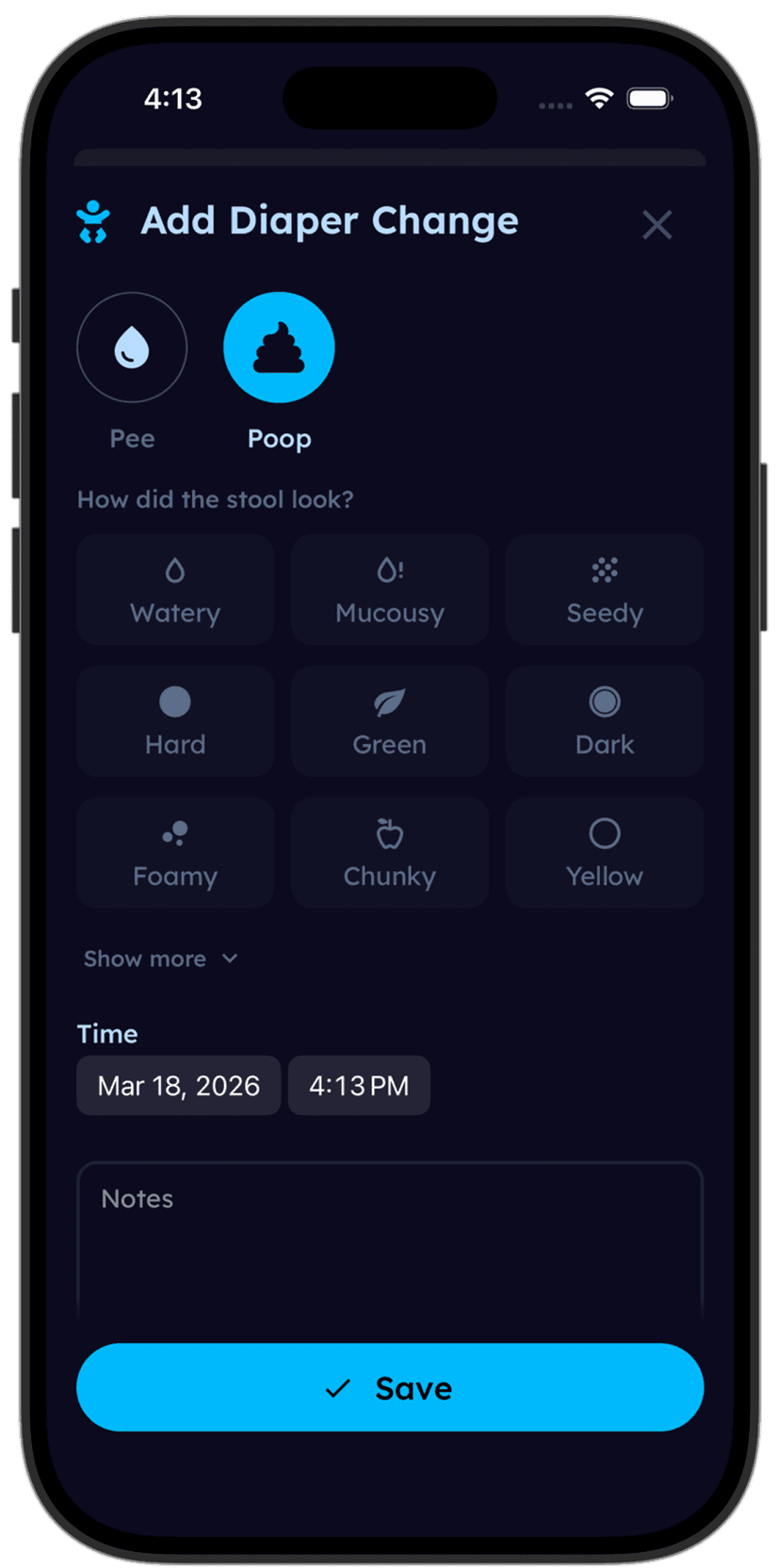
Tinylog tracks diapers so you can spot patterns.
Log wet and dirty diapers, note blowouts and rashes, track output over days and weeks. Bring the data to your next pediatrician visit.


Absorbency: Both Are Surprisingly Good
In independent absorbency tests, store-brand diapers routinely perform within 10–15% of premium brands. That gap has shrunk dramatically over the past five years.
Parent's Choice absorbs liquid quickly and distributes it reasonably well. It handles normal daytime volumes without issues. Where it struggles is at higher volumes — think overnight or during a cluster-feeding phase when your newborn is going through 12+ diapers a day. The thinner core can feel damp to the touch sooner.
Up & Up packs a slightly thicker absorbent core. In side-by-side testing, it holds approximately 15–20% more liquid before reaching saturation. This gives it a meaningful edge for overnight use and for heavy wetters.
Neither store brand offers a dedicated "overnight" diaper. If your baby consistently soaks through at night, you might consider sizing up at bedtime or using a name-brand overnight diaper for that one change.
| Product | Typical Price | Cost Per Diaper | Monthly Estimate |
|---|---|---|---|
| Parent's Choice (Size 1, 168-ct box) | $17–$22 | ~$0.10–$0.13 | ~$25–$39 |
| Up & Up (Size 1, 168-ct box) | $21–$26 | ~$0.13–$0.15 | ~$33–$45 |
| Parent's Choice (Size 3, 124-ct box) | $18–$24 | ~$0.15–$0.19 | ~$30–$46 |
| Up & Up (Size 3, 112-ct box) | $21–$27 | ~$0.19–$0.24 | ~$38–$58 |
Price: Parent's Choice Is Hard to Beat
Let's be blunt: Parent's Choice is one of the cheapest diapers you can buy in the United States. At around $0.10–$0.13 per diaper for Size 1, you're looking at roughly $25–$39 per month. That's about half what you'd spend on Pampers or Huggies.
Up & Up is also a great deal, running about $0.13–$0.15 per diaper for Size 1. That's $33–$45 per month. Still way cheaper than name brands, but noticeably more than Parent's Choice.
Over a year, the difference between Parent's Choice and Up & Up adds up to roughly $60–$120. Not life-changing, but not nothing either — especially if you're buying diapers for multiples.
Ways to save even more:
- Walmart+ members get free shipping on Parent's Choice with no minimum order.
- Target Circle regularly drops 10–15% off Up & Up diapers, sometimes stacking with manufacturer coupons.
- Buy the biggest box available. Per-diaper cost drops significantly with larger packs.
- Don't stockpile one size. Babies grow fast. Buy 2–3 weeks' worth at a time, max.
Choose Parent's Choice If
- You shop at Walmart regularly and want the easiest option
- Budget is your top priority — Parent's Choice is one of the cheapest diapers in America
- Your baby is bigger and needs Size 7 (Up & Up maxes out at Size 6)
- You want the option of a scented diaper
- Your baby isn't a super heavy wetter and doesn't need the thickest core
Choose Up & Up If
- You want a fragrance-free diaper without having to check labels
- Softness matters to you — Up & Up feels closer to a name-brand diaper
- Your baby is chunky and needs a stretchier waistband and leg openings
- You need better overnight performance from a store-brand diaper
- You shop at Target regularly and use Target Circle for additional savings
- Leak protection is a priority — Up & Up's triple-layer guard is a step up
Where to Buy
If price is the priority, Parent's Choice Diapers (~$0.12/diaper in bulk) are one of the best values in the entire diaper market. They do the job, they're widely available at every Walmart and on Walmart.com, and your baby won't know the difference. Grab the biggest box you can find.
If you want a store-brand diaper that feels a step closer to name brands, Up & Up Diapers (~$0.14/diaper in bulk) offer better softness, a stretchier fit, and stronger overnight performance. Available at Target stores and Target.com, with frequent Target Circle discounts.
Our honest take: if you're on a tight budget, Parent's Choice is the move. If you can spend a couple extra cents per diaper and want a nicer feel, Up & Up is worth it. Both are dramatically cheaper than Pampers or Huggies, and your baby will be just fine in either.
Tinylog earns a small commission on purchases made through these links, at no cost to you.
Before you buy, it's worth checking promo.new for a deal. It doesn't cover everything, but we've had good luck with it.
The Bottom Line
Store-brand diapers are a smart choice for the vast majority of families. Both Parent's Choice and Up & Up deliver solid absorbency, basic leak protection, and hypoallergenic materials at a fraction of name-brand prices.
Up & Up (Target) edges out on softness, fit, overnight absorbency, leak protection, and fragrance-free formulation across all sizes.
Parent's Choice (Walmart) wins on price, availability, and size range (up to Size 7).
For most families, the best approach is to buy whichever brand matches the store you already shop at. If you shop at both Walmart and Target, grab a small pack of each and see which fits your baby better. The savings compared to name brands — roughly $300–$600 per year — are real and significant.
If you're tracking diaper output — which your pediatrician will ask about in those early weeks — Tinylog makes it easy to log changes and spot patterns over time.
Related Guides
- Pampers Swaddlers vs. Huggies Little Snugglers — The two most popular premium diapers compared
- Baby Diaper Rash — Causes, treatment, and when to call your doctor
- Baby Feeding Chart — How much your baby should eat by age
- Baby Constipation — What's normal and when to worry
Sources
- Consumer Reports. "19 Best Diapers From Our Tests." consumerreports.org, 2026.
- Mommyhood101. "The Best Diapers of 2026, Tested & Reviewed." mommyhood101.com.
- BabyGearLab. "Best Disposable Diapers — Store Brand Comparison." babygearlab.com, 2026.
- Walmart.com. "Parent's Choice Diapers — Product Information." 2026.
- Target.com. "Up & Up Diapers — Product Information." 2026.
- ShoeStringBaby.com. "Store Brand Diaper Comparison: Walmart vs. Target vs. Amazon." 2025.
- WeHaveKids. "Are Store-Brand Diapers Worth It? A Detailed Comparison." wehavekids.com.
This guide is for informational purposes only. Diaper choice is a personal preference based on your baby's individual needs. If your baby develops persistent rash or skin irritation with any diaper brand, consult your pediatrician.
Frequently asked questions
- Are Parent's Choice diapers as good as name-brand diapers?
- In independent absorbency tests, Parent's Choice diapers perform within 10–15% of premium brands like Pampers and Huggies. They use similar materials — superabsorbent polymer, wood pulp, and polypropylene liners. The main differences are in softness, elastic quality, and fragrance options.
- Are Up & Up diapers good quality?
- Yes. Target's Up & Up diapers consistently rank among the best store-brand diapers in consumer testing. They score well on absorbency, leak protection, and softness. Many parents find them comparable to Huggies in fit and feel.
- Which is cheaper, Parent's Choice or Up & Up?
- Parent's Choice is typically 1–3 cents cheaper per diaper. At Walmart, you can find Parent's Choice as low as $0.10–$0.14 per diaper in bulk. Up & Up runs about $0.12–$0.17 per diaper. Over a month, the difference is roughly $5–$15.
- Do Parent's Choice or Up & Up diapers have fragrance?
- Parent's Choice diapers are available in both scented and unscented versions. Up & Up diapers are fragrance-free across all sizes. If you want to avoid fragrance entirely, Up & Up is the simpler choice.
- Can store-brand diapers cause more diaper rash?
- There is no evidence that store-brand diapers cause more rash than name brands. Diaper rash is primarily caused by prolonged moisture contact, not the diaper brand. Both Parent's Choice and Up & Up are hypoallergenic and free of latex, parabens, and elemental chlorine.
- Which store-brand diaper is best for overnight?
- Up & Up tends to perform slightly better overnight due to a thicker absorbent core and better elastic fit around the legs and waist. For heavy overnight wetters, some parents size up regardless of brand. Neither store brand offers a dedicated overnight diaper.