
GUIDE
Tommee Tippee Natural Start vs. NUK Simply Natural Glass Bottles
Published on
Both are solid bottles with breast-like nipples. Tommee Tippee excels at colic reduction with its built-in anti-colic valve. NUK stands out for durability and chemical-free glass construction. Your baby's latch preference will likely be the deciding factor.
Tommee Tippee Natural Start Anti-Colic and NUK Simply Natural Glass Bottles take different approaches to the same goal — a comfortable, low-fuss feeding experience that works alongside breastfeeding. One is plastic with advanced venting; the other is borosilicate glass with a unique multi-hole nipple. Both have loyal followings for good reasons.
Log bottles, nursing, and pumping
Two Popular Bottles, Two Very Different Approaches
Tommee Tippee Natural Start Anti-Colic and NUK Simply Natural Glass Bottles both aim to make bottle-feeding feel more like breastfeeding — but they get there in completely different ways.
Tommee Tippee bets on a wide, breast-shaped nipple and a built-in anti-colic valve that vents air away from the milk. It's made from lightweight BPA-free plastic designed to be easy to hold and safe when dropped.
NUK bets on borosilicate glass and a unique multi-hole orthodontic nipple that distributes milk in a pattern closer to how it flows from the breast. The glass construction means zero plastic chemical concerns and a bottle that stays pristine for years.
The honest truth: your baby's nipple preference will matter more than any spec sheet. But the material choice — plastic vs. glass — has real implications for cleaning, durability, chemical exposure, and daily convenience.
For more on feeding amounts by age, see our baby feeding chart.
| Feature | Tommee Tippee Natural Start | NUK Simply Natural Glass | What It Means |
|---|---|---|---|
| Manufacturer | Mayborn Group (part of Soho House & Co) | NUK (Newell Brands) | Both are well-established baby product companies with decades of bottle design experience. |
| Bottle material | Polypropylene plastic (BPA-free) | Borosilicate glass (BPA-free by nature) | Glass eliminates all plastic chemical concerns. Plastic is lighter and shatterproof. |
| Nipple shape | Wide, dome-shaped breast-like nipple | Orthodontic with multiple micro-holes | Different approaches to mimicking breastfeeding. Baby preference varies widely. |
| Anti-colic system | Built-in anti-colic valve in nipple | Air system vent in nipple base | Tommee Tippee's valve is more pronounced. Both reduce air ingestion vs. standard bottles. |
| Nipple flow rates | Slow, medium, fast, variable | Slow flow (0m+), medium (6m+), fast (12m+) | Tommee Tippee offers more flow options including a variable-flow nipple. |
| Capacity options | 5 oz and 9 oz | 4 oz and 8 oz | Similar range. Tommee Tippee's sizes are slightly larger per bottle. |
| Weight (empty) | ~2.5 oz (5 oz bottle) | ~5.5 oz (4 oz bottle) | Glass is roughly twice as heavy. This matters for older babies who hold their own bottle. |
| Durability | Good — plastic resists drops but can scratch and cloud over time | Excellent — glass resists scratching, staining, and odor absorption | Glass lasts longer and stays cleaner. Plastic survives drops better. |
| Ease of cleaning | Dishwasher-safe (top rack); can absorb odors over time | Dishwasher-safe; glass does not retain odors or stains | Glass is easier to keep truly clean long-term. |
| Temperature handling | Standard — avoid extreme heat | Borosilicate tolerates rapid temperature changes | Glass handles freezer-to-warmer transitions without risk of warping. |
The Material Question: Plastic vs. Glass
This is the most fundamental difference between these two bottles, and it affects almost everything else.
Tommee Tippee's polypropylene plastic is BPA-free, lightweight, and shatterproof. It is the practical choice for daily use, daycare, and on-the-go feeding. The tradeoff: plastic can scratch over time, absorb odors from formula, and will eventually cloud or discolor. Most pediatricians recommend replacing plastic bottles every 4–6 months.
NUK's borosilicate glass is the same material used in lab equipment and high-end cookware. It contains no plastics, no BPA, no phthalates — not because those chemicals were removed, but because glass never contained them. It does not scratch, stain, absorb odors, or degrade. The tradeoff: it is heavier and can break if dropped on a hard surface.
If avoiding plastic-to-milk contact is important to you, glass is the clear winner. If your baby is in daycare or you need bottles that survive being thrown from a high chair, plastic makes more sense.
Anti-Colic Performance: How the Venting Systems Compare
Both bottles include venting to reduce air swallowing, but Tommee Tippee puts more engineering into this area.
Tommee Tippee's anti-colic valve sits at the base of the nipple and actively channels air through the vent and away from the milk. During feeding, the valve opens to equalize pressure so the nipple does not collapse and the baby does not have to break suction to let air in. This reduces the volume of air mixed into the milk by a meaningful amount.
NUK's air system uses a vent integrated into the nipple base. It works, but it is a simpler mechanism. NUK's primary anti-colic strategy is the multi-hole nipple, which controls flow rate and reduces the gulping that causes air ingestion.
If your baby has significant gas or colic symptoms, Tommee Tippee's dedicated anti-colic valve gives it an edge in this category. If your baby does not have notable gas issues, both venting systems are adequate.
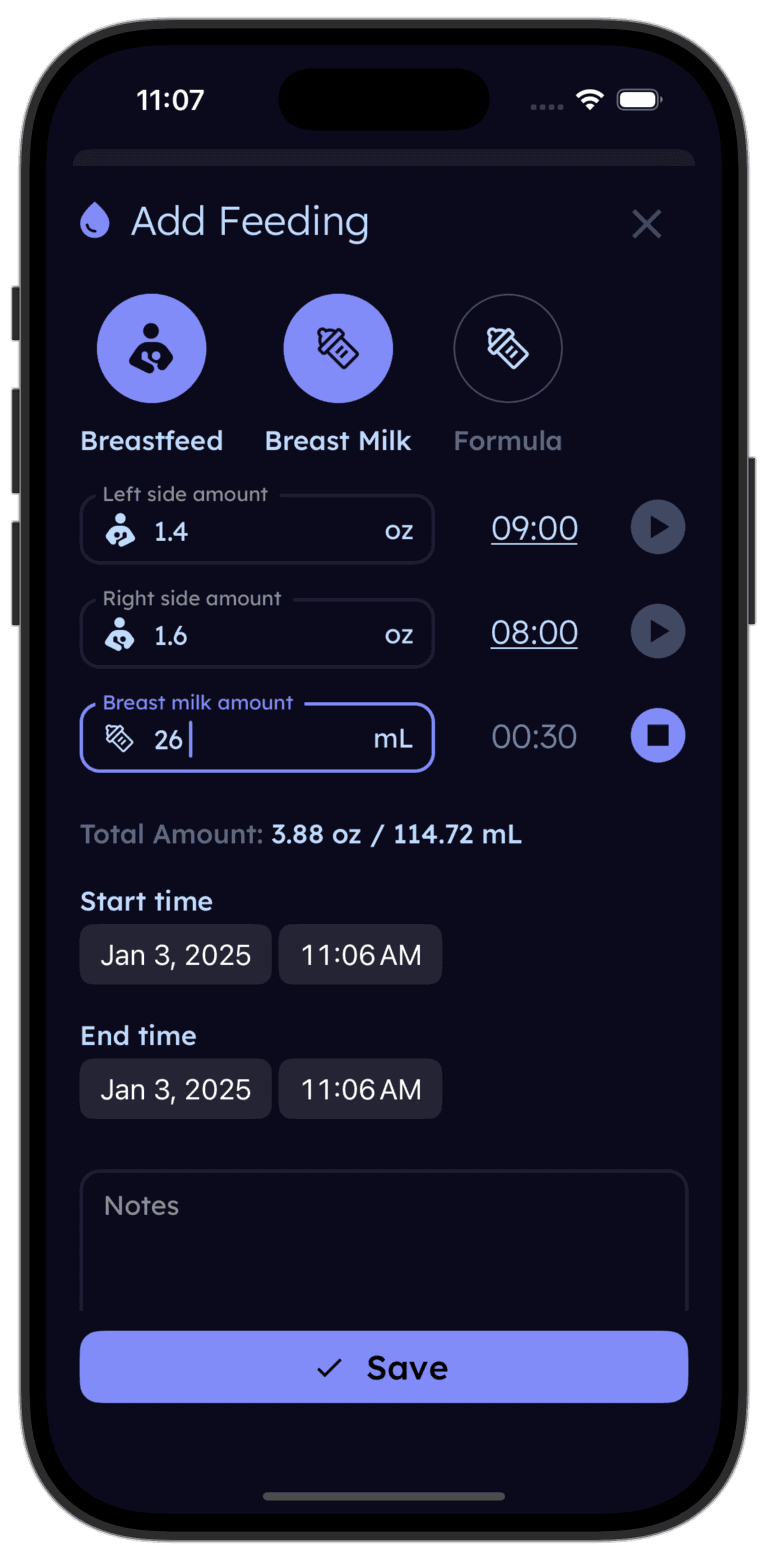
Tinylog tracks feeds so you can spot patterns.
Log bottle feeds, nursing sessions, and pumping. Track ounces over days and weeks. Bring the data to your next pediatrician visit.


Nipple Shape and Latch: The Factor That Matters Most
No amount of spec comparison matters if your baby refuses the nipple. This is the single most important variable, and it is entirely personal.
Tommee Tippee's nipple is wide and dome-shaped, designed to mimic the feel of a breast in the baby's mouth. It encourages a wide latch similar to breastfeeding. Many breastfed babies transition to this shape easily.
NUK's nipple is orthodontic — asymmetric and flatter, with multiple micro-holes at the tip instead of a single opening. The micro-holes distribute milk across the palate in a pattern that more closely resembles how breast milk flows during nursing. NUK claims this supports healthy oral development.
Both designs have strong evidence behind them. But babies are particular, and some will accept one shape and reject the other outright. The best strategy is to try both before committing to a full set.
| Product | Typical Price | Cost Per Bottle | Notes |
|---|---|---|---|
| Tommee Tippee Natural Start Anti-Colic (5 oz, 3-pack) | $18–$24 | ~$6–$8 | Often bundled in starter sets with accessories |
| NUK Simply Natural Glass (4 oz, 3-pack) | $24–$30 | ~$8–$10 | Higher upfront cost; glass lasts through multiple children |
| Tommee Tippee Natural Start Anti-Colic (9 oz, 3-pack) | $20–$26 | ~$7–$9 | Replacement nipples ~$5–$7 for a 2-pack |
| NUK Simply Natural Glass (8 oz, 1-pack) | $10–$14 | ~$10–$14 | Replacement nipples ~$5–$7 for a 2-pack |
Price: Upfront vs. Long-Term Value
Tommee Tippee wins on upfront cost — plastic bottles are simply cheaper to manufacture. A full set of Tommee Tippee bottles (six bottles, mixed sizes) typically runs $35–$50. An equivalent NUK glass set costs $55–$75.
But the long-term math is different. Plastic bottles should be replaced every 4–6 months as they scratch and degrade. Glass bottles can last through multiple children if handled carefully. If you plan to have more than one child, glass often costs less over the total span of use.
Replacement nipples cost roughly the same for both brands — about $5–$7 for a 2-pack — and both recommend replacing nipples every 1–2 months regardless of bottle material.
Practical cost tips:
- Registry discounts at Target, Amazon, and BuyBuy Baby often take 10–15% off bottles.
- Starter kits from both brands bundle bottles with brushes and extra nipples at a better per-item price.
- Do not overbuy before your baby picks a favorite. Start with 2–3 bottles of one brand. Expand only after your baby shows a clear preference.
Choose Tommee Tippee Natural Start If
- Your baby struggles with gas, spit-up, or colic symptoms
- You want a lightweight bottle that's safe if dropped
- Your baby latches well onto a wide, dome-shaped nipple
- You travel frequently and need shatterproof bottles
- You prefer more nipple flow-rate options as your baby grows
Choose NUK Simply Natural Glass If
- You want to avoid all plastic contact with milk or formula
- Your baby prefers an orthodontic nipple shape
- Long-term durability matters — you plan to reuse bottles for future children
- Easy, deep cleaning is a priority (glass does not absorb odors or stains)
- You want a bottle that handles temperature changes without degradation
- Your baby is still young enough that you hold the bottle during feeds
Where to Buy
If colic reduction is your top concern, the Tommee Tippee Natural Start Anti-Colic (~$7/bottle in a 3-pack) is a strong choice — the dedicated anti-colic valve, wide breast-like nipple, and lightweight design make it practical for everyday use. The 3-pack or starter kit on Amazon is the best value.
If you want glass construction and long-term durability, the NUK Simply Natural Glass Bottles (~$9/bottle in a 3-pack) are worth the premium — no plastic contact with milk, easy deep cleaning, and a bottle that will not degrade over years of use. The multi-hole nipple is also a standout feature for breastfed babies.
Our honest advice: buy one or two of each before committing. The "right" bottle is whichever one your baby accepts and feeds from comfortably. No review can predict that for your specific child.
Tinylog earns a small commission on purchases made through these links, at no cost to you.
Want to save a few bucks? promo.new is worth a quick look. It won't always have your product, but when it does, the savings are real.
The Bottom Line
Tommee Tippee Natural Start Anti-Colic and NUK Simply Natural Glass Bottles are both well-designed, thoughtful products. The core tradeoff is straightforward:
Tommee Tippee Natural Start wins on anti-colic venting, lighter weight, shatterproof durability, lower upfront cost, and more flow-rate options.
NUK Simply Natural Glass wins on material purity, long-term durability, ease of deep cleaning, temperature resilience, and zero plastic chemical concerns.
For most families, the deciding factor will be whether your baby prefers the wide dome nipple (Tommee Tippee) or the orthodontic multi-hole nipple (NUK). Buy a small quantity of each, test them, and then stock up on the winner.
If you are tracking feeding amounts and schedules — which is especially helpful when introducing bottles to a breastfed baby — Tinylog makes it easy to log every feed and share data with your pediatrician.
Related Guides
- Baby Feeding Chart — How much your baby should eat by age
- Breastfeeding Basics — Latching, positioning, and supply
- Baby Gas Relief — Causes, remedies, and when to call your doctor
- Formula Feeding — Types, preparation, and storage
Sources
- Tommee Tippee. "Natural Start Anti-Colic Baby Bottles — Product Information." tommeetippee.com, 2026.
- NUK USA. "Simply Natural Glass Baby Bottles — Product Information." nukusa.com, 2026.
- Wirecutter (The New York Times). "The Best Baby Bottles." nytimes.com, 2025.
- BabyGearLab. "Best Baby Bottles 2026 — Tested and Reviewed." babygearlab.com, 2026.
- American Academy of Pediatrics. "Feeding From a Bottle." healthychildren.org, 2025.
- Consumer Reports. "Best Baby Bottles From Our Tests." consumerreports.org, 2026.
- What to Expect. "Best Baby Bottles for Every Type of Feeding." whattoexpect.com, 2026.
This guide is for informational purposes only. Bottle choice is a personal preference based on your baby's individual needs. If your baby has difficulty feeding, persistent gas, or refuses bottles, consult your pediatrician or a lactation consultant.
Frequently asked questions
- Does the Tommee Tippee Natural Start Anti-Colic bottle really reduce colic?
- Tommee Tippee's anti-colic valve is designed to vent air away from milk so your baby swallows less air during feeds. Many parents report reduced gas and fussiness. However, colic has multiple causes, and no single bottle eliminates it entirely. The venting system does measurably reduce air ingestion compared to non-vented bottles.
- Are NUK Simply Natural Glass Bottles safe if dropped?
- NUK Simply Natural Glass Bottles are made from borosilicate glass, which is more resistant to thermal shock and breakage than regular glass. That said, glass can still shatter if dropped on a hard surface. Many parents use silicone sleeves for extra protection. They are not ideal for older babies who throw bottles.
- Which bottle is better for switching between breast and bottle?
- Both are designed to mimic the breast. NUK's multi-hole nipple distributes milk in a pattern similar to breastfeeding, while Tommee Tippee's wide, dome-shaped nipple encourages a wide latch. Success varies by baby — some prefer one shape over the other. Buying one of each to test is the most reliable approach.
- Can you use Tommee Tippee nipples on NUK bottles or vice versa?
- No. Tommee Tippee and NUK use different proprietary threading and sizing. Nipples are not interchangeable between brands. You must use each brand's own nipples with their bottles.
- How do you clean NUK glass bottles compared to Tommee Tippee plastic bottles?
- Both are dishwasher-safe (top rack for Tommee Tippee plastic components). Glass bottles are easier to sanitize because glass does not absorb odors or stains and can handle higher sterilization temperatures without degrading. Both brands' nipples should be inspected regularly for wear and replaced every two months.
- Which bottle is cheaper in the long run?
- Tommee Tippee has a lower upfront cost per bottle. NUK glass bottles cost more initially but last significantly longer — glass does not scratch, stain, or degrade the way plastic does. If you plan to reuse bottles for a second child, glass is often the better long-term investment.