GUIDE

White or Pale Baby Poop

White, pale, or chalky stool in a baby is never normal and requires immediate medical evaluation.

Bile is what gives stool its normal brown, green, or yellow color. When stool is white, pale gray, or the color of white clay, it means bile is not reaching the intestines — and the most critical cause is biliary atresia, a condition where early treatment dramatically changes outcomes.

This Is the One Color That Is Never Normal

Of all the stool colors you will see during your baby's first year — and you will see many — there is exactly one that should always prompt an immediate call to your pediatrician: white, pale gray, or chalky. Not light yellow. Not pale green. We are talking about stool that is the color of white clay, putty, chalk, or pale cement. Stool that has no color at all.

This guide is intentionally urgent in tone, but it is not meant to cause panic. The reason we emphasize speed is simple: the most serious condition associated with pale stool — biliary atresia — has dramatically better outcomes when it is caught early. Days and weeks matter. Parents who know what to look for are the first line of detection, and awareness is the single most powerful tool available.

Here is the core concept: bile, which is produced by the liver and stored in the gallbladder, is what gives stool its color. When bile flows normally into the intestines during digestion, it turns stool shades of yellow, green, brown, or orange. When bile cannot reach the intestines — because the bile ducts are blocked, damaged, or absent — the stool comes out white, pale, or the color of clay. This is called acholic stool (meaning "without bile"), and it always requires investigation.

Baby Stool Color Reference
Yellow (mustard, seedy)
What It Usually MeansNormal — typical breastfed baby stool
What to DoNo concern
Green (army green, pea soup)
What It Usually MeansNormal — common in formula-fed babies or during diet transitions
What to DoNo concern
Brown (peanut butter, tan)
What It Usually MeansNormal — common as baby starts solids
What to DoNo concern
Orange (butternut squash, carrot)
What It Usually MeansNormal — often dietary (beta-carotene foods)
What to DoNo concern
Pale yellow (light but still has some color)
What It Usually MeansPossibly normal but worth monitoring
What to DoMonitor closely — if it gets lighter, call pediatrician
White, pale gray, or chalky (white clay, putty, chalk)
What It Usually MeansAbnormal — bile is not reaching the intestines
What to DoCall pediatrician immediately — same-day evaluation
Black and tarry (after meconium period)
What It Usually MeansAbnormal — possible upper GI bleeding
What to DoSeek medical attention promptly
Normal baby stool covers a wide range of colors. The critical distinction is between 'some shade of color' (bile is present) and 'no color at all' (bile may not be reaching the intestines).

Why Bile Matters: A Quick Anatomy Lesson

To understand why pale stool is so concerning, it helps to know what bile does. Your baby's liver produces bile — a yellow-green fluid that serves two important functions. First, it helps break down and absorb fats and fat-soluble vitamins (A, D, E, and K) from food. Second, it carries waste products, including bilirubin (the same pigment that causes jaundice), out of the body through the stool.

Bile travels from the liver through a network of tiny tubes called bile ducts, into the gallbladder for storage, and then into the small intestine when food needs to be digested. It is the bilirubin in bile that gives stool its characteristic color. Without bile reaching the intestines, stool loses its color entirely — and fats and essential vitamins cannot be properly absorbed.

When bile cannot drain, it backs up into the liver. This causes progressive liver damage — inflammation, scarring (fibrosis), and eventually cirrhosis if not treated. The bile pigments that cannot exit through the stool get rerouted through the blood and kidneys, which is why babies with bile duct problems often have persistent jaundice (yellow skin from excess bilirubin in the blood) and dark urine (bilirubin excreted through the kidneys instead of the intestines).

Biliary Atresia: What Every Parent Should Know

Biliary atresia is the most important condition associated with pale or white stool in infants. It is a rare condition — affecting approximately 1 in 10,000 to 15,000 live births — but it is the leading cause of liver transplantation in children, which is why early detection is critical.

In biliary atresia, the bile ducts outside the liver (and sometimes inside) become inflamed, scarred, and blocked. The cause is not fully understood — it is not inherited, not caused by anything the mother did during pregnancy, and not preventable. It typically develops in the first few weeks of life. Babies with biliary atresia are usually born looking healthy, and the condition reveals itself gradually as jaundice persists and stools become progressively paler.

The initial presentation can be deceptive. Many newborns have jaundice in the first week or two of life — this is normal physiological jaundice and resolves on its own. But in biliary atresia, the jaundice does not resolve. It persists beyond 2-3 weeks and may deepen. Meanwhile, stools gradually lose their color, and urine may darken. Because the early symptoms overlap with common, benign newborn jaundice, biliary atresia can be missed if parents and providers are not specifically looking for it.

This is exactly why awareness of stool color matters so much. Parents change diapers many times a day. They are the first to notice when something looks different. A parent who knows that pale stool is abnormal can flag it immediately — and that awareness can mean the difference between a timely diagnosis and a delayed one.


Warning Signs of Biliary Atresia

  • Pale, white, or clay-colored stool that persists or worsens
  • Jaundice (yellow skin and eyes) that does not resolve by 2-3 weeks of age
  • Dark urine that stains the diaper yellow or brown
  • Enlarged or firm liver (your pediatrician may detect this on exam)
  • Poor growth or failure to thrive despite adequate feeding
  • Easy bruising or bleeding (in later stages, due to impaired vitamin K absorption)

If your baby has persistent jaundice beyond 2-3 weeks combined with pale stool, contact your pediatrician urgently. Early diagnosis is the single most important factor in treatment outcomes.

The Kasai Procedure and Why Timing Is Everything

The primary treatment for biliary atresia is the Kasai procedure (also called a Kasai portoenterostomy), a surgery in which the damaged bile ducts are removed and a loop of intestine is connected directly to the liver to create a new pathway for bile to drain. The operation was developed by Dr. Morio Kasai in the 1950s and remains the standard first-line treatment worldwide.

Here is the critical fact: the Kasai procedure is most successful when performed before 60 days of age. Studies consistently show that earlier surgery correlates with better bile drainage, slower progression of liver damage, and a reduced need for liver transplantation. When performed before 30 to 45 days, success rates are highest. After 90 days, the liver may already have significant scarring, and the procedure is less likely to restore adequate bile flow.

This is not meant to scare you. It is meant to underscore why stool color screening matters. Every week of earlier detection translates into better odds for the baby. The Kasai procedure is not a cure — some children with biliary atresia will eventually need a liver transplant — but it can buy years of time with a native liver, and for many children, it is the only surgery they ever need.

Biliary Atresia Diagnosis Timeline
Birth to 30 days
What's HappeningBiliary atresia symptoms typically begin to appear. Jaundice may initially be attributed to normal newborn jaundice.
30 to 45 days
What's HappeningIdeal window for diagnosis. Persistent jaundice and pale stools should trigger immediate workup including blood tests and ultrasound.
Before 60 days
What's HappeningThe Kasai procedure (portoenterostomy) has the best outcomes when performed before 60 days of age. Success rates for bile drainage are significantly higher.
60 to 90 days
What's HappeningThe Kasai procedure can still be performed but outcomes begin to decline. Every week matters.
After 90 days
What's HappeningThe Kasai procedure has lower success rates. Some infants may eventually need a liver transplant.
Timing data from NASPGHAN and the Biliary Atresia Research Consortium. Every day of earlier detection improves outcomes.

The Stool Color Card: A Screening Tool That Saves Lives

In 2004, Taiwan became the first country in the world to implement a nationwide stool color card screening program for biliary atresia. The program provides parents of every newborn with a card showing photographs of normal-colored stools and abnormal pale stools. Parents are instructed to compare their baby's stool to the card during the first month of life and to contact their doctor immediately if the stool matches the pale or acholic images.

The results were striking. A landmark study by Lien et al. published in Pediatrics in 2011 found that the stool color card program significantly improved the rate of early diagnosis of biliary atresia in Taiwan. The proportion of infants who received the Kasai procedure before 60 days of age increased substantially after the program was introduced, and outcomes improved accordingly.

Several other countries and regions have since adopted or piloted similar screening programs, including Japan, parts of Europe, and parts of Canada. In the United States, NASPGHAN (the North American Society for Pediatric Gastroenterology, Hepatology and Nutrition) recommends that pediatricians ask about stool color at every well-child visit in the first month and that parents be educated about the significance of acholic stool.

You do not need a physical stool color card to use this concept. Simply knowing that pale, white, or clay-colored stool is abnormal — and acting on it — puts you in the same position as a parent using the card. The message is the same: if the stool has no color, call your doctor today.

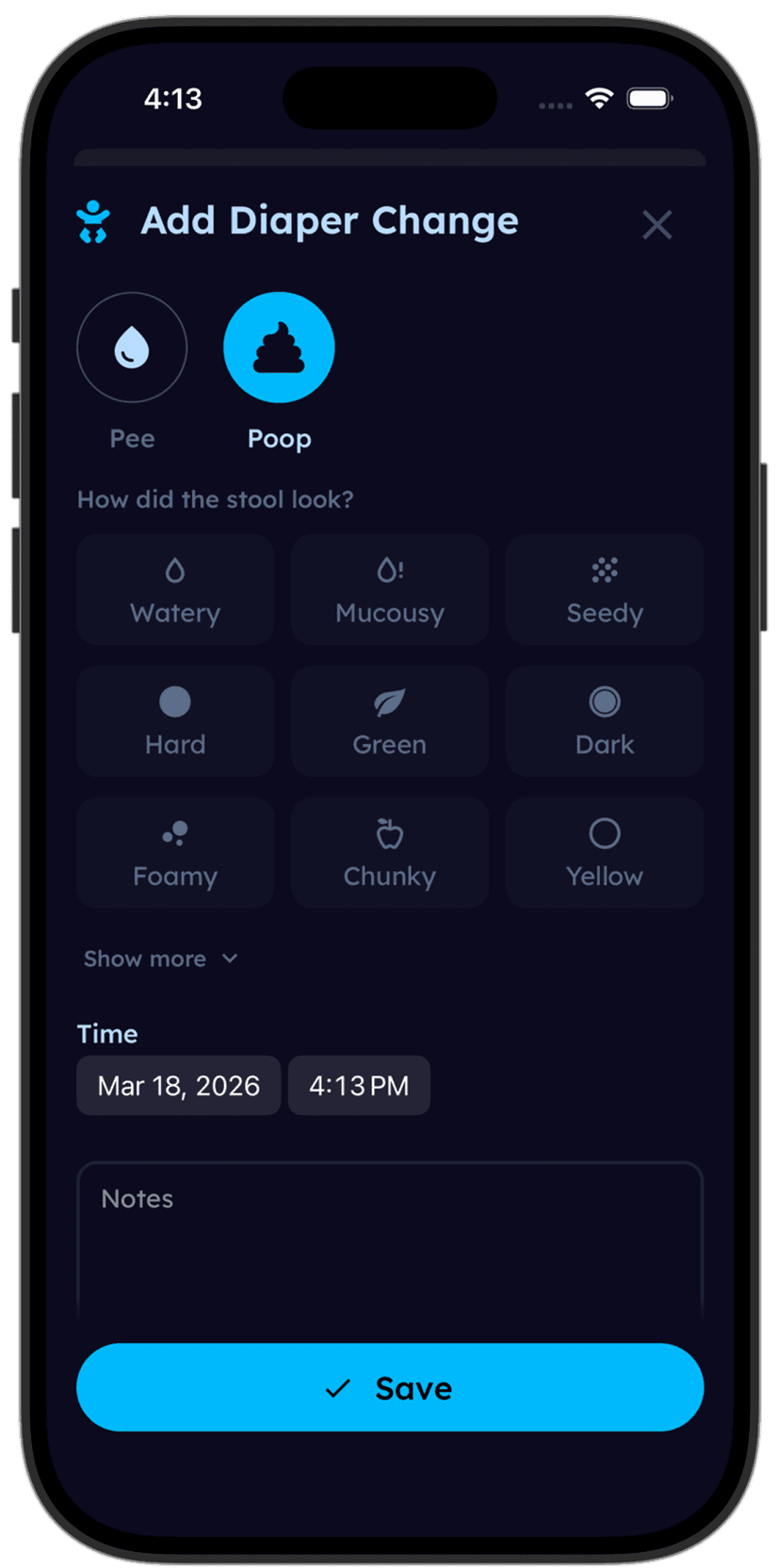
tinylog diaper tracking screen showing stool color notes

A diaper log gives your pediatrician the timeline they need.

When you track diaper changes in tinylog, you can note stool color and consistency for each change. If you ever need to tell your pediatrician 'the stools have been getting paler over the last four days,' having a log with dates and notes turns a vague concern into actionable clinical information.

Download on the App StoreGet It On Google Play

When to Call Your Pediatrician Immediately

  • Stool that is white, pale gray, chalky, or the color of white clay or putty
  • Stool that is consistently very pale — lighter than usual with no obvious dietary cause
  • Yellowing of the skin or whites of the eyes (jaundice) that persists beyond 2-3 weeks of age
  • Dark yellow or brown urine in a baby whose stool is pale (bile pigments diverted to urine)
  • A swollen or firm abdomen
  • Poor weight gain combined with any of the above signs

Do not wait for the next scheduled well-child visit. Pale stool combined with prolonged jaundice warrants same-day or next-day evaluation. If you cannot reach your pediatrician, go to a pediatric urgent care or emergency department.

What to Tell Your Doctor

If you see pale or white stool, here is how to communicate effectively with your pediatrician so the right workup happens quickly.

Describe the exact color

Use real-world comparisons: 'It looked like white clay,' 'It was the color of putty,' 'It was like pale cement.' Better yet, bring a photo or the diaper itself. Pediatricians would much rather see the actual stool than rely on a description.

Note how many pale stools you've seen

Was this a single diaper, or has it been happening for several days? One pale stool could occasionally be a fluke, but repeated pale stools are a pattern that needs investigation. This is where a diaper log becomes invaluable.

Mention any jaundice

If your baby's skin or the whites of their eyes still look yellow beyond the first two weeks of life, tell your doctor. Prolonged jaundice combined with pale stool is a classic presentation of biliary atresia and should prompt immediate testing.

Describe the urine color

When bile cannot flow into the intestines, bile pigments are excreted through the kidneys instead, turning the urine dark. If your baby's urine is staining the diaper a deeper yellow or brown while the stool is pale, mention this — it is an important diagnostic clue.

Other Possible Causes of Pale Stool

While biliary atresia is the most critical diagnosis to rule out, it is not the only possible cause of pale stool. Other conditions that can reduce bile flow include choledochal cysts (dilations of the bile ducts), neonatal hepatitis (inflammation of the liver from various causes), Alagille syndrome (a genetic condition affecting bile ducts), and rarely, gallstones or bile duct compression.

Certain medications can also temporarily lighten stool color. Antacids containing aluminum hydroxide and barium used in imaging studies are known to cause pale stools. However, these causes should be evident from the baby's medication or medical history, and they should never be assumed without first ruling out more serious conditions.

The key principle is this: do not self-diagnose a benign cause of pale stool. Let your pediatrician evaluate it. The workup for pale stool — which typically includes blood tests for liver function and bilirubin levels, and an abdominal ultrasound — is noninvasive and readily available. The peace of mind from a negative workup is worth far more than the anxiety of waiting.

The Bottom Line

White, pale, or chalky baby poop is the one stool color that is never wait-and-see. It means bile is not reaching the intestines, and the most critical possible cause — biliary atresia — requires early diagnosis and surgery for the best outcomes. The Kasai procedure is most effective before 60 days of age, which means every day of awareness counts.

You do not need to obsessively examine every diaper under bright light. Normal stool varies widely — yellow, green, brown, orange, and everything in between. What you are watching for is the absence of color. Stool that looks like white clay, putty, chalk, or pale cement. If you see it, call your pediatrician immediately, take a photo, and describe what you are seeing. That simple action could be the most important thing you do for your child's health.

Tracking your baby's diapers in tinylog gives you a record that you and your pediatrician can review together. But for this particular color, the log is less important than the phone call. See pale stool, call your doctor. That is the entire message.

Related Guides

Sources

  • Lien, T. H., et al. (2011). Effects of the infant stool color card screening program on 5-year outcome of biliary atresia in Taiwan. Hepatology, 53(1), 202-208.
  • NASPGHAN. (2017). Guideline for the Evaluation of Cholestatic Jaundice in Infants. Journal of Pediatric Gastroenterology and Nutrition, 64(1), 154-168.
  • American Academy of Pediatrics (AAP). (2023). Jaundice in Newborns. HealthyChildren.org.
  • Harpavat, S., et al. (2019). Newborn Screening for Biliary Atresia: Lessons from Taiwan and Future Directions. Current Gastroenterology Reports, 21(10).
  • Hartley, J. L., Davenport, M., & Kelly, D. A. (2009). Biliary atresia. The Lancet, 374(9702), 1704-1713.
  • WHO. (2023). Infant and Young Child Feeding: Counselling and Support. World Health Organization.

Medical Disclaimer

This guide is for informational purposes only and is not a substitute for professional medical advice, diagnosis, or treatment. White, pale, or chalky stool in an infant is a medical finding that requires prompt evaluation by a healthcare provider. If your baby has pale stool, do not delay — contact your pediatrician or seek medical care immediately.

Get this guide in your inbox.
We'll email you this guide so you have it as a reference — including the stool color comparison and what to tell your pediatrician.
Track stool color — it could be the detail that matters most.
Download tinylog free — log every diaper with notes and never lose a detail.
Download on the App StoreGet It On Google Play