
GUIDE
Aveeno Baby Daily Moisture vs. Cetaphil Baby Wash & Shampoo
Published on
Aveeno Baby is the better pick for dry or eczema-prone skin thanks to its colloidal oatmeal formula. Cetaphil Baby is a solid all-around wash with a gentler lather and slightly lower price. Both are tear-free, fragrance-free (in their sensitive lines), and pediatrician-tested.
Aveeno Baby and Cetaphil Baby are two of the most recommended baby washes by pediatricians and dermatologists. They take different approaches — Aveeno leans on its proprietary oat-based moisturizing complex, while Cetaphil focuses on a mild, no-frills cleansing formula. The right choice depends on your baby's skin type, how much moisture they need, and your budget.
Two Trusted Baby Washes, Two Different Approaches
Aveeno Baby and Cetaphil Baby are staples on pediatrician recommendation lists — and for good reason. Both are tear-free, gentle, and designed specifically for delicate baby skin. But they are not the same product doing the same thing.
Aveeno Baby Daily Moisture Wash & Shampoo is built around natural colloidal oatmeal, an ingredient with a long history of soothing and moisturizing irritated or dry skin. It cleans your baby while leaving behind a light layer of moisture. Think of it as a wash that doubles as a skin treatment.
Cetaphil Baby Wash & Shampoo takes a more minimalist path. It uses mild, glycerin-based cleansers to remove dirt and oil without adding much back. It gets the job done, rinses clean, and stays out of the way. No scent, no residue, no frills.
The honest truth is that most babies do well with either one. The choice becomes more important when your baby has dry skin, eczema, or sensitivities that make bath time a little more complicated.
| Feature | Aveeno Baby | Cetaphil Baby | What It Means |
|---|---|---|---|
| Manufacturer | Johnson & Johnson (Aveeno brand) | Galderma (Cetaphil brand) | Both are backed by major skin-care companies with long track records in dermatology. |
| Key active ingredient | Natural colloidal oatmeal | Glycerin-based mild cleansers | Aveeno's oat complex provides active moisturizing during the wash. Cetaphil focuses on gentle cleansing without stripping oils. |
| Tear-free | Yes | Yes | Tie. Both are formulated to be tear-free for baby's eyes. |
| Soap & paraben free | Yes — soap-free, paraben-free, phthalate-free | Yes — soap-free, paraben-free, hypoallergenic | Tie. Neither contains soap, parabens, or harsh detergents. |
| Fragrance | Lightly scented (natural oat scent, no added fragrance) | Fragrance-free | Cetaphil is the better choice if you want absolutely zero scent. Aveeno has a mild, natural smell. |
| Moisturizing ability | Strong — colloidal oatmeal actively hydrates skin | Moderate — cleans without stripping, but no active moisturizer | Aveeno wins here. The oat formula leaves skin noticeably softer after bath time. |
| Lather | Light to moderate lather | Very gentle, low lather | Aveeno produces slightly more lather. Cetaphil's minimal lather can feel like it is not cleaning, but it is. |
| Dermatologist recommended | Yes — recommended for dry and eczema-prone skin | Yes — recommended as a gentle everyday wash | Both carry strong dermatologist endorsements. Aveeno is more commonly cited for eczema-prone babies. |
| 2-in-1 (wash + shampoo) | Yes | Yes | Tie. Both work as body wash and shampoo in one product. |
| Consistency / texture | Creamy, slightly thick gel | Thin, clear liquid | Aveeno feels richer on the skin. Cetaphil is lighter and rinses off faster. |
| Bottle sizes | 8 oz, 18 oz, 33 oz (pump) | 7.8 oz, 13.5 oz | Aveeno offers a larger pump bottle option, which is more convenient for bath time. |
| NEA Seal of Acceptance | Yes — accepted by the National Eczema Association | Yes (Cetaphil Eczema line; standard Baby Wash varies) | Aveeno's standard baby wash carries the NEA seal. For Cetaphil, the eczema-specific line holds it. |
The Oatmeal Difference: Why It Matters
The biggest difference between these two washes comes down to one ingredient: colloidal oatmeal.
Colloidal oatmeal is finely ground oat that has been used for centuries to soothe irritated skin. It is recognized by the FDA as a skin protectant and is a go-to recommendation from dermatologists for babies dealing with eczema, cradle cap dryness, or general winter-weather dryness.
Aveeno built its entire baby line around this ingredient. When you wash your baby with Aveeno Baby Daily Moisture, the oat complex binds to skin and helps lock in moisture. Parents often notice that their baby's skin feels softer and smoother after bath time compared to using a basic cleanser.
Cetaphil does not include oatmeal or a comparable active moisturizer in its standard Baby Wash & Shampoo. It cleans gently — it does that well — but it does not add moisture back. For babies with healthy, normal skin, this is perfectly fine. For babies who step out of the bath looking dry or patchy, the Aveeno formula has a clear advantage.
If your baby has eczema or consistently dry skin, the oatmeal-based formula can make a noticeable difference in how their skin feels between baths. If your baby's skin is healthy, Cetaphil's simpler approach works just as well for everyday cleaning.
Fragrance and Sensitivity: A Closer Look
One area where Cetaphil has a slight edge is scent. Cetaphil Baby Wash & Shampoo is completely fragrance-free — there is no added scent and no noticeable smell from the formula itself.
Aveeno Baby Daily Moisture Wash does not contain added synthetic fragrance, but it has a mild, natural oat scent that comes from the colloidal oatmeal ingredient. Most parents describe it as very faint and pleasant. However, if your baby reacts to any scent at all, or if you are trying to eliminate every possible variable while troubleshooting skin issues, the truly unscented Cetaphil formula might be the safer starting point.
Both products are:
- Tear-free for baby's eyes
- Soap-free — they use mild surfactants instead of traditional soap
- Paraben-free and free of phthalates
- Allergy-tested and suitable for sensitive skin
- Pediatrician-tested and widely recommended
For the vast majority of babies, both washes are gentle enough for regular use without causing irritation. The fragrance question only becomes meaningful if your baby has shown sensitivity to scented products.
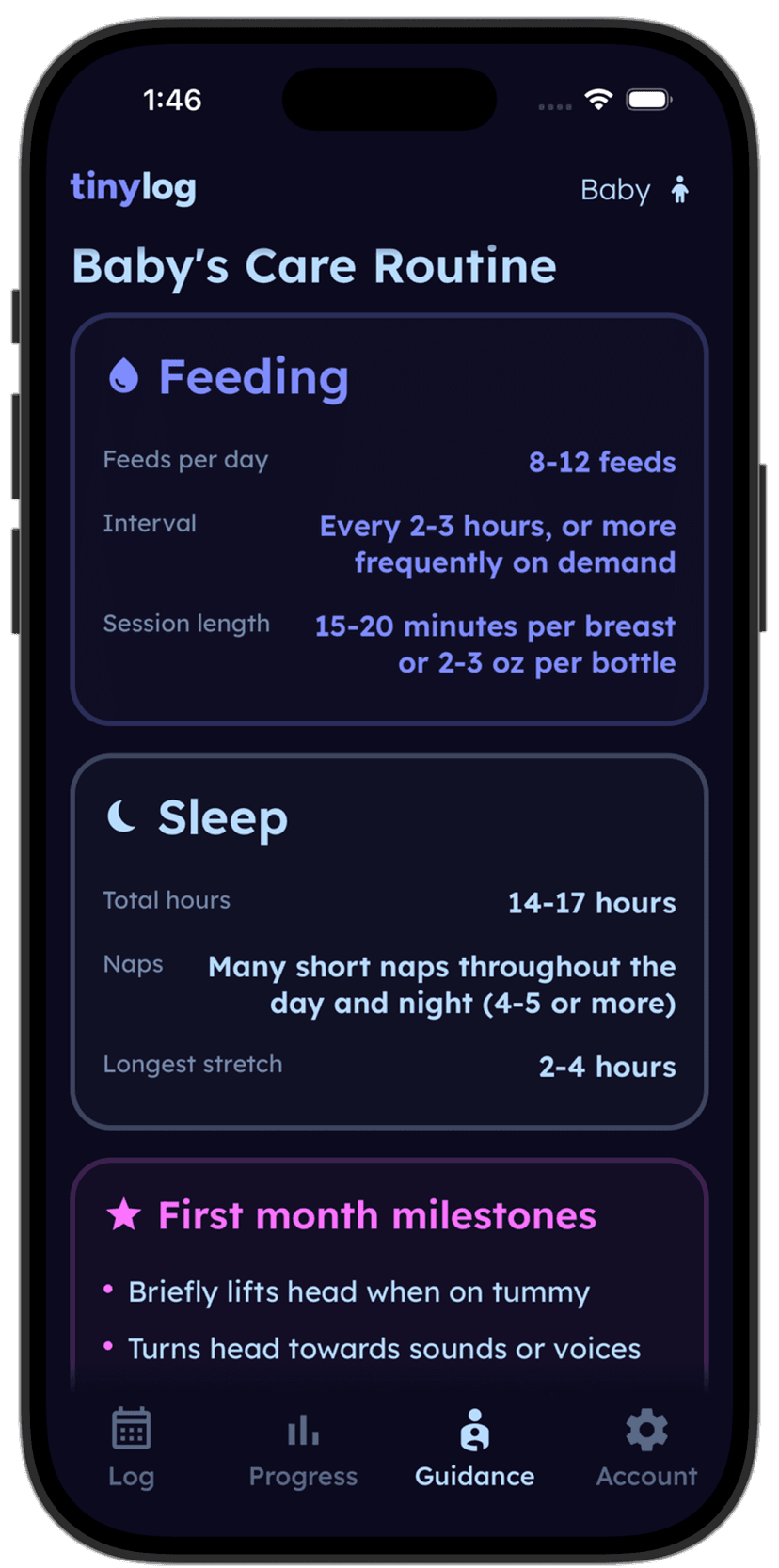
Tinylog tracks feedings so you can spot patterns.
Log feedings, baths, and skin changes all in one place. See patterns over time and share the data with your pediatrician.


| Product | Typical Price | Cost Per Ounce | Monthly Estimate |
|---|---|---|---|
| Aveeno Baby Daily Moisture Wash & Shampoo (18 oz) | $8–$11 | ~$0.44–$0.61 | ~$8–$11 |
| Aveeno Baby Daily Moisture Wash & Shampoo (33 oz pump) | $13–$16 | ~$0.39–$0.48 | ~$7–$10 |
| Cetaphil Baby Wash & Shampoo (13.5 oz) | $7–$10 | ~$0.52–$0.74 | ~$7–$10 |
| Cetaphil Baby Wash & Shampoo (7.8 oz) | $5–$7 | ~$0.64–$0.90 | ~$8–$12 |
Price: Surprisingly Close
Unlike some baby product comparisons where one option costs twice as much, Aveeno and Cetaphil are priced in the same ballpark. At most retailers, you are looking at a difference of a dollar or two per bottle.
Where Aveeno pulls ahead on value is the 33 oz pump bottle. At roughly $0.39–$0.48 per ounce, it is the cheapest per-ounce option across both brands. The pump format is also genuinely useful during bath time when you are holding a slippery baby with one hand.
Cetaphil's 13.5 oz bottle is competitively priced, but the per-ounce cost is slightly higher than Aveeno's larger sizes. Cetaphil does not currently offer a comparable jumbo pump bottle.
A few ways to save on either brand:
- Subscribe and save on Amazon for 5–15% off recurring deliveries
- Buy the largest available size — per-ounce cost drops significantly
- Watch for Target, Walmart, and CVS sales — both brands go on sale regularly
- Stack with store coupons or cashback apps like Ibotta
Lather, Rinse, and the Bath Experience
Parents notice real differences in how these two washes feel during bath time.
Aveeno produces a light, creamy lather that feels rich without being heavy. The slightly thicker gel consistency makes it easy to work into skin and scalp. It rinses off cleanly but leaves skin feeling soft — not squeaky. Some parents describe the after-bath skin as having a light, smooth feel.
Cetaphil is a thinner, almost watery liquid that produces very little lather. This can be surprising if you are used to conventional body washes. The low lather does not mean it is not cleaning — it absolutely is — but some parents feel like they need to use more product because it does not "feel" like it is working. It rinses off instantly with no residue whatsoever.
Neither approach is better in an absolute sense. If you like the feel of a lathering wash and want that post-bath softness, Aveeno delivers. If you want the fastest, cleanest rinse with zero residue, Cetaphil is your pick.
Choose Aveeno Baby Daily Moisture If
- Your baby has dry skin, eczema, or rough patches that need extra moisture
- You want a wash that actively hydrates while it cleans
- Your pediatrician or dermatologist has recommended an oat-based wash
- You prefer a creamier, richer lather during bath time
- You want the larger pump bottle option for easier one-handed use
Choose Cetaphil Baby Wash & Shampoo If
- Your baby has healthy skin and you want a simple, gentle everyday wash
- You prefer a completely fragrance-free product with no scent at all
- You want a thinner formula that rinses off quickly with minimal residue
- Budget is a priority and you want solid quality at a lower shelf price
- Your baby does not have dryness or eczema issues that need active treatment
- You prefer a lighter wash that does not leave any film on skin
Where to Buy
If your baby has dry or eczema-prone skin, Aveeno Baby Wash & Shampoo (~$0.39–$0.61/oz depending on size) is the stronger choice — the colloidal oatmeal formula actively moisturizes while it cleans, and the 33 oz pump bottle is both economical and practical for bath time.
If you want a straightforward, fragrance-free everyday wash for healthy skin, Cetaphil Baby Wash & Shampoo (~$0.52–$0.74/oz) is a reliable pick — gentle, no-frills, and trusted by pediatricians. It rinses clean and leaves nothing behind.
Our honest take: for babies with normal skin, either wash is a great choice and you genuinely cannot go wrong. For babies with dryness, eczema, or rough patches, the oat-based Aveeno formula gives you a meaningful advantage at bath time.
Tinylog earns a small commission on purchases made through these links, at no cost to you.
Tip: check promo.new before purchasing. It's hit or miss depending on the product, but when it hits, you'll be glad you checked.
The Bottom Line
Aveeno Baby Daily Moisture and Cetaphil Baby Wash & Shampoo are both excellent, pediatrician-backed baby washes. The differences are real but manageable:
Aveeno Baby wins on moisturizing power (colloidal oatmeal), skin-soothing ability, larger bottle options, and the National Eczema Association seal of acceptance. It is the better wash for babies with dry or sensitive skin.
Cetaphil Baby wins on simplicity, fragrance-free formulation, fast rinsing, and a slightly lower entry price. It is a dependable everyday wash for babies with healthy skin who do not need extra moisture.
Both are tear-free, soap-free, and gentle enough for regular use from birth. You are choosing between two good options — not between a good one and a bad one.
If you are testing a new wash and want to track how your baby's skin responds, Tinylog makes it easy to log baths and note any changes in skin condition over time. Patterns that are hard to see day-to-day become clear when you have a few weeks of data.
Sources
- Aveeno.com. "Aveeno Baby Daily Moisture Wash & Shampoo — Product Information." 2026.
- Cetaphil.com. "Cetaphil Baby Wash & Shampoo — Product Information." 2026.
- National Eczema Association. "Seal of Acceptance — Aveeno Baby Products." nationaleczema.org.
- American Academy of Dermatology. "How to Bathe Your Newborn." aad.org, 2025.
- HealthyChildren.org (AAP). "Bathing Your Baby." healthychildren.org, 2025.
- Healthline Parenthood. "Best Baby Washes and Shampoos." healthline.com, 2026.
- BabyCenter. "Choosing a Baby Wash: What to Look For." babycenter.com, 2026.
Related Guides
This guide is for informational purposes only and is not medical advice. Every baby's skin is different. If your baby develops persistent dryness, rash, or irritation with any wash, stop using it and talk to your pediatrician.
Frequently asked questions
- Is Aveeno Baby Wash safe for newborns?
- Yes. Aveeno Baby Daily Moisture Wash & Shampoo is tear-free, soap-free, and allergy-tested. It is widely used from birth. That said, newborns do not need daily baths — two to three times a week is plenty in the early weeks. Always check with your pediatrician if your baby has specific skin conditions.
- Does Cetaphil Baby Wash help with eczema?
- Cetaphil Baby Wash & Shampoo is gentle enough for eczema-prone skin, but it does not contain active moisturizing ingredients like colloidal oatmeal. Cetaphil does make a separate Eczema Calming line. For the standard Baby Wash & Shampoo, it cleans without stripping moisture but does not actively treat dry skin the way an oat-based formula can.
- Can I use Aveeno Baby Wash as a shampoo too?
- Yes. Aveeno Baby Daily Moisture Wash & Shampoo is a 2-in-1 product designed for both body and hair. It lathers lightly and rinses clean without leaving residue. Most baby washes in this category are designed as combined wash and shampoo products.
- Which baby wash do pediatricians recommend more often?
- Both brands appear regularly on pediatrician recommendation lists. Aveeno tends to be recommended more often for babies with dry or eczema-prone skin because of the colloidal oatmeal ingredient. Cetaphil is frequently recommended as a reliable, affordable everyday wash. Your pediatrician may have a specific preference based on your baby's skin.
- Are either of these washes truly fragrance-free?
- Cetaphil Baby Wash & Shampoo is fragrance-free in the standard formulation. Aveeno Baby Daily Moisture Wash uses a lightly scented natural oat formula — it has a mild oat scent but Aveeno states it is formulated without parabens, phthalates, dyes, or added fragrance. If you need a completely unscented product, Cetaphil has the edge.
- How often should I bathe my baby with these washes?
- For most babies, two to three baths per week is enough in the first year. Over-bathing can dry out delicate skin, regardless of which wash you use. On non-bath days, a warm washcloth for face, neck folds, and diaper area is sufficient. If your baby has very dry skin, less frequent baths with a moisturizing wash like Aveeno may help.