GUIDE

Baby Acne

Baby acne is caused by maternal hormones and clears on its own. Do not treat it.

Your perfect newborn suddenly looks like a teenager and you are wondering what you did wrong. Nothing. This is one of the most common and most temporary skin conditions in newborns.

What Baby Acne Actually Is

Baby acne — technically neonatal cephalic pustulosis or neonatal acne — is your newborn's skin reacting to hormones. During pregnancy, maternal androgens cross the placenta and circulate in your baby's bloodstream. After birth, these hormones stimulate your baby's tiny, immature sebaceous (oil) glands, which respond by producing more oil than they can handle. The result: small, pimple-like bumps on the face, exactly like a miniature version of teenage acne.

It affects about 20% of newborns and typically appears between two and four weeks of age — right around the time you have finally figured out feeding and are starting to feel like maybe you can do this parenting thing. Then your perfect baby's face breaks out and you wonder what went wrong.

Nothing went wrong. The hormones are metabolized and cleared from your baby's system over the first few months of life, and the acne disappears with them. By three to four months, most babies have completely clear skin with zero intervention. No creams, no treatments, no special routines.

The reason this is worth knowing about is not because you need to do anything — you do not — but because it prevents you from doing things that make it worse. Putting lotions, oils, or acne products on a newborn's face can clog pores, irritate skin, or cause contact dermatitis, turning a harmless, self-resolving condition into an actual problem.


Baby Acne vs. Other Newborn Face Bumps
Neonatal Acne
What It Looks LikeSmall red/white bumps (pimple-like) on cheeks, forehead, chin
When It Appears2-4 weeks of life
Itchy?No
How LongClears by 3-4 months
What to DoNothing. Wash gently with water.
Milia
What It Looks LikeTiny white bumps (like whiteheads) on nose, cheeks, chin
When It AppearsPresent at birth
Itchy?No
How Long1-2 months
What to DoNothing. Do not squeeze.
Erythema Toxicum (ETN)
What It Looks LikeRed blotches with white/yellow pustules — looks like flea bites
When It AppearsDays 2-5 of life
Itchy?No
How Long5-7 days
What to DoNothing. Very common (up to 50% of newborns).
Eczema
What It Looks LikeDry, rough, scaly red patches
When It Appears2-6 months
Itchy?Very itchy
How LongChronic — months to years
What to DoMoisturize aggressively. May need prescription.
Infantile Acne
What It Looks LikeMore prominent acne with comedones (blackheads/whiteheads), papules, and sometimes nodules
When It Appears2-12 months
Itchy?No
How LongCan persist for months to years
What to DoSee pediatrician — may need treatment to prevent scarring.
Contact Irritation
What It Looks LikeRed, irritated skin only where something touched — detergent, drool, spit-up
When It AppearsAny time
Itchy?May be mildly irritated
How LongResolves when irritant removed
What to DoRemove irritant. Gentle cleaning.
The most common newborn face bumps — acne, milia, and ETN — all resolve on their own without treatment. The one that does NOT resolve on its own is eczema, which needs moisturizing.

What to Do (and What Not to Do)

The treatment for baby acne is aggressively simple: gentle washing with water, and patience. That is it. The temptation to do more is strong — especially when your mother-in-law suggests putting breast milk on it, or the internet tells you to try coconut oil — but doing nothing is genuinely the best approach.

Baby Acne Do's and Don'ts
Wash face gently with warm water once a day
Not ThisUse acne products (salicylic acid, benzoyl peroxide)
Use a soft cloth or your hand — no scrubbing
Not ThisScrub, exfoliate, or use rough washcloths
Pat dry gently
Not ThisApply lotions, oils, or creams to the bumps
Use fragrance-free baby cleanser if needed
Not ThisSqueeze, pop, or pick at the bumps
Keep the area clean and dry
Not ThisUse adult skincare products of any kind
Be patient — it clears on its own
Not ThisWorry that it will scar (neonatal acne does not scar)
Take the newborn photos anyway
Not ThisDelay photos waiting for clear skin — you will regret it
The hardest part of managing baby acne is resisting the urge to manage it. Your baby's skin knows what to do. Give it time.
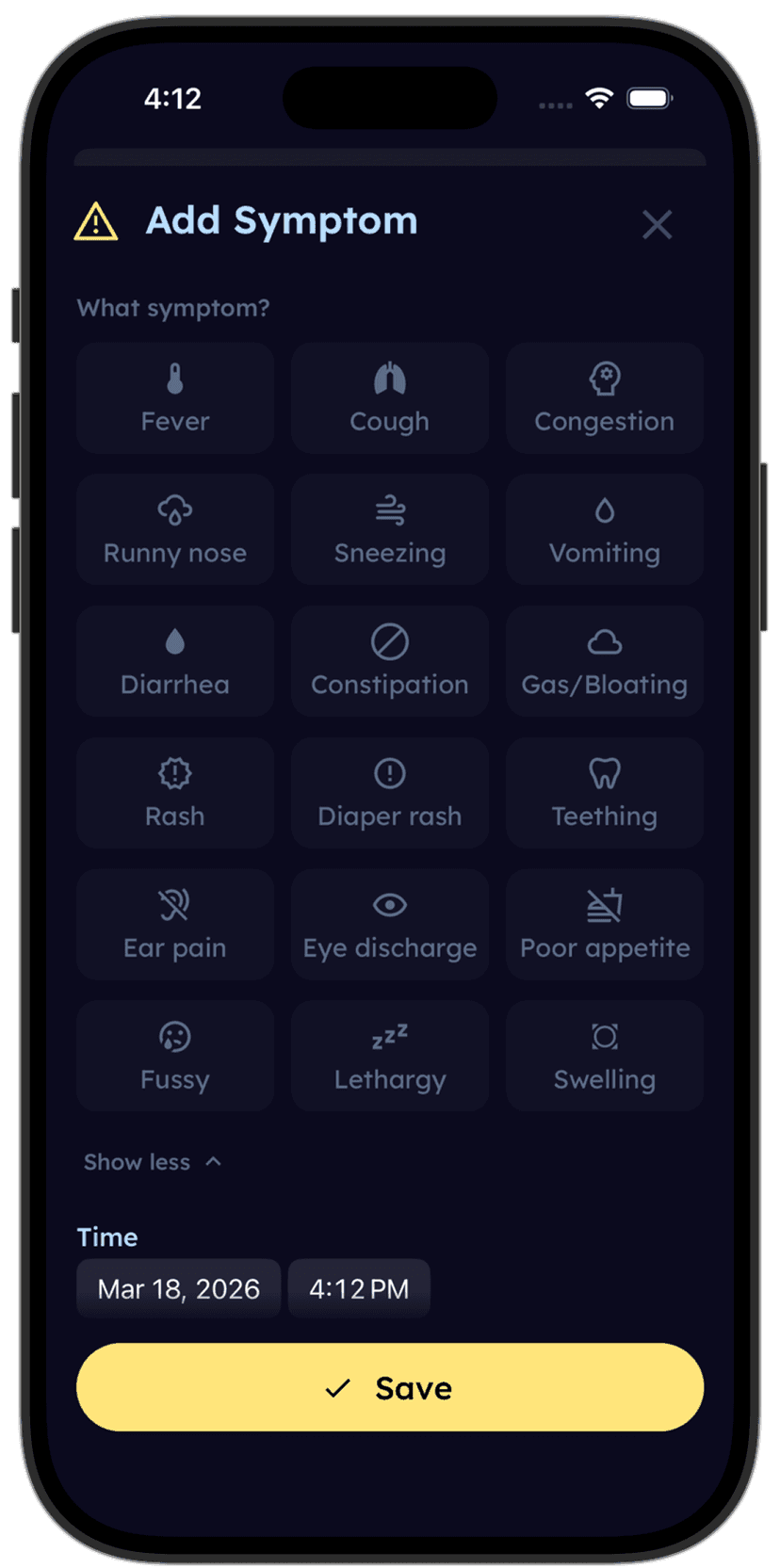
tinylog symptom tracking showing skin observation log

Is it getting worse or have you just been staring at it?

When you look at your baby's face twenty times a day, it is impossible to tell if the acne is improving or you are just used to it. Snap a photo and log it in tinylog weekly — the before-and-after comparison will show you the progress your daily scrutiny cannot.

Download on the App StoreGet It On Google Play

Reassuring Signs — Just Baby Acne

  • Bumps are limited to the face — cheeks, forehead, chin, nose
  • Baby is completely unbothered — no itching, no fussiness
  • Bumps appeared in the first month of life and look like tiny pimples
  • The skin between the bumps looks normal and healthy (not dry or scaly)
  • The bumps are gradually improving or staying the same (not getting dramatically worse)

If these describe your baby, this is standard neonatal acne and will resolve on its own. No treatment needed.

Warning Signs — Mention to Your Pediatrician

  • Acne persists beyond 4-6 months of age — may be infantile acne needing treatment
  • Blackheads (comedones) or deep, inflamed nodules are present — this is different from neonatal acne
  • Acne appears after 12 months of age — unusual, needs hormonal evaluation
  • Skin around the bumps is dry, rough, and flaky — may be eczema, not acne
  • Baby seems itchy or uncomfortable — acne does not itch, so this suggests a different condition
  • Bumps are spreading to the body and look like blisters — rule out infections

Neonatal acne (first 4 weeks, small pimples) is always benign. Infantile acne (after 2 months, with comedones) or late-onset acne (after 12 months) should be evaluated.

Tips and Myth-Busting

This has nothing to do with hygiene

You are not washing your baby's face wrong. You are not washing it too little or too much. Baby acne is caused by maternal hormones that crossed the placenta before birth. Your baby's oil glands are reacting to hormones they will metabolize and clear on their own. There is nothing you could have done differently.

Neonatal vs. infantile acne matters

Neonatal acne (first 4 weeks) is almost always benign and resolves on its own. Infantile acne (2-12 months) can be more significant — it may include comedones (blackheads) and inflammatory lesions that can potentially scar. If your baby develops acne after 2 months of age, especially with blackheads, mention it to your pediatrician.

Take the photos anyway

Every newborn photographer has seen baby acne. They know how to angle the light, soften the images, and capture your baby's face beautifully regardless. And honestly, when you look back at these photos in five years, you will barely notice the bumps. You will notice how tiny your baby was. Do not miss that window.

Breast milk on the face is not medicine

You will hear this advice from well-meaning relatives and mom groups. There is no evidence that applying breast milk to baby acne helps clear it. Breast milk contains fats that could potentially clog pores. The best thing you can put on baby acne is nothing.

Related Guides

  • Baby Rash Types — Visual guide to every rash your baby might get
  • Newborn Skin — All the normal skin changes in the first weeks of life
  • Baby Eczema — How to tell eczema apart from baby acne
  • Cradle Cap — Another common newborn skin condition
  • Heat Rash — Tiny bumps that can look similar to acne

Sources

  • Serna-Tamayo, C., et al. (2014). Neonatal and infantile acne vulgaris: an update. Cutis, 94(1), 13-16.
  • American Academy of Pediatrics (AAP). (2024). Baby Acne. HealthyChildren.org.
  • Eichenfield, L. F., et al. (2013). Neonatal and Infant Dermatology. 3rd ed. Elsevier.
  • O'Connor, N. R., et al. (2008). Newborn Skin: Part I. Common Rashes. American Family Physician, 77(1), 47-52.

Medical Disclaimer

This guide is for informational purposes only and is not a substitute for professional medical advice. If your baby's acne is severe, persistent beyond 4 months, or accompanied by other symptoms, please consult your pediatrician.

Get this guide in your inbox.
We'll email you this guide so you can stop worrying about your newborn's bumpy face.
Tracking what's normal means knowing what's not.
Download tinylog free — log milestones and symptoms with a few taps.
Download on the App StoreGet It On Google Play