GUIDE

Chickenpox in Babies

Chickenpox is an itchy, blistering rash with lesions in multiple stages at once — red bumps, fluid-filled blisters, and crusted scabs all on the same body.

Your baby is covered in spots that seem to be doing different things at the same time. Some are tiny red bumps, some are filled with fluid, and some are already crusting over. That 'all stages at once' pattern is the hallmark of chickenpox — and it is one of the most distinctive rashes in pediatrics.

What Chickenpox Actually Looks Like

Chickenpox — caused by the varicella-zoster virus (VZV) — has a rash that is unmistakable once you know what to look for. The key feature is lesions in multiple stages at the same time. On any given day, you will see fresh red bumps, fluid-filled blisters, cloudy blisters, and dried-up scabs all coexisting on your baby's body. No other common childhood rash does this.

The rash starts on the trunk — chest, belly, and back — then spreads to the face, scalp, arms, and legs. It tends to be heaviest on the trunk and lighter on the extremities. Spots can also appear inside the mouth, on the scalp, in the diaper area, and occasionally on the eyelids. In an unvaccinated baby, expect 200 to 500 individual lesions. Each one starts as a small red bump, fills with clear fluid to become what doctors call a "dewdrop on a rose petal" blister, then clouds over, breaks, and crusts into a scab.

New crops of spots continue appearing for 3 to 5 days. This is why you see all stages at once — the first crop is already scabbing while the latest crop is just starting as red bumps. Once new spots stop appearing and everything has crusted over, the contagious period is over and healing is underway.

The rash is intensely itchy — more itchy than most other childhood rashes. This is the part that makes everyone miserable. Your baby cannot understand why they itch, they scratch instinctively, and scratching breaks blisters open, which increases infection risk and scarring. Managing the itch is your primary job for the next 5-7 days.


Chickenpox Stage-by-Stage Progression
Stage 1: Papules (Day 1-2)
What It Looks LikeSmall red or pink bumps, 2-4mm. Look like insect bites. Start on the trunk, then spread to face, scalp, and limbs.
Itch LevelMild — just starting
What to DoConfirm with pediatrician. Start itch management early. Trim baby's nails short to prevent scratching.
Stage 2: Vesicles (Day 2-4)
What It Looks LikeBumps fill with clear fluid and become blisters — 'dewdrop on a rose petal' appearance. Fragile, easily broken. New bumps continue appearing in crops.
Itch LevelIntense — this is the worst phase
What to DoCalamine lotion on intact blisters. Oatmeal baths. Antihistamine with pediatrician's guidance. Loose cotton clothing.
Stage 3: Pustules (Day 3-5)
What It Looks LikeFluid becomes cloudy or yellowish. Blisters look less clear, more opaque. Some start to collapse.
Itch LevelStill significant
What to DoDo not pop blisters. Continue itch relief. Watch for signs of bacterial skin infection around lesions.
Stage 4: Crusts/Scabs (Day 4-7)
What It Looks LikeBlisters break open and form dark, crusty scabs. Scabs are irregular, brownish. New crops of fresh bumps may still be appearing alongside scabs.
Itch LevelDecreasing — scabs are less itchy than blisters
What to DoDo not pick scabs — increases scarring risk. Continue gentle skin care. Baby is contagious until ALL blisters are scabbed.
Stage 5: Resolution (Day 7-14)
What It Looks LikeScabs fall off over 1-2 weeks. Temporary flat pink or light marks where lesions were. Marks fade over weeks to months.
Itch LevelMinimal
What to DoNo special care. Keep skin moisturized. Pink marks will fade. Sun protection on healing skin to reduce scarring.
All five stages can be visible on your baby's body at the same time. New crops of bumps appear every 1-2 days for 3-5 days, so early lesions are already scabbing while new ones are just forming.
Chickenpox vs. Similar Rashes
Chickenpox
Rash DescriptionBlisters in MULTIPLE stages at once (bumps + blisters + scabs). Trunk-heavy.
Where on the BodyStarts on trunk, spreads to face, scalp, limbs. Can include mouth, scalp, diaper area.
Itchy?Very itchy
Fever?Low-moderate (100-102°F)
Hand, Foot, and Mouth (HFMD)
Rash DescriptionSmall blisters or red spots. All in the SAME stage. Painful mouth sores.
Where on the BodyPalms, soles, buttocks, mouth. NOT trunk-heavy.
Itchy?Not usually itchy (painful)
Fever?Low-moderate
Impetigo
Rash DescriptionHoney-colored crusted sores. Often around nose and mouth. Bacterial, not viral.
Where on the BodyFace (around nose/mouth), hands, diaper area. Localized clusters.
Itchy?Mildly itchy
Fever?Usually none
Bug Bites
Rash DescriptionFirm red bumps. Often in clusters or lines. No fluid-filled vesicles.
Where on the BodyExposed skin areas. Often grouped in patterns.
Itchy?Very itchy
Fever?None
Scabies
Rash DescriptionTiny burrows and red bumps. No clear fluid blisters. Between fingers, wrists, ankles.
Where on the BodyIn babies: palms, soles, scalp, face. Scattered.
Itchy?Extremely itchy, worse at night
Fever?None
The fastest way to distinguish chickenpox from HFMD: chickenpox is trunk-heavy with multi-stage blisters. HFMD is hands-feet-mouth with same-stage spots. Chickenpox blisters are itchy. HFMD mouth sores are painful.
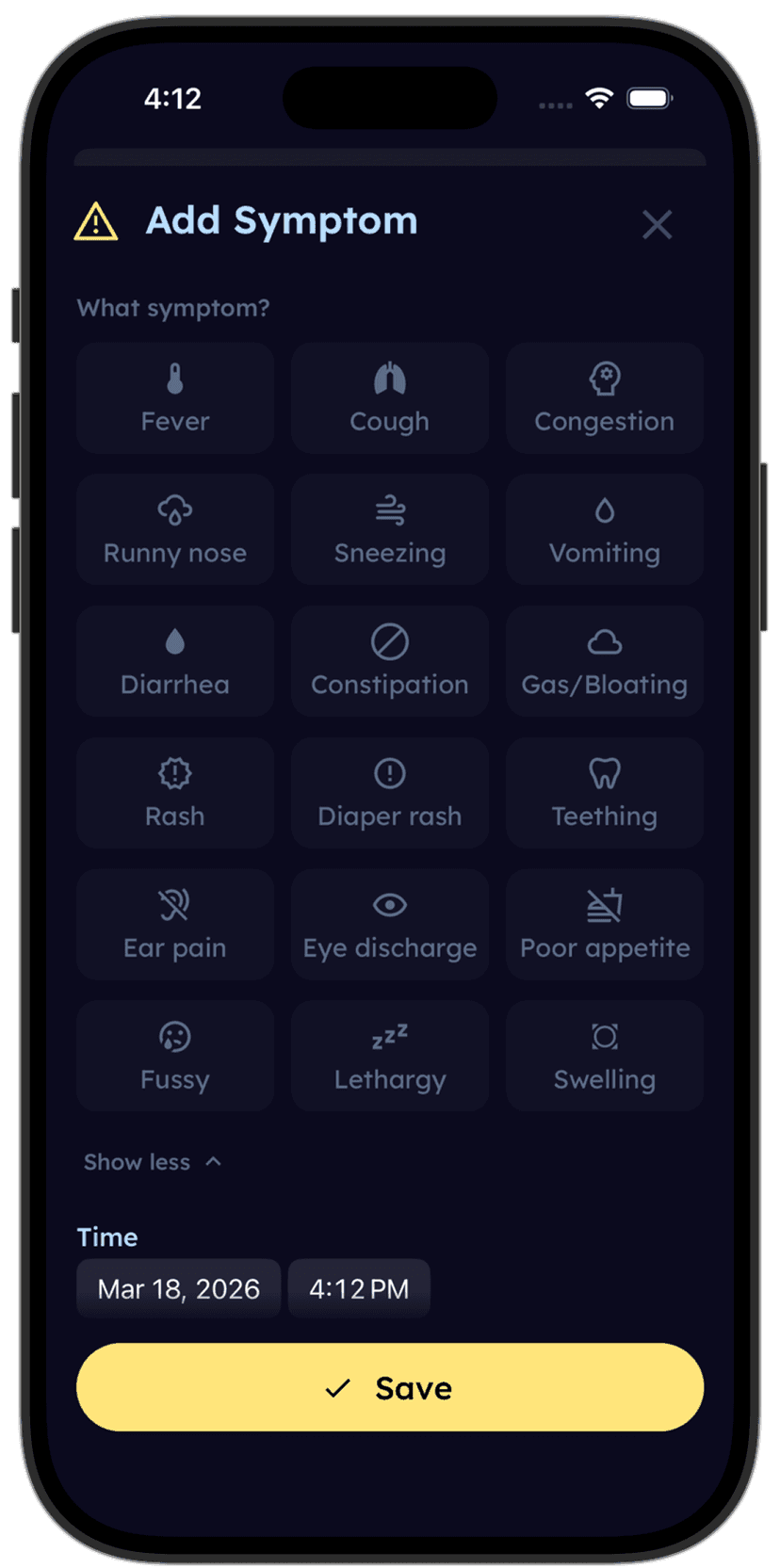
tinylog symptom tracking log showing chickenpox progression over several days

'When did the first spots show up?' Your pediatrician will ask.

Tracking when new crops appear, how the fever trends, and what medications you gave is exactly what your pediatrician needs. Log symptoms and meds in tinylog so you have a clear timeline instead of a foggy guess.

Download on the App StoreGet It On Google Play

The Vaccine Timeline: Why Babies Under 12 Months Are Unprotected

Here is the uncomfortable reality: the varicella vaccine is not given until 12 months of age. That means babies under one year have no vaccine protection against chickenpox. They rely entirely on herd immunity and, if their mother had chickenpox or was vaccinated before pregnancy, on maternal antibodies that were passed during pregnancy and breastfeeding. Those maternal antibodies wane over the first several months of life.

This is why chickenpox in a baby under 12 months warrants a call to the pediatrician — they are in a vulnerable window. For babies under 4 weeks old, chickenpox can be severe and even dangerous, especially if the mother was not immune.

Once your baby turns 12 months, they can get the first dose of the varicella vaccine, which provides about 85% protection against any chickenpox and over 95% protection against severe chickenpox. The second dose at 4-6 years boosts protection to approximately 98%.

If your unvaccinated baby over 12 months is exposed to chickenpox, contact your pediatrician immediately — the vaccine can be given within 3-5 days of exposure and can prevent or significantly reduce the severity of the illness. For babies under 12 months who are exposed, varicella immune globulin (VariZIG) may be an option.

Varicella Vaccine Schedule
First dose (varicella vaccine)
When12-15 months of age
Protection LevelAbout 85% effective at preventing any chickenpox. Over 95% effective at preventing severe chickenpox.
NotesGiven as a standalone varicella vaccine or as part of MMRV (measles, mumps, rubella, varicella).
Second dose
When4-6 years of age
Protection LevelBoosts effectiveness to about 98% for preventing any chickenpox.
NotesCan be given earlier (at least 3 months after the first dose) if there is an outbreak or exposure.
Catch-up for unvaccinated kids 7-12
WhenTwo doses, 3 months apart
Protection LevelSame high effectiveness as the standard schedule.
NotesIf your child missed the standard schedule, catch-up dosing is available.
Post-exposure prophylaxis
WhenWithin 3-5 days of exposure
Protection LevelCan prevent or significantly reduce severity if given soon after exposure.
NotesContact your pediatrician immediately if your unvaccinated baby is exposed. Vaccine can be given to babies 12+ months. For babies under 12 months, varicella immune globulin (VariZIG) may be available.
The varicella vaccine is one of the most effective childhood vaccines. Even when breakthrough infection occurs, the disease is dramatically milder.

Breakthrough Chickenpox in Vaccinated Kids

About 5-10% of vaccinated children will still get chickenpox — this is called breakthrough varicella. Before you question the vaccine, understand what breakthrough cases look like compared to unvaccinated cases:

Unvaccinated: 200-500 blisters, fever up to 104°F, 7-10 days of illness, higher risk of complications like bacterial skin infections and pneumonia.

Vaccinated (breakthrough): Fewer than 50 lesions — often as few as 10-30. Many are flat red spots that never develop into classic blisters. Little or no fever. Shorter duration. Much lower complication risk.

Breakthrough chickenpox can be tricky to diagnose because it does not always look like "classic" chickenpox. The spots may not blister, the fever may be absent, and the child may barely seem sick. But they are still contagious and still need to stay home until all lesions have crusted or faded.

The vaccine turned chickenpox from a week-long ordeal with real complication risk into something that, for most vaccinated children, is a minor blip.

Treatment: Managing the Itch and Keeping Your Baby Comfortable

There is no antiviral treatment for chickenpox in otherwise healthy children. (Acyclovir is reserved for immunocompromised children, newborns, and severe cases — your pediatrician will determine if it is needed.) Your job is itch management, fever control, and preventing skin infections from scratching.

Calamine lotion

Dab onto individual blisters with a cotton ball or pad. Let dry. Apply as often as needed. Avoid applying near eyes. The pink stuff your mother used on you. It still works. Provides a cooling, drying effect that reduces itch for 1-2 hours.

Lukewarm oatmeal bath

Add colloidal oatmeal (like Aveeno) to lukewarm (not hot) bathwater. Let baby soak for 10-15 minutes. Pat dry gently — do not rub. Oatmeal contains avenanthramides, which are natural anti-itch compounds. Do this 2-3 times a day during the peak blister phase.

Cool compresses

Wet a clean washcloth with cool water. Press gently on itchy areas. Reapply as needed. Simple and effective for targeted itch relief. Good for fussy babies who resist lotion application.

Oral antihistamine

Diphenhydramine (Benadryl) or cetirizine (Zyrtec) for babies 6+ months. ALWAYS call your pediatrician for dosing. Do not guess. Antihistamines reduce the itch signal. Diphenhydramine also causes drowsiness, which can help itchy babies sleep.

Mittens or socks on hands

Cover baby's hands with soft mittens or clean socks. Especially helpful at night when scratching happens unconsciously. Scratching opens blisters, increases infection risk, and leads to scarring. Covering hands is the simplest prevention.

Keep nails short and clean

Trim baby's fingernails as short as safely possible. File smooth edges. Clean under nails daily. Even with mittens, babies find ways to scratch. Short, clean nails reduce the damage when they do.

Why You Must Never Use Aspirin (Reye Syndrome)

This gets its own section because it is that serious. Aspirin and chickenpox is a dangerous combination that can trigger Reye syndrome — a rare but potentially fatal condition that causes rapid swelling of the liver and brain. Reye syndrome has a mortality rate of 20-40% and can cause permanent brain damage in survivors.

Since the warning against aspirin use during viral illnesses became widespread in the 1980s, Reye syndrome cases have dropped by over 90%. The warning works — but only if parents know about it.

Aspirin, Reye Syndrome, and Chickenpox
What is Reye syndrome?
AnswerA rare but potentially fatal condition causing swelling in the liver and brain. It occurs almost exclusively in children and teenagers who take aspirin (or aspirin-containing products) during a viral illness — especially chickenpox and influenza.
Why is aspirin dangerous during chickenpox?
AnswerThe exact mechanism is not fully understood, but aspirin during an active varicella infection dramatically increases the risk of Reye syndrome. The combination of the virus and aspirin appears to trigger mitochondrial damage in the liver and brain.
What should I use instead?
AnswerAcetaminophen (Tylenol) for babies 2+ months. Ibuprofen (Advil, Motrin) for babies 6+ months. NEVER aspirin. Some pediatricians also recommend avoiding ibuprofen during chickenpox due to a possible link with more severe skin infections — ask your pediatrician.
What about Pepto-Bismol?
AnswerPepto-Bismol contains bismuth subsalicylate — a salicylate related to aspirin. Do NOT give Pepto-Bismol to children or teenagers with chickenpox or any viral illness. This is easy to miss.
The aspirin-Reye syndrome connection during viral illness is well established. Use acetaminophen (Tylenol) for fever and pain. Discuss ibuprofen with your pediatrician.
Chickenpox Contagion: What You Need to Know
When is my baby contagious?
AnswerFrom 1-2 days BEFORE the rash appears until every single blister has crusted over. This typically means 5-7 days of contagion after the rash starts. The pre-rash contagious window is why chickenpox spreads so easily — your child exposes others before you even know they are sick.
How does it spread?
AnswerTwo ways: direct contact with fluid from the blisters, and airborne respiratory droplets. Chickenpox is extraordinarily contagious — one of the most transmissible diseases. About 90% of non-immune people who live with an infected person will catch it.
When can my baby go back to daycare?
AnswerWhen ALL blisters have crusted over completely — no open or weeping blisters. This usually takes about 5-7 days after the rash appears. Some daycares may have additional requirements. A doctor's note may be needed.
Can my newborn catch it from a sibling?
AnswerYes, and this is a serious concern. Chickenpox in babies under 4 weeks can be severe. If your newborn is exposed, contact your pediatrician immediately. Varicella immune globulin (VariZIG) may be given to protect the newborn.
Am I immune if I had chickenpox as a kid?
AnswerAlmost certainly yes. Past infection provides lifelong immunity. If you are unsure whether you had it, a blood test can check. If you are pregnant and NOT immune and your child gets chickenpox, contact your OB immediately.
Chickenpox is one of the most contagious diseases. The pre-rash contagious window makes containment nearly impossible — your child spreads it before anyone knows they have it.

Reassuring Signs — Typical Chickenpox Course

  • Rash is following the expected pattern — starting on trunk, crops of new spots, multiple stages visible at once
  • Baby has a low-grade fever (under 102°F) that responds to acetaminophen
  • Baby is drinking fluids and making wet diapers normally
  • Itching is manageable with calamine lotion, oatmeal baths, and/or antihistamines
  • New spots stop appearing after 4-5 days — the end is near
  • Baby is fussy but still has periods of normal play and interaction
  • Scabs are forming without signs of infection (no spreading redness, swelling, or pus)

If the rash is progressing through the normal stages, your baby is drinking fluids, and the itch is manageable, you are on track. The worst is usually over by day 5.

Warning Signs — Call Your Pediatrician or Go to the ER

  • Baby under 4 weeks old with suspected chickenpox — this is high-risk and needs immediate evaluation
  • Fever above 104°F or fever that returns after initially going away (suggests secondary infection)
  • Skin around blisters becomes red, swollen, warm, or painful — signs of bacterial skin infection (cellulitis)
  • Blisters develop streaking redness or start oozing pus — not normal chickenpox progression
  • Baby is refusing fluids and showing dehydration signs (fewer wet diapers, dry mouth, no tears)
  • Baby seems increasingly lethargic, confused, or difficult to wake
  • Stiff neck, persistent vomiting, or severe headache (in older babies/toddlers) — rare but possible encephalitis
  • Difficulty breathing or persistent cough — possible pneumonia complication
  • Baby is immunocompromised (taking steroids, has a known immune condition) — needs antiviral treatment

Most chickenpox cases resolve without complications. But bacterial skin infection from scratching is the most common complication, and babies under 12 months and immunocompromised children are at higher risk for serious illness.

Tips for Getting Through Chickenpox

The 'all stages at once' trick is your diagnostic shortcut

No other common childhood rash does this. If you can see a fresh red bump, a fluid-filled blister, and a crusted scab all at the same time on your baby's body, it is chickenpox. HFMD blisters are all in the same stage. Bug bites are all bumps. Impetigo is all crusty. Only chickenpox gives you the full spectrum simultaneously.

Never, ever aspirin

This one is non-negotiable. Do not give aspirin (or any product containing salicylates, including Pepto-Bismol) to a child with chickenpox. The risk of Reye syndrome — a rare but potentially fatal liver and brain condition — is real and well-documented. Use acetaminophen for fever. Talk to your pediatrician about ibuprofen. But aspirin is an absolute no.

The worst day is usually day 3-4

The first two days, new spots are appearing and it is manageable. By day 3-4, you have the maximum number of active blisters, the itching is at its peak, your baby is miserable, and you are wondering if this is normal. It is. After day 4-5, new spots stop appearing and everything starts crusting over. You are past the worst part even though it does not feel like it.

Breakthrough chickenpox is a thing — and it is mild

If your vaccinated child gets chickenpox, do not panic and do not lose faith in the vaccine. The vaccine is about 85% effective at preventing any chickenpox, but over 95% effective at preventing severe chickenpox. A vaccinated child who gets it typically has fewer than 50 spots (instead of 200-500), a lower fever, and recovers faster. The vaccine did its job — it turned a week-long miserable illness into a minor inconvenience.

Baths help, not hurt

Old advice said to avoid bathing during chickenpox. That is outdated. Lukewarm baths — especially oatmeal baths — soothe itching, keep skin clean, and reduce infection risk. Do not use hot water (it makes itching worse) and do not scrub. Pat dry gently. Bathe 2-3 times a day during the peak blister phase.

Related Guides

  • Baby Rash Types — Visual guide to every rash your baby might get
  • Hand, Foot, and Mouth Disease (Babies) — Another blistering illness often confused with chickenpox
  • Impetigo — A bacterial skin infection that can develop on chickenpox blisters
  • Baby Hives — Itchy raised spots that can look like early chickenpox
  • Roseola — Another common childhood rash with a fever-then-rash pattern

Sources

  • American Academy of Pediatrics (AAP). (2024). Chickenpox (Varicella). HealthyChildren.org.
  • Centers for Disease Control and Prevention (CDC). (2024). Chickenpox (Varicella) — For Healthcare Professionals. CDC.gov.
  • Marin, M., et al. (2008). Prevention of Varicella: Recommendations of the Advisory Committee on Immunization Practices (ACIP). MMWR Recommendations and Reports, 56(RR-4), 1-40.
  • Seward, J. F., et al. (2004). Varicella disease after introduction of varicella vaccine in the United States, 1995-2000. JAMA, 292(6), 704-708.
  • National Reye's Syndrome Foundation. (2024). What is Reye's Syndrome? reyessyndrome.org.

Medical Disclaimer

This guide is for informational purposes only and is not a substitute for professional medical advice. If your baby has suspected chickenpox and is under 12 months old, immunocompromised, or showing signs of complications (high fever, skin infection, difficulty breathing, lethargy), contact your pediatrician or seek emergency care. Never give aspirin to a child with chickenpox.

Get this guide in your inbox.
We'll email you this guide so you have the symptom timeline, itch relief tips, and warning signs ready when you need them.
New spots every morning. The log shows your pediatrician the full picture.
Download tinylog free — track symptoms, fevers, and medications in a few taps.
Download on the App StoreGet It On Google Play