GUIDE

Baby Fever Chart by Age

What counts as a dangerous fever depends entirely on your baby's age.

A 100.4°F fever in a two-week-old is an emergency room visit tonight. That same temperature in a one-year-old who is playing and drinking normally? Probably fine to monitor at home. This guide gives you the exact thresholds by age so you know when to act and when to watch.

The One Rule Every Parent Needs to Know

If you remember nothing else from this guide, remember this: a baby's age changes everything about how you respond to a fever.

A temperature of 100.4°F in a three-week-old newborn is an emergency that requires an ER visit tonight — not tomorrow morning, not after you call the nurse line, tonight. That same 100.4°F in a one-year-old who is drinking, playing, and making wet diapers? You can almost certainly monitor at home and call your pediatrician in the morning.

This is not about the number on the thermometer. It is about what your baby's immune system is capable of handling at their stage of development. A newborn's immune system is profoundly immature. It cannot localize infections the way an older baby's can, which means a simple urinary tract infection can become sepsis rapidly. By six months, the immune system is more developed, and fever becomes a healthy sign that the body is fighting an infection — not an automatic emergency.

The chart below gives you the exact thresholds, but the principle is simple: the younger the baby, the lower the threshold for action, and the faster you need to move.

Baby Fever Thresholds by Age
0-28 days (newborn)
Fever Threshold100.4°F (38°C) or higher
What to DoER immediately — no exceptions
Key NotesAny fever in a newborn is a medical emergency. Do not give fever reducers. Do not wait until morning. Go now.
1-3 months
Fever Threshold100.4°F (38°C) or higher
What to DoCall pediatrician immediately — likely ER
Key NotesYour pediatrician will almost certainly want to see your baby or send you to the ER. Serious bacterial infections must be ruled out at this age.
3-6 months
Fever Threshold102°F (38.9°C) or higher
What to DoCall pediatrician
Key NotesAt 100.4-101.9°F, monitor closely and call if behavior changes. At 102°F+, call your pediatrician regardless of behavior.
6-24 months
Fever Threshold102°F (38.9°C) or higher, OR any fever lasting more than 24 hours
What to DoCall pediatrician
Key NotesBehavior matters more than the number. A playful baby with 102°F is less concerning than a listless baby with 101°F.
24+ months
Fever Threshold104°F (40°C) or higher, OR any fever lasting more than 3 days
What to DoCall pediatrician
Key NotesMost fevers in toddlers are viral and self-limiting. Focus on comfort, hydration, and behavior.
These thresholds assume a rectal temperature reading. If using a different method, see our guide on how to take a baby's temperature for conversion guidance. When in doubt, err on the side of calling your pediatrician.

What to Do Right Now

You are reading this guide because your baby has a fever, or you want to be prepared when it happens. Either way, here are the steps to take — in order — right now.

Take the temperature correctly

Use a rectal thermometer for babies under 3 months — it is the only reliable method at this age. For older babies, rectal remains the gold standard, but temporal artery (forehead) thermometers are acceptable. Write down the exact reading, the time, and the method used. You will need this information when you call your pediatrician.

Check your baby's age against the chart

This is the single most important factor. A temperature of 100.4°F means completely different things depending on whether your baby is two weeks old or two years old. Under 28 days with any fever: go to the ER now. Under 3 months: call your pediatrician immediately. Over 3 months: use the behavior-plus-temperature framework below.

Watch the baby, not the thermometer

For babies over 3 months, behavior is a better indicator of severity than the number. Is your baby making eye contact? Taking fluids? Having wet diapers? Consolable when held? A baby who scores well on these questions — even with a fever of 103°F — is usually managing the illness well. A baby who fails these checks at 101°F needs attention.

Manage comfort, not the number

Acetaminophen (Tylenol) is appropriate for babies 3 months and older. Ibuprofen (Motrin/Advil) is appropriate for babies 6 months and older. The goal is not to eliminate the fever — fever is the immune system working. The goal is to help your baby feel comfortable enough to rest and drink. Never give aspirin to children.

Keep a log

Write down every temperature reading with the time and any medications given. Track fluid intake and wet diapers. This log will be invaluable when you call your pediatrician — they will ask for these exact details. A fever that has been rising steadily for 12 hours tells a different story than one that has been spiking and returning to normal.

What This Looks Like in Real Life

It is 10 PM. Your seven-month-old has been fussy all day and now feels hot. You take a rectal temperature: 102.3°F. Your heart starts racing. Here is what you do.

First, take a breath. Your baby is seven months old — past the high-risk window for newborns. Check the chart: at 6-24 months, 102°F is the threshold for calling your pediatrician. You are just above it, so a call is warranted. But before you dial, assess behavior.

Is your baby drinking? She took half a bottle an hour ago. Making wet diapers? The last one was two hours ago. Making eye contact? Yes, she looks at you when you talk to her, though she is clearly not feeling great. Consolable? She calms down when you hold her.

These are all reassuring signs. You give an appropriate dose of acetaminophen (she is over 3 months, so this is safe), note the time and temperature in your log, and call your pediatrician's after-hours line. The on-call nurse asks exactly the questions you are prepared for: age, temperature, method, behavior, wet diapers, fluid intake. Based on your answers, she advises monitoring at home, pushing fluids, and calling back if the fever exceeds 104°F or behavior changes.

You check again at midnight: 101.1°F. The acetaminophen is working. She is sleeping. You set an alarm for 3 AM, check again — 100.8°F — and by morning the fever is 100.2°F. She is fussy but drinking. You call your pediatrician's office when they open, and they schedule a same-day visit to check her ears and throat.

That is how most fever episodes go for babies over six months. Concerning? Yes. Emergency? Usually not.


tinylog app screen showing temperature readings logged with timestamps

Log every temperature reading — your pediatrician will ask for the trend.

When you call about a fever, your pediatrician wants specifics: what was the temperature, when, and has it been going up or down? Log readings in tinylog with timestamps so you have an accurate fever curve instead of trying to remember what the thermometer said three hours ago.

Download on the App StoreGet It On Google Play

When to Call Your Pediatrician

Call your pediatrician (during office hours or the after-hours line) if:

  • Your baby is 1-3 months old with a temperature of 100.4°F or higher — this is always a same-day call
  • Your baby is 3-6 months old with a temperature of 102°F or higher
  • Your baby is 6-24 months old with a fever lasting more than 24 hours, or a temperature of 102°F or higher with behavioral changes
  • Any age: fever lasting more than 3 days, even if low-grade
  • Any age: fever that keeps returning after a few days of being gone (could indicate a secondary infection)
  • Your baby has a fever and is pulling at their ear, has a new rash, or has started vomiting or having diarrhea
  • You are worried — trust your instincts

Your pediatrician would always rather get a call from a cautious parent than see a baby who has been sick too long without evaluation.

Signs That Suggest Your Baby Is Handling the Fever Well

  • Baby is alert and makes eye contact when fever is managed
  • Still interested in feeding, even if eating a bit less than usual
  • Producing wet diapers at a normal or near-normal rate
  • Responds to your voice and touch
  • Has periods of playfulness between fever spikes
  • Sleeping more than usual but arousable and alert when awake

If these describe your baby, the fever is likely doing its job — helping the immune system fight an infection. Continue to monitor, push fluids, and manage comfort.

Go to the ER Immediately If You See Any of These

  • Any fever (100.4°F+) in a baby under 28 days old — this is always an emergency
  • Temperature above 104°F (40°C) at any age
  • Baby is limp, unresponsive, or extremely difficult to wake
  • Difficulty breathing — fast breathing, grunting, nostril flaring, or ribs pulling in
  • Seizure or convulsion (even if it stops on its own)
  • Purple or dark spots on the skin that do not fade when pressed (possible petechiae)
  • Stiff neck combined with fever
  • Bulging fontanelle (the soft spot appears raised or swollen)
  • Signs of dehydration — no wet diapers for 6+ hours, no tears, sunken fontanelle
  • Baby is inconsolable — nothing provides comfort for an extended period

Do not wait for a callback. Do not wait until morning. If any of these apply, go to the emergency room now. For newborns under 28 days with any fever, see our detailed guide on fever in newborns under 3 months.

Watch the Baby, Not the Thermometer

This is the phrase pediatricians repeat over and over, and it is worth internalizing: for babies over three months, behavior matters more than the number.

A baby with a temperature of 103°F who is alert, taking fluids, making wet diapers, and engaging with you is generally coping well. The immune system is doing its job, and the high temperature is part of that process. Many common childhood viruses produce fevers of 103-104°F, and while that number feels alarming, it does not automatically mean the illness is severe.

Conversely, a baby with a temperature of only 101°F who is limp, refuses all fluids, has not had a wet diaper in eight hours, and cannot be consoled is showing signs of a more serious process. The temperature is low, but the behavior is worrisome.

This does not apply to newborns. For babies under 28 days, any fever at 100.4°F or above is an emergency regardless of how well the baby appears to be acting. And for babies 1-3 months, the threshold is the same — call immediately. Their immune systems are too immature to rely on behavior as a gauge of severity. For the full picture on why newborn fever is different, see our guide on fever in newborns under 3 months.

A Note on Fever Reducers

Acetaminophen (Tylenol) is approved for babies 3 months and older. Ibuprofen (Motrin, Advil) is approved for babies 6 months and older. Never give aspirin to any child — it is associated with Reye's syndrome, a rare but potentially fatal condition.

The purpose of fever reducers is comfort, not normalization. You do not need to bring the temperature all the way down to 98.6°F. If your baby's temperature drops from 103°F to 101°F and they perk up, start drinking, and seem more comfortable, the medication is doing its job.

A few important notes: always dose by weight, not age, and use the dosing device that comes with the medication — kitchen spoons are not accurate. Do not alternate acetaminophen and ibuprofen unless your pediatrician specifically tells you to, as this increases the risk of dosing errors. And never give a fever reducer to a baby under 3 months without explicit direction from your pediatrician — at that age, you need to be at the doctor's office, not managing at home.

For accurate temperature readings to guide your response, see our guide on how to take a baby's temperature.

tinylog app screen showing medication and temperature tracking log

Track medications alongside temperatures.

Log when you gave acetaminophen or ibuprofen in tinylog right alongside your temperature readings. When it is 3 AM and you cannot remember if the last dose was two hours ago or four, you will have the answer.

Download on the App StoreGet It On Google Play

Practical Fever Tips

The 'happy fever' is real

Some babies run fevers of 102-103°F and continue playing, eating, and acting relatively normal between doses of fever reducer. This is sometimes called a 'happy fever,' and while it sounds counterintuitive, it is actually reassuring. It suggests the immune system is fighting a routine viral infection and the baby has the reserves to handle it. Keep monitoring, but do not panic solely because the number is high.

Fever is not the enemy

This is counterintuitive for parents, but fever itself is not dangerous — it is the body's defense mechanism against infection. The illness causing the fever is what matters. You do not need to 'break' a fever. You do not need to get the temperature back to 98.6°F. You need to keep your baby comfortable, hydrated, and monitored. The fever will resolve when the infection does.

Bundling can raise temperature

Before treating a slightly elevated temperature, make sure your baby is not just overdressed. Remove a layer, wait 15-20 minutes, and retake. A genuinely over-bundled baby can show a temperature of 99-100°F that resolves with fewer clothes. This is not a fever — it is a thermoregulation issue. True fevers do not resolve by removing a blanket.

Febrile seizures are terrifying but usually not dangerous

About 2-5% of children between 6 months and 5 years will have a febrile seizure — a convulsion triggered by a rapid rise in temperature. They are absolutely terrifying to witness, but the vast majority are brief (under 5 minutes), do not cause brain damage, and do not mean your child has epilepsy. If a seizure occurs, lay your child on their side, do not put anything in their mouth, time the seizure, and call 911 if it lasts more than 5 minutes.

Related Guides

Sources

  • American Academy of Pediatrics (AAP). (2024). Fever and Your Baby. HealthyChildren.org.
  • Sullivan, J. E., & Farrar, H. C. (2011). Fever and Antipyretic Use in Children. Pediatrics, 127(3), 580-587. (AAP Clinical Report)
  • Pantell, R. H., et al. (2021). Evaluation and Management of Well-Appearing Febrile Infants 8 to 60 Days Old. Pediatrics, 148(2), e2021052228. (AAP Clinical Practice Guideline)
  • National Institute for Health and Care Excellence (NICE). (2023). Fever in Under 5s: Assessment and Initial Management. NICE Guideline NG143.
  • Centers for Disease Control and Prevention. (2024). Fever: First Aid. CDC.gov.

Medical Disclaimer

This guide is for informational purposes only and is not a substitute for professional medical advice, diagnosis, or treatment. Fever in infants can indicate serious illness. Always consult your pediatrician or healthcare provider about your baby's specific situation. If your baby is under 3 months old with a fever of 100.4°F or higher, seek immediate medical attention. Call 911 if your baby is having difficulty breathing, is unresponsive, or is having a seizure.

Get this fever chart in your inbox.
We'll email you this guide so you can pull up the age-specific thresholds at 2 AM without searching.
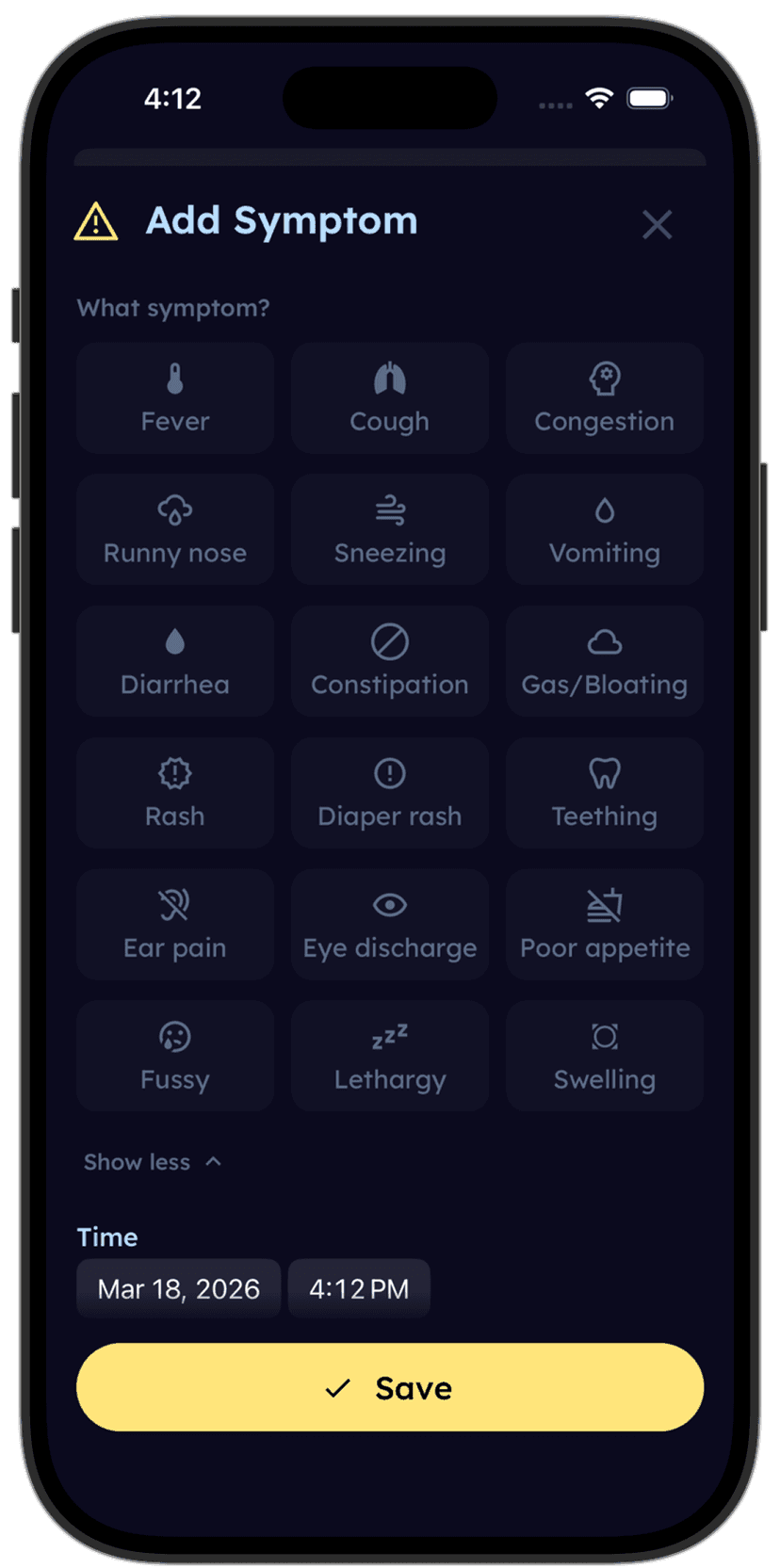
Track every temperature reading so you can see the trend.
Download tinylog free — log fevers and symptoms with a single tap.
Download on the App StoreGet It On Google Play