
Bicycle legs
Lay baby on their back and gently move their legs in a cycling motion. This can help move gas and stool through the intestines. It's the most recommended and gentlest first step.
GUIDE
Published on ·Updated on
It depends on your baby's age and how they're fed — it might be perfectly normal.
A breastfed baby over 6 weeks old can go up to 7–10 days without pooping and be completely fine. A formula-fed baby going 3+ days without a stool may need a closer look. Here's how to tell the difference between infrequent pooping and actual constipation.
Log wet and dirty diapers
“Babies all have different types of stools, and every baby's a little bit different.”
You're here because your baby hasn't pooped in three days and you need to know if that's okay. Here's the short answer: it depends almost entirely on two things — your baby's age and how they're being fed.
If your baby is breastfed and older than about six weeks, three days without a stool is well within the normal range. Genuinely, honestly normal. Some breastfed babies go seven to ten days between bowel movements after the six-week mark, and their pediatricians don't blink. Breast milk is so efficiently absorbed by the body that sometimes there's simply very little waste to excrete. When the stool finally arrives — and it will — it's typically soft, sometimes explosive, and perfectly healthy.
If your baby is formula-fed, the calculus is a little different. Formula-fed babies tend to stool more regularly, usually every one to three days. A three-day gap in a formula-fed baby isn't necessarily alarming, but it sits closer to the edge of what's typical, especially if it's accompanied by discomfort, a hard belly, or stools that come out hard and pellet-like.
And if your baby is under six weeks old — regardless of feeding type — a three-day gap is not normal. In the first six weeks of life, regular stooling is one of the key indicators that your baby is getting enough to eat. If a newborn under six weeks hasn't pooped in 24 hours, contact your pediatrician.
| Scenario | Normal Gap | Recommended Action |
|---|---|---|
| Breastfed, under 6 weeks | Should stool at least 1–3x daily | Contact pediatrician if no stool for 24+ hours — could indicate insufficient milk intake |
| Breastfed, 6 weeks – 6 months | Up to 7–10 days between stools | Normal if stool is soft when it arrives and baby is gaining weight. No intervention needed. |
| Formula-fed, under 6 weeks | Should stool at least 1–2x daily | Contact pediatrician if no stool for 48+ hours |
| Formula-fed, 6 weeks – 6 months | 1–3 days between stools is typical | 3+ days may warrant a call, especially if stool is hard or baby is uncomfortable |
| Any baby, 6–12 months (on solids) | 1–2 days between stools | 3+ days with hard stool or discomfort warrants a pediatrician check |
| Toddler, 12–24 months | 1–2 days between stools | Ongoing hard stools or withholding behavior — discuss with your pediatrician |
This is the distinction that matters most, and it's the one that causes the most unnecessary anxiety. Constipation is not defined by how often your baby poops. It's defined by how hard the stool is and how much discomfort it causes.
A baby who poops once a week with soft, normal-looking stool is not constipated. They're just an infrequent pooper. A baby who poops every day but produces hard, dry pellets and screams during the process might actually be constipated. The frequency is a red herring — it's the consistency and comfort that tell the real story.
This is surprisingly hard to internalize when you're staring at a diaper pail that hasn't been used in four days. Your instinct says something must be wrong. But if your baby is eating normally, seems comfortable, has a soft belly, and eventually produces a soft stool — even a spectacular one — then their body is just operating on its own schedule, and that schedule is fine.
Actual constipation in infants presents with specific signs: stool that looks like small hard balls or rabbit droppings, straining with visible pain (not just the normal grunting and red-faced effort that all babies do), a belly that feels hard or looks distended, and sometimes refusal to eat. If you're seeing those signs, it's worth a call to your pediatrician. If you're not, your baby is probably just taking their time.
| Category | Infrequent Pooping (Normal) | Constipation (Talk to Your Doctor) |
|---|---|---|
| Stool consistency | Soft, seedy, mushy, or pasty when it arrives | Hard, dry, pellet-like — resembles small rocks or rabbit droppings |
| Baby's comfort | Baby seems relaxed and comfortable between stools | Baby is fussy, seems to be in pain, arches back, or cries during attempts |
| Belly | Soft and normal to the touch | Hard, distended, or visibly swollen |
| Feeding | Baby eats normally and seems satisfied | Baby may refuse feeds or eat less than usual |
| Straining | May grunt or turn red briefly — normal infant bearing down | Prolonged straining (10+ minutes) without result, crying with effort |
| Blood | None | May see streaks of blood on hard stool or in diaper from anal fissure |
The science behind this is actually pretty elegant. Breast milk is composed of exactly what a human infant needs — proteins, fats, sugars, antibodies — and the baby's gut absorbs it with remarkable efficiency. By the time the digestive system is done extracting nutrients (which takes longer as the gut matures around the six-week mark), there's genuinely very little solid waste remaining. So the body waits until there's enough material to warrant a bowel movement, and that can take days.
This is different from formula, which contains cow's milk proteins and other components that create more indigestible bulk. Formula-fed babies simply have more waste to pass, which is why they tend to stool more frequently and with thicker consistency.
The shift usually happens somewhere between four and eight weeks of age. Parents who've been changing four to eight dirty diapers a day suddenly find themselves on day two, then day three, then day five with nothing. The natural reaction is alarm. But if this is a breastfed baby who is otherwise happy, feeding well, and gaining weight — this is their gut maturing, not malfunctioning.
It's worth noting that when the stool finally does arrive after a long gap, it can be... impressive. Parents sometimes describe it as a "poop explosion" — a large, soft, sometimes spectacularly messy bowel movement. This is the payoff for several days of accumulation, and it's completely normal. Have the backup outfit ready.
These signs warrant a conversation with your doctor. If you see white or chalky stool, seek medical attention immediately — it can indicate a serious liver condition.
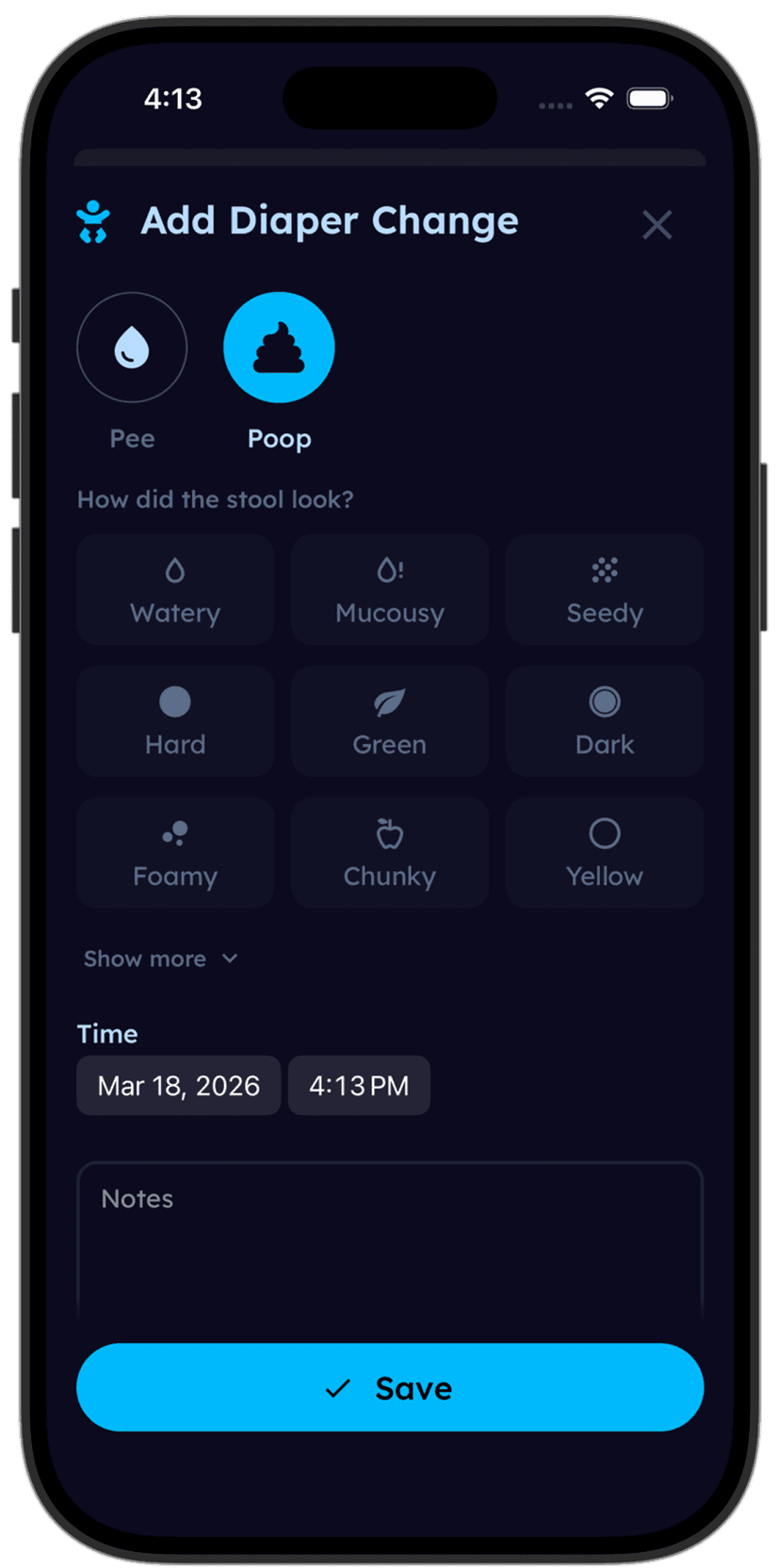
Use Tinylog to track the actual gaps between stools. When you can see that last week it was two days and this week it's three, the pattern feels a lot less scary than trying to remember when the last one was.


Lay baby on their back and gently move their legs in a cycling motion. This can help move gas and stool through the intestines. It's the most recommended and gentlest first step.
Using gentle, clockwise circular motions around baby's belly button can help stimulate the bowels. Think of it as following the path of the intestines. Use light pressure — you're guiding, not pushing.
A warm bath can relax the abdominal muscles and help things move along. The warm water is soothing and the change in position can sometimes be all it takes. Worth trying before anything else.
The gentle pressure of lying on the belly can help push things along. If your baby tolerates tummy time well, a few extra minutes on the mat might do the trick.
Glycerin suppositories, rectal thermometer stimulation, juice, or any other remedies should only be used on your pediatrician's specific advice. What works for one baby may not be appropriate for yours, and some commonly shared home remedies can actually cause problems.
Several transitions in your baby's first year can temporarily affect stooling patterns. Knowing what to expect can keep you from worrying about perfectly predictable changes.
Starting solids (around 6 months): This is one of the most common triggers for a temporary change in bowel habits. New foods — especially iron-fortified cereals, bananas, and applesauce — can slow things down. Meanwhile, fiber-rich foods like prunes, pears, and peas tend to keep things moving. If your baby gets backed up when starting solids, try adjusting the balance of binding foods versus fiber-rich foods before assuming something is wrong.
Switching formulas: A change in formula can disrupt the gut for a few days to a week as the microbiome adjusts to new proteins and carbohydrate sources. If the change was recommended by your pediatrician, give it a full week before judging whether it's working. If constipation persists or worsens, follow up with your doctor.
Illness: A mild virus, teething, or even a vaccination can temporarily change stooling patterns. Decreased appetite during illness means less going in, which means less coming out. Once baby is eating normally again, the usual pattern should resume.
Developmental milestones: This one surprises people. Some babies alter their eating and stooling patterns around big developmental leaps — learning to crawl, pull to stand, or walk. The body seems to redirect resources, and the gut temporarily slows down. It resolves on its own.
What matters most is what's normal for your specific baby. If your baby has always pooped every other day and suddenly goes four days, that's a change worth noting. If your baby regularly goes five days between stools and has done so for weeks, that's just their rhythm.
When you're worried about a three-day gap, it helps to look back and see that last week there was a two-day gap and the week before that a four-day gap. Tinylog makes it easy to scroll back and see the actual timeline rather than relying on anxious memory.
When the stool finally arrives, take a second to note whether it's soft or hard. That one detail is the difference between 'my baby just poops infrequently' and 'my baby might actually be constipated.'
It's tempting to do something when your baby hasn't pooped in a few days. But for most healthy babies over 6 weeks — especially breastfed ones — the stool is coming. It's just taking its time. Unnecessary interventions can actually disrupt the developing gut.
This guide is based on published recommendations from the American Academy of Pediatrics (AAP), HealthyChildren.org, NASPGHAN, and peer-reviewed research including Zangen et al. on stooling patterns in breastfed infants. It is intended for general educational purposes only and does not constitute medical advice. Every baby is different, and if you have concerns about your baby's bowel habits, stool consistency, or overall health, please consult your pediatrician.
Baby Constipation — Causes, remedies, and when to worry
How Often Should Baby Poop? — Normal frequency by age