GUIDE

Why Do Babies Poop More at Night?

Nighttime feedings trigger the gastrocolic reflex — and young babies can't hold it until morning.

The gastrocolic reflex is stronger in newborns, which means eating at night almost guarantees a dirty diaper soon after. Here's the biology behind it, when it gets better, and how to handle those 3 AM changes without waking everyone up.

The Gastrocolic Reflex: Why Eating Means Pooping

If you've noticed that your baby seems to produce a dirty diaper within minutes of starting a feed — day or night — you're observing the gastrocolic reflex in action. This is a completely normal physiological response where the act of eating sends a signal to the colon to make room for incoming food by moving its current contents along.

In adults, this reflex exists too (it's why some people feel the urge to use the bathroom after a big meal), but it's subtle and easily overridden. In newborns, it's neither subtle nor optional. The reflex is significantly stronger in young infants because their nervous system is still immature. The signal from stomach to colon fires with full intensity, and the baby's body complies immediately. There's no "hold it until morning" mechanism in place yet.

This is the primary reason babies poop at night. It's not a digestive problem. It's not an allergy. It's not even really about nighttime specifically — it's about feeding. Since young babies eat every two to three hours around the clock, every feed is a potential trigger for a bowel movement. The overnight feeds just happen to be the ones that feel most brutal because you're supposed to be sleeping.

The good news is that the gastrocolic reflex weakens as the nervous system matures. By about three to four months, many babies start producing fewer dirty diapers at night. By six months — especially as nighttime feeds drop — most babies stop pooping overnight entirely. There's a light at the end of this particular tunnel.

Nighttime Pooping by Age — What to Expect
0–6 weeks
Night Poop FrequencyVery common — often after every night feed
Gastrocolic ReflexVery strong
Night FeedsEvery 2–3 hours
NotesExpect 2–4 nighttime dirty diapers. This is peak nighttime poop season.
6 weeks – 3 months
Night Poop FrequencyCommon — 1–3 per night
Gastrocolic ReflexStill strong but starting to mature
Night FeedsEvery 3–4 hours
NotesGradually improving. Some babies start skipping nighttime poops.
3–6 months
Night Poop FrequencyOccasional — 0–1 per night
Gastrocolic ReflexWeakening noticeably
Night Feeds1–2 per night (some drop to 0)
NotesMany babies stop pooping at night around this stage
6–12 months
Night Poop FrequencyRare
Gastrocolic ReflexApproaching adult levels
Night Feeds0–1 per night
NotesNighttime pooping is unusual — may indicate illness or dietary issue if it starts again
Individual babies vary significantly. These are general patterns — your baby may mature faster or slower.

The Other Reasons Babies Poop at Night

The gastrocolic reflex gets most of the credit, but there are a few other factors at play during those nighttime hours.

Immature digestive motility. A newborn's intestines are still learning how to move food along efficiently. Peristalsis — the wave-like muscle contractions that push stool through the intestines — doesn't follow a mature day-night pattern yet. In adults, the colon tends to slow down at night and pick up in the morning. In babies, it just runs on its own chaotic schedule, which means bowel movements can happen at any hour.

Nighttime feeding volume. For breastfed babies especially, nighttime feeding sessions can be lengthy and caloric. Prolactin — the hormone that drives milk production — peaks overnight, which means nighttime breast milk may actually be richer in fat. More food in means more to process, and the gastrocolic reflex takes care of the rest.

Position and relaxation. Babies spend the night lying flat, which can facilitate the movement of gas and stool through the intestines. A deeply relaxed baby whose abdominal muscles aren't tensed (as they might be during active play) may find it easier to pass stool. This is also why tummy time during the day sometimes produces dirty diapers — the gentle pressure helps things along.

Gut microbiome development. The bacterial community in your baby's intestines is being built from scratch, and it doesn't operate on a day-night cycle yet. The fermentation and gas production from these bacteria happen continuously, and sometimes the timing just works out to be 2 AM. As the microbiome matures and diversifies (especially once solids are introduced around six months), bowel movements tend to consolidate into daytime hours.

Nighttime Diaper Changes — Do This, Not That
Lighting
Do ThisUse a dim red or amber nightlight — just enough to see
Not ThisTurn on the overhead light or use your phone flashlight on full brightness
Noise
Do ThisKeep white noise running. Whisper or stay silent.
Not ThisTalk to baby, narrate the change, or turn off the sound machine
Stimulation
Do ThisMinimal eye contact. Calm, slow movements.
Not ThisPlay, smile at baby, or engage in any way that signals 'it's wake-up time'
Setup
Do ThisPre-stage diapers, wipes, and cream within arm's reach
Not ThisRummage through drawers or leave the room to get supplies
Clothing
Do ThisUse zipper sleepers or sleep sacks — one zip and you're in
Not ThisSnap-button pajamas that require fine motor skills at 3 AM
Temperature
Do ThisKeep wipes warm (a wipe warmer or tucked under your arm)
Not ThisApply cold wipes to a sleeping baby's skin — guaranteed wake-up
The goal is to handle the diaper and get everyone back to sleep as fast as possible.

How to Handle 3 AM Diaper Changes Without Fully Waking Baby

The art of the nighttime diaper change is all about minimizing stimulation. Your goal is to change the diaper while keeping baby in the drowsiest state possible. Every extra light, sound, and interaction signals "morning" to your baby's developing circadian rhythm, and once that switch flips, you could be up for an hour trying to get them back down.

Lighting is the single biggest factor. Use a dim red or amber nightlight — these wavelengths are less likely to suppress melatonin production than white or blue light. Position it so you can see the diaper area without illuminating baby's face. If you use your phone as a light source, switch it to the dimmest setting and hold it off to the side.

Keep the white noise machine running throughout the change. If you don't use one, consider starting — the consistent background sound covers the rustling of wipes and diapers and helps baby stay in the sleep zone.

Move slowly and deliberately. Avoid talking, making eye contact, or doing anything that says "let's interact." This feels cold and counterintuitive when your baby is staring up at you, but at 3 AM, boring is the goal. You can be warm and engaging at 7 AM. Right now, you're a silent, efficient diaper-changing machine.

One more trick: warm the wipes. A cold wipe on a warm belly is one of the most reliable ways to jolt a baby fully awake. A wipe warmer solves this, or you can tuck a wipe under your arm for thirty seconds before using it. Small detail, big difference.


When Nighttime Pooping Might Signal a Problem

  • Sudden increase in nighttime pooping after months of sleeping through — especially with diarrhea
  • Blood or mucus in nighttime stools
  • Baby waking and crying in pain — not just grunting or fussing
  • Nighttime pooping accompanied by vomiting or fever
  • White, pale grey, or chalky stool at any time of day — seek immediate medical attention
  • Explosive, watery diarrhea multiple times per night (possible infection)

Nighttime pooping in young babies (under 3–4 months) is almost always normal. If it returns after stopping, or is accompanied by other symptoms, check in with your pediatrician.

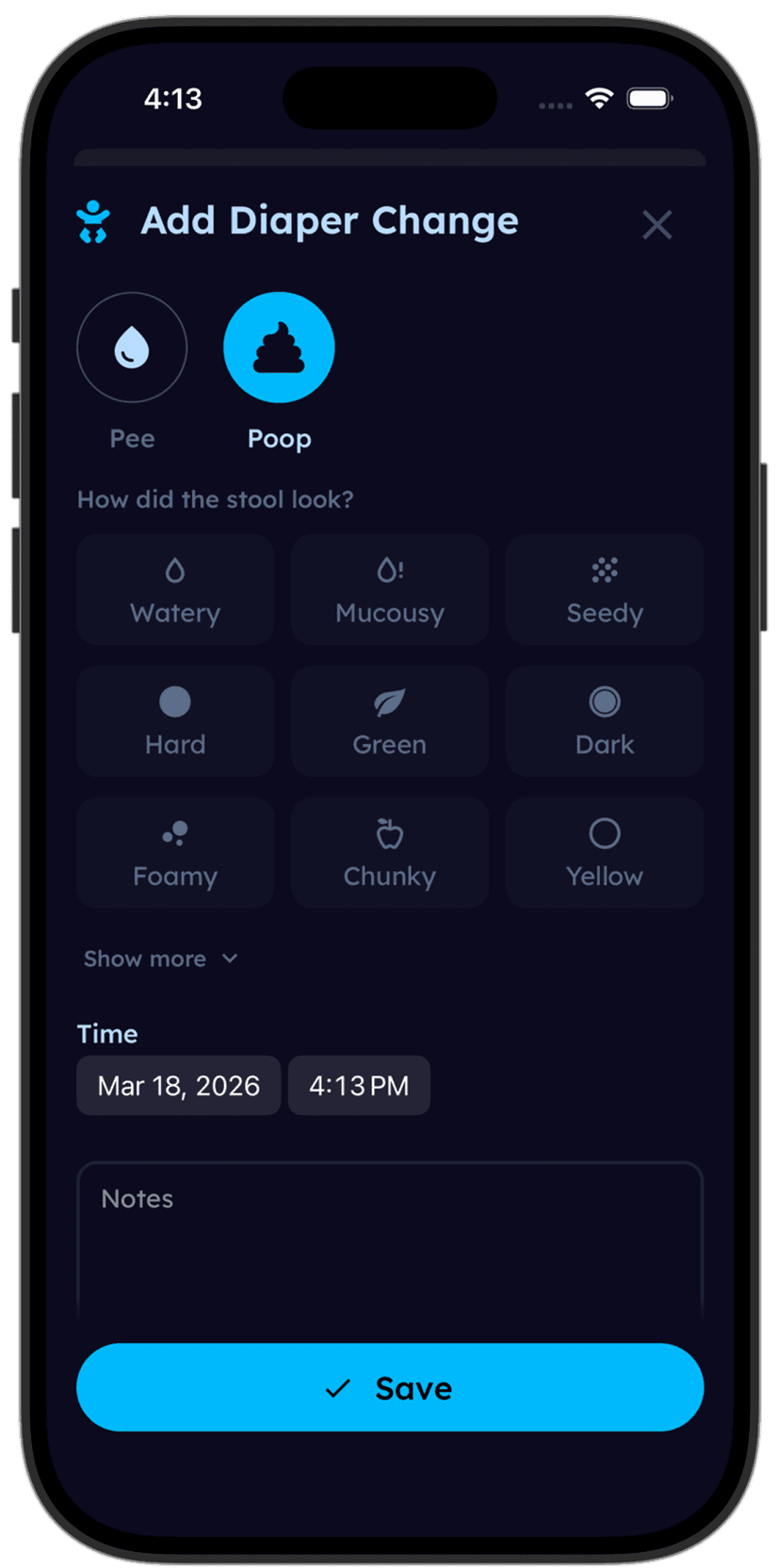
tinylog diaper tracking screen for nighttime logging

Your 3 AM brain will not remember this in the morning.

One tap in tinylog logs the time, type, and gets you back to bed. In the morning, you'll see the full nighttime picture — how many changes, what time, poop or just wet — without trying to reconstruct it from foggy memory.

Download on the App StoreGet It On Google Play

When Does It Stop?

The trajectory is clear even if the exact timing varies by baby. Most infants follow a pattern roughly like this: peak nighttime pooping in the first six weeks, gradual decline between six weeks and three months, and significant drop-off by three to four months as the gastrocolic reflex matures and nighttime feeds stretch out.

By six months, the majority of babies have consolidated their bowel movements into daytime hours. This correlates with two big developments: the maturation of the enteric nervous system (the gut's own nervous system) and the reduction or elimination of nighttime feeds. Without food hitting the stomach at 2 AM, the gastrocolic reflex has nothing to trigger.

Some babies get there faster. Some take longer. A handful of babies continue to occasionally poop at night well into the second half of the first year, and in the absence of other symptoms, this is just their digestive system's timeline. If nighttime pooping returns after a period of not happening — particularly if it's accompanied by diarrhea, blood, or significant fussiness — that's a different situation worth discussing with your pediatrician, as it could indicate a food sensitivity, virus, or other issue.

Until then, keep the nightlight dim, the wipes warm, and the zip-up sleepers stocked. This phase doesn't last forever — even though it absolutely feels like it will at 3:47 AM on a Tuesday.

Practical Tips for Surviving Nighttime Diapers

Set up a nighttime diaper station

Before bed, lay out everything you'll need: two diapers, wipes (lid open), cream, a change of clothes just in case. Put them all within arm's reach of the changing area. The less you have to search for in the dark, the faster you'll both be back in bed.

Change before the feed, not after

If your baby typically poops during a feed, try changing the diaper before you start. Yes, they might poop again — but more often, the diaper change wakes them just enough to feed well, and the post-feed drowsiness helps them fall back asleep faster. Experiment and see what works for your baby.

Skip the wet-only changes at night

Unless your baby has diaper rash or very sensitive skin, a wet-only diaper at night can usually wait until the next feed. Modern diapers are designed to wick moisture away from skin for hours. Poopy diapers, though, always need changing — stool causes rash much faster than urine.

Use overnight diapers for the long stretch

Overnight diapers or going up one diaper size at night can hold more, leak less, and mean you only need to change for poop — not because the diaper overflowed at 4 AM. A lot of parents swear by this simple switch.

Log it without fully waking up

A quick tap in tinylog takes two seconds and means you won't have to remember in the morning whether the 2 AM change was poop or just wet. Your half-asleep brain will not retain this information. Trust me.

Invest in zip-up sleepers

Snap-button pajamas are designed by people who have never changed a diaper at 3 AM in the dark. Zip-up sleepers with a two-way zipper let you access the diaper area without fully undressing the baby. Your fumbling, sleep-deprived fingers will thank you.

Sources and Medical Disclaimer

This guide draws on published information from the American Academy of Pediatrics (AAP), HealthyChildren.org, the CDC, and the World Health Organization (WHO). It is intended for general educational purposes only and does not constitute medical advice. If you have concerns about your baby's nighttime bowel habits, sleep patterns, or digestive health, please consult your pediatrician or healthcare provider.

Related Guides

Get this guide in your inbox.
We'll email you these nighttime diaper tips so you can reference them during those dark, bleary hours.
Log the 3 AM diaper without losing your mind.
Download tinylog free — track diapers with a single tap.
Download on the App StoreGet It On Google Play