GUIDE

Baby Ringworm

Ringworm is a fungal infection, not a worm. It causes ring-shaped patches on the body or scaly bald spots on the scalp.

You noticed a round, red, scaly patch on your baby and someone said 'ringworm' and now you are picturing actual worms under the skin. Take a breath. There are no worms. It is a very common, very treatable fungal infection — like athlete's foot, but on the body or scalp. Most cases clear up with the right treatment.

What Ringworm Actually Is (Spoiler: Not a Worm)

First things first — there is no worm. Ringworm is caused by dermatophyte fungi, the same family that causes athlete's foot (tinea pedis) and jock itch (tinea cruris). The name comes from the ring-shaped rash it creates: a red, scaly border that expands outward with clearing in the center, forming a circle. Someone a long time ago thought it looked like a worm curling under the skin, and the name stuck. It is terrible naming. You can stop imagining parasites now.

The medical name depends on where the infection is. On the body, it is tinea corporis. On the scalp, it is tinea capitis. On the face, tinea faciei. Same fungus family, different locations, and — critically — different treatment requirements. Body ringworm is usually handled with over-the-counter antifungal cream. Scalp ringworm requires prescription oral medication. This distinction matters a lot, because parents who try to treat scalp ringworm with cream alone end up frustrated and confused when it does not clear.

Ringworm is very common in children. It thrives in warm, moist environments, spreads easily through direct contact, and children in daycare are basically living in a fungal transmission paradise — close physical contact, shared surfaces, communal nap mats. Add a family pet into the mix and you have all the ingredients.

The fungus feeds on keratin, the protein in the outer layer of skin, hair, and nails. It spreads outward from the point of infection, which is why the rash expands in a circle — the leading edge of the fungal growth is the active border, and the center heals as the fungus moves outward. That is the ring.


Types of Ringworm in Babies
Tinea Corporis (body ringworm)
What It Looks LikeRound or oval patch with a raised, red, scaly border and central clearing — the classic 'ring' shape. May be slightly itchy.
WhereArms, legs, trunk, face — anywhere on the body
TreatmentTopical antifungal cream (clotrimazole, miconazole, terbinafine) applied 1-2 times daily for 2-4 weeks.
Tinea Capitis (scalp ringworm)
What It Looks LikeScaly patches on the scalp with hair loss. Broken hairs leave black dots. May have dandruff-like flaking or a boggy, swollen mass (kerion).
WhereScalp — often the back or sides of the head
TreatmentOral antifungal medication (griseofulvin or terbinafine) for 4-8 weeks. Topical cream alone does NOT work. Antifungal shampoo (selenium sulfide or ketoconazole) used as adjunct to reduce shedding.
Tinea Faciei (face ringworm)
What It Looks LikeRed, scaly patch on the face — may not form a complete ring. Can be mistaken for eczema or allergic reaction.
WhereCheeks, forehead, around the eyes
TreatmentTopical antifungal cream. Avoid topical steroids on the face — they can make fungal infections worse (tinea incognito).
Scalp ringworm is the most important to identify correctly because it REQUIRES oral medication. Topical cream alone will not work for tinea capitis.

How to Tell Ringworm From Eczema (and Everything Else)

The number one question parents ask about a round, scaly patch: is this ringworm or eczema? It is a fair question because they can look similar at first glance, especially on a squirming baby who will not hold still for your dermatology examination.

The key difference is the ring. Ringworm forms a distinct ring with a raised, scaly border and central clearing — the middle of the patch looks more normal than the edges. Eczema patches are uniformly dry and rough without central clearing and without a raised border. Eczema also tends to be much itchier and comes back over and over in the same areas.

If you are not sure, your pediatrician can do a simple scraping test — gently scraping a few skin cells from the border of the rash and looking under a microscope for fungal elements. This is quick, painless, and gives a definitive answer.

Ringworm vs. Other Conditions That Look Similar
Ringworm (Tinea)
What It Looks LikeRound patch with raised, scaly border and central clearing — ring shape
Itch LevelMild to moderate
Key DifferenceRing shape with central clearing is distinctive. Expands outward over days. Responds to antifungals, not moisturizer.
Eczema (Atopic Dermatitis)
What It Looks LikeDry, rough, red patches without a ring shape. No central clearing.
Itch LevelIntense — often severe
Key DifferenceChronic and recurring. Family history of allergies/asthma. No ring shape. Responds to moisturizer and steroids.
Nummular Eczema
What It Looks LikeRound, coin-shaped patches that can look like ringworm — but no central clearing and no raised border
Itch LevelModerate to severe
Key DifferenceHardest to distinguish from ringworm. Usually multiple patches at once. Does not expand outward. May need a scraping test.
Pityriasis Rosea
What It Looks LikeStarts with one large oval 'herald patch' then smaller patches spread across the trunk
Itch LevelMild
Key DifferenceHerald patch followed by a 'Christmas tree' distribution on the back. Viral — resolves on its own in 6-8 weeks.
Granuloma Annulare
What It Looks LikeRing of firm, skin-colored or slightly pink bumps. No scaling.
Itch LevelUsually not itchy
Key DifferenceNo scaling or flaking. Bumps are firm and smooth. Harmless — resolves on its own.
Contact Dermatitis
What It Looks LikeRed, itchy rash matching the shape of whatever touched the skin
Itch LevelModerate to severe
Key DifferenceShape matches the contact area — not a perfect ring. Clear cause-and-effect with an irritant or allergen.
Nummular eczema is the trickiest to distinguish from ringworm. If you are not sure, ask your pediatrician for a KOH scraping — it takes minutes and gives a clear answer.

Treatment: Body vs. Scalp

Where the ringworm is determines how you treat it. This is not a one-size-fits-all situation.

Body ringworm is the easy one. Over-the-counter antifungal cream — clotrimazole (Lotrimin) or miconazole — applied twice daily for 2-4 weeks clears most cases. The key mistakes are not applying the cream past the visible border (the fungus extends beyond what you can see) and stopping too early because the rash looks better.

Scalp ringworm is a different animal entirely. The fungus lives inside the hair shaft and follicle, and no amount of cream on the surface of the scalp will reach it. Your pediatrician needs to prescribe oral antifungal medication — typically griseofulvin (the gold standard for children) or terbinafine. Treatment takes 4-8 weeks. An antifungal shampoo is often used alongside the oral medication to reduce fungal shedding and decrease contagion, but the shampoo alone will not cure it.

One practical note about griseofulvin: it absorbs dramatically better when taken with fatty food. Give it with whole milk, peanut butter, ice cream, or cheese. This is not a minor detail — absorption can double or triple with a fatty meal, which means better drug levels and faster clearing. Your pharmacist or pediatrician should mention this, but in case they do not — fat is your friend here.

Ringworm Treatment Options
Body (tinea corporis)
MedicationClotrimazole 1% cream (Lotrimin) or Miconazole 2% cream
How to ApplyApply thin layer to the rash plus 1-2 cm of surrounding normal skin, twice daily
Duration2-4 weeks — continue for at least 1 week AFTER the rash looks clear
Prescription Needed?No — available over the counter
Body (resistant/extensive)
MedicationTerbinafine 1% cream (Lamisil)
How to ApplyApply thin layer once or twice daily
Duration1-2 weeks
Prescription Needed?No — OTC, but check with pediatrician for babies under 2
Scalp (tinea capitis)
MedicationGriseofulvin oral suspension (first-line) or Terbinafine oral granules
How to ApplyGiven by mouth — griseofulvin absorbs best with fatty food (give with whole milk or peanut butter)
DurationGriseofulvin: 6-8 weeks. Terbinafine: 4-6 weeks.
Prescription Needed?Yes — prescription required
Scalp (adjunct)
MedicationSelenium sulfide 2.5% shampoo or Ketoconazole 2% shampoo
How to ApplyUse as shampoo 2-3 times per week — lather, leave on 5 minutes, rinse
DurationThroughout the oral treatment course
Prescription Needed?Selenium sulfide 2.5% is Rx; ketoconazole 2% is Rx. OTC versions (1%) are available.
For body ringworm, continue antifungal cream for at least 1 full week after the rash appears to have cleared. For scalp ringworm, complete the entire prescribed course of oral medication — do not stop early.
tinylog medication tracking showing antifungal treatment log

Track the cream applications so you actually finish the full course.

Ringworm treatment fails most often because parents stop too early. Log each antifungal cream application or oral medication dose in tinylog so you can see exactly how many days you have left — and so you do not accidentally skip doses when sleep deprivation hits.

Download on the App StoreGet It On Google Play

Scalp Ringworm: Why It Needs Special Attention

Scalp ringworm deserves its own section because it is genuinely different from body ringworm and getting it wrong has consequences.

Tinea capitis is the most common fungal infection in children ages 3 months to 14 years. It presents as scaly patches on the scalp — sometimes with obvious hair loss, sometimes just looking like bad dandruff. The telltale sign is "black dot" hair loss: the fungus invades the hair shaft, weakening it until the hair breaks off at the scalp surface, leaving dark dots where the broken shaft sits in the follicle.

The scariest complication is a kerion — an inflammatory reaction where the scalp develops a boggy, swollen, tender, pus-oozing mass. A kerion looks terrifying and is often mistaken for a bacterial abscess. It is actually the immune system mounting an aggressive response to the fungus. Kerions need oral antifungals and sometimes a short course of oral steroids to control the inflammation. Without treatment, they can cause permanent scarring and hair loss.

Here is what matters most: do not try to treat scalp ringworm yourself with over-the-counter cream. It will not work. See your pediatrician, get the oral prescription, give it with fat, and complete the full course. Hair regrowth typically begins within 4-6 weeks of starting treatment, though it can take several months to fully normalize.

How to Prevent Spreading

Ringworm is contagious from about 48 hours before the rash appears until treatment has been started. The fungal spores can survive on surfaces, fabrics, and objects for months — which is why reinfection and household spread are common if you only treat the rash without addressing the environment.

Preventing Ringworm from Spreading
Do not share personal items
DetailsNo sharing towels, hairbrushes, combs, hats, pillows, or clothing with the infected child. Wash these items in hot water.
Wash hands after touching the rash
DetailsWash your hands and your baby's hands after applying cream or touching the affected area. The fungus transfers easily.
Check your pets
DetailsCats and dogs — especially kittens and puppies — are common ringworm carriers. They may have bald, scaly patches, or they may look completely normal (asymptomatic carriers). If your baby has ringworm and you have pets, get the animals checked by a vet.
Keep the area covered
DetailsCover the rash with clothing or a loose bandage when around other children. This prevents direct skin-to-skin transfer.
Clean shared surfaces
DetailsThe fungus can live on surfaces for months. Clean bathroom surfaces, shared toys, and floors. Wash bedding and towels in hot water with regular detergent.
Treat all infected family members simultaneously
DetailsIf one child has it and another family member develops a suspicious patch, treat both at the same time. Otherwise they keep passing it back and forth.
The fungus can live on contaminated objects for months. Environmental cleaning is just as important as treating the skin.

Daycare and Contagion Rules

Here is the practical question every parent asks: when can my kid go back to daycare?

The American Academy of Pediatrics says children with ringworm do not need to be excluded from daycare or school as long as treatment has started. Most individual daycares, however, have their own policies — and many require 24-48 hours of antifungal treatment plus the ability to cover the affected area with clothing or a bandage.

For body ringworm, this is usually straightforward. Start the cream, cover the patch, and your child can return per your daycare's specific policy.

Scalp ringworm is trickier. You cannot really "cover" the scalp, and some daycares have stricter exclusion policies for tinea capitis. Using antifungal shampoo (selenium sulfide or ketoconazole) reduces fungal shedding on the scalp surface and may help satisfy daycare requirements. Ask your pediatrician for a note confirming treatment has started — most daycares accept this.

One thing to know: ringworm is contagious but it is not a hygiene failure. Children get it because they are children — they touch everything, share everything, and roll around on the floor. Your daycare should not treat this differently than any other common childhood infection.

Reassuring Signs — Treatment Is Working

  • The ring is getting smaller and less raised after 1-2 weeks of antifungal cream
  • The rash stopped spreading to new areas
  • Itching has decreased
  • The scaly border is flattening out and the skin is smoothing
  • Your baby is acting completely normal — ringworm does not cause fever, fussiness, or appetite changes on its own

Improvement usually starts within 1-2 weeks for body ringworm. Scalp ringworm takes longer — expect 4-6 weeks before you see real improvement. Keep going.

Warning Signs — See Your Pediatrician

  • Scalp patch is swollen, boggy, tender, and oozing — this may be a kerion (intense inflammatory reaction) that needs oral antifungals and possibly steroids to prevent permanent hair loss
  • Rash is spreading despite 2 weeks of consistent antifungal cream — may need a stronger medication or the diagnosis may be wrong
  • Fever develops alongside the rash — secondary bacterial infection may have set in on top of the fungal infection
  • Multiple family members or pets are developing circular rashes — the source needs to be identified and treated simultaneously
  • Rash appears to be getting worse after using steroid cream — steroids suppress the immune response and allow the fungus to spread (tinea incognito)
  • Hair loss on the scalp is getting worse or not regrowing after treatment — needs re-evaluation

A kerion on the scalp needs prompt treatment to prevent permanent hair loss. Do not wait on this one — call your pediatrician right away if the scalp is swollen and tender.

Tips for Managing Ringworm

There are no worms — tell grandma

The name is misleading and it freaks everyone out. Ringworm is caused by a fungus, the same type that causes athlete's foot. There is nothing crawling under your baby's skin. The 'ring' refers to the shape of the rash, not a worm. You will probably have to explain this to at least four relatives.

Cream goes PAST the border

The most common treatment mistake is applying antifungal cream only to the visible rash. The fungus extends beyond the visible border into normal-looking skin. Apply the cream to the rash plus at least 1-2 centimeters of surrounding healthy-looking skin. Otherwise the edges keep expanding because you are not treating the leading edge of the infection.

Do not stop when it looks better

The second most common mistake is stopping treatment too early. Ringworm often looks dramatically better within a week, and parents stop the cream because it 'cleared up.' The fungus is still there — you just cannot see it yet. Continue for the full course (usually 2-4 weeks for body, 6-8 weeks for scalp) or it will come right back.

Steroid cream makes it worse

If you already had a steroid cream at home — maybe leftover from an eczema flare — and you put it on the rash thinking it was eczema, you may have noticed it initially looked better. That is because steroids reduce inflammation. But steroids also suppress the local immune response, letting the fungus spread unchecked. This is called tinea incognito and it makes the infection larger, harder to diagnose, and harder to treat. If you have been using steroid cream on a ring-shaped rash, stop and switch to antifungal.

Scalp ringworm is a whole different situation

Body ringworm is straightforward — cream for a few weeks and it is gone. Scalp ringworm is harder because the fungus gets inside the hair shaft where cream cannot reach. Your baby needs oral antifungal medication for 4-8 weeks. This is not optional. Topical cream alone will not clear scalp ringworm no matter how diligently you apply it. Give griseofulvin with a fatty food (whole milk, peanut butter, ice cream) for best absorption.

Check the cat

If your baby keeps getting ringworm and you have a cat — especially a kitten — the cat is the most likely source. Cats can carry the Microsporum canis fungus with no symptoms or with subtle bald patches. A vet can do a Wood's lamp examination or fungal culture. Treating the baby without treating the cat means the baby will keep getting reinfected.

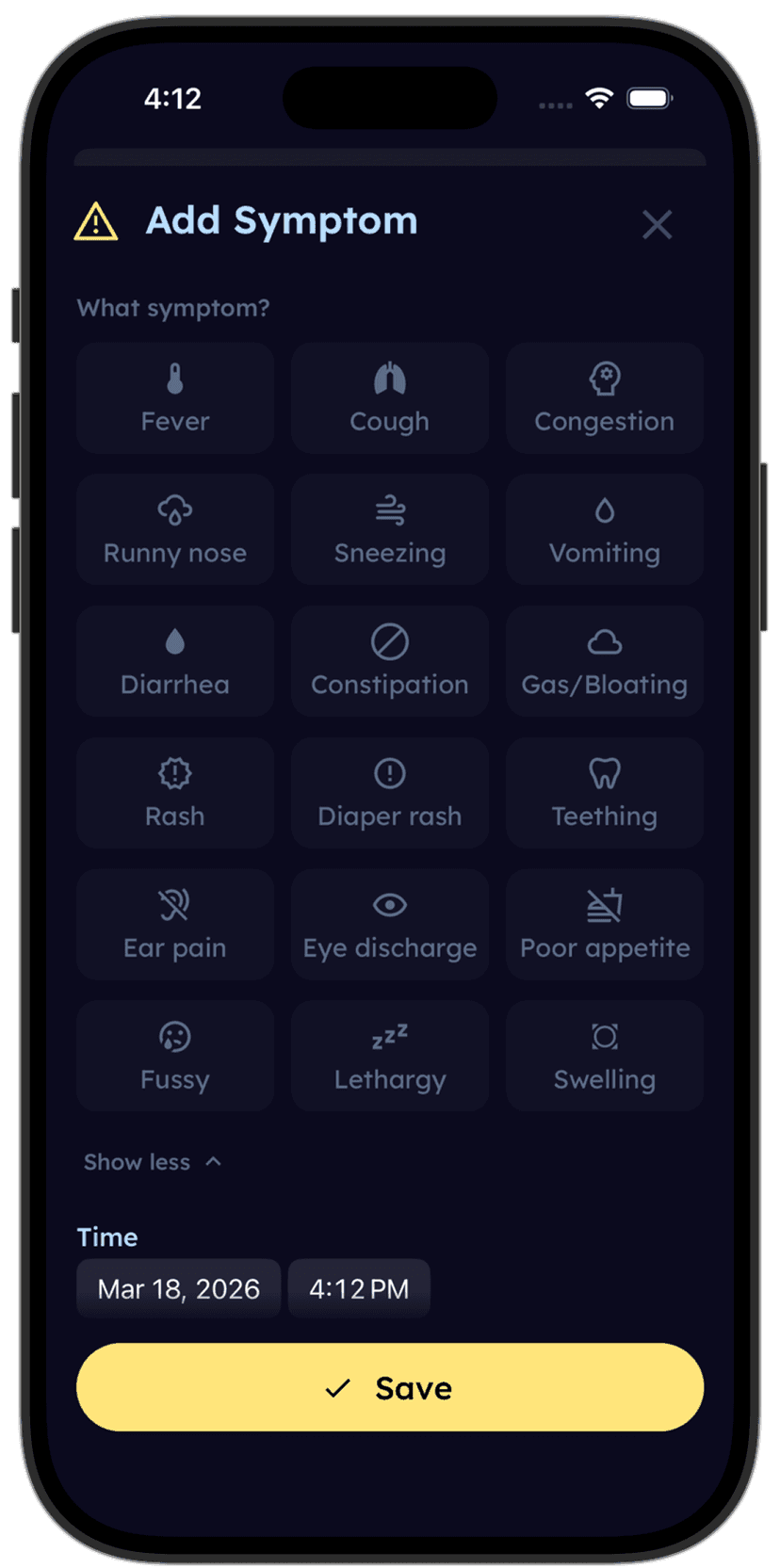
tinylog symptom tracking showing ringworm treatment progress log

Is the patch getting bigger or smaller? Check the log.

When you are staring at a ring-shaped rash every day, it is hard to tell if it is actually improving or you are just hoping it is. Log the size and appearance in tinylog each time you apply the cream, and you will have an objective record to show your pediatrician if treatment is not working.

Download on the App StoreGet It On Google Play

Related Guides

  • Baby Rash Types — Visual guide to every rash your baby might get
  • Baby Eczema — Eczema and ringworm can look similar but need different treatments
  • Impetigo — Another skin infection that can mimic or complicate ringworm
  • Diaper Rash — Fungal diaper rash is caused by the same family of organisms
  • Molluscum Contagiosum — Another common contagious skin condition in children

Sources

  • American Academy of Pediatrics (AAP). (2024). Ringworm (Tinea). HealthyChildren.org.
  • Chen, X., et al. (2022). Tinea Capitis in Children: A Systematic Review and Meta-Analysis of Antifungal Treatment. Pediatric Dermatology, 39(2), 173-182.
  • Gupta, A. K., & Mays, R. R. (2017). The Diagnosis and Management of Tinea Corporis in Children. Pediatric Dermatology, 34(1), 3-14.
  • Hay, R. J. (2017). Tinea Capitis: Current Status. Mycopathologia, 182(1-2), 87-93.
  • Fuller, L. C., et al. (2014). British Association of Dermatologists' guidelines for the management of tinea capitis. British Journal of Dermatology, 171(3), 454-463.

Medical Disclaimer

This guide is for informational purposes only and is not a substitute for professional medical advice. Ringworm on the scalp requires prescription oral medication — do not attempt to treat it with over-the-counter cream alone. If a rash is spreading, not improving with treatment, or you are unsure of the diagnosis, see your pediatrician.

Get this guide in your inbox.
We'll email you this guide so you have the treatment timeline and daycare rules handy when you need them.
Track the patch size so you know if treatment is working.
Download tinylog free — log symptoms, medications, and changes day by day.
Download on the App StoreGet It On Google Play