
Tour both settings
Seeing the birth center and the hospital labor ward in person tells you more than any guide. Pay attention to how you feel in each space — comfort and safety perception matter for labor progression.
GUIDE
Published on
Birth centers offer a low-intervention, home-like environment for low-risk pregnancies with transfer rates around 12-15%. Hospitals provide immediate access to surgical intervention and NICU care. Both are safe for the right candidates.
Where you give birth affects everything from your pain management options to who's in the room. Here's the evidence.
Track from the very first day
“At the heart of midwifery is conversations. Through these dialogues, we aim to build trust, keep you informed about what is happening inside your body, and support you in exploring your options.”
 Elizabeth Oppert, MSN, Certified Nurse Midwife, UChicago Medicine Family Birth Center
The difference between giving birth in a birth center and giving birth in a hospital goes far beyond the decor. These are fundamentally different models of care, with different philosophies about birth, different intervention thresholds, and different safety profiles.
Birth centers operate on the principle that birth is a normal physiological process that usually doesn't require medical intervention. They provide a calm, home-like environment with continuous midwifery support, freedom of movement, and access to natural pain relief like hydrotherapy. They do not offer epidurals, Pitocin augmentation, or surgical delivery.
Hospitals operate on the principle that birth is a medical event requiring monitoring and immediate access to intervention. They provide continuous fetal monitoring, pharmacological pain relief, and on-site surgical capability. The 2013 National Birth Center Study II, which followed over 15,000 birth center admissions, found a C-section rate of 6% and an intrapartum transfer rate of 12.4% — both dramatically lower than national hospital averages. But birth centers achieve these numbers partly through careful screening: only low-risk pregnancies are accepted.
| Aspect | Birth Center | Hospital |
|---|---|---|
| Setting | Home-like rooms with beds, tubs, and space to move. No medical equipment visible unless needed. | Medical environment with fetal monitors, IV access, and surgical suites nearby. |
| Pain management | Hydrotherapy, nitrous oxide (some centers), movement, massage, breathing. No epidural available. | Full range: epidural, IV narcotics, nitrous oxide, plus non-pharmacological options. |
| Intervention rates | C-section rate ~6%. Minimal routine interventions. No continuous fetal monitoring unless indicated. | National C-section rate ~32%. Routine IV, continuous fetal monitoring, and time-based protocols are common. |
| Provider | Midwives (CNMs or CPMs). Same midwife often provides prenatal care and attends the birth. | OB-GYN or CNM. May deliver with an on-call provider you've never met. |
| Transfer capability | Must transfer to hospital for C-section, epidural, or complications. Transfer rate 12-15%. | All services available on-site. No transfer needed for any scenario. |
| Postpartum stay | Typically go home 4-12 hours after birth if mother and baby are stable. | Typical stay is 1-2 days (vaginal) or 2-4 days (C-section). |
| Cost | $2,000-$6,000 total. Lower facility fees. Insurance coverage varies. | $10,000-$30,000+. Higher facility fees. Typically covered by insurance. |
Outcomes data from the National Birth Center Study II (Stapleton et al., 2013).
Transfer rates are highest for first-time mothers (~25%) and lower for experienced mothers (~6%).
Hospital birth is appropriate for all risk levels and is the only option for high-risk pregnancies.
Many hospitals now offer low-intervention options. Ask about midwifery-led units within hospital settings.
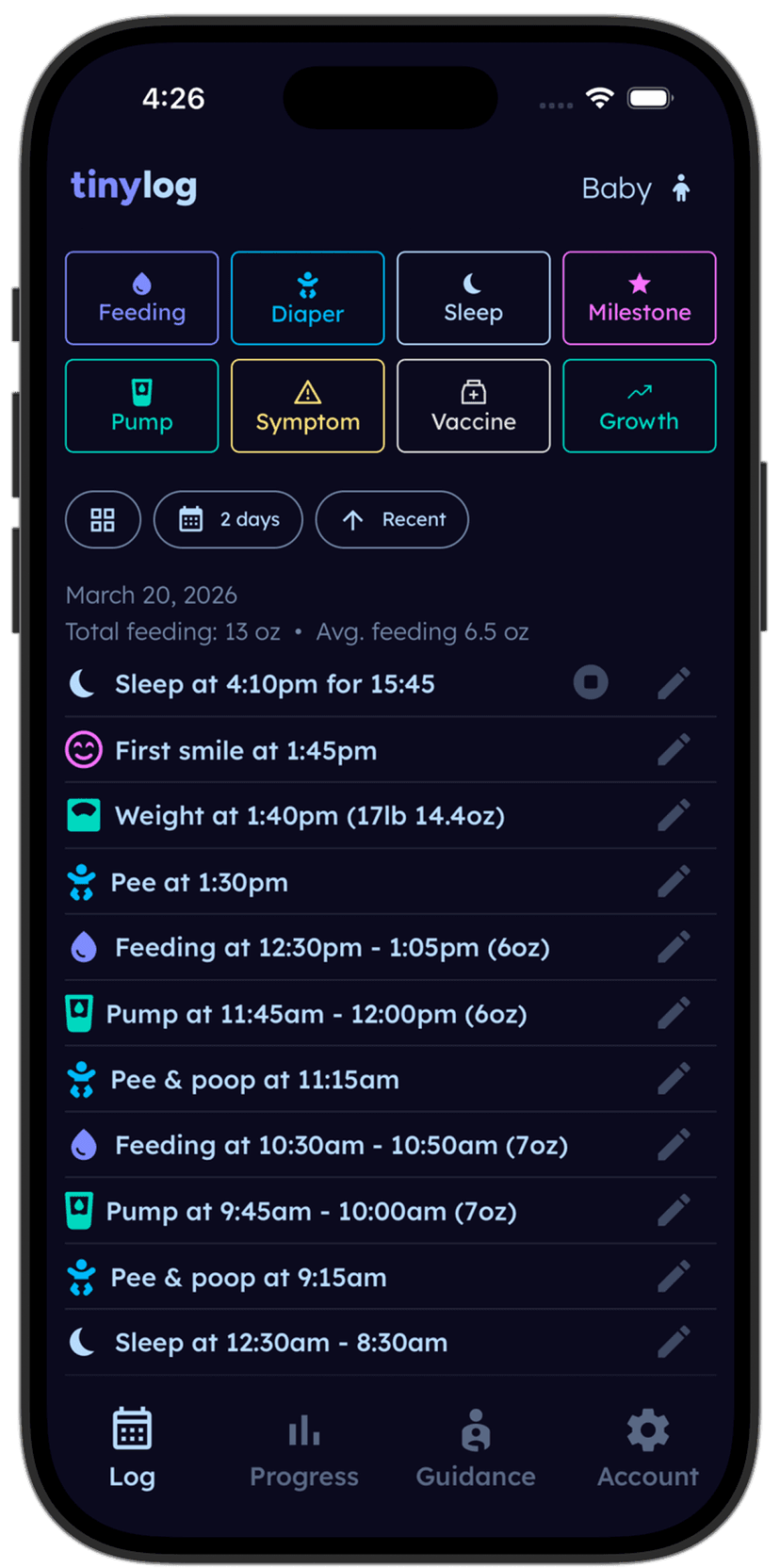
Tinylog helps you track feeds, diapers, and sleep from the very first hour — whether you come home 6 hours after a birth center delivery or 3 days after a hospital stay.


Birth centers screen carefully, and for good reason. You're generally a good candidate if your pregnancy is low-risk, you're carrying a single baby in a head-down position, you're between 37-42 weeks, and you have no medical conditions that increase delivery risk (preeclampsia, gestational diabetes requiring medication, placenta previa, etc.).
First-time mothers should know that birth center transfer rates are higher for them — approximately 25% compared to about 6% for experienced mothers, according to the NBCS II data. Most transfers are non-emergency (slow labor progression, desire for pain relief) rather than urgent. But the possibility is real and worth factoring into your planning.
If you want the option of an epidural, a birth center is not the right choice. This isn't a limitation you can work around — it's a fundamental feature of the model. Be honest with yourself about your pain management preferences before committing to a setting that doesn't offer pharmacological options.
The right setting depends on three things: your risk profile, your pain management preferences, and your birth philosophy.
If you're high-risk, the decision is made — hospital birth is the medically appropriate choice. If you're low-risk and you want an epidural available just in case, a hospital with a supportive provider is the best fit. If you're low-risk, committed to an unmedicated birth, and want a calm environment with continuous midwifery support, a birth center offers a compelling option with strong safety data.
Consider the hybrid option too. Many hospitals now have midwifery-led units or "natural birth suites" that offer a birth-center-like experience with hospital backup down the hall. This gives you the low-intervention environment with immediate access to surgical intervention if needed. It's increasingly the best of both worlds.
Seeing the birth center and the hospital labor ward in person tells you more than any guide. Pay attention to how you feel in each space — comfort and safety perception matter for labor progression.
If you choose a birth center, ask specifically about transfer logistics: how far is the hospital, what triggers a transfer, how long does it take, and does your midwife come with you? These details matter.
About 12-15% of birth center births transfer to hospitals. Having a hospital backup plan doesn't mean you've failed — it means you're prepared. Pack a hospital bag either way.
This guide is for informational purposes only and is not a substitute for professional medical advice. Consult your healthcare provider for guidance specific to your situation.