
GUIDE
Burt's Bees Baby Bee Nourishing Lotion vs. Earth Mama Organic Baby Lotion
Published on
Burt's Bees Baby Bee Nourishing Lotion is a budget-friendly, lightweight daily moisturizer made with buttermilk and sunflower oil. Earth Mama Organic Baby Lotion is a USDA-certified organic lotion built around calendula and colloidal oatmeal. Both are gentle and naturally sourced, but they differ in certification, ingredient philosophy, and price.
These two lotions sit in the same general category — lightweight, daily-use baby moisturizers — but their formulations reflect different priorities. Burt's Bees focuses on affordability and wide availability with a proven natural formula. Earth Mama focuses on organic sourcing and skin-soothing botanicals. This guide breaks down the real differences so you can pick the right one for your baby.
Two Natural Lotions, Two Different Philosophies
Burt's Bees Baby Bee Nourishing Lotion and Earth Mama Organic Baby Lotion are both lightweight, naturally formulated baby moisturizers. They sit in the same product category and serve the same basic purpose — daily hydration for your baby's skin after bath time. But the brands behind them approach the job from different angles.
Burt's Bees Baby Bee Nourishing Lotion is the affordable crowd-pleaser. It uses buttermilk, sunflower seed oil, shea butter, and aloe vera to deliver gentle, everyday moisture. It has been a drugstore staple for years, and you can grab it at Target, Walmart, CVS, or your local grocery store without a second thought. At roughly $9 for a 12 oz bottle, it is one of the best values in the natural baby lotion space.
Earth Mama Organic Baby Lotion is the certified organic alternative. Built around calendula, colloidal oatmeal, organic olive oil, and organic shea butter, it carries the USDA Certified Organic label — meaning at least 95% of its ingredients are organically sourced. It costs more per ounce, but for families who prioritize organic certification and skin-soothing botanicals, the premium feels justified.
Both are good lotions. The question is which one fits your baby's skin, your values, and your budget.
| Feature | Burt's Bees Baby Bee Lotion | Earth Mama Organic Baby Lotion | What It Means |
|---|---|---|---|
| Brand background | Burt's Bees (founded 1984, now owned by Clorox) | Earth Mama (founded 2002, independent, Oregon-based) | Earth Mama is a smaller, independent brand focused on pregnancy and baby. Burt's Bees is a major natural brand with wide distribution. |
| Product type | Lightweight nourishing lotion | Lightweight organic lotion | Both are daily-use lotions that absorb into the skin. Neither is an ointment or heavy barrier cream. |
| Key ingredients | Buttermilk, sunflower seed oil, shea butter, coconut oil, aloe vera | Organic calendula, colloidal oatmeal, organic olive oil, organic shea butter | Different ingredient philosophies. Burt's Bees leans on classic emollients. Earth Mama highlights soothing botanicals and oatmeal. |
| Organic certification | Not certified organic (labeled ~99% natural) | USDA Certified Organic | Earth Mama wins if organic certification is a priority for your family. Burt's Bees is natural but not certified organic. |
| Fragrance | Mild natural scent from buttermilk and botanicals | Light natural scent from calendula and vanilla | Both have subtle, pleasant scents. Neither uses synthetic fragrance. Most babies tolerate both well. |
| Texture and absorption | Smooth and light — absorbs within a minute or two | Silky and thin — absorbs quickly, no greasy residue | Very similar in feel. Both are easy to spread over a full body and absorb without leaving a heavy film. |
| Skin-soothing properties | Gentle hydration from aloe and shea butter | Colloidal oatmeal (FDA-recognized skin protectant) and calendula | Earth Mama has a stronger soothing profile thanks to the oatmeal and calendula. Burt's Bees hydrates but is less targeted for irritation. |
| Free of common irritants | No parabens, phthalates, petrolatum, or SLS | No parabens, phthalates, mineral oil, petrolatum, or artificial fragrance | Both avoid the major irritants parents worry about. Earth Mama's organic certification adds another layer of sourcing assurance. |
| Packaging | Pump bottle (6 oz, 12 oz) | Pump bottle (8 oz) | Both use convenient pump bottles. Burt's Bees offers more size options, including a larger 12 oz bottle for better per-ounce value. |
| Pediatrician-tested | Yes — pediatrician-tested and hypoallergenic | Dermatologist-tested; NSF/ANSI 305 certified | Both carry professional testing labels. Burt's Bees adds a hypoallergenic claim. Earth Mama has NSF organic personal care certification. |
| Availability | Widely available — Amazon, Target, Walmart, CVS, grocery stores | Amazon, Target, Whole Foods, natural baby boutiques | Burt's Bees is easier to grab in a pinch. Earth Mama is available at major retailers but not as ubiquitous in drugstores and grocery chains. |
Ingredients: Natural vs. Certified Organic
Both lotions are built on plant-based, naturally derived ingredients — but they are not identical in how they source and certify those ingredients.
Burt's Bees calls its formula about 99% natural. The star ingredients are buttermilk (a gentle lactic acid source that softens skin), sunflower seed oil (rich in vitamin E and fatty acids), shea butter (a classic moisturizer), and aloe vera (soothing and hydrating). The formula includes a small number of mild synthetic preservatives to maintain shelf stability. It is free of parabens, phthalates, petrolatum, and SLS.
Earth Mama carries the USDA Certified Organic label. Its formula centers on organic calendula (a traditional herb used for centuries to calm irritated skin), colloidal oatmeal (one of the few ingredients the FDA recognizes as a skin protectant), organic olive oil, and organic shea butter. The organic certification means the sourcing, processing, and handling of ingredients all meet federal organic standards.
A few things worth noting:
- Colloidal oatmeal gives Earth Mama a genuine soothing advantage. Dermatologists frequently recommend oatmeal-based products for babies with sensitive or easily irritated skin.
- Buttermilk in Burt's Bees is a dairy derivative. If your baby has a diagnosed dairy allergy or sensitivity, ask your pediatrician whether topical buttermilk is a concern. Most dermatologists say topical dairy is not the same as ingesting it, but it is worth a conversation.
- Calendula in Earth Mama is generally very well tolerated. However, babies with ragweed allergies (rare in infants, more relevant for older children) may theoretically react to calendula since they are in the same plant family.
- Synthetic preservatives in Burt's Bees are minimal, but they exist. If your family strictly avoids synthetic ingredients across all products, Earth Mama's organic formula aligns more closely with that preference.
Neither lotion contains anything alarming. The gap between them is more about sourcing standards and botanical choices than safety.
Texture and Application: More Alike Than Different
Unlike comparisons between an ointment and a lotion, this matchup features two products that feel quite similar in your hands.
Burt's Bees pumps out smoothly, spreads easily over arms, legs, and torso, and absorbs within a minute or two. There is no greasy film left behind. You can dress your baby right after applying. The 12 oz pump bottle is easy to operate one-handed — helpful when you are holding a squirmy post-bath baby.
Earth Mama has a slightly silkier texture. It comes out of the pump thin and smooth, glides across skin without resistance, and absorbs quickly. Like Burt's Bees, it leaves no heavy residue. The 8 oz pump bottle is slightly smaller but works the same way.
In terms of day-to-day use, most parents would not notice a dramatic difference in feel between the two. Both are lightweight, fast-absorbing, and easy to apply head-to-toe. If you handed them to a parent without labels, they might struggle to tell them apart based on texture alone.
The real difference is what happens after absorption. Earth Mama's colloidal oatmeal and calendula are designed to do ongoing soothing work on the skin's surface. Burt's Bees provides solid hydration but is less targeted for calming irritation. Over several days of consistent use, parents of babies with sensitive skin tend to notice that the soothing ingredients in Earth Mama make a visible difference.
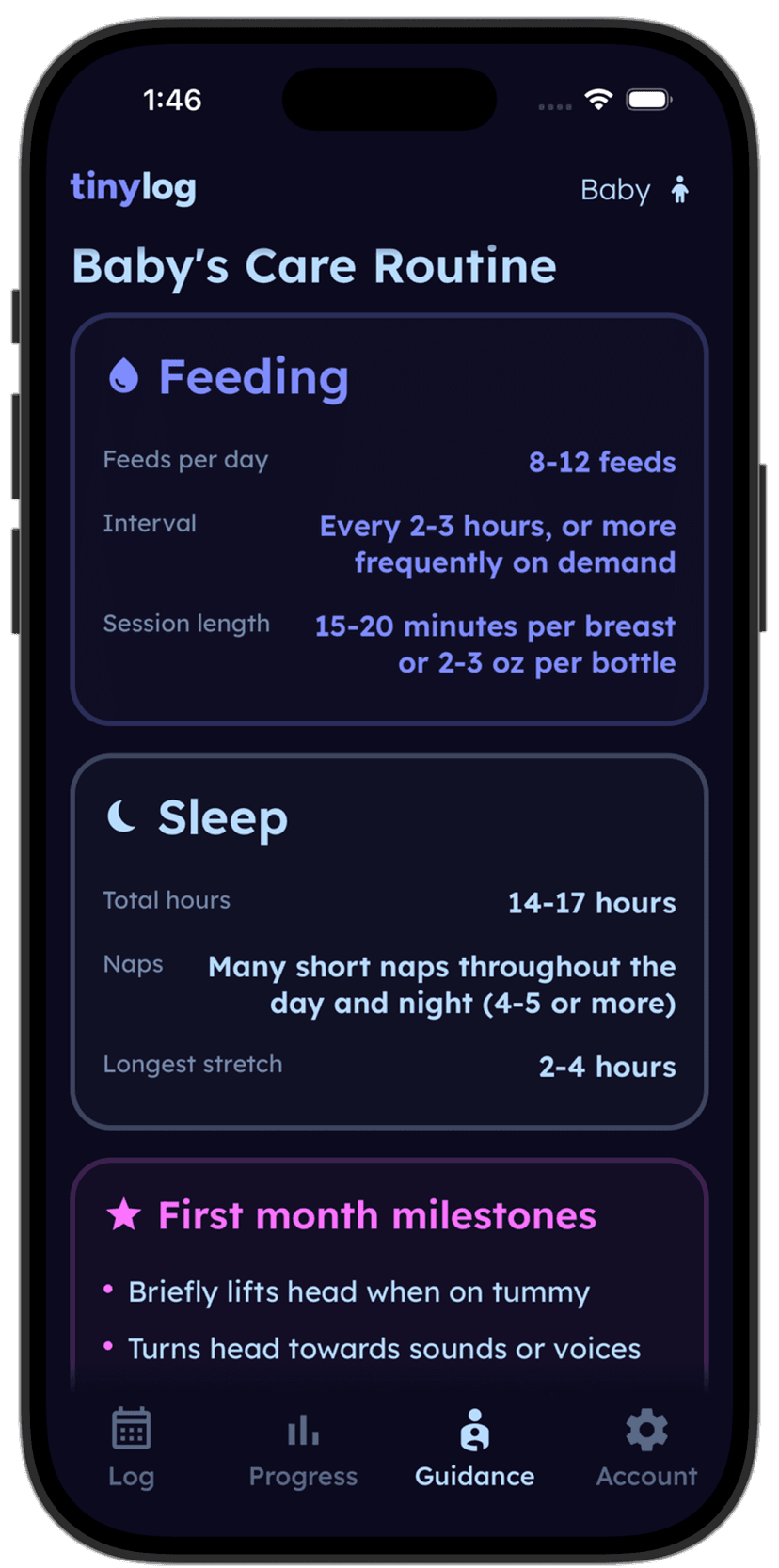
Tinylog tracks feedings so you can spot patterns.
Log every feeding, diaper change, and skin observation. When you try a new lotion, you will have a timeline to see if anything changes. Bring the data to your pediatrician.


| Product | Typical Price | Cost Per Ounce | Monthly Estimate |
|---|---|---|---|
| Burt's Bees Baby Bee Nourishing Lotion (12 oz) | $8–$11 | ~$0.70–$0.90/oz | ~$8–$15 (one bottle lasts 4–6 weeks with daily use) |
| Burt's Bees Baby Bee Nourishing Lotion (6 oz) | $6–$8 | ~$1.00–$1.30/oz | ~$10–$16 (may need two bottles per month with daily use) |
| Earth Mama Organic Baby Lotion (8 oz) | $12–$16 | ~$1.50–$2.00/oz | ~$12–$20 (one bottle lasts 3–5 weeks with daily use) |
Price: Burt's Bees Is the Clear Budget Winner
The cost difference between these two lotions is meaningful for families buying baby lotion month after month.
Burt's Bees in the 12 oz bottle runs about $0.70–$0.90 per ounce. At that price, it is one of the most affordable natural baby lotions you can buy. A single bottle lasts four to six weeks with daily full-body use, putting the monthly cost around $8–$15.
Earth Mama at 8 oz runs about $1.50–$2.00 per ounce — roughly double the per-ounce cost. A bottle lasts three to five weeks with daily use, bringing the monthly cost to about $12–$20.
Over a year, that difference adds up. A family using Burt's Bees exclusively might spend $100–$150 on baby lotion. A family using Earth Mama might spend $150–$240. The gap is roughly $50–$90 per year — not a huge amount on its own, but baby expenses pile up fast.
Ways to save on each:
- Burt's Bees: Buy the 12 oz bottle (better per-ounce value than the 6 oz), use Amazon Subscribe & Save, watch for Target Circle deals, and look for BOGO promotions at drugstores.
- Earth Mama: Buy through Amazon Subscribe & Save, check for multi-pack options on the Earth Mama website, and look for sales at Whole Foods and natural baby stores.
If budget is tight and both lotions work well for your baby's skin, Burt's Bees gives you more product for less money. If organic certification and the soothing botanical blend matter to your family, the extra cost of Earth Mama may feel like money well spent.
When the Organic Label Matters (and When It Doesn't)
The USDA Certified Organic label on Earth Mama is the single biggest differentiator between these two products. Whether that matters depends on your family's values and your baby's skin.
When organic certification matters:
- You are committed to reducing your baby's exposure to synthetic pesticides, processing agents, and non-organic additives across all products — food, skincare, and household items
- Your baby has highly reactive skin and you want the cleanest possible ingredient sourcing to minimize variables
- You want third-party verification (not just a brand's own claims) that the ingredients are sourced to a specific standard
When it may not matter as much:
- Your baby's skin tolerates conventional natural products well and shows no signs of sensitivity
- You are comfortable with "99% natural" labeling and do not require formal organic certification
- The price difference is a stretch for your monthly baby budget
It is worth saying plainly: a non-organic product is not automatically unsafe, and an organic product is not automatically better for your baby's skin. The organic label tells you about sourcing standards, not about clinical effectiveness. Burt's Bees is a well-tested, widely trusted product that has worked for millions of babies. Earth Mama's organic certification is a meaningful differentiator for families who value it, but it does not make Burt's Bees a bad choice.
Choose Burt's Bees Baby Bee Lotion If
- Budget is a top priority and you want a quality natural lotion at the lowest per-ounce cost
- You want a daily moisturizer that is easy to find at practically any store
- Your baby has healthy skin that needs routine hydration rather than targeted soothing
- You prefer a larger bottle option (12 oz) that lasts longer between purchases
- You want a pediatrician-tested, hypoallergenic formula with a long track record
Choose Earth Mama Organic Baby Lotion If
- Organic certification is a priority for your family's purchasing decisions
- Your baby has easily irritated or sensitive skin that benefits from colloidal oatmeal
- You want a lotion with calendula, a traditional skin-soothing botanical
- You prefer to support an independent, parent-founded brand
- You are willing to spend a bit more per ounce for certified organic sourcing
- Your baby's skin tends to react to conventional products and you want the cleanest ingredient chain possible
Where to Buy
If you want a reliable, affordable daily moisturizer with a proven natural formula, Burt's Bees Baby Bee Lotion (~$9 for 12 oz) is hard to beat on value. It is gentle, widely available, pediatrician-tested, and easy on the budget. The pump bottle makes post-bath moisturizing fast and simple.
If organic certification matters to your family and you want a lotion with genuine skin-soothing ingredients like calendula and colloidal oatmeal, Earth Mama Organic Baby Lotion (~$14 for 8 oz) is worth the extra cost. The USDA Organic label backs up what is on the bottle, and the formula is built to calm sensitive skin.
Our honest take: both of these lotions do a good job of keeping baby skin soft and hydrated. Burt's Bees is the practical, budget-friendly pick. Earth Mama is the upgrade for families who want organic sourcing and soothing botanicals. You cannot go wrong with either one.
Tinylog earns a small commission on purchases made through these links, at no cost to you.
We've found promo.new handy for finding discounts on baby gear. Doesn't always have what you need, but it's worth a shot.
The Bottom Line
Burt's Bees Baby Bee Nourishing Lotion and Earth Mama Organic Baby Lotion are both solid choices for daily baby skincare — but they are built for slightly different priorities.
Burt's Bees is the everyday workhorse. Affordable, lightweight, widely available, and gentle enough for daily use from day one. It hydrates well, absorbs fast, and costs less than almost any other natural baby lotion on the market. For families who want a dependable daily moisturizer without overthinking it, this is a strong pick.
Earth Mama is the thoughtful upgrade. USDA-certified organic, built around calendula and colloidal oatmeal, and designed with sensitive skin in mind. It costs more per ounce, but the ingredient profile is genuinely different — not just in sourcing, but in the soothing properties those ingredients bring to the table. For families who prioritize organic certification or have a baby with easily irritated skin, it delivers real value.
Neither lotion is a heavy-duty treatment product. If your baby has active eczema, persistent dry patches, or cracked skin, you may need an ointment or barrier cream in addition to a daily lotion. But for keeping healthy skin soft and moisturized after bath time, both of these do the job well.
And if you are switching products or introducing a new lotion, tracking your baby's feedings and skin observations in Tinylog can help you notice whether anything changes — so you have real data to share with your pediatrician instead of guessing.
Related Guides
- Baby Eczema — Causes, treatment options, and when to see a dermatologist
- Baby Acne — What causes it and how to manage it
- Baby Diaper Rash — Prevention, treatment, and when to call the pediatrician
- Baby Heat Rash — How to identify and soothe heat-related skin irritation
Sources
- BurtsBees.com. "Baby Bee Nourishing Lotion — Product Details and Ingredients." 2026.
- EarthMamaOrganics.com. "Organic Baby Lotion — Product Information." 2026.
- USDA. "Organic Labeling Standards." usda.gov.
- National Eczema Association. "Moisturizers and Emollients for Eczema." nationaleczema.org, 2025.
- American Academy of Dermatology. "How to Care for Your Baby's Skin." aad.org, 2025.
- FDA. "Skin Protectant Drug Products for Over-the-Counter Human Use — Colloidal Oatmeal." fda.gov.
- Healthline Parenthood. "Best Natural and Organic Baby Lotions." healthline.com, 2026.
This guide is for informational purposes only and does not replace medical advice. Every baby's skin is different. If your baby has persistent eczema, rashes, or skin irritation, consult your pediatrician or a pediatric dermatologist before choosing skincare products.
Frequently asked questions
- Is Burt's Bees Baby Bee Lotion safe for newborns?
- Yes. Burt's Bees Baby Bee Nourishing Lotion is pediatrician-tested and formulated for babies from birth onward. It is free of parabens, phthalates, petrolatum, and SLS. The lightweight formula absorbs quickly and is gentle enough for daily use on newborn skin. As with any new product, a small patch test is a good idea if your baby has very reactive skin.
- Is Earth Mama Organic Baby Lotion good for eczema?
- Earth Mama Organic Baby Lotion contains colloidal oatmeal and calendula, both of which are recognized for soothing irritated skin. It works well for mild dryness and as a maintenance moisturizer between eczema flare-ups. For active, severe eczema, a thicker ointment or a prescription barrier cream may provide stronger relief. Consult your pediatrician for persistent eczema.
- What does USDA Certified Organic mean for baby lotion?
- USDA Certified Organic means at least 95% of the ingredients are organically produced without synthetic pesticides, fertilizers, or GMOs. Earth Mama carries this certification. It does not automatically mean the product is safer or more effective than a non-organic product, but it does mean the ingredient sourcing meets a specific federal standard that some families prioritize.
- Does Burt's Bees Baby Bee Lotion contain synthetic ingredients?
- Burt's Bees states that the Baby Bee Nourishing Lotion is about 99% natural. It does include a small number of mild synthetic preservatives to maintain shelf stability. It does not contain parabens, phthalates, petrolatum, or SLS. The formula is not certified organic, but the core ingredients — buttermilk, sunflower seed oil, shea butter — are naturally derived.
- Can I use both lotions on my baby?
- Yes, though there is not much practical reason to use two lightweight lotions at the same time. Most parents choose one as their daily go-to. Some families keep Burt's Bees as the everyday workhorse and use Earth Mama when they want the soothing benefits of calendula and oatmeal — for instance, after a mild rash clears up or during a dry-skin stretch.
- Which lotion is better for sensitive skin?
- Both are formulated for sensitive baby skin. Earth Mama has a slight edge here because of its colloidal oatmeal content, which the FDA recognizes as a skin protectant, and its organic certification means fewer synthetic processing agents. Burt's Bees is also gentle, but if your baby reacts to conventional products frequently, Earth Mama's cleaner ingredient chain may be worth trying first.