
GUIDE
Enfamil NeuroPro vs. Similac Pro-Advance
Published on
Both are top-tier infant formulas that meet all FDA nutritional requirements. Enfamil NeuroPro includes MFGM and higher DHA levels for brain development. Similac Pro-Advance is gentler on some babies' stomachs and contains no palm olein oil. Cost is very similar.
Enfamil NeuroPro and Similac Pro-Advance are the two best-selling standard infant formulas in the United States. Both are milk-based, iron-fortified, and designed for full-term babies from birth through 12 months. For most healthy infants, either formula will support normal growth and development. The differences come down to fat source, specific brain-supporting ingredients, and how your baby tolerates each one.
Log bottles, note spit-up, and track intake
Two Trusted Formulas — Here's What Actually Separates Them
Enfamil NeuroPro and Similac Pro-Advance are the two formulas you will see most often on store shelves, in hospital sample bags, and in pediatrician recommendations. Both are milk-based, iron-fortified, and designed for healthy, full-term infants from birth to 12 months.
The honest truth: both formulas will nourish your baby well. They meet identical FDA nutritional requirements, and decades of research support both. But there are real differences in fat sources, brain-development ingredients, and how individual babies tolerate each one.
We broke down the ingredients, nutritional profiles, and pricing so you can pick with confidence — or feel good about switching if your baby is fussy on one.
For more on how much your baby should eat by age, see our baby feeding chart.
| Feature | Enfamil NeuroPro | Similac Pro-Advance | What It Means |
|---|---|---|---|
| Manufacturer | Reckitt (Mead Johnson) | Abbott Laboratories | Two of the largest infant nutrition companies in the world. |
| Protein source | Nonfat milk, whey protein concentrate | Nonfat milk, whey protein concentrate | Tie. Both use cow's milk protein with a whey-to-casein ratio designed to mimic breast milk. |
| Fat source | Palm olein, coconut, soy, and high oleic sunflower oils | High oleic safflower, soy, and coconut oils | Similac avoids palm olein oil, which some studies link to harder stools and lower calcium absorption. |
| DHA level | Higher DHA concentration | Standard DHA level | Enfamil includes more DHA, an omega-3 fatty acid important for brain and eye development. |
| MFGM (milk fat globule membrane) | Yes — included | No | Enfamil wins here. MFGM is found in breast milk and supports cognitive development. |
| 2'-FL HMO (human milk oligosaccharide) | Yes — included | Yes — included | Tie. Both contain this prebiotic that supports immune and gut health. |
| Non-GMO | Not labeled non-GMO | Non-GMO labeled | Similac carries the non-GMO label. Both meet all FDA safety standards. |
| Iron content | Iron-fortified (1.8 mg per 5 fl oz) | Iron-fortified (1.8 mg per 5 fl oz) | Tie. Both meet AAP recommendations for iron-fortified formula. |
| Prebiotics/probiotics | Prebiotics (polydextrose, GOS) | Prebiotics (2'-FL HMO, FOS, GOS) | Both support gut health. Similac's prebiotic blend is slightly more diverse. |
| Taste acceptance | Slightly sweeter taste profile | Milder, more neutral taste | Varies by baby. Some prefer Enfamil's sweetness; others take to Similac's milder flavor more easily. |
| Available forms | Powder, ready-to-feed, single-serve packets | Powder, ready-to-feed, concentrated liquid | Both offer convenient options. Enfamil has single-serve packets; Similac has concentrated liquid. |
The Fat Source Difference That Parents Should Know About
The most meaningful difference between these two formulas is the fat blend.
Enfamil NeuroPro uses palm olein oil as its primary fat source. Palm olein is widely used in infant formula because its fatty acid profile resembles the palmitic acid found in breast milk. However, some research suggests that palm olein oil can lead to harder stools and may reduce calcium and fat absorption in certain babies.
Similac Pro-Advance deliberately excludes palm olein oil, using a blend of high oleic safflower oil, soy oil, and coconut oil instead. Abbott (Similac's manufacturer) markets this as their "OptiGRO" blend and highlights the improved calcium absorption in clinical studies.
What does this mean in practice? If your baby is prone to constipation or hard stools, Similac's palm-olein-free formula may be worth trying first. If your baby has no digestive issues, the fat source difference is less likely to matter day to day.
Brain Development: Enfamil's Strongest Selling Point
Enfamil NeuroPro's key differentiator is its MFGM + DHA combination. MFGM (milk fat globule membrane) is a complex lipid naturally found in breast milk that surrounds fat droplets. Research suggests MFGM supports cognitive development, and Enfamil is one of the few mainstream formulas that includes it.
Enfamil NeuroPro also contains a higher concentration of DHA (docosahexaenoic acid) than Similac Pro-Advance. DHA is an omega-3 fatty acid critical for brain and eye development in the first year of life.
Similac Pro-Advance contains DHA and ARA as well, but at lower levels and without MFGM. Both formulas support normal brain development, but if maximizing brain-supporting ingredients is your priority, Enfamil has a stronger case here.
It is worth noting that the long-term cognitive differences between formulas with varying DHA levels are modest in clinical research. Adequate nutrition overall matters more than any single ingredient.
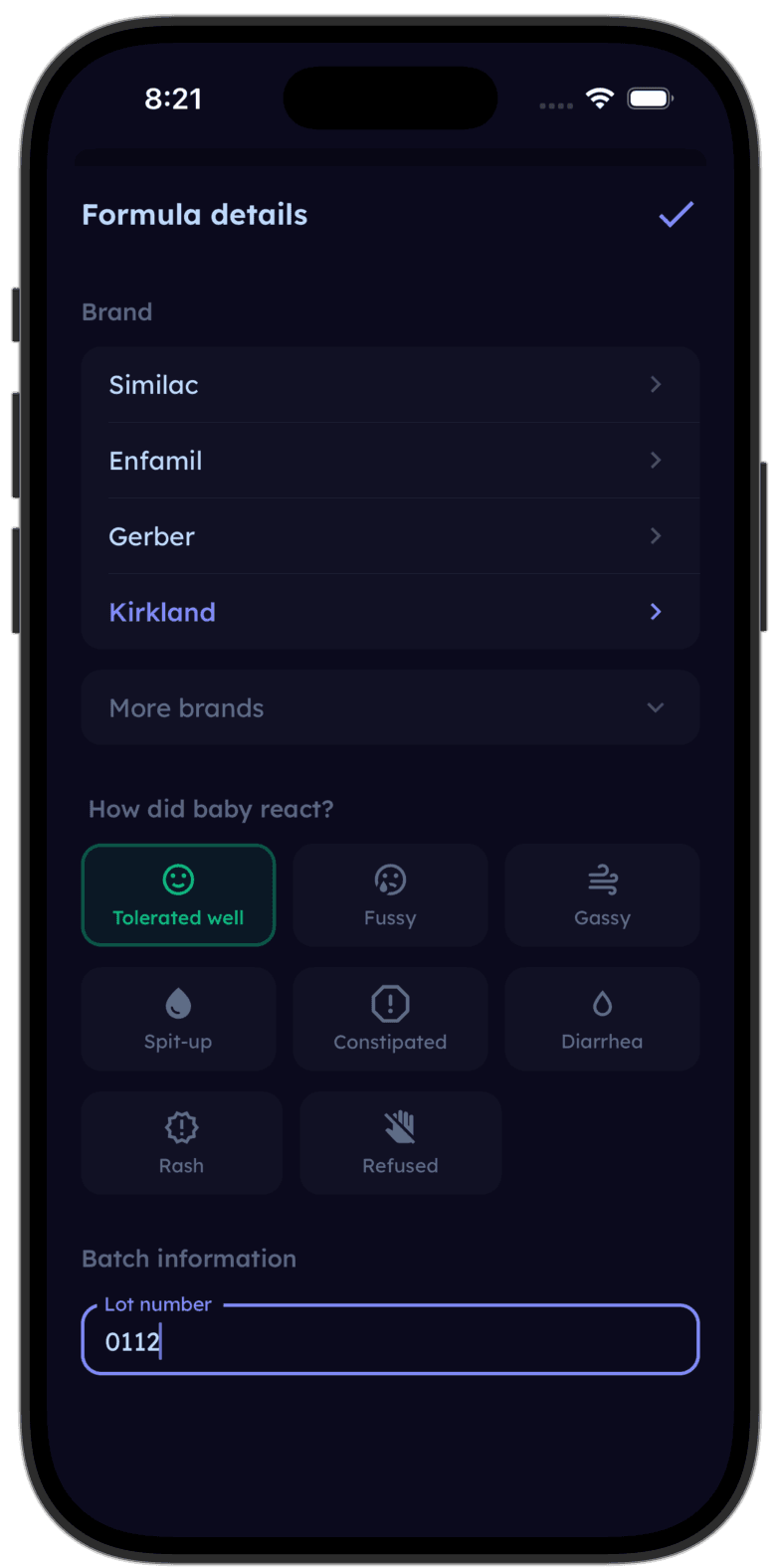
Tinylog tracks feedings so you can spot patterns.
Log bottle amounts, note spit-up and fussiness, track daily intake over time. Bring the data to your next pediatrician visit.


Tolerance and Digestive Comfort
Every baby's gut is different, and tolerance is the single most important factor in choosing a formula. The "best" formula on paper means nothing if your baby spits it up or screams after every feeding.
Common tolerance differences parents report:
- Babies on Enfamil NeuroPro sometimes have firmer stools, likely related to the palm olein oil. Some parents also report more gas, though this varies widely.
- Babies on Similac Pro-Advance tend to have softer stools. The no-palm-olein formulation may also result in slightly better calcium absorption.
If your baby is experiencing excessive spit-up, gas, or fussiness on either formula, talk to your pediatrician before switching. Sometimes the issue is technique (bottle angle, nipple flow rate, burping) rather than the formula itself.
Give any new formula at least 5–7 days before judging tolerance. Babies' digestive systems need time to adjust.
| Product | Typical Price | Cost Per Fl Oz (Prepared) | Monthly Estimate |
|---|---|---|---|
| Enfamil NeuroPro (20.7 oz powder tub) | $33–$38 | ~$0.20–$0.23/fl oz prepared | ~$140–$175 |
| Similac Pro-Advance (20.6 oz powder tub) | $32–$37 | ~$0.19–$0.22/fl oz prepared | ~$135–$170 |
| Enfamil NeuroPro (32 fl oz ready-to-feed) | $10–$13 | ~$0.31–$0.41/fl oz | ~$220–$290 |
| Similac Pro-Advance (32 fl oz ready-to-feed) | $10–$12 | ~$0.31–$0.38/fl oz | ~$215–$280 |
Price: Nearly Identical, But Powder Saves Real Money
The per-ounce price difference between Enfamil NeuroPro and Similac Pro-Advance is negligible — usually less than 2 cents per prepared fluid ounce. Over a month, that is $5–$10 at most.
What actually moves the needle on formula costs:
- Buy powder over ready-to-feed. Powder costs roughly 40–50% less per prepared ounce. Ready-to-feed is convenient but expensive.
- Use manufacturer coupons. Both Enfamil and Similac run loyalty programs with meaningful discounts. Sign up for both before your baby arrives.
- Consider store brands. Kirkland (Costco), Parent's Choice (Walmart), and Up & Up (Target) make formulas that are nutritionally equivalent to name brands at 30–50% lower cost. The FDA regulates all infant formula to the same nutritional standards.
- Buy in bulk. Larger powder tubs and multi-packs from warehouse clubs offer the best per-ounce pricing.
The honest answer: formula costs add up fast regardless of brand. Budget $140–$180/month for powder and focus on whichever formula your baby tolerates best.
Choose Enfamil NeuroPro If
- Brain development support is your top priority (higher DHA + MFGM)
- Your baby accepts a slightly sweeter taste profile
- You want single-serve packets for on-the-go convenience
- Your baby tolerates palm olein oil without stool issues
- Your pediatrician specifically recommends Enfamil NeuroPro
Choose Similac Pro-Advance If
- Your baby tends toward harder stools or constipation (no palm olein oil)
- Non-GMO labeling is important to you
- You want a formula with a more diverse prebiotic blend
- Your baby prefers a milder, more neutral taste
- You want concentrated liquid as a middle-ground between powder and ready-to-feed
- Calcium absorption is a concern (no palm olein oil means better calcium uptake)
Where to Buy
If brain development ingredients are your priority, Enfamil NeuroPro (~$0.21/fl oz prepared in powder) delivers the highest DHA levels and is one of the few formulas with MFGM. The powder tub from Amazon, Target, or Costco is the best value.
If you want a palm-olein-free formula with non-GMO labeling, Similac Pro-Advance (~$0.20/fl oz prepared in powder) is a strong choice — softer stools for many babies, better calcium absorption in studies, and a diverse prebiotic blend. Same retailers, similar pricing.
Our honest advice: your baby's tolerance matters more than any ingredient list. Buy a small container of each if you are undecided, and let your baby's digestion be the tiebreaker.
Tinylog earns a small commission on purchases made through these links, at no cost to you.
Looking for a discount? Try checking promo.new. It doesn't always find what you're looking for, but when it does, it works like a charm.
The Bottom Line
Both Enfamil NeuroPro and Similac Pro-Advance are excellent, well-researched infant formulas. The differences are real but specific:
Enfamil NeuroPro stands out for higher DHA levels and the inclusion of MFGM — two brain-development ingredients that give it an edge if cognitive support is your top priority.
Similac Pro-Advance stands out for its palm-olein-free fat blend (softer stools, better calcium absorption), non-GMO labeling, and a slightly more diverse prebiotic blend.
For most healthy babies, either formula will support normal growth and development. The best formula is the one your baby tolerates well, takes willingly, and that you can afford consistently.
If you are tracking feeds — which is especially helpful when troubleshooting fussiness or spit-up — Tinylog makes it easy to log bottles and spot intake patterns over time.
Related Guides
- Baby Feeding Chart — How much your baby should eat by age
- Baby Constipation — What's normal and when to worry
- Baby Gas — Causes, relief, and when to call your doctor
- Baby Spit-Up — Normal spit-up vs. reflux warning signs
Sources
- Enfamil.com. "Enfamil NeuroPro Infant Formula — Product Information." 2026.
- Similac.com. "Similac Pro-Advance Infant Formula — Product Information." 2026.
- Nelson SE, et al. "Palm olein in infant formula: absorption of fat and minerals." Journal of the American College of Nutrition, 1998.
- Timby N, et al. "Neurodevelopment, nutrition, and growth until 12 months of age in infants fed a formula with bovine MFGM." Clinical Nutrition, 2014.
- American Academy of Pediatrics. "Choosing an Infant Formula." HealthyChildren.org, 2025.
- Consumer Reports. "Best Baby Formulas From Our Tests." consumerreports.org, 2026.
- FDA.gov. "Infant Formula Requirements and Regulations." U.S. Food and Drug Administration, 2025.
This guide is for informational purposes only and is not medical advice. Formula choice should be discussed with your pediatrician, especially if your baby has allergies, reflux, or other medical conditions. If your baby shows signs of a formula intolerance or allergy, consult your doctor before switching.
Frequently asked questions
- Is Enfamil NeuroPro or Similac Pro-Advance closer to breast milk?
- Both formulas are designed to mimic breast milk composition. Enfamil NeuroPro includes MFGM (milk fat globule membrane), a component naturally found in breast milk that supports brain development. Similac Pro-Advance contains 2'-FL HMO (human milk oligosaccharide), which supports immune health. Neither formula is identical to breast milk, but both incorporate breast-milk-inspired ingredients.
- Does Enfamil NeuroPro cause more constipation than Similac?
- Enfamil NeuroPro uses palm olein oil as a fat source, which some studies link to harder stools and reduced calcium absorption in certain infants. Similac Pro-Advance does not contain palm olein oil and uses a blend of high oleic safflower, soy, and coconut oils instead. Some parents report softer stools with Similac, though individual results vary.
- Which formula is cheaper, Enfamil or Similac?
- Prices are within a few cents per ounce of each other. Both cost roughly $0.18–$0.24 per prepared fluid ounce depending on container size and retailer. Powder tubs offer the best value. Store-brand equivalents can cost 30–50% less and are nutritionally comparable.
- Can I switch between Enfamil NeuroPro and Similac Pro-Advance?
- Yes. There is no medical reason you cannot switch between standard formulas. Most pediatricians suggest trying a formula for at least a week before switching, so you can fairly evaluate tolerance. Mixing two different formulas in the same bottle is also safe, though it complicates troubleshooting if issues arise.
- Which formula has more DHA for brain development?
- Enfamil NeuroPro contains a higher concentration of DHA (docosahexaenoic acid) than Similac Pro-Advance. Enfamil also includes MFGM, which works alongside DHA to support cognitive development. Both formulas contain DHA and ARA, but Enfamil markets brain development as its primary differentiator.
- Are Enfamil NeuroPro and Similac Pro-Advance both non-GMO?
- Similac Pro-Advance is labeled as non-GMO. Enfamil NeuroPro does not carry a non-GMO label. If non-GMO sourcing is important to you, Similac has the edge here. Both formulas meet all FDA safety and nutritional requirements regardless of GMO status.