GUIDE

Foamy Baby Poop Explained

Foamy poop is usually caused by excess lactose reaching the large intestine — most often from a foremilk-hindmilk imbalance in breastfed babies.

Frothy, bubbly stool that looks like it has tiny air pockets can be alarming, but the most common cause is manageable. Here's what foamy poop means, what is driving it, and when it crosses the line from minor feeding adjustment to something that needs medical attention.

What Foamy Baby Poop Looks Like

Foamy baby poop has a distinctive appearance that is different from normal loose breastfed stool. Instead of the typical smooth or seedy texture, foamy poop looks frothy — like the stool has been aerated. You might see tiny air bubbles throughout, or the stool may have a whipped or fizzy quality, almost like someone stirred air into it. Think of the foam on top of a cappuccino, or the froth that appears when you shake a bottle of soapy water. That bubbly, lightweight texture is what gives foamy poop its name.

The color is often green or greenish-yellow rather than the classic mustard yellow of healthy breastfed stool. The green tint is actually significant — it is often a clue that the stool moved through the intestines faster than normal, or that baby is getting more foremilk than hindmilk. The combination of green color and frothy texture is the classic visual signature of a foremilk-hindmilk imbalance.

Foamy stools may also be more watery than usual and can be accompanied by notable gas — both during and between feedings. Some parents report that the stool almost seems to fizz in the diaper, which is the result of gas produced by lactose fermentation in the large intestine. The smell may be slightly more acidic or sour than typical breastfed poop, which has that mild, almost sweet odor.

It is worth noting that a single foamy diaper does not constitute a pattern. Babies produce all kinds of one-off unusual diapers. Foamy poop becomes worth investigating when it is a consistent finding — the majority of diapers over several days showing the same frothy, green appearance.

The Science: Why Poop Becomes Foamy

To understand foamy poop, you need to understand lactose and how it is processed. Lactose is the primary sugar in both breast milk and standard infant formula. To digest lactose, your baby's small intestine produces an enzyme called lactase, which breaks lactose down into simpler sugars (glucose and galactose) that can be absorbed into the bloodstream.

Under normal circumstances, lactase handles the lactose load efficiently, and everything gets digested in the small intestine. But when more lactose arrives than the available lactase can process — which is called lactose overload — the undigested lactose passes into the large intestine. Bacteria in the large intestine ferment the undigested lactose, producing gas (carbon dioxide and hydrogen) and organic acids. That gas is what makes the stool foamy. The acids are what can make baby's bottom red and irritated.

The most common reason for lactose overload in breastfed babies is not a deficiency of lactase — it is an excess of lactose arriving too quickly. This happens when baby consumes a disproportionate amount of foremilk, which is higher in lactose and lower in fat. Fat slows gastric emptying, so when baby gets plenty of hindmilk (the fattier milk at the end of a feed), the lactose arrives in the small intestine at a manageable pace. When baby gets mostly foremilk, the lactose rushes through without enough fat to slow it down, overwhelming the lactase.

This is a critical distinction: your baby almost certainly produces enough lactase. The problem is that the lactose is arriving too fast and in too great a quantity for the enzyme to keep up. Fix the feeding mechanics, and the foamy poop typically resolves.


Foremilk vs. Hindmilk — Understanding the Imbalance
Foremilk (beginning of feed)
DescriptionThinner, more watery, higher in lactose (milk sugar), lower in fat. Comes out first when baby latches.
Hindmilk (end of feed)
DescriptionThicker, creamier, higher in fat, lower in lactose. Arrives as the breast empties. This is the calorie-dense milk that satisfies baby and produces the classic yellow, seedy stool.
When imbalance occurs
DescriptionIf baby switches breasts too quickly or feeds are cut short, baby may get foremilk from both breasts without enough hindmilk from either. The excess lactose ferments in the gut.
Result of imbalance
DescriptionGreen, frothy, gassy stools. Baby may seem hungry soon after feeding because foremilk is less calorie-dense. Fussiness and excessive gas are common.
Breast milk exists on a continuum — not a sharp switch from foremilk to hindmilk. The fat content increases gradually as the breast empties. The key is allowing baby to drain one breast thoroughly.
Causes of Foamy Baby Poop — From Common to Rare
Foremilk-hindmilk imbalance
How CommonMost common
MechanismBaby gets more low-fat foremilk than high-fat hindmilk. Excess lactose ferments in the large intestine, producing gas and frothy stool.
Typical AppearanceGreen-tinged, frothy, sometimes explosive. Baby may also be gassy and fussy.
Lactose overload
How CommonCommon
MechanismRelated to foremilk imbalance but can also occur with oversupply. Too much lactose overwhelms the available lactase enzyme, leading to fermentation.
Typical AppearanceWatery, foamy, greenish. May be accompanied by excessive gas, bloating, and cramping.
Oversupply of breast milk
How CommonCommon
MechanismMother produces more milk than baby needs. Baby fills up on foremilk before reaching hindmilk. Fast letdown can also cause baby to gulp air.
Typical AppearanceGreen, frothy, copious. Baby may choke, sputter, or pull off during letdown.
Viral gastroenteritis
How CommonOccasional
MechanismInfection damages the intestinal lining, temporarily reducing lactase production. This secondary lactose intolerance causes fermentation and foamy stools.
Typical AppearanceWatery, foamy, foul-smelling. Often accompanied by vomiting, fever, and increased frequency.
Food sensitivity (cow's milk protein)
How CommonOccasional
MechanismCow's milk protein in mother's diet (or in formula) triggers intestinal inflammation, which can produce mucus-streaked, frothy stools.
Typical AppearanceMay have blood or mucus alongside foam. Baby may be generally fussy, especially after feeds.
True lactase deficiency (congenital)
How CommonExtremely rare
MechanismBaby is born without the ability to produce lactase enzyme. Affects fewer than 1 in 60,000 infants.
Typical AppearanceSevere watery diarrhea from birth, failure to thrive, dehydration. Requires immediate medical intervention.
Foremilk-hindmilk imbalance and oversupply account for the vast majority of foamy poop in breastfed babies. True lactase deficiency is extremely rare — do not assume your baby has it without medical testing.

How to Fix Foremilk-Hindmilk Imbalance

The good news is that the most common cause of foamy poop is also the most fixable. Adjusting your breastfeeding technique can resolve foremilk-hindmilk imbalance within days for most families. The core principle is simple: let your baby finish one breast before offering the other.

When you switch breasts after a set amount of time — "10 minutes per side" is the classic outdated advice — your baby may never reach the hindmilk on either breast. Instead, they get two servings of foremilk: one from each side. The excess lactose from all that foremilk is what produces the green, frothy stool.

Instead of watching the clock, watch your baby. Let them feed on one breast until they slow down, pull off, or seem satisfied. If they are still hungry after that, offer the second breast. At the next feeding, start on the breast you did not fully drain. This ensures that at least one breast gets thorough drainage at each feed, which means baby gets the fattier hindmilk.

For mothers with a confirmed oversupply — where the volume of milk significantly exceeds what baby needs — a technique called block feeding may help. In block feeding, you feed from only one breast for a 2-3 hour window, then switch to the other breast for the next window. This signals to each breast to reduce production slightly while guaranteeing that baby gets full drainage (and full hindmilk) from the feeding side. Block feeding should be done under the guidance of a lactation consultant, as reducing supply too aggressively can create new problems.

Feeding Strategies to Reduce Foamy Poop
Finish one breast before offering the other
DetailsLet baby drain one breast completely (or as much as they want) before switching sides. This ensures they reach the fattier hindmilk. If baby seems satisfied after one breast, do not force the second.
PriorityStart here
Avoid timed switching (e.g., '10 minutes per side')
DetailsClock-based feeding can cut feeds short before baby reaches hindmilk. Instead, let baby's behavior guide you — when they slow down, pop off, or seem done, then offer the other side.
PriorityStart here
Try block feeding for oversupply
DetailsFeed from only one breast for a 2-3 hour block, then switch to the other for the next block. This reduces supply gradually while ensuring baby gets full drainage of each breast. Only use this for confirmed oversupply — discuss with a lactation consultant.
PriorityIf oversupply is confirmed
Address fast letdown
DetailsIf baby chokes or sputters at letdown, try laid-back breastfeeding (reclined position) or hand-express briefly before latching to slow the initial flow.
PriorityIf baby struggles at letdown
Consult a lactation consultant
DetailsIf foamy green stools persist despite adjusting feeding patterns, a lactation consultant can assess latch, positioning, and supply to identify the root cause.
PriorityIf home adjustments are not working
Start with the simplest adjustments. Most cases of foremilk imbalance resolve within a few days of letting baby finish one breast fully. If improvement does not occur within 1-2 weeks, consult a lactation professional.
Normal vs. Worrisome — When to Act
Occasional foamy diaper mixed in with normal seedy stools
VerdictNormal variation
ActionNo action needed — one foamy diaper does not indicate a problem
Consistently green, frothy stools but baby is gaining weight well and content between feeds
VerdictLikely foremilk imbalance
ActionTry finishing one breast fully before switching. Monitor for improvement over a few days.
Green, foamy stools with excessive gas, fussiness, and baby wanting to feed constantly
VerdictProbable foremilk-hindmilk imbalance or oversupply
ActionAdjust feeding technique. Consider consulting a lactation consultant if no improvement in a week.
Foamy, watery, foul-smelling stools with sudden increase in frequency, vomiting, or fever
VerdictLikely viral infection
ActionMonitor hydration closely. Contact your pediatrician, especially if baby is under 3 months.
Foamy stools with blood or mucus, persistent crying, and/or skin rash
VerdictPossible food sensitivity or allergy
ActionContact your pediatrician. They may recommend an elimination diet or formula change.
Context matters. Foamy poop in a thriving, weight-gaining baby is a very different situation from foamy poop in a baby who is fussy, losing weight, or showing signs of dehydration.

Warning Signs That Need Medical Attention

  • Foamy stools accompanied by blood or mucus — may indicate infection or cow's milk protein allergy
  • Poor weight gain or weight loss despite frequent feeding
  • Signs of dehydration — fewer wet diapers, dark urine, dry mouth, sunken fontanelle
  • Fever above 100.4 degrees F (38 degrees C) alongside foamy diarrhea
  • Severe, persistent fussiness with feeding refusal
  • Foamy stools that persist for more than 1-2 weeks despite feeding adjustments
  • White, pale, or clay-colored stools — requires immediate medical attention regardless of foam
  • Baby under 3 months with any change in stool pattern that concerns you

Most foamy poop is a feeding management issue, not a medical emergency. But the signs above warrant a call to your pediatrician to rule out infection, allergy, or other causes.

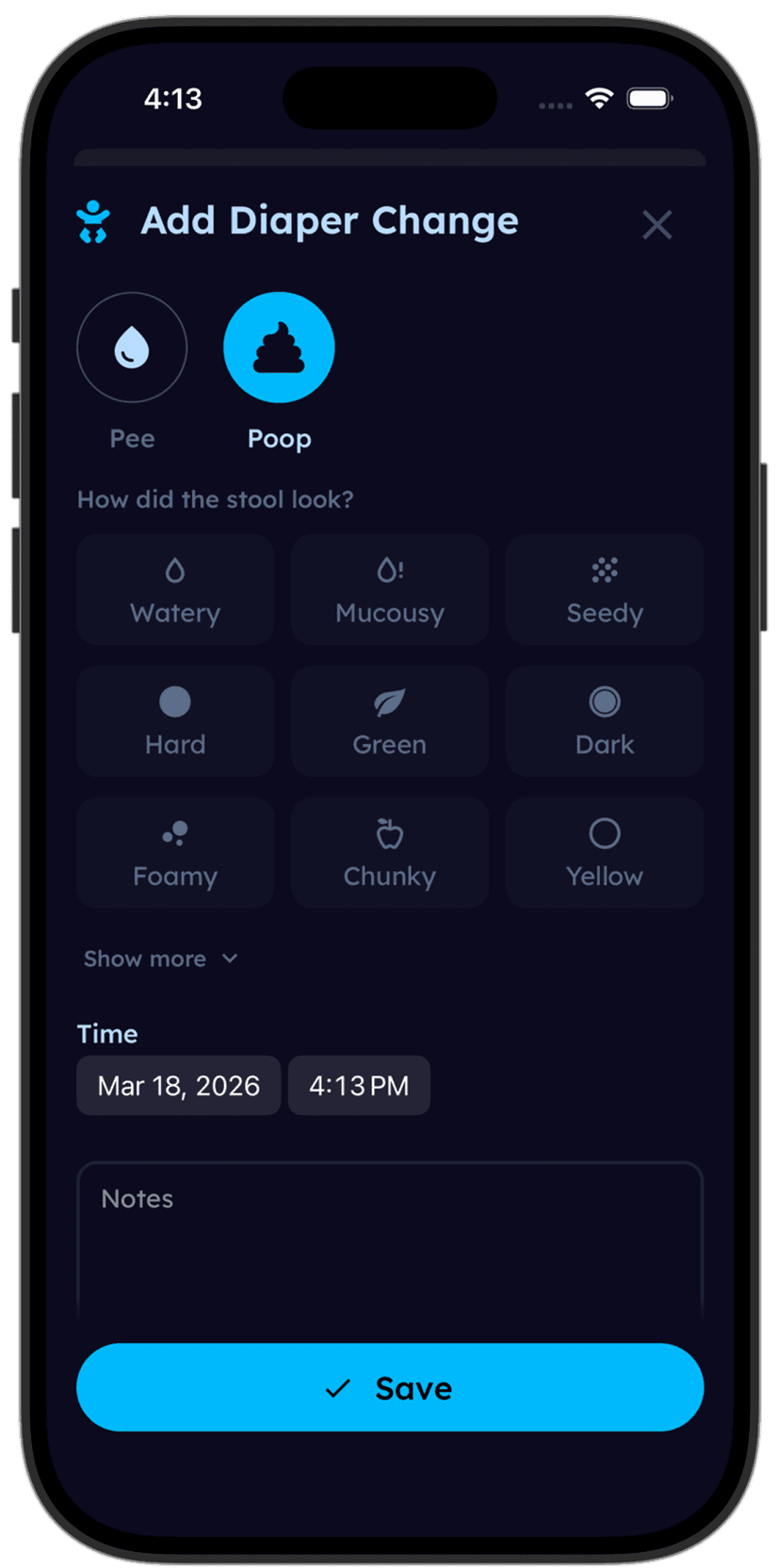
tinylog feeding and diaper tracking showing feed-to-diaper correlation

Connect the dots between feeds and diapers.

Log which breast, how long, and what the next diaper looks like — all in tinylog. When you're trying to troubleshoot foamy poop, seeing feeds and diapers side by side makes it much easier to spot whether short feeds on alternating sides are the culprit.

Download on the App StoreGet It On Google Play

Practical Tips for Dealing with Foamy Poop

Foamy poop is usually a feeding puzzle, not a medical crisis

The vast majority of foamy poop in breastfed babies comes down to feeding mechanics — how long baby stays on each breast, how fast your letdown is, and whether baby is reaching hindmilk. This is fixable. It does not mean something is wrong with your milk or your baby.

Track feeds and stools together to find the pattern

If you log which breast you fed on, how long the feed lasted, and what the next diaper looks like, you will often spot the connection within a few days. Tinylog makes it easy to see whether short feeds on alternating sides consistently produce foamy green diapers.

Green poop is not always a problem

Occasional green-tinged poop in a breastfed baby is normal and does not automatically mean foremilk imbalance. It becomes worth investigating when green, frothy stools are the consistent pattern — not just a one-off.

Ignore the lactose intolerance panic

True congenital lactose intolerance is one of the rarest conditions in pediatric medicine. If someone suggests your baby is lactose intolerant because of foamy stools, the actual explanation is almost certainly lactose overload from feeding patterns — not a genetic inability to produce lactase. Do not stop breastfeeding based on this misconception.

Oversupply is real and surprisingly common

Some mothers produce significantly more milk than their baby needs, which makes foremilk-hindmilk imbalance more likely. Signs include a fast, forceful letdown that makes baby choke, breasts that always feel full, and frequent leaking. A lactation consultant can help you manage supply without compromising your baby's intake.

Related Guides

Sources

  • American Academy of Pediatrics (AAP). (2024). Breastfeeding and Infant Stool Patterns. HealthyChildren.org.
  • Woolridge, M. W., & Fisher, C. (1988). Colic, "overfeeding," and symptoms of lactose malabsorption in the breast-fed baby: a possible artifact of feed management? The Lancet, 332(8607), 382-384.
  • North American Society for Pediatric Gastroenterology, Hepatology and Nutrition (NASPGHAN). (2023). Lactose Intolerance in Infants and Children. NASPGHAN.org.
  • World Health Organization (WHO). (2023). Breastfeeding: Positioning and Attachment. WHO.int.
  • Heyman, M. B. (2006). Lactose Intolerance in Infants, Children, and Adolescents. Pediatrics, 118(3), 1279-1286.

Medical Disclaimer

This guide is for informational purposes only and is not a substitute for professional medical advice. If you have concerns about your baby's stool, feeding patterns, or weight gain, please consult your pediatrician or a certified lactation consultant. Do not make significant changes to breastfeeding routines without professional guidance.

Get this guide in your inbox.
We'll email you this guide so you can reference it when you're troubleshooting a frothy diaper situation.
Track poop changes alongside feeding patterns.
Download tinylog free — track diapers with a single tap.
Download on the App StoreGet It On Google Play