
Don't count tablespoons
The amounts in this guide are ballpark ranges, not targets. Babies' appetites vary by the day — some days they eat a lot, some days almost nothing. What matters is the pattern over days and weeks, not any single meal.
GUIDE
Published on
At 6 months: a tablespoon or two. By 12 months: 3 meals plus snacks. The progression is gradual, and the exact amounts matter less than you think — because milk handles the heavy lifting until 12 months.
If your 7-month-old ate two bites of banana and you're worried, this guide is for you.
Log foods and reactions
"Is my baby eating enough?" is the question that drives the most anxiety during the solid food transition. And the honest answer, for most babies, is: yes. They're eating enough.
The reason this question causes so much stress is that the amounts babies eat in early solid feeding look absurdly small to adult eyes. A tablespoon of mashed sweet potato and two bites of banana don't look like a meal. They look like a spill.
But at 6-7 months, that's what a meal is. Because breast milk or formula is still doing the heavy nutritional lifting. Solids at this age are practice — exposure to flavors, textures, and the mechanical skills of eating. The calories, protein, and micronutrients are coming from milk. As long as milk intake is adequate, a baby who eats very little solid food in the first weeks is not in nutritional trouble.
The amounts increase gradually over the second half of the first year, and by 12 months, solids have become the primary nutrition source. But it's a slow transition, not a switch that flips.
| Age | Meals Per Day | Typical Amount Per Meal | Role of Milk | Notes |
|---|---|---|---|---|
| 6 months | 1 | 1-2 tablespoons per meal | Primary nutrition source. Milk provides 100% of nutritional needs. | Solids are practice. If baby eats nothing, they're still fine. Zero pressure on amounts. |
| 7 months | 1-2 | 2-4 tablespoons per meal | Still primary. Milk provides ~90%+ of calories. | Baby is getting more efficient. Some meals are bigger; some are still minimal. |
| 8 months | 2-3 | 4-6 tablespoons (about 1/4 cup) per meal | Still primary but solids contributing more. Milk ~75-80% of calories. | Meals start to feel like real meals. Wider variety of textures. |
| 9 months | 3 | 1/4 to 1/2 cup per meal | Still important but solids now a significant portion. Milk ~60-70%. | Three meals a day is typical. Snacks may start. Pincer grasp opens up new foods. |
| 10-11 months | 3 + 1-2 snacks | 1/4 to 3/4 cup per meal | Shifting. Solids and milk more balanced. Milk ~50%. | Portions increasing. Family meals becoming normal. Baby eating recognizable food. |
| 12 months | 3 + 2 snacks | 1/4 to 1 cup per meal | Solids become primary nutrition. Milk (now cow's milk) supplementary — 16-24 oz/day. | The big shift. Solid food is now the main event. Milk is the supporting role. |
When you see these cues, the meal is over. Don't push for 'just one more bite.' Trust baby's signals.
If baby is showing hunger cues after finishing what's on the tray, offer more. Babies who regulate their own intake eat to their needs.
The amounts in this guide are ballpark ranges, not targets. Babies' appetites vary by the day — some days they eat a lot, some days almost nothing. What matters is the pattern over days and weeks, not any single meal.
If your baby is following their growth curve — even if it's the 15th percentile — they're getting enough. The amount of food they eat at any individual meal is far less important than their overall growth trajectory. Your pediatrician tracks this at well visits.
During growth spurts, babies eat more. During illness, they eat less. During teething, they may refuse solids entirely. A week of lower intake during a cold is not a concern. The appetite will return.
Hunger and fullness cues tell you more than the amount of food remaining on the plate. A baby who turns away after 3 bites is done — even if you prepared a beautiful meal. A baby who devours everything and looks for more is still hungry — even if you thought it was enough.
The one thing that actually matters is that baby sits upright at 90 degrees with feet flat on something solid. The Stokke Tripp Trapp (~$280) nails this — adjustable seat and footrest, pulls right up to your table, and your kid will still use it at age ten. If that is out of budget, the IKEA Antilop (~$25) works great with a $15 aftermarket footrest.
Tinylog earns a small commission on purchases made through these links, at no cost to you.
Want to save a few bucks? promo.new is worth a quick look. It won't always have your product, but when it does, the savings are real.
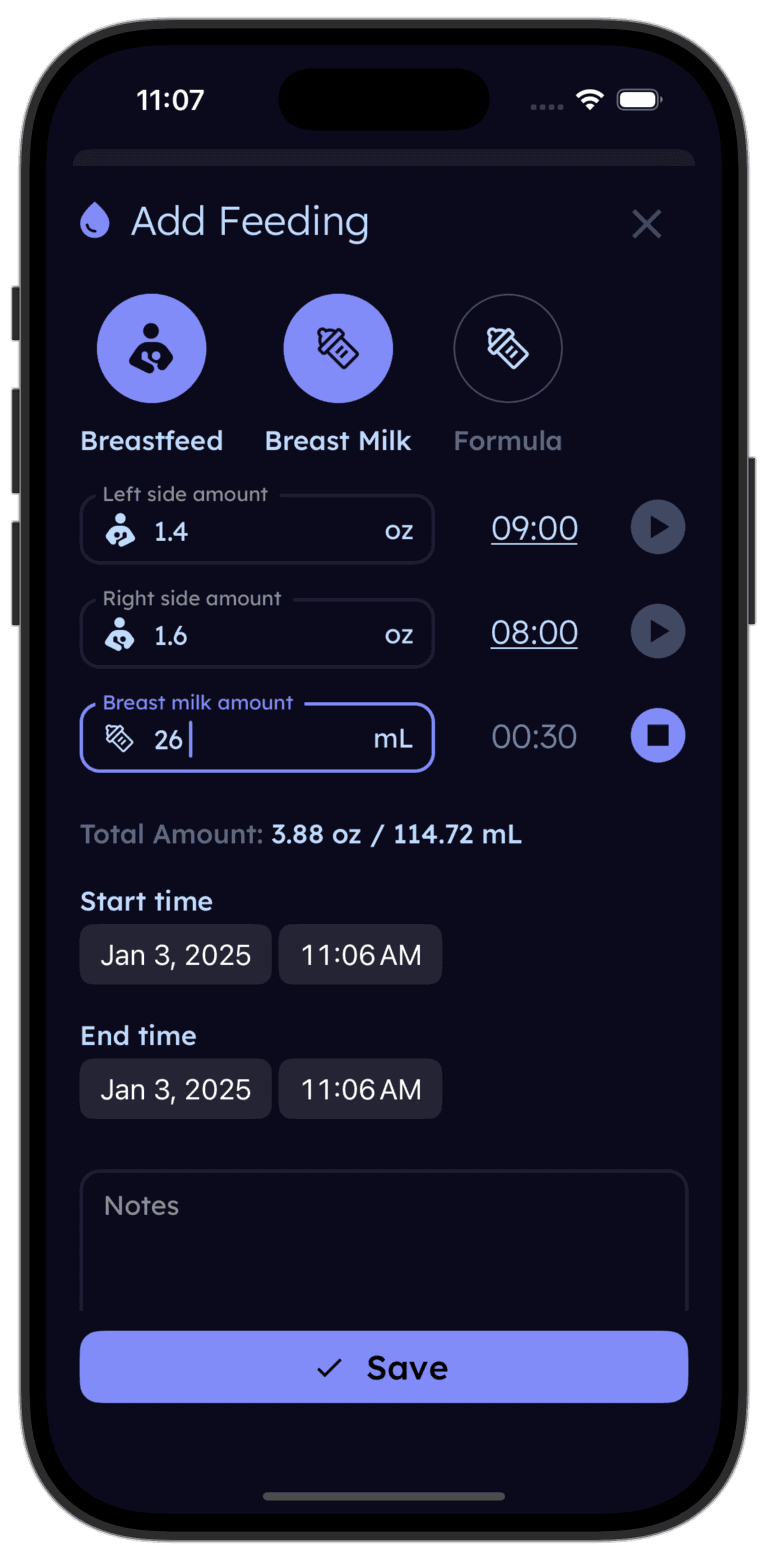
Tinylog tracks both milk feeds and solid meals, so you can see how the balance shifts over time. Instead of guessing, you've got data. And data beats anxiety.


The shift from milk-primary to solid-primary nutrition doesn't happen overnight. Here's a rough picture:
6 months: 90%+ of calories from milk. Solids are new and amounts are tiny.
9 months: 60-70% from milk, 30-40% from solids. Meals are established but milk is still the main source.
12 months: About 50/50 for many babies, shifting to solids-primary. Milk transitions from breast milk/formula to whole cow's milk (16-24 oz per day).
15-18 months: Solids are clearly primary. Milk is supplementary. Three meals plus snacks provide the bulk of nutrition.
The biggest shift happens between 9-12 months. If your baby is eating very little solid food at 10-11 months, it may be worth checking whether milk intake is too high — a very common scenario where excessive milk intake suppresses appetite for solids.
Is Baby Eating Enough? — Balancing solids and milk in the first year
Baby Feeding Chart — How much and how often by age
How to Start Solids — A first-time parent's complete guide
This guide is for informational purposes only and is not a substitute for professional medical advice. Consult your pediatrician before starting solids, especially regarding allergen introduction for high-risk infants. All caregivers should be trained in infant CPR before offering solid foods.