GUIDE

Caring for a Sick Baby at Home

Most childhood illnesses can be managed at home with comfort, hydration, and watchful monitoring.

Your baby is sick, and you want to do everything right. The good news is that most common illnesses — colds, mild fevers, stomach bugs — resolve on their own with supportive care. Here is your practical playbook for keeping your baby comfortable, staying on top of what matters, and knowing when the plan needs to change.

Setting Up the Sick Room

When your baby is sick, your physical environment matters more than you might think. A few simple adjustments to the room can make a meaningful difference in comfort and recovery. You are not building a hospital ward — you are creating a space where a small, miserable person can rest, breathe, and heal.

Start with temperature. A sick room should be comfortably cool — around 68 to 72 degrees Fahrenheit. This is counterintuitive when your baby has a fever and you want to wrap them in blankets, but overheating a feverish baby makes things worse. Dress them in a single light layer. If they are shivering, one more layer is fine, but resist the urge to bundle. Their body is running hot for a reason — it is fighting an infection, and you want to let it do that work without trapping excess heat.

If your baby has any respiratory symptoms — congestion, cough, runny nose — a cool-mist humidifier is one of the most useful tools you can have. Moist air helps loosen mucus, soothes irritated airways, and makes breathing easier. Place it three to four feet from the crib, clean the tank daily (standing water grows bacteria and mold remarkably fast), and use fresh water each day. A quick note: use a cool-mist humidifier, not warm-mist. Warm-mist models pose a burn risk if knocked over, and there is no therapeutic advantage.

Keep everything you might need within arm's reach. Saline drops, the bulb syringe or NoseFrida, a thermometer, age-appropriate fever medication, extra burp cloths, a water bottle for yourself. You do not want to be searching the medicine cabinet at 3 AM with a screaming baby in one arm.


Sick Room Setup Checklist
Cool-mist humidifier
Why It MattersAdds moisture to the air, helping loosen congestion and soothe irritated airways. Clean daily to prevent mold and bacteria buildup. Do NOT use warm-mist humidifiers — they pose a burn risk.
PriorityHigh for respiratory illness
Room temperature 68-72°F (20-22°C)
Why It MattersOverheating can worsen fever and discomfort. A comfortably cool room helps regulate body temperature. Dress baby in one light layer — do not bundle up a feverish baby.
PriorityHigh
Saline drops and bulb syringe or NoseFrida
Why It MattersFor nasal congestion. Saline loosens mucus; suction removes it. Essential for babies who cannot blow their own nose — which is all babies.
PriorityHigh for congestion
Thermometer (rectal for under 3 months, any reliable method for older)
Why It MattersRectal temperature is the gold standard for infants under 3 months. For older babies, temporal artery or tympanic thermometers are acceptable. Know what is accurate for your baby's age.
PriorityEssential
Acetaminophen or ibuprofen (age-appropriate)
Why It MattersAcetaminophen (Tylenol) from 2 months, ibuprofen (Advil/Motrin) from 6 months. Have the correct concentration on hand and know your baby's weight-based dose. Never give aspirin to children.
PriorityHave on hand
Extra sheets and burp cloths
Why It MattersSick babies produce more fluid output — spit-up, nasal drainage, potential vomiting. Having extras within arm's reach saves middle-of-the-night laundry runs.
PriorityPractical
You do not need to buy everything on this list — but having a thermometer, saline drops, suction device, and age-appropriate fever medication on hand before illness strikes saves a lot of midnight pharmacy runs.

Feeding a Sick Baby

The single most important thing during illness is hydration. Not food — hydration. A sick baby who is drinking well but refusing solids is doing fine. A sick baby who is refusing all fluids is a problem that needs attention.

For babies under six months, breast milk or formula IS hydration. You do not need to give water — and in fact, water can be dangerous for very young infants because it dilutes their sodium levels. If your baby is breastfed, offer the breast more frequently than usual. Sick babies often want shorter, more frequent nursing sessions rather than full feeds. This is fine. They are getting fluid, antibodies, and comfort all at once. If your baby is formula-fed, offer smaller bottles more often. Do not dilute the formula.

Sick babies often eat less, and this is normal and temporary. Their body is redirecting energy toward fighting infection, and appetite is one of the first things to go. Do not force feeds. Offer frequently, accept what they take, and do not panic if intake is lower than usual for a day or two. The appetite will come back once they start feeling better — sometimes with a vengeance.

For babies on solids, prioritize liquids over food. If they want to eat, offer simple, familiar foods — this is not the time for adventurous new foods or complex meals. Some babies revert to wanting only milk during illness, and that is perfectly acceptable. Let their body guide you.

What you should track: total fluid intake (roughly — you do not need to measure to the milliliter), number of wet diapers, and whether they are producing tears when crying. These are your real-time hydration indicators.

Feeding Approach by Age During Illness
Under 6 months (breastfed)
ApproachOffer the breast more frequently in shorter sessions. Baby may want to nurse for comfort even if not hungry — this is fine and beneficial. Breast milk antibodies help fight infection.
NotesDo not worry about schedules during illness. Follow baby's cues.
Under 6 months (formula-fed)
ApproachOffer smaller, more frequent bottles. If baby refuses a full bottle, try half the amount twice as often. Do not dilute formula.
NotesContact pediatrician if baby refuses all feeds for more than 4-6 hours.
6-12 months
ApproachPrioritize breast milk or formula for hydration. Offer water in small sips. Solid food intake may decrease — this is temporary and normal. Do not force solids.
NotesPedialyte if recommended by pediatrician. Avoid juice during illness.
12+ months
ApproachOffer fluids frequently — water, breast milk, or Pedialyte. Appetite for solid food often decreases during illness and returns during recovery. Offer simple, familiar foods when interested.
NotesMilk may worsen congestion perception (mucus thickening). Offer water as primary fluid.
The golden rule: offer frequently, accept what they take, do not force. Hydration is the priority, not caloric intake.

Managing Congestion

Nasal congestion in a baby is miserable for everyone. Babies are obligate nose breathers for the first several months of life, which means a stuffy nose does not just annoy them — it directly interferes with their ability to eat and sleep. A baby who cannot breathe through their nose cannot effectively breastfeed or bottle-feed, creating a cascade of problems.

Your best tool is the saline-and-suction method. Place two to three drops of saline (available over the counter, no prescription needed) in each nostril. Wait thirty to sixty seconds for the saline to loosen the mucus. Then use a bulb syringe or NoseFrida to gently suction it out. The timing matters — do this before feeds so they can breathe while eating, and before sleep so they can rest without struggling.

A word about frequency: limit suctioning to two to three times per day. More frequent suctioning actually irritates the nasal passages and causes swelling, which makes congestion worse. It is tempting to suction every time you hear a sniffle, but restraint is important here. Save it for the moments when it matters most — before eating and before sleep.

Over-the-counter cold medications are NOT safe for babies and young children. The FDA recommends against using cough and cold products in children under two years old. These medications do not work in young children, and they carry real risks including sedation, elevated heart rate, and — in rare cases — death. Stick with saline, suction, humidifier, and time.

Congestion Relief Methods
Saline drops + suction
How ToPlace 2-3 drops of saline in each nostril. Wait 30-60 seconds for mucus to loosen. Use a bulb syringe (squeeze before inserting, release slowly) or NoseFrida to suction. Do before feeds and before sleep.
When to Use2-3 times per day maximum — more frequent suctioning irritates nasal passages
Cool-mist humidifier
How ToRun in baby's room during sleep. Keep it 3-4 feet from the crib. Clean the tank daily with soap and water. Replace water daily — do not let it sit.
When to UseDuring naps and overnight
Steamy bathroom
How ToRun a hot shower with the bathroom door closed for 10-15 minutes to create steam. Sit with baby in the steamy room (NOT in the shower). The moist air helps loosen congestion.
When to UseBefore bedtime or when congestion is worst
Elevate the head of the crib slightly
How ToPlace a rolled towel UNDER the mattress (not under baby's head) to create a gentle incline. This helps mucus drain. Never place pillows or blankets in the crib.
When to UseDuring sleep
Upright positioning during the day
How ToHold baby upright or use a carrier. Gravity helps mucus drain. Supervised upright time can provide significant relief.
When to UseDuring waking hours
No over-the-counter cold or cough medications for babies under 2 years old. Saline and suction are safe and effective. Time does the rest.
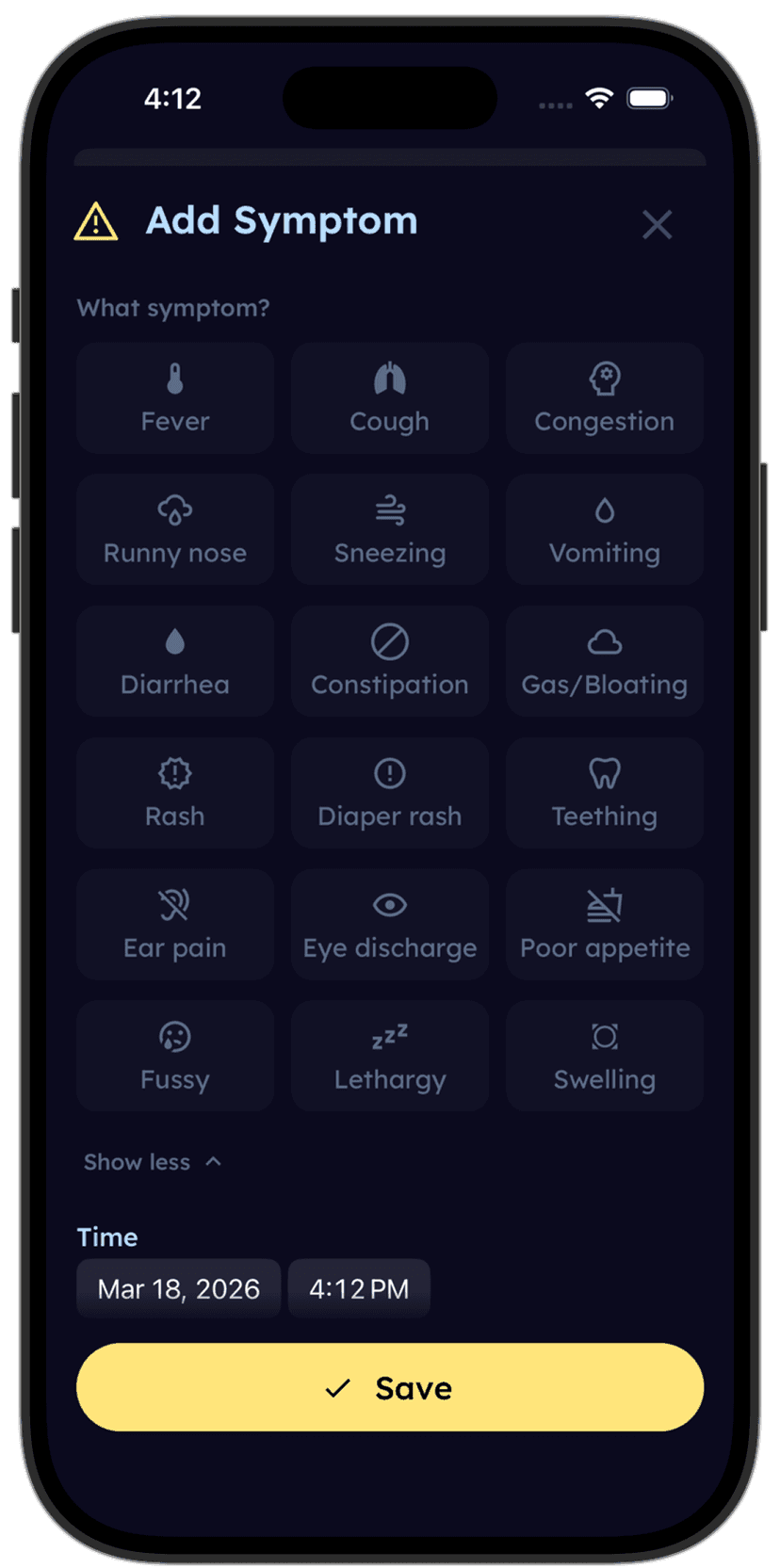
tinylog medication and symptom tracking screen during baby illness

Track medications and symptoms so you never lose count.

Log every dose of Tylenol with the exact time in tinylog, track temperature readings throughout the day, and monitor wet diaper counts. When you call your pediatrician, you will have every answer they need — and when it is 3 AM, you will know exactly when the next dose is safe.

Download on the App StoreGet It On Google Play

What to Track During Illness

When your baby is sick, information is your most valuable tool. Your pediatrician will ask specific questions if you call, and "I think the fever was around 101 sometime this morning" is much less useful than "101.3 rectal at 8:15 AM, given 2.5 mL acetaminophen at 8:30, rechecked at 10 AM and it was 99.8."

You do not need to obsess over every detail, but a simple log of the key metrics — temperature, medications, feeds, and diapers — gives you and your doctor a clear picture of whether things are getting better, staying the same, or getting worse. Here is what matters most.

Essential Things to Log During Baby Illness

  • Temperature — time taken, reading, and method (rectal, temporal, tympanic)
  • Medications given — name, dose, and exact time (critical for knowing when the next dose is safe)
  • Feed times and amounts — even partial feeds, so you can assess total intake
  • Wet diapers — count and approximate volume (is it a full wet diaper or just damp?)
  • Dirty diapers — noting consistency changes (especially important during stomach bugs)
  • Sleep patterns — when and how long, so you can spot unusual lethargy vs. normal extra sleep
  • Symptom changes — is congestion getting better or worse? Is the cough changing character?
  • Behavioral notes — alert and interactive during awake periods? Or listless and unresponsive?

You will not remember these details across multiple days of illness. Write it down or log it in an app. This information directly influences medical decisions.

When to Change the Plan — Call Your Doctor or Go to the ER

  • Any fever in a baby under 3 months old (100.4°F / 38°C or higher rectally) — this always requires medical evaluation
  • Fever above 104°F (40°C) at any age
  • Fever lasting more than 3-5 days without improvement
  • Signs of dehydration: fewer than 4 wet diapers in 24 hours, no tears, sunken fontanelle, dry mouth
  • Difficulty breathing: fast breathing, nostrils flaring, ribs pulling in with each breath, grunting
  • Baby is unusually lethargic — hard to wake, floppy, not making eye contact, not responding to you
  • Refusal to eat or drink for more than 6-8 hours (less for young infants)
  • Rash that does not fade when you press on it (do the glass test — press a clear glass against the rash)
  • Inconsolable crying for more than 3 hours despite comfort measures
  • Your gut says something is wrong — parental instinct matters, and pediatricians take it seriously

Trust your instincts. Pediatricians consistently say that parental concern — 'something is not right' — is one of the most reliable early indicators of serious illness. If your gut says call, call.

Comfort Measures That Help

Modern medicine has its limits with common childhood illnesses — most viral infections simply need to run their course. But comfort measures are not meaningless. A baby who is held, soothed, and kept comfortable is a baby whose stress response is lower, whose sleep is better, and whose body can devote more resources to healing.

Skin-to-skin contact is not just for newborns. When your sick baby is lying against your bare chest, their heart rate, breathing, and body temperature stabilize. Your body literally helps regulate theirs. This is measurable, documented physiology — not just a nice idea. Hold your sick baby as much as they want to be held. The independent sleep training can resume next week.

For fever discomfort, a lukewarm bath can help — emphasis on lukewarm, not cold. Cold water causes shivering, which paradoxically raises core body temperature. You want water that feels neutral to your inner wrist. Let them soak for ten to fifteen minutes. Some babies find this soothing; others hate it when they are sick. Follow your baby's lead.

And here is a brief note for the caregivers: you matter in this equation too. A sick baby is a marathon, not a sprint, and you cannot run a marathon on no sleep and coffee alone. If you have a partner, take shifts. If someone offers to help, say yes. Eat something. Drink water. This is not about self-indulgence — it is about staying functional enough to keep caring for a baby who needs you alert and present. One exhausted parent making a medication dosing error at 4 AM is a real and preventable risk.

Practical Tips for Sick Baby Home Care

Treat for comfort, not the thermometer

Fever is not the enemy — it is your baby's immune system doing its job. A baby with a fever of 101°F who is playing and drinking normally does not need medication. A baby with a fever of 100.5°F who is miserable and refusing to eat might benefit from it. Treat your baby's comfort level, not the number on the thermometer. The one exception: any fever of 100.4°F or higher in a baby under 3 months requires medical evaluation regardless of how well they seem.

Write it down — you will not remember

At 2 AM on night three of a cold, you will not remember when you last gave Tylenol, how many wet diapers there were today, or whether the last temperature was 101 or 102. Write everything down or log it in an app. This is not optional — it is how you make safe dosing decisions and give your pediatrician useful information when you call.

Lower your expectations for everything else

When your baby is sick, your only job is keeping them hydrated, comfortable, and monitored. Everything else — the laundry, the schedule, your email, the organic purée you were going to make — can wait. This is a temporary crisis mode, and it ends. Give yourself permission to do the minimum on everything that is not your sick baby.

Caregiver self-care is not optional

You cannot monitor a sick baby effectively if you are running on no sleep and no food. Accept help. Sleep when someone else can watch the baby. Eat actual meals. Drink water. This is not selfishness — it is strategic. A sick baby needs an alert, functioning caregiver. Tag-team with a partner if possible. Ask a grandparent, friend, or neighbor to hold the baby for an hour while you shower and nap.

Related Guides

Sources

  • American Academy of Pediatrics. (2025). Fever and Your Baby. HealthyChildren.org.
  • Sullivan, J. E., & Farrar, H. C. (2011). Fever and Antipyretic Use in Children. Pediatrics, 127(3), 580-587.
  • World Health Organization. (2023). Integrated Management of Childhood Illness. WHO.int.
  • American Academy of Pediatrics. (2024). Caring for Your Baby and Young Child: Birth to Age 5. 8th Edition.
  • Centers for Disease Control and Prevention. (2024). Symptom Relief for Upper Respiratory Infections in Children. CDC.gov.

Medical Disclaimer

This guide is for informational purposes only and is NOT a substitute for professional medical advice. When in doubt, always call your pediatrician. If your baby is under 3 months with a fever, having difficulty breathing, showing signs of dehydration, or seems seriously unwell, seek immediate medical attention.

Get this guide in your inbox.
We'll email you this guide so you have the home care checklist and warning signs ready whenever illness strikes.
Track symptoms, fevers, and feeds during illness.
Download tinylog free — log everything in seconds so you remember what your pediatrician will ask.
Download on the App StoreGet It On Google Play