
GUIDE
Huggies Little Movers vs. Pampers Baby Dry
Published on
Both are solid diapers for active babies. Huggies Little Movers wins on flexibility and fit during movement. Pampers Baby Dry wins on overnight absorbency and value. They cost about the same per diaper.
Once your baby starts crawling and cruising, you need a diaper that actually stays put. Huggies Little Movers and Pampers Baby Dry are the two top-selling diapers for babies in Sizes 3–7, and both are designed for mobility. But they take very different design approaches — and the right choice depends on your baby's build, skin, and sleep patterns.
Log changes, blowouts, and rashes
Your Baby Started Moving — Now the Diaper Can't Keep Up
Here's what nobody tells you: the diaper that worked perfectly for your newborn might be a disaster once your baby starts crawling. The moment those legs start pumping, you need a diaper that moves with them instead of bunching up around the knees or sliding halfway down.
Huggies Little Movers and Pampers Baby Dry are the two most popular options for this stage. They solve different problems. Little Movers is built for mobility first. Baby Dry is built for maximum absorbency duration. Both work. Which one works better depends on your kid.
We compared materials, fit, absorbency, pricing, and real parent feedback so you can skip the trial-and-error phase — or at least shorten it.
For more on tracking output patterns, see our baby feeding chart.
| Feature | Huggies Little Movers | Pampers Baby Dry | What It Means |
|---|---|---|---|
| Manufacturer | Kimberly-Clark | Procter & Gamble | Same two giants. Huggies is Kimberly-Clark, Pampers is P&G. |
| Designed for | Active, crawling, and walking babies | All-day and overnight dryness | Different priorities. Little Movers focuses on mobility; Baby Dry focuses on absorption duration. |
| Size range | Sizes 3–7 (16–41+ lbs) | Sizes 1–7 (8–41+ lbs) | Pampers Baby Dry covers more sizes. Little Movers starts at Size 3 because that is when most babies become mobile. |
| Fragrance | Fragrance-free | Light fragrance added | Huggies wins for sensitive skin. Some parents like the Pampers scent; others avoid it entirely. |
| Absorbent core | LSA (Leak Stop Absorb) core with contoured shape | 3 layers of absorbent material with LockAway Channels | Both handle heavy wetting. Pampers' layered approach edges out for overnight; Huggies' contoured core stays put during movement. |
| Fit technology | Double Grip Strips + contoured shape | Stretchy sides with standard fit | Little Movers' grip strips are specifically engineered to prevent sagging and shifting. Noticeable difference on active crawlers. |
| Waistband | Flexible elastic waistband | Elastic waistband | Both have elastic waistbands. Little Movers' is slightly more flexible to accommodate movement. |
| Leak protection | Leak Lock system + pocketed waistband | Dual Leak-Guard Barriers + up to 12 hrs protection | Huggies' pocketed waistband catches blowouts up the back. Pampers' barriers focus on leg leaks and extended wear. |
| Wetness indicator | Yes — color-changing line | Yes — color-changing line (Sizes 1–3 only) | Huggies keeps the indicator across all sizes. Pampers drops it after Size 3, which annoys some parents. |
| Hypoallergenic | Yes — dermatologist-tested, free of parabens and elemental chlorine | Yes — dermatologist-tested, free of parabens and elemental chlorine | Tie. Both meet the same baseline safety standards. |
| Overnight performance | Good — handles standard overnight wetting | Very good — built for up to 12 hours of dryness | Pampers Baby Dry has the edge here. Its three-layer core is designed for extended absorption windows. |
| Eco claims | Plant-based materials in liner | No specific eco claims | Minor difference. Neither is biodegradable. If sustainability matters, look at Huggies' plant-based lines or dedicated eco brands. |
The Fit Problem Nobody Talks About
Most diaper leaks are not absorption failures. They are fit failures. A diaper that gaps at the legs or sags in the back will leak even if it has plenty of absorption capacity left.
Huggies Little Movers address this with their Double Grip Strips — adhesive-like strips on the inside of the waistband that grip your baby's clothing and help prevent the diaper from sliding down. The contoured shape hugs closer to the body and moves with your baby rather than bunching. Parents of chunky-thighed crawlers tend to love these.
Pampers Baby Dry takes a more traditional approach — stretchy sides and a standard elastic waistband. It works fine for most babies, but it does not have the same anti-sag features. If your baby is particularly active or has a slim waist with chunky legs, you may notice more shifting.
The real test: put your baby in each brand and let them crawl for 30 minutes. Whichever stays in place better is your diaper.
Absorbency: Daytime vs. Overnight
This is where their design philosophies diverge the most.
Pampers Baby Dry is engineered around one idea: keep your baby dry for as long as possible. The three-layer absorbent core with LockAway Channels distributes and traps moisture across the entire diaper. Pampers claims up to 12 hours of protection, and independent testing suggests that claim holds up reasonably well for average wetters.
Huggies Little Movers use an LSA (Leak Stop Absorb) core that is more contoured and compact. It absorbs quickly and efficiently, but the total capacity is slightly lower than Baby Dry's. It is built to absorb fast during active play, not necessarily to hold maximum volume over 12 hours.
For daytime use, both perform well. The difference is marginal when you are changing every 2–3 hours.
For overnight, Pampers Baby Dry has a measurable edge. If your baby is soaking through diapers by morning, Baby Dry's extended-wear design is worth trying before you size up or add a booster pad.
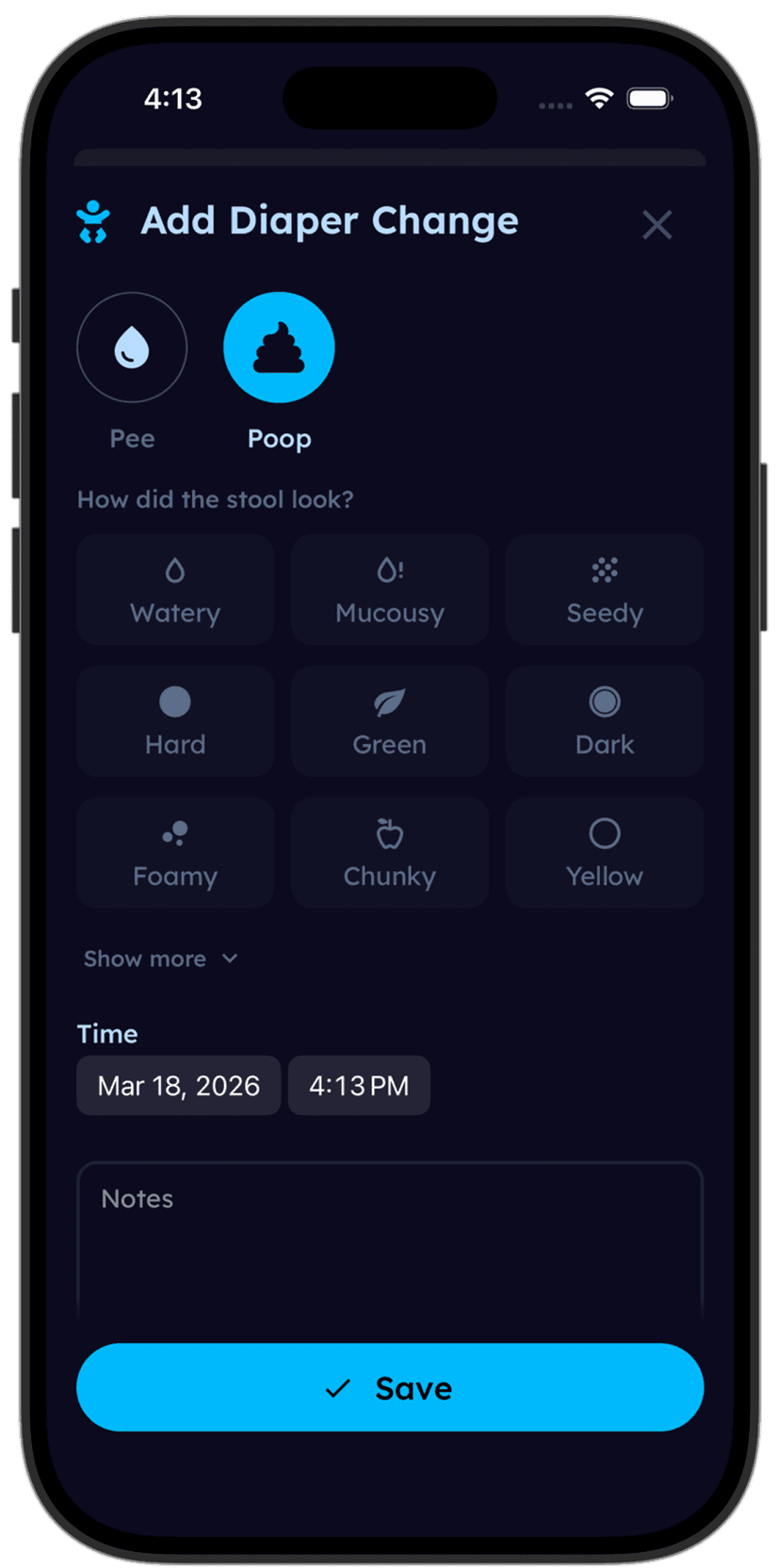
Tinylog tracks diapers so you can spot patterns.
Log wet and dirty diapers, note blowouts and rashes, track output over days and weeks. Bring the data to your next pediatrician visit.


Fragrance: Still a Dealbreaker
Same story as the newborn lines: Pampers Baby Dry has fragrance, Huggies Little Movers does not.
If your baby's skin is fine with Pampers' scent, this does not matter. But if you have been dealing with unexplained rashes and you are using a scented diaper, switching to fragrance-free is the first thing most pediatric dermatologists will recommend. It is an easy variable to eliminate.
Huggies Little Movers are fragrance-free, paraben-free, and made without elemental chlorine bleaching. Pampers Baby Dry meets the same paraben and chlorine standards but adds fragrance.
Sizing and When to Switch
One important difference: Pampers Baby Dry starts at Size 1. Huggies Little Movers starts at Size 3.
This makes sense. Little Movers is designed for babies who are actively moving, and most babies are not crawling in Size 1. If your baby is in Sizes 1–2, Baby Dry is an option but Little Movers is not. Most parents transition to Little Movers around 6–9 months when crawling kicks in.
Both lines go up to Size 7, which covers toddlers up to 41+ lbs.
A quick sizing tip: if you are getting frequent leaks at the legs but the diaper is not full, you probably need to size up rather than switch brands. A too-small diaper will leak on any brand.
| Product | Typical Price | Cost Per Diaper | Monthly Estimate |
|---|---|---|---|
| Huggies Little Movers (Size 3, 156-ct box) | $44–$52 | ~$0.28–$0.33 | ~$50–$66 |
| Pampers Baby Dry (Size 3, 168-ct box) | $42–$49 | ~$0.25–$0.29 | ~$45–$58 |
| Huggies Little Movers (Size 5, 120-ct box) | $44–$53 | ~$0.37–$0.44 | ~$55–$70 |
| Pampers Baby Dry (Size 5, 132-ct box) | $42–$50 | ~$0.32–$0.38 | ~$48–$61 |
Price: Baby Dry Is the Budget Winner
Pampers Baby Dry is consistently 2–5 cents cheaper per diaper than Huggies Little Movers. That is because Baby Dry is Pampers' value line, while Little Movers is Huggies' premium active-baby product.
Over a month, that adds up to roughly $5–$15 depending on your baby's age and how many diapers you burn through.
Ways to close that gap:
- Costco's Kirkland diapers are made by Kimberly-Clark (same company as Huggies) and cost significantly less if budget is tight.
- Amazon Subscribe & Save knocks 5–15% off both brands.
- Target Circle and Walmart+ run diaper deals constantly.
- Buy bigger boxes. The per-diaper cost drops substantially when you go from a 20-count pack to a 150+ count box.
If cost is the only thing you care about, Pampers Baby Dry wins. If you are willing to pay a small premium for better active-baby fit, Little Movers is worth it.
Choose Huggies Little Movers If
- Your baby is crawling, cruising, or walking and the current diaper keeps sagging or shifting
- You want a completely fragrance-free diaper
- Your baby has sensitive skin or is prone to rashes
- You need the pocketed waistband for catching blowouts up the back
- Your baby is chunky or has thick thighs — the contoured shape accommodates bigger builds
- You want a wetness indicator that works in every size
Choose Pampers Baby Dry If
- Overnight dryness is your top priority — your baby is a heavy nighttime wetter
- You want the most affordable per-diaper cost for everyday use
- You need sizes below Size 3 (Baby Dry starts at Size 1)
- You prefer the three-layer absorbent core for longer stretches between changes
- Your baby runs lean and long — Baby Dry tends to fit narrower builds well
Where to Buy
If your baby is on the move and you are tired of adjusting a sagging diaper every ten minutes, Huggies Little Movers (~$0.30/diaper in bulk) are built specifically for this stage — Double Grip Strips, contoured fit, fragrance-free, and that pocketed waistband parents love for blowout protection. Best value in the big box at Costco or Amazon.
If overnight dryness is the bigger concern or you want the most affordable per-diaper price, Pampers Baby Dry (~$0.27/diaper in bulk) delivers strong all-around performance with a three-layer core built for extended wear. Available everywhere in sizes starting from Size 1.
Same advice as always: buy a small pack of each before committing to a bulk box. The best diaper is the one that fits your baby without leaking.
Tinylog earns a small commission on purchases made through these links, at no cost to you.
Want to save a few bucks? promo.new is worth a quick look. It won't always have your product, but when it does, the savings are real.
The Bottom Line
These are two good diapers that solve different problems.
Huggies Little Movers are the better choice for active babies who need a diaper that stays put during crawling, cruising, and walking. The Double Grip Strips, contoured shape, and fragrance-free formula make them a premium pick for mobile babies with sensitive skin.
Pampers Baby Dry are the better choice if overnight dryness is your main concern or if you want solid everyday performance at a lower per-diaper cost. The three-layer core genuinely holds more over extended periods.
For most families in this stage, the real answer is: use Little Movers during the day when your baby is active, and Baby Dry at night when you need maximum absorption. There is no rule that says you have to pick one brand for everything.
If you are tracking diaper output — which helps you notice hydration changes and digestive patterns — Tinylog makes it easy to log changes and share data with your pediatrician.
Related Guides
- Pampers Swaddlers vs. Huggies Little Snugglers — The newborn diaper showdown
- Baby Diaper Rash — Causes, treatment, and when to call your doctor
- Baby Constipation — What's normal and when to worry
- Baby Feeding Chart — How much your baby should eat by age
Sources
- Huggies.com. "Huggies Little Movers — Product Information and Features." 2026.
- Pampers.com. "Pampers Baby Dry Diapers — Product Information." 2026.
- Consumer Reports. "19 Best Diapers From Our Tests." consumerreports.org, 2026.
- Mommyhood101. "The Best Diapers of 2026, Tested & Reviewed." mommyhood101.com.
- BabyGearLab. "Best Disposable Diapers." babygearlab.com, 2026.
- WeHaveKids. "Huggies vs. Pampers: An In-Depth Comparison." wehavekids.com.
- ShoeStringBaby.com. "Ultimate Pampers vs. Huggies Guide (Visuals & Real Testing)." 2025.
This guide is for informational purposes only. Diaper choice is a personal preference based on your baby's individual needs. If your baby develops persistent rash or skin irritation with any diaper brand, consult your pediatrician.
Frequently asked questions
- Are Huggies Little Movers or Pampers Baby Dry better for active babies?
- Huggies Little Movers are specifically designed for crawling and walking babies. Their Double Grip Strips and contoured shape help the diaper stay in place during movement. Pampers Baby Dry works well too, but its primary focus is long-lasting dryness rather than mobility.
- Which diaper lasts longer overnight — Huggies Little Movers or Pampers Baby Dry?
- Pampers Baby Dry claims up to 12 hours of protection and uses three layers of absorbent material designed for extended wear. Huggies Little Movers also performs well overnight, but Pampers Baby Dry's core is optimized more heavily for maximum absorption over long stretches.
- Do Huggies Little Movers or Pampers Baby Dry contain fragrance?
- Pampers Baby Dry contains a light fragrance. Huggies Little Movers are fragrance-free. If your baby has sensitive skin or you want to avoid added scents, Huggies is the safer pick.
- Which is cheaper — Huggies Little Movers or Pampers Baby Dry?
- Pampers Baby Dry is typically 1–3 cents cheaper per diaper than Huggies Little Movers. Pampers Baby Dry is positioned as a value line, while Little Movers is a premium product. Both drop in price significantly when bought in bulk at warehouse clubs.
- What sizes do Huggies Little Movers and Pampers Baby Dry come in?
- Huggies Little Movers are available in Sizes 3–7 (16–41+ lbs). Pampers Baby Dry covers Sizes 1–7 (8–41+ lbs). If you need smaller sizes, Pampers Baby Dry starts earlier. Both max out at Size 7.
- Can I switch between Huggies Little Movers and Pampers Baby Dry?
- Absolutely. There is no medical reason to stick with one brand. Many parents buy whichever is on sale. The only reason to commit to one is if your baby's skin reacts to the other or one brand consistently fits better.