
GUIDE
Pampers Swaddlers vs. Pampers Baby Dry
Published on
Pampers Swaddlers are the premium newborn-friendly diaper with a quilted liner and umbilical cord notch. Pampers Baby Dry are the long-lasting absorbency workhorse built for up to 12 hours of dryness. Swaddlers prioritize softness and skin contact; Baby Dry prioritizes holding more liquid for longer stretches.
These are Pampers' two best-selling diapers, and parents constantly mix them up. They come from the same company and look similar on the shelf, but they're built for different stages and priorities. Swaddlers is the go-to for newborns and younger babies who need a gentle, snug fit. Baby Dry is the go-to for extended wear and overnight protection — especially once your baby starts sleeping longer stretches.
Log changes, blowouts, and rashes
Two Diapers, One Brand — Here's What Actually Separates Them
Walk into any store and you'll see Pampers Swaddlers and Pampers Baby Dry sitting right next to each other in nearly identical packaging. They're both blue. They both say Pampers. They both have a smiling baby on the box. No wonder parents grab whichever one is closer and assume they're basically the same thing.
They're not. These two diapers are built for different priorities, and choosing the right one can mean the difference between a dry night and a 3 AM sheet change.
Pampers Swaddlers is the premium line. It's the diaper most hospitals send home with new parents. It has a quilted BreatheFree liner that's noticeably softer, a contoured fit, an umbilical cord notch for newborns, and a wetness indicator that works across every size. It's designed to feel gentle against brand-new skin.
Pampers Baby Dry is the absorbency workhorse. It's built to hold more liquid for longer — up to 12 hours, according to Pampers. The core is thicker, the liner is designed to feel dry to the touch even when the diaper is loaded, and it costs less per diaper. It's the practical pick for parents who need a diaper that just works, especially overnight.
For more on how many diapers to expect each day, check our baby feeding chart.
| Feature | Pampers Swaddlers | Pampers Baby Dry | What It Means |
|---|---|---|---|
| Manufacturer | Procter & Gamble | Procter & Gamble | Same company, same brand. The engineering DNA is shared, but these diapers are built for different jobs. |
| Best for | Newborns and younger babies — softness and skin comfort | Extended wear and overnight — maximum absorbency | Swaddlers shine early on. Baby Dry shines at night and during long stretches between changes. |
| Size range | Newborn through Size 8 (up to 46+ lbs) | Newborn through Size 7 (up to 41+ lbs) | Swaddlers offers one extra size at the top. Both start at newborn. |
| Inner liner | Quilted BreatheFree Liner (moisture-wicking, soft texture) | Dri-Weave liner (drier-feeling surface) | Swaddlers' liner is softer and more cushioned. Baby Dry's liner focuses on keeping the surface dry. |
| Absorbent core | Absorb Away Liner with channeled core | Extra Absorb Channels for up to 12 hours | Baby Dry holds more total liquid. Swaddlers distributes moisture faster but has less raw capacity. |
| Overnight performance | Good for 6–8 hours; may leak on heavy wetters | Up to 12 hours of dryness protection | Baby Dry is the clear winner for overnight use. This is its core selling point. |
| Wetness indicator | Yes — color-changing line (all sizes) | Yes — color-changing line (smaller sizes) | Swaddlers keeps the indicator across all sizes. Baby Dry drops it in larger sizes. |
| Umbilical cord notch | Yes (Newborn size) | No | Swaddlers wins for fresh newborns. The notch protects a healing cord stump. |
| Fragrance | Light fragrance | Light fragrance | Tie. Both contain fragrance. Neither is fragrance-free. |
| Softness / texture | Quilted, noticeably softer feel | Smooth but firmer; more utilitarian texture | Swaddlers are softer in hand and against skin. Most parents notice the difference immediately. |
| Bulkiness | Thinner, more contoured profile | Slightly thicker due to extra absorbent material | Swaddlers look sleeker under clothes. Baby Dry can appear puffy, especially when wet. |
| Hypoallergenic | Yes — dermatologist-tested | Yes — dermatologist-tested | Tie. Both are hypoallergenic and free of parabens and latex. |
Softness vs. Absorbency: The Core Tradeoff
Every diaper brand faces the same engineering tension: softer materials tend to absorb less, and more absorbent cores tend to be thicker and stiffer. Swaddlers and Baby Dry sit on opposite sides of this tradeoff.
Pampers Swaddlers use a quilted BreatheFree liner that's genuinely soft — pick one up and you'll feel the difference immediately compared to Baby Dry. The absorbent core uses channeled technology to distribute moisture across the pad, which keeps the diaper from getting heavy in one spot. This works well for daytime use and moderate wetters.
Pampers Baby Dry use a Dri-Weave liner that feels drier to the touch when wet — the surface pulls moisture down into the core faster, keeping the layer against your baby's skin from feeling damp. The Extra Absorb Channels hold significantly more total liquid than Swaddlers, which is why Baby Dry can handle 10–12 hours between changes for most babies.
In plain terms: Swaddlers feel nicer. Baby Dry hold more. If your baby is under 6 months and you're changing diapers every 2–3 hours anyway, Swaddlers' softness matters more than Baby Dry's extra capacity. Once your baby starts sleeping longer stretches, Baby Dry's absorbency becomes the priority.
The Newborn Factor: Why Swaddlers Win Early
If you're bringing a baby home from the hospital, Swaddlers is almost certainly the right first diaper. Here's why:
The umbilical cord notch. Swaddlers' newborn size has a cutout at the front that sits below your baby's healing belly button. This prevents the diaper from rubbing against the cord stump, which can be irritating and slow healing. Baby Dry doesn't have this feature.
The wetness indicator across all sizes. In the first weeks, you're counting wet diapers to make sure your newborn is eating enough. Swaddlers' color-changing stripe makes this dead simple — yellow means dry, blue means wet. Baby Dry has a wetness indicator too, but it's dropped in larger sizes.
The softer liner. Newborn skin is remarkably thin and sensitive. Swaddlers' quilted BreatheFree liner is noticeably gentler than Baby Dry's more utilitarian surface.
None of this means Baby Dry is bad for newborns — it works fine. But Swaddlers was specifically designed with those first fragile weeks in mind, and the details add up.
For more on what to expect in those early days, see our newborn development guide.
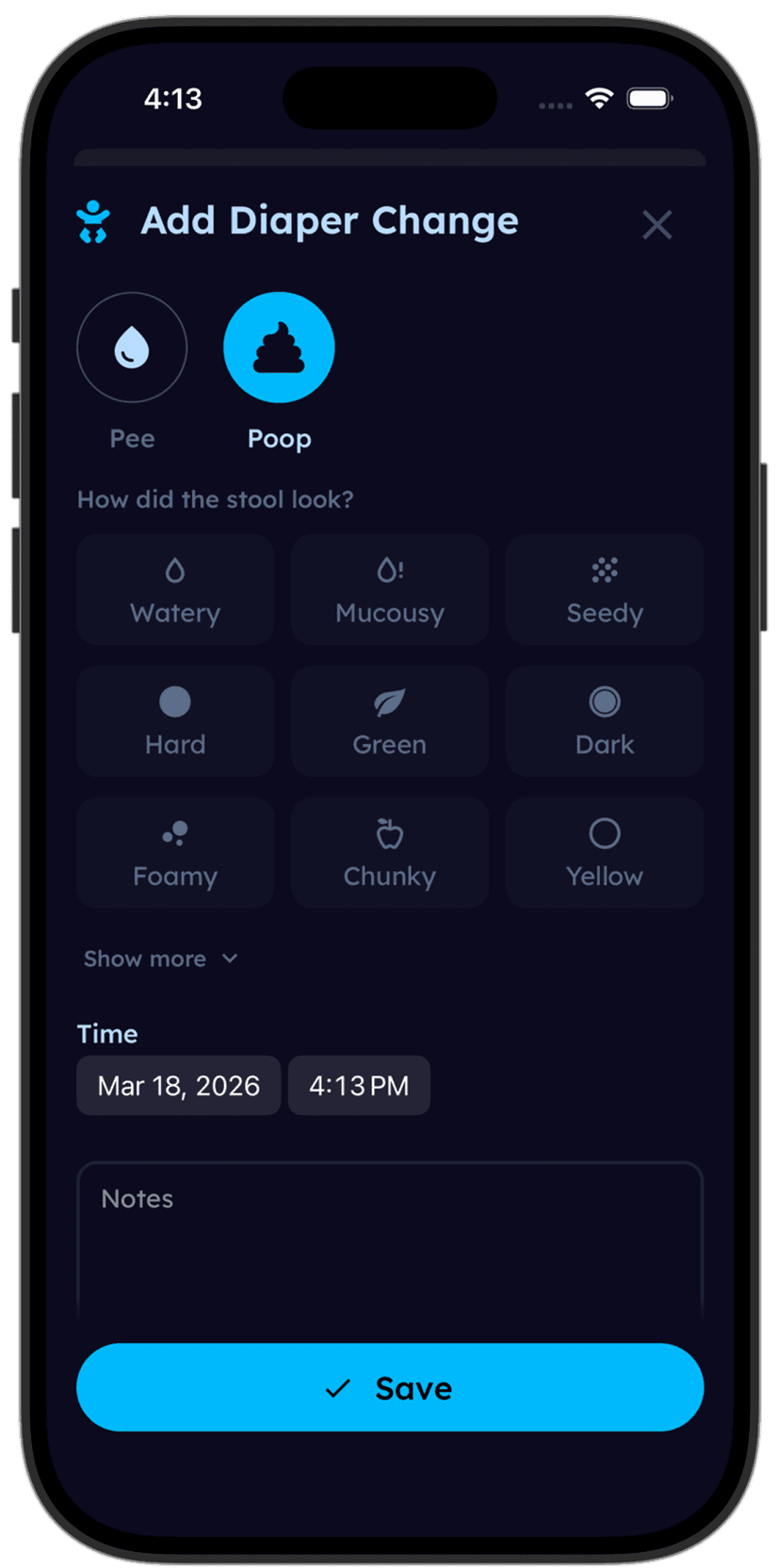
Tinylog tracks diapers so you can spot what's working.
Log wet and dirty diapers, note which brand you're using, track rashes over time. When you switch diapers, you'll have the data to see if it made a difference.


Overnight: Baby Dry's Strongest Argument
If you're reading this because your baby is leaking through diapers at night, Baby Dry is probably your answer.
Pampers Baby Dry was engineered for extended wear. The extra absorbent material and the Dri-Weave liner are built to handle long stretches without a change. For most babies, that means 10–12 hours of reliable overnight protection — which roughly matches a full night of sleep once your baby drops nighttime feeds.
Swaddlers can handle overnight for lighter wetters, but they weren't designed for it. Parents who try Swaddlers at night often find leaks starting around the 7–8 hour mark, especially once their baby is past the newborn stage and producing more urine.
A trick that works: Many parents use Swaddlers during the day and switch to Baby Dry for bedtime. This isn't overthinking — it's using the right tool for the right situation. You get Swaddlers' softness when your baby is awake and Baby Dry's capacity when they're sleeping.
If even Baby Dry isn't cutting it overnight, try sizing up one size for nighttime. A slightly larger diaper holds more absorbent material and provides more coverage. This is one of the most effective overnight leak fixes that costs zero extra.
| Product | Typical Price | Cost Per Diaper | Monthly Estimate |
|---|---|---|---|
| Pampers Swaddlers (Size 1, ~198-ct box) | $44–$52 | ~$0.22–$0.26 | ~$55–$78 |
| Pampers Baby Dry (Size 1, ~198-ct box) | $38–$46 | ~$0.19–$0.23 | ~$48–$69 |
| Pampers Swaddlers (Size 3, ~136-ct box) | $42–$50 | ~$0.31–$0.37 | ~$56–$88 |
| Pampers Baby Dry (Size 3, ~168-ct box) | $42–$50 | ~$0.25–$0.30 | ~$45–$72 |
Price: Baby Dry Is the Better Deal
Baby Dry costs 3–6 cents less per diaper than Swaddlers. That sounds like nothing until you multiply it across 8–10 daily changes for months on end.
At Size 1, the difference is roughly $7–$12 per month. At Size 3, it's about $8–$16 per month. Over a full year of diapering, choosing Baby Dry over Swaddlers saves approximately $80–$180 — enough to buy a decent baby carrier or a couple months of baby food.
Here's how to spend less on whichever you choose:
- Warehouse clubs (Costco, Sam's Club) sell both in bulk boxes at 15–20% below retail
- Amazon Subscribe & Save takes off an additional 5–20% depending on your total subscriptions
- Target Circle and Walmart+ run frequent Pampers promotions
- Pampers Rewards app earns points on every pack that can be redeemed for coupons
If budget is the deciding factor and your baby doesn't have a strong preference, Baby Dry gives you more absorbency for less money. That's a hard combination to beat.
Choose Pampers Swaddlers If
- Your baby is a newborn and you want the umbilical cord cutout
- Softness against your baby's skin is a top priority
- You want a wetness indicator that works across all diaper sizes
- Your baby is a lighter wetter who doesn't need 12-hour absorbency
- You prefer a thinner, more contoured diaper that fits well under clothes
- You're willing to pay a few extra cents per diaper for the premium feel
Choose Pampers Baby Dry If
- You need a diaper that lasts through 10–12 hour overnight stretches
- Your baby is a heavy wetter who soaks through other diapers
- Budget matters — Baby Dry costs 3–6 cents less per diaper
- You want an all-purpose diaper that handles day and night without switching
- You're past the newborn stage and prioritize absorbency over softness
- You're looking for the best value in the Pampers lineup
Where to Buy
For newborns and younger babies who need a soft, premium fit, Pampers Swaddlers (~$0.24/diaper in bulk) are the diaper most hospitals trust for a reason — quilted liner, umbilical cord notch, and a wetness indicator that takes the guesswork out of early parenting. Grab the big box at Amazon, Costco, or Sam's Club for the best per-diaper price.
For overnight protection and all-around value, Pampers Baby Dry (~$0.21/diaper in bulk) delivers more absorbency at a lower cost. Up to 12 hours of dryness means fewer nighttime leaks and fewer 3 AM sheet changes. It's the practical choice once your baby is past the newborn stage and sleeping longer stretches.
Honest advice: if your baby is under 3 months, start with Swaddlers. Once they're sleeping through the night and you need more absorbency, transition to Baby Dry — or use both. Swaddlers by day, Baby Dry by night is a strategy that works for thousands of parents.
Tinylog earns a small commission on purchases made through these links, at no cost to you.
Want to save a few bucks? promo.new is worth a quick look. It won't always have your product, but when it does, the savings are real.
The Bottom Line
Pampers Swaddlers and Pampers Baby Dry are both solid diapers from the same company, built for different stages and priorities.
Pampers Swaddlers win on softness, newborn features (umbilical cord notch, full-size wetness indicator), skin comfort, and that premium feel. They're the better choice for newborns and younger babies, and for parents who prioritize gentle materials against their baby's skin.
Pampers Baby Dry win on absorbency, overnight protection, and price. They're the better choice for heavy wetters, extended wear, and parents who want reliable performance at a lower cost per diaper.
The truth is, most families end up using both at some point — Swaddlers in the early months, then transitioning to Baby Dry as overnight stretches get longer. Or Swaddlers during the day and Baby Dry at night. There's no wrong answer as long as your baby is dry and comfortable.
If you're tracking diaper output to make sure feeding is on track — especially in those early weeks — Tinylog makes it easy to log every change, note which brand you're using, and share the data with your pediatrician.
Related Guides
- Pampers Swaddlers vs. Huggies Little Snugglers — The two biggest newborn diapers compared
- Pampers Cruisers vs. Pampers Baby Dry — Mobility vs. absorbency for active babies
- Baby Diaper Rash — Causes, treatment, and when to call your doctor
- Baby Feeding Chart — How much your baby should eat by age
Sources
- Pampers.com. "Pampers Swaddlers Diapers — Product Information." 2026.
- Pampers.com. "Pampers Baby Dry Diapers — Product Information." 2026.
- Consumer Reports. "19 Best Diapers From Our Tests." consumerreports.org, 2026.
- BabyGearLab. "Best Disposable Diapers 2026." babygearlab.com.
- Mommyhood101. "The Best Diapers of 2026, Tested & Reviewed." mommyhood101.com.
- DiaperDabbler.com. "What's the Difference Between All the Pampers Diapers?" diaperdabbler.com, 2025.
- Babylist.com. "How to Tell the Difference Between Pampers Diaper Types." babylist.com, 2025.
- Healthline Parenthood. "How to Choose the Best Diaper for Your Baby." healthline.com.
This guide is for informational purposes only. Diaper choice is a personal preference based on your baby's individual needs. If your baby develops persistent rash or skin irritation with any diaper brand, consult your pediatrician.
Frequently asked questions
- What is the main difference between Pampers Swaddlers and Pampers Baby Dry?
- Pampers Swaddlers are designed as a premium diaper with a soft, quilted BreatheFree liner, a wetness indicator in all sizes, and an umbilical cord notch for newborns. Pampers Baby Dry are designed for maximum absorbency with up to 12 hours of dryness protection. Swaddlers prioritize softness and skin comfort; Baby Dry prioritizes holding more liquid for longer periods.
- Which is better for newborns, Pampers Swaddlers or Baby Dry?
- Pampers Swaddlers are the better newborn diaper. They have an umbilical cord cutout in the newborn size that protects a healing belly button, a softer quilted liner, and a wetness indicator that's easy to read during those early weeks when you're still learning your baby's cues. Baby Dry works for newborns too, but Swaddlers are specifically designed for that stage.
- Can Pampers Baby Dry be used as an overnight diaper?
- Yes. Pampers Baby Dry is one of the most popular overnight diapers because its core is designed for up to 12 hours of protection. Many parents who use Swaddlers during the day switch to Baby Dry at bedtime. For heavy wetters, sizing up one size for nighttime can add extra absorbent capacity.
- Do Pampers Swaddlers and Baby Dry both have fragrance?
- Yes. Both Pampers Swaddlers and Pampers Baby Dry contain a light fragrance. If you need a fragrance-free Pampers option, Pampers Pure Protection is the alternative. Huggies Special Delivery and Honest Company diapers are also fragrance-free options from other brands.
- Are Pampers Swaddlers more expensive than Baby Dry?
- Yes. Swaddlers typically cost 3–6 cents more per diaper than Baby Dry in the same size. Over a month, that adds up to roughly $6–$18 depending on how many diapers your baby goes through. Baby Dry is one of the more budget-friendly options in the Pampers lineup.
- Which Pampers diaper is better for active babies?
- Neither Swaddlers nor Baby Dry is specifically designed for active babies. For crawlers and walkers, Pampers Cruisers with their stretchy 3-Way Fit are the better option. Between Swaddlers and Baby Dry, Swaddlers tend to be thinner and slightly more flexible, which some active babies prefer during the day.