
GUIDE
Pampers Swaddlers vs. Pampers Cruisers
Published on
Swaddlers are Pampers' premium newborn-and-up diaper — soft, snug, and built for maximum absorbency from day one. Cruisers are the active-baby diaper designed for crawlers and walkers, with a stretchy 3-Way Fit that moves with your child. Most families start with Swaddlers and graduate to Cruisers once their baby gets mobile.
These two diapers come from the same company but serve different stages. Swaddlers cover Newborn through Size 8 and prioritize cocooning softness and a secure fit for smaller babies. Cruisers start at Size 3 and prioritize flexibility and freedom of movement. The overlap zone — Sizes 3 through 7 — is where the decision actually matters.
Log changes, blowouts, and rashes
Two Pampers Diapers, Two Different Jobs
If you've been buying Pampers Swaddlers since your baby was born, you've probably noticed another Pampers box on the shelf — Cruisers — and wondered what the difference is. Or maybe your baby just started crawling and you're dealing with more leaks than usual, and someone told you to try Cruisers.
Here's the short version: Swaddlers are built for absorbency and newborn comfort. Cruisers are built for movement.
Pampers Swaddlers is the premium line that most parents start with. Hospitals stock them. They have the BreatheFree liner, the wetness indicator, the umbilical cord cutout — all the features designed for those early weeks and months when your baby is mostly lying down and you're changing diapers every two hours.
Pampers Cruisers pick up where Swaddlers' design starts to feel limiting. Once your baby is rolling, crawling, pulling up, and eventually walking, a thick, snug diaper can bunch at the legs and sag when wet. Cruisers' 3-Way Fit system — stretchy waistband, sides, and legs — keeps the diaper in place during all that movement.
The overlap zone is Sizes 3 through 7. That's where you actually have a choice to make.
| Feature | Pampers Swaddlers | Pampers Cruisers | What It Means |
|---|---|---|---|
| Manufacturer | Procter & Gamble | Procter & Gamble | Same company, same Pampers brand. The core engineering DNA is shared. |
| Designed for | Newborns through toddlers — softness, absorbency, snug fit | Active babies — crawlers, cruisers, and walkers | Swaddlers cover the early months. Cruisers take over when mobility kicks in. |
| Size range | Newborn through Size 8 (up to 46+ lbs) | Sizes 3–7 (16–41+ lbs) | Swaddlers start earlier and go bigger. Cruisers only begin when babies are mobile. |
| Fit system | Contoured shape with Blowout Barrier and snug leg cuffs | 3-Way Fit: stretchy waistband, sides, and leg openings | Swaddlers wrap snugly around smaller babies. Cruisers flex and stretch with active ones. |
| Absorbent core | Channeled core for fast, high-volume absorption | Multi-layer core with LockAway Channels to prevent sagging | Swaddlers hold slightly more total liquid. Cruisers distribute moisture to stay thin. |
| Inner liner | BreatheFree Liner (moisture-wicking, breathable) | Standard soft liner | Swaddlers' BreatheFree liner is a genuine comfort advantage for younger babies. |
| Wetness indicator | Yes — color-changing line (all sizes) | No | Swaddlers win. The wetness indicator is helpful, especially for new parents still learning cues. |
| Umbilical cord cutout | Yes (Newborn size) | No | Only relevant for newborns, where Swaddlers is the only option anyway. |
| Fragrance | Light fragrance | Light fragrance | Tie. Both contain fragrance. Neither is fragrance-free. |
| Bulkiness | Medium — slightly thicker due to extra absorbent material | Thinner, more flexible profile | Cruisers are noticeably slimmer under clothes. Swaddlers can look puffy on bigger babies. |
| Blowout protection | Blowout Barrier at the back + Dual Leak-Guard Barriers | Dual Leak-Guard Barriers at legs | Swaddlers have a dedicated back barrier — a real advantage during the blowout-prone early months. |
| Hypoallergenic | Yes — dermatologist-tested | Yes — dermatologist-tested | Tie. Both meet the same safety standard. |
Fit and Flexibility: Where Cruisers Shine
Hold a Swaddler and a Cruiser side by side. The Swaddler feels thicker, softer, more padded — like a cocoon. The Cruiser feels thinner, stretchier, almost like a pull-up.
That difference matters once your baby is mobile. Swaddlers wrap snugly, which is perfect for a baby who is mostly lying on their back or sitting in a swing. But that snug wrap can become restrictive when a baby is squatting, lunging, or doing that determined army-crawl toward the dog's food bowl.
Cruisers flex with every position change. The 3-Way Fit system stretches at the waist, sides, and legs simultaneously. The diaper moves with your baby instead of against them. Parents who switch almost always notice that their baby seems more comfortable — fewer red marks at the legs, less bunching at the crotch, and a lower profile under clothing.
One sizing note: Cruisers tend to run slightly smaller than Swaddlers in the same numbered size. If your baby is at the top of a size range in Swaddlers, consider sizing up when you try Cruisers.
Absorbency: Where Swaddlers Hold the Edge
Swaddlers use a channeled absorbent core with more total sodium polyacrylate (the superabsorbent polymer in all disposable diapers). This means they can absorb more liquid overall and do it faster — important during those early months when your baby may be peeing every 20 to 30 minutes.
Cruisers use a multi-layer core with LockAway Channels designed to distribute moisture evenly across the pad. This prevents the diaper from getting heavy and saggy in one spot — critical for a moving baby — but it means slightly less total absorbent capacity compared to Swaddlers.
In practical terms:
- During the day, both perform well for most babies. You're changing frequently enough that capacity isn't an issue.
- Overnight, Swaddlers have a real advantage for heavy wetters. The extra absorbent material buys you another hour or two before leaks.
- During active play, Cruisers' moisture distribution prevents sagging-related leaks that Swaddlers can be prone to on bigger, mobile babies.
Some parents solve this by using Cruisers during the day and Swaddlers (or Pampers Baby Dry) at night. It's a practical approach, not overthinking.
For more on tracking your baby's diaper output, see our baby feeding chart.
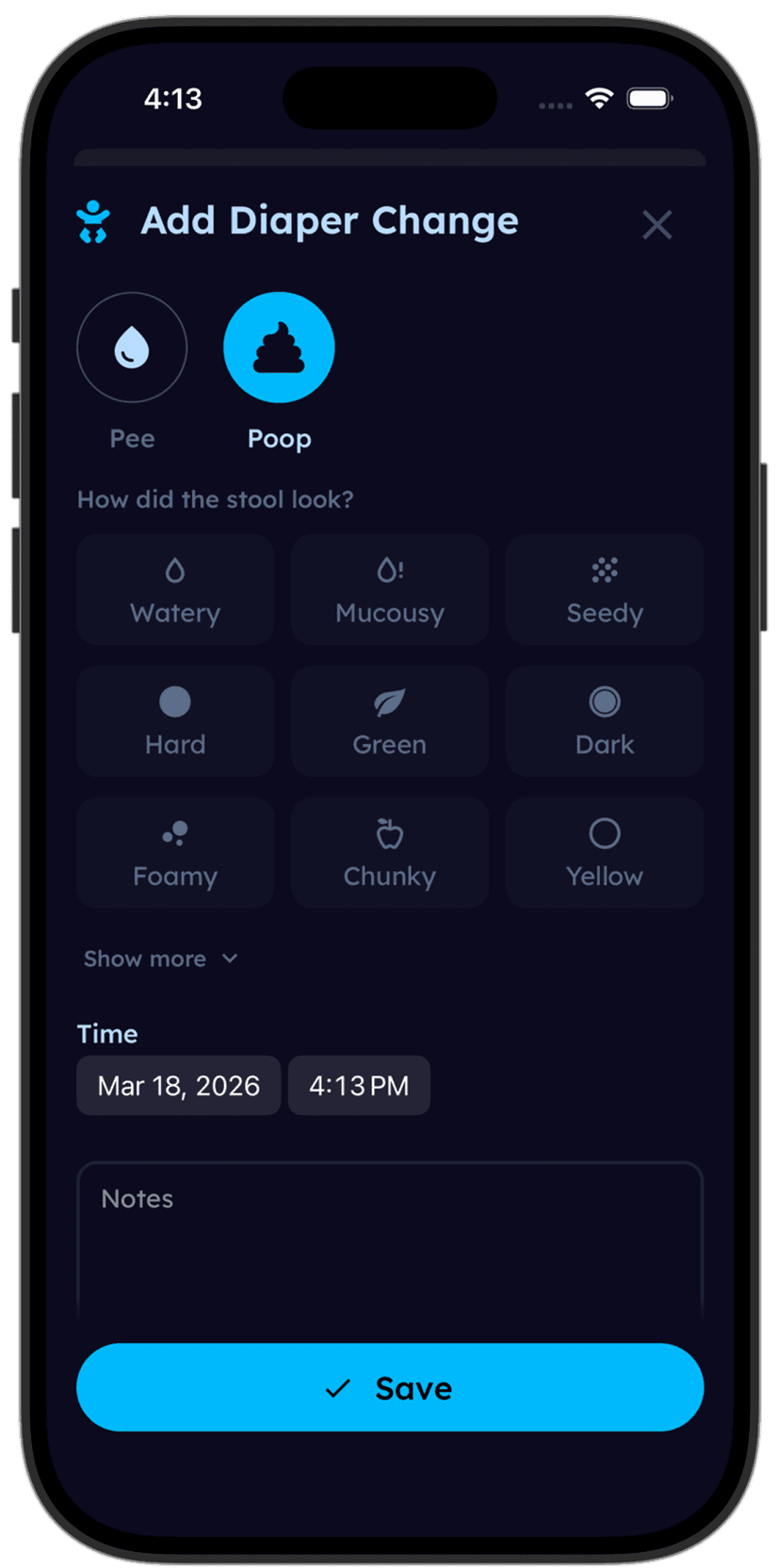
Tinylog tracks diapers so you can spot patterns.
Log wet and dirty diapers, note which brand you're using, track rashes and blowouts. When you switch diaper lines, you'll have the data to see if it made a difference.


The Transition: When to Switch from Swaddlers to Cruisers
There's no magic date on the calendar. The right time to switch depends on your baby, not their age. Look for these signals:
- Your baby is crawling, pulling up, or cruising along furniture. This is the most obvious trigger. Mobility demands a diaper that moves.
- You're seeing more leaks during playtime — especially at the legs. Swaddlers' snug fit can gap when babies are in active positions.
- The diaper looks bulky and bunched when your baby is moving around. If it's riding up or folding at the crotch, Cruisers' thinner profile will help.
- Your baby is in Size 3 or above. Cruisers don't come in Sizes 1 or 2, so the switch can't happen until then anyway.
Some parents switch cold turkey. Others buy one box of Cruisers for daytime and keep Swaddlers for naps and nighttime. There's no wrong approach — you're just matching the tool to the task.
Worth noting: you don't have to switch at all. Swaddlers go up to Size 8. If your baby does fine in them through toddlerhood, there's no rule that says you need Cruisers. The switch is about solving a problem (leaks, restricted movement, bulkiness), not hitting a milestone on a checklist.
Blowout Protection: Swaddlers Has a Feature Cruisers Doesn't
Swaddlers include a Blowout Barrier — a pocketed back waistband designed to catch those up-the-back explosions that every parent knows too well. This is particularly useful in the newborn period and early months when breastfed baby poop is liquid and unpredictable.
Cruisers have Dual Leak-Guard Barriers at the legs but no dedicated back barrier. By the time most babies are in Cruisers, their stool is firmer (thanks to solid foods), so back blowouts are less common. But if your baby still has frequent blowouts in the Size 3–4 range, this is one reason to stick with Swaddlers a bit longer.
For more on what's normal, see our baby constipation guide.
| Product | Typical Price | Cost Per Diaper | Monthly Estimate |
|---|---|---|---|
| Pampers Swaddlers (Size 3, ~136-ct box) | $42–$50 | ~$0.31–$0.37 | ~$56–$88 |
| Pampers Cruisers (Size 3, ~156-ct box) | $46–$54 | ~$0.30–$0.35 | ~$54–$84 |
| Pampers Swaddlers (Size 5, ~120-ct box) | $44–$52 | ~$0.37–$0.43 | ~$55–$86 |
| Pampers Cruisers (Size 5, ~112-ct box) | $46–$54 | ~$0.41–$0.48 | ~$62–$96 |
Price: Surprisingly Close
Unlike some Pampers comparisons where there's a big cost gap, Swaddlers and Cruisers are priced within a few cents of each other. In the sizes where they overlap (3–7), Swaddlers are typically 2–4 cents cheaper per diaper, which works out to about $4–$10 per month.
That's not nothing, but it's also not enough to let price drive the decision. Choose based on your baby's needs, not the per-diaper math.
To spend less on either:
- Warehouse clubs (Costco, Sam's Club) carry both in large boxes at 15–20% below retail
- Amazon Subscribe & Save takes off 5–20% depending on your subscription count
- Target Circle and Walmart+ run frequent Pampers promotions
- Stack coupons — manufacturer coupons from Pampers.com work at most retailers alongside store discounts
Choose Pampers Swaddlers If
- Your baby is under 6 months or not yet crawling
- You want a wetness indicator to help track diaper changes
- Maximum absorbency matters more than a slim profile
- Your baby is a heavy wetter and you need high-volume overnight protection
- You want the Blowout Barrier for those early-months blowouts
- You prefer sticking with one diaper line from birth through toddlerhood
Choose Pampers Cruisers If
- Your baby is crawling, cruising, or walking and needs freedom of movement
- You want a thinner, less bulky diaper that fits well under clothes
- Your baby gets fussy or restricted in thicker diapers
- Daytime leak protection during active play is your main concern
- Your baby is in Size 3 or above and on the move
- You plan to pair Cruisers for daytime with a more absorbent diaper at night
Where to Buy
For newborns and younger babies (or any age where absorbency is the priority), Pampers Swaddlers (~$0.34/diaper in bulk) are the go-to. The BreatheFree liner, wetness indicator, and Blowout Barrier make them the most complete Pampers diaper for the first several months. Grab the big box at Amazon, Costco, or Sam's Club for the best per-diaper price.
For active babies in Size 3 and up, Pampers Cruisers (~$0.33/diaper in bulk) earn their spot. The 3-Way Fit design genuinely reduces bunching and sag-related leaks during active play. Your crawling, cruising, or walking baby will move more freely — and you'll deal with fewer wardrobe-ruining leaks.
If you're not sure which one your baby needs right now, start with a small pack of Cruisers alongside your usual Swaddlers. Use Cruisers during the day for a week and see if you notice fewer leaks and a more comfortable baby. That one-box experiment will tell you more than any comparison chart.
Tinylog earns a small commission on purchases made through these links, at no cost to you.
We've found promo.new handy for finding discounts on baby gear. Doesn't always have what you need, but it's worth a shot.
The Bottom Line
Pampers Swaddlers and Pampers Cruisers are both quality diapers from the same company — but they're built for different stages and different priorities.
Pampers Swaddlers win on absorbency, newborn features (wetness indicator, cord cutout, Blowout Barrier), size range, and that cocooning softness younger babies benefit from.
Pampers Cruisers win on flexibility, slim fit, and freedom of movement for active babies. They're the diaper that doesn't hold your crawler back.
For many families, the answer is both — Swaddlers for the first several months, then a transition to Cruisers once the baby is mobile. Some parents even run both simultaneously: Cruisers during active daytime hours, Swaddlers for overnight absorbency. That's a smart, practical approach.
If you're tracking diaper output to make sure your baby is eating and hydrating enough, Tinylog makes it easy to log every change and share the data with your pediatrician.
Related Guides
- Pampers Swaddlers vs. Huggies Little Snugglers — The two biggest newborn diapers compared
- Pampers Cruisers vs. Pampers Baby Dry — Active diaper vs. overnight workhorse
- Baby Diaper Rash — Causes, treatment, and when to call your doctor
- Baby Feeding Chart — How much your baby should eat by age
Sources
- Pampers.com. "Pampers Swaddlers Diapers — Product Information." 2026.
- Pampers.com. "Pampers Cruisers Diapers — Product Information." 2026.
- Consumer Reports. "19 Best Diapers From Our Tests." consumerreports.org, 2026.
- BabyGearLab. "Best Disposable Diapers 2026." babygearlab.com.
- Mommyhood101. "The Best Diapers of 2026, Tested & Reviewed." mommyhood101.com.
- Babylist.com. "How to Tell the Difference Between Pampers Diaper Types." babylist.com, 2025.
- Healthline Parenthood. "How to Choose the Best Diaper for Your Baby." healthline.com.
This guide is for informational purposes only. Diaper choice is a personal preference based on your baby's individual needs. If your baby develops persistent rash or skin irritation with any diaper brand, consult your pediatrician.
Frequently asked questions
- What is the difference between Pampers Swaddlers and Pampers Cruisers?
- Pampers Swaddlers are a premium diaper designed for newborns and younger babies with a BreatheFree liner, umbilical cord cutout (Newborn size), wetness indicator, and channeled absorbent core. Pampers Cruisers are designed for active babies who are crawling or walking, with a stretchy 3-Way Fit waistband, flexible side panels, and a thinner profile that moves with your child. Swaddlers start at Newborn; Cruisers start at Size 3.
- When should I switch from Pampers Swaddlers to Pampers Cruisers?
- Most parents switch when their baby starts crawling or pulling up — typically around 6 to 10 months of age, which usually coincides with moving into Size 3 or 4. If your baby seems frustrated by a bulky diaper or you're noticing more leaks during active play, it's a good time to try Cruisers.
- Can I keep using Pampers Swaddlers after my baby starts crawling?
- Yes. Swaddlers go up to Size 8, so there's no requirement to switch. Some babies do perfectly well in Swaddlers through toddlerhood. However, if your baby is very active, Cruisers' stretchy fit may reduce bunching, sagging, and movement-related leaks.
- Are Pampers Swaddlers more absorbent than Pampers Cruisers?
- Yes, generally. Swaddlers have a channeled absorbent core with slightly more total absorbent capacity than Cruisers. The difference is most noticeable overnight — Swaddlers tend to handle heavy wetters better during extended sleep. Cruisers distribute moisture quickly to prevent sagging but hold less total volume.
- Do Pampers Swaddlers and Cruisers both have fragrance?
- Yes. Both Swaddlers and Cruisers contain a light fragrance. If you need a fragrance-free Pampers diaper, Pampers Pure Protection is the option to look at.
- Which is cheaper, Pampers Swaddlers or Pampers Cruisers?
- Pampers Swaddlers are typically 2–4 cents cheaper per diaper than Cruisers in the same size. Over a month, that works out to roughly $4–$10 in savings. Both can be found at lower prices through warehouse clubs, Amazon Subscribe & Save, and store promotions.