
Own both types
Use a forehead thermometer for quick screening and a rectal thermometer when you need a definitive answer. This is especially important under 3 months, where a single degree can change the clinical response.
GUIDE
Published on
Rectal thermometers are the gold standard for accuracy in infants, especially under 3 months. Forehead (temporal artery) thermometers are convenient but less precise. For newborns, rectal is what your pediatrician will trust.
The right thermometer depends on your baby's age and the stakes of the reading.
Track fever readings over time
“It's most accurate to use a rectal thermometer for infants and young children, but if you feel uneasy doing this, use whichever device makes you most comfortable.”
 Dr. Tracy Lim, MD, Pediatrician, Cleveland Clinic
Not all temperature readings carry the same stakes. For a 5-month-old with a runny nose who feels warm, a forehead thermometer that reads 100.2°F is probably close enough. You know baby has a low-grade fever, and your response is the same whether it's 99.8°F or 100.6°F: fluids, rest, watch and wait.
But for a 6-week-old who feels warm, accuracy is critical. A rectal temperature of 100.4°F (38°C) or higher in an infant under 3 months is a medical emergency — our guide on fever in newborns under 3 months explains why this threshold typically triggers blood tests, urinalysis, and sometimes a lumbar puncture. A forehead thermometer reading of 100.4°F in this age group isn't reliable enough to base that decision on — and a falsely low reading could delay needed evaluation.
This is why the AAP and most pediatricians recommend rectal temperature as the standard for infants under 3 months. After that age, forehead thermometers become reasonable screening tools, with rectal confirmation when precision matters. For a step-by-step walkthrough covering every method, see our guide on how to take baby's temperature.
| Aspect | Rectal | Forehead (Temporal Artery) |
|---|---|---|
| Accuracy | Gold standard — measures true core temperature | Within 0.5-1°F of rectal in most studies, but variable |
| AAP recommendation | Preferred method for infants under 3 months | Acceptable screening tool for infants over 3 months |
| Ease of use | Requires positioning, lubricant, and a calm baby | Quick swipe across forehead — takes 2-3 seconds |
| Baby comfort | Most babies fuss or cry during the reading | Usually well-tolerated, can be done during sleep |
| Affected by environment | Minimal — core temperature is stable | Sweating, drafts, and ambient temperature can affect readings |
| Speed | 10-30 seconds depending on thermometer | 1-3 seconds per swipe |
| Cost | $8-15 for a quality digital rectal thermometer | $25-60 for a temporal artery thermometer |
Accuracy matters most in the first 3 months when fever thresholds drive clinical decisions.
Practice the technique before you need it — it's much easier than it looks.
Convenience matters when you're checking temperature multiple times during a sick day.
If a forehead reading suggests fever in a young infant, confirm with a rectal reading.
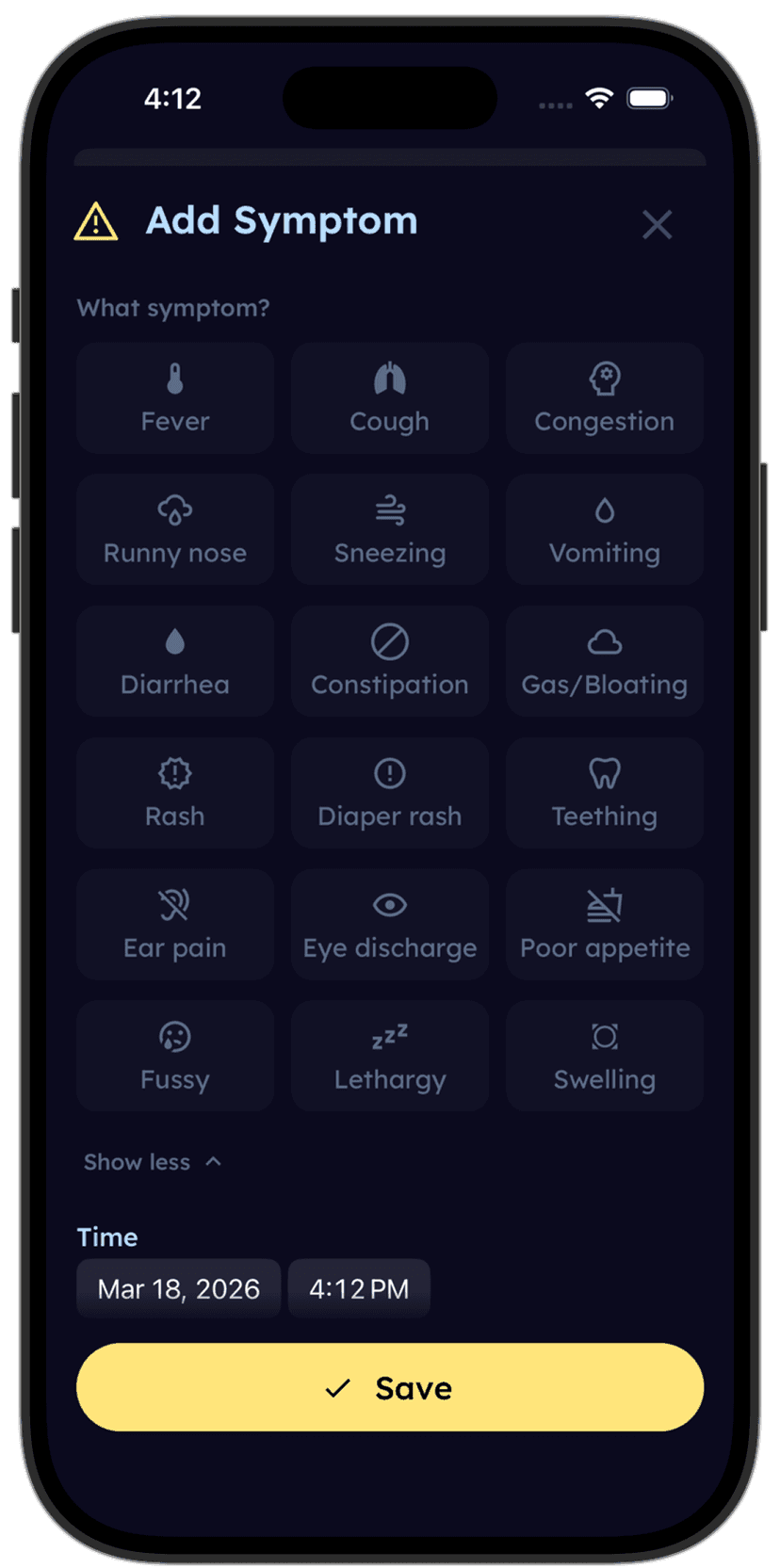
Tinylog logs each temperature reading with timestamps, so you can see whether fever is rising, falling, or holding steady. Show your pediatrician a clear trend instead of guessing.


It sounds intimidating, but it's genuinely simple once you've done it once. Here's the technique:
Lay baby on their back with knees bent toward their chest, or face-down across your lap. Apply a small amount of petroleum jelly to the thermometer tip. Gently insert the tip 1/2 to 1 inch into the rectum — no further. Hold the thermometer in place (and hold baby still) until it beeps. Remove and read.
The entire process takes 10-30 seconds. Use a flexible-tip digital thermometer — they're safer and more comfortable than rigid tips. Clean the thermometer with rubbing alcohol or soap and water after each use.
For rectal readings: Any basic flexible-tip digital thermometer works. The Vicks ComfortFlex or FridaBaby Quick-Read are popular options at $8-12. You don't need anything fancy — accuracy is built into the method, not the price tag.
For forehead readings: The Exergen Temporal Scanner is the most studied temporal artery thermometer and is used in many pediatric offices. It costs $25-40. Braun and iProven also make well-reviewed models. Avoid no-contact infrared thermometers marketed for industrial use — they're designed for surfaces, not skin.
Skip ear thermometers for infants: Tympanic (ear) thermometers are unreliable in babies because their ear canals are too small and curved for accurate readings. They become more useful after age 2. Once you have your reading, check our baby fever chart by age to understand what the number means for your baby's age group.
Use a forehead thermometer for quick screening and a rectal thermometer when you need a definitive answer. This is especially important under 3 months, where a single degree can change the clinical response.
If you use a standard digital thermometer rectally, label it 'RECTAL ONLY' with tape or marker. Do not use the same thermometer orally. Many parents buy a different color for each purpose.
Under 3 months: 100.4°F (38°C) rectal is an emergency — call your pediatrician immediately. 3-6 months: 101°F (38.3°C) warrants a call. Over 6 months: focus on how baby looks and acts, not just the number.
This guide is for informational purposes only and is not a substitute for professional medical advice. Consult your pediatrician for guidance specific to your baby.