GUIDE

Roseola in Babies

High fever for days with no explanation, then a rash appears — and the rash means it's almost over.

Roseola is the classic fever-then-rash illness that catches almost every parent off guard. The fever is alarming. The rash is reassuring. Here is everything you need to know to get through it.

The Classic Roseola Pattern: Fever First, Rash Second

Roseola is one of those illnesses that is almost impossible to diagnose while it is happening and completely obvious in retrospect. The pattern is distinctive, but the fever comes first — and during the fever phase, all you know is that your baby is burning up.

The cause is human herpesvirus 6 (HHV-6), a member of the herpes virus family that has nothing to do with cold sores or genital herpes. Nearly every child encounters HHV-6 by age two. It spreads through respiratory droplets from people who carry the virus asymptomatically — which is most older children and adults. The incubation period is five to fifteen days, so by the time your baby develops a fever, the exposure happened up to two weeks ago, and you will likely never know the source.

Here is the classic sequence: your baby develops a fever. Not a low-grade "maybe they're a little warm" fever — a real one. Temperatures of 103 to 105 degrees Fahrenheit are typical, and they can persist for three to five days. During this time, your baby may have a mildly runny nose or slightly swollen eyelids, but otherwise looks surprisingly well between fever spikes. They play, they smile, they nurse — and then the temperature shoots back up and they are miserable again. You call the pediatrician. They examine your baby and cannot find an obvious source for the fever. Ears look fine. Throat looks fine. Lungs are clear. "It might be roseola," they say. "We will know when the rash appears."

Then, sometime between day three and day five, the fever breaks — often dramatically. One temperature check reads 103 degrees Fahrenheit, and six hours later your baby is at 98.6 degrees Fahrenheit. Within twelve to twenty-four hours of the fever breaking, a rash appears. Pink or reddish flat spots, sometimes slightly raised, starting on the trunk and spreading to the neck, face, and limbs. And here is the key: the rash is not a sign that things are getting worse. The rash means it is over. Your baby usually feels fine once the rash appears. The rash is not itchy, not painful, and not contagious. It fades on its own within two to three days, sometimes within hours.

Most parents experience profound relief at the rash. After days of anxious fever-monitoring, the rash is the answer. It was roseola all along.


Roseola Timeline: What to Expect Day by Day
Incubation (Day 1-15)
What You'll SeeNo symptoms. Baby was exposed 5-15 days before fever begins.
What to ExpectYou will not know exposure has occurred. HHV-6 spreads through respiratory secretions from asymptomatic carriers — often older children or adults.
Fever phase (Day 1-5 of illness)
What You'll SeeHigh fever, often 103-105°F. May have mild runny nose, slight irritability, mildly swollen eyelids, decreased appetite. Baby may look surprisingly well between fever spikes.
What to ExpectThis is the hardest part. The fever is high and persistent, and you often have no idea what is causing it. Your pediatrician may not be able to diagnose roseola yet because the rash has not appeared.
Fever breaks (Day 3-5)
What You'll SeeTemperature drops to normal, often quite suddenly — sometimes within hours.
What to ExpectYou will feel immense relief. Your baby may seem almost back to normal. Then the rash appears.
Rash phase (Day 4-7)
What You'll SeePink or red flat or slightly raised spots appear on the trunk, then spread to the neck, face, and limbs. Not itchy. Not painful. Baby usually feels fine.
What to ExpectThe rash typically lasts 2-3 days and fades without treatment. Some rashes last only hours. Your baby is no longer contagious.
Recovery (Day 7-10)
What You'll SeeRash fades. Baby returns to normal. Appetite returns. Sleep normalizes.
What to ExpectFull recovery. One-and-done for most children — lasting immunity develops against HHV-6.
This is the classic roseola pattern. Some babies have a milder course with lower fevers or a barely noticeable rash. Others skip the rash entirely and you never get the satisfying 'mystery solved' moment.

Managing the Fever: What to Do Right Now

The fever is the hardest part of roseola — not because it is medically dangerous in itself, but because watching your baby spike to 104 degrees Fahrenheit for the third day in a row is genuinely frightening. Here is what you need to know: fever is your baby's immune system working. It is not the enemy. The goal of treatment is comfort, not a specific number on the thermometer.

Acetaminophen (Tylenol) for babies 2+ months

Acetaminophen can be given every 4-6 hours to manage fever and discomfort. Dose by weight, not age — your pediatrician or pharmacist can confirm the correct dose for your baby. The goal is not to normalize the temperature entirely but to bring it down enough that your baby is more comfortable, eating, and sleeping.

Ibuprofen (Motrin/Advil) for babies 6+ months

Ibuprofen can be given every 6-8 hours and is often more effective than acetaminophen for high fevers. It can be alternated with acetaminophen if a single medication is not providing adequate relief — but discuss the alternating schedule with your pediatrician first so dosing stays clear. Never give ibuprofen to babies under 6 months.

NEVER give aspirin

Aspirin should never be given to children or teenagers. It is associated with Reye's syndrome, a rare but life-threatening condition affecting the liver and brain. This applies to all aspirin-containing products. Stick to acetaminophen and ibuprofen only.

Keep your baby hydrated

Fever increases fluid losses. Offer breast milk or formula more frequently than usual. For babies over 6 months, small amounts of water are also fine. Watch for signs of dehydration — fewer wet diapers, dry mouth, no tears. Hydration matters more than getting the fever number down.

Dress lightly and keep the room comfortable

A feverish baby does not need to be bundled up. Dress in light, breathable clothing. Keep the room at a comfortable temperature. A lukewarm (not cold) bath may help your baby feel more comfortable, but do not use cold water or alcohol rubs — these can cause shivering, which actually raises the core temperature.

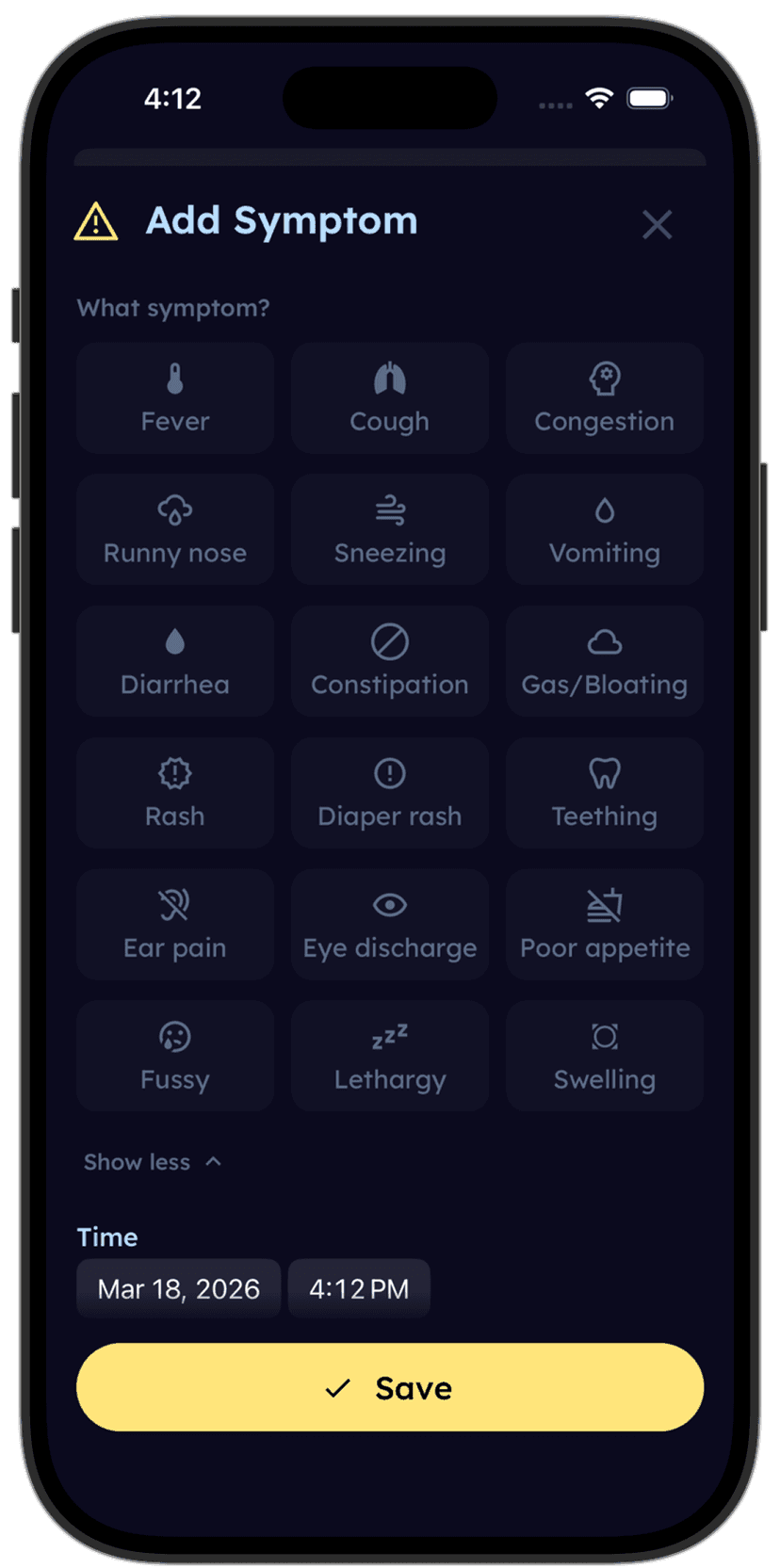
tinylog temperature tracking screen showing a multi-day fever log during roseola

Log every temperature reading — the pattern matters.

During roseola, the fever pattern is diagnostic. Track every temperature reading in tinylog with a timestamp. When the fever breaks and the rash appears, you will have a clear record showing the classic roseola arc. This data also helps your pediatrician confirm the diagnosis and rule out other causes.

Download on the App StoreGet It On Google Play

Febrile Seizures: The Scary Part You Should Know About

Febrile seizures are the main complication of roseola, and roseola is actually the single most common trigger for febrile seizures in infants. About 10 to 15 percent of children with roseola will have a febrile seizure, compared to the general febrile seizure rate of about 2 to 5 percent across all febrile illnesses.

Febrile seizures are triggered by the rapid rise in temperature, not the absolute peak. A baby whose temperature shoots from 99 degrees Fahrenheit to 104 degrees Fahrenheit in an hour is at higher risk than one whose temperature has been sitting steadily at 103 degrees Fahrenheit. This is why febrile seizures often happen early in the illness, during the first spike, sometimes before you even know your baby has a fever.

If your baby has a febrile seizure, it will be one of the most frightening moments of your life. Their body may stiffen, their limbs may jerk rhythmically, their eyes may roll back, and they may briefly stop breathing or turn blue around the lips. It feels like an emergency because it looks like one. But here is the medical reality: simple febrile seizures — those lasting less than five minutes, involving the whole body rather than one side, and occurring only once during the illness — are almost always benign. They do not cause brain damage. They do not mean your child has epilepsy. They do not affect development.

That said, any first seizure should be evaluated by a medical professional. And seizures lasting longer than five minutes require emergency intervention — call 911.

Febrile Seizures and Roseola: Key Facts

  • Febrile seizures occur in about 10-15% of children with roseola — a higher rate than most other febrile illnesses
  • They are triggered by the rapid RISE in temperature, not the absolute number — a spike from 99°F to 104°F is the risk, not a steady 103°F
  • Most febrile seizures last less than 5 minutes and stop on their own
  • During a seizure: place your baby on their side on a flat, safe surface. Do NOT restrain them or put anything in their mouth
  • Time the seizure — your provider will want to know how long it lasted
  • Call 911 if the seizure lasts longer than 5 minutes, if your baby has trouble breathing after it stops, or if it is your baby's first seizure
  • Simple febrile seizures (brief, generalized, one episode per illness) do NOT cause brain damage and do NOT mean your child has epilepsy
  • About one-third of children who have one febrile seizure will have another one during a future febrile illness
  • Giving fever reducers does NOT reliably prevent febrile seizures — the seizure often occurs during the initial rapid temperature rise, before you know your baby is sick

Febrile seizures are frightening but almost always harmless. Knowing what to do — and what NOT to do — during a seizure can make a terrifying situation more manageable.

When to Call Your Pediatrician, When to Go to the ER, When to Call 911

Most roseola cases can be managed entirely at home with fever reducers and fluids. But the high fevers that characterize roseola — especially before you know it is roseola — reasonably trigger concern.

Call your pediatrician when your baby has had a high fever for more than 24 hours without an obvious source. They may want to examine your baby to rule out ear infections, urinary tract infections, or other causes. Once roseola is suspected, they can help you manage expectations for the remaining days of fever. Also call if fever persists beyond five days without a rash, if your baby is refusing fluids, or if you have any concerns about hydration.

Go to the ER if your baby is under three months with a fever over 100.4 degrees Fahrenheit (roseola is uncommon in this age group, and any fever in a young infant needs urgent evaluation). Also go if your baby appears lethargic, has a stiff neck, has a bulging fontanelle, or seems seriously unwell beyond what you would expect from a fever.

Call 911 if your baby is having a seizure lasting longer than five minutes, if they are not breathing normally after a seizure, or if they are unresponsive. During a seizure, place your baby on their side on a safe surface, do not put anything in their mouth, and time the seizure.

Action Guide: When to Seek Help
Fever of 103-105°F in a baby 6-24 months who is otherwise drinking fluids and making wet diapers
Recommended ActionCall pediatrician for guidance
DetailsHigh fevers are expected with roseola, but your pediatrician should know. They may want to rule out other causes, especially before the rash appears.
Fever lasting more than 5 days without a rash appearing
Recommended ActionCall pediatrician
DetailsRoseola fever typically lasts 3-5 days. If fever persists beyond 5 days without explanation, other causes need to be considered.
Baby is refusing all fluids or showing dehydration signs
Recommended ActionCall pediatrician same day
DetailsThe fever itself is manageable. Dehydration is the real risk. If your baby will not drink, they need evaluation.
Rash appears but is accompanied by ongoing fever
Recommended ActionCall pediatrician
DetailsIn roseola, the rash appears AFTER the fever breaks. If both are present simultaneously, it may not be roseola.
First febrile seizure — lasted less than 5 minutes, baby recovered quickly
Recommended ActionCall pediatrician immediately (or call 911 during the seizure if unsure)
DetailsEven brief seizures should be reported and evaluated. Your pediatrician will want to examine your baby.
Seizure lasting more than 5 minutes, or baby not recovering/breathing normally after seizure
Recommended ActionCall 911
DetailsProlonged seizures require emergency intervention. Do not drive to the ER yourself — call 911 for paramedic support.
Baby under 3 months with fever over 100.4°F
Recommended ActionGo to ER
DetailsRoseola is rare under 3 months, and any fever in this age group needs urgent evaluation regardless of suspected cause.
Baby is lethargic, inconsolable, has a stiff neck, or has a bulging fontanelle
Recommended ActionGo to ER
DetailsThese signs suggest something more serious than roseola, such as meningitis. Seek immediate evaluation.
High fevers in babies are always unsettling, even when the cause is benign. If you are worried, calling your pediatrician is never wrong.

What This ISN'T: Roseola vs. Other Rash Illnesses

Several childhood illnesses involve fever and rash, but the pattern and details differ significantly.

Roseola vs. Other Fever-and-Rash Illnesses
Measles
Key DifferenceMeasles rash starts on the FACE and spreads downward (roseola starts on the trunk). Measles includes the '3 Cs': cough, coryza (runny nose), conjunctivitis (red eyes) — and the child looks sick DURING the rash. Koplik spots (white spots inside the cheeks) appear before the rash. Measles is far more serious. Vaccination has made it rare.
Allergic reaction / drug rash
Key DifferenceAllergic rashes are often itchy (roseola is not). They may include hives (raised welts) and can appear at any time, not specifically after a fever breaks. Drug rashes often appear 7-10 days into an antibiotic course. No preceding multi-day fever.
Fifth disease (parvovirus B19)
Key DifferenceThe classic 'slapped cheek' appearance — bright red rash on both cheeks, followed by a lacy rash on the body. Mild or no fever (unlike roseola's high fever). Older age range — more common in school-age children than infants.
Scarlet fever
Key DifferenceRash feels like sandpaper and starts in the groin, armpits, and neck before spreading. Accompanies a strep throat infection — sore throat, swollen tonsils, sometimes 'strawberry tongue.' Requires antibiotic treatment. Roseola does not involve a sore throat.
Hand, foot, and mouth disease
Key DifferenceBlisters or sores in the mouth and rash on the palms of hands and soles of feet (and sometimes buttocks). Rash location is very different from roseola's trunk-first pattern. Mouth sores cause significant feeding pain.
The roseola pattern — high fever for days, fever breaks, THEN rash appears on the trunk — is quite distinctive once you know to look for it. Most other rash illnesses have the rash and fever overlapping.

What This Looks Like in Real Life

Your eleven-month-old wakes up on Monday morning warm to the touch. Thermometer reads 103.2 degrees Fahrenheit. No runny nose, no cough, no vomiting, no rash. He is cranky and clingy but will nurse. You give acetaminophen and his temperature comes down to 101 degrees Fahrenheit. He plays on the floor for an hour. Then by late afternoon, his temperature is back to 103.8 degrees Fahrenheit. You alternate with ibuprofen.

Tuesday is the same. Wednesday is the same. Each morning you think the fever might be breaking. Each afternoon it returns. You call the pediatrician on Tuesday. They see him Wednesday morning, look in his ears, check his throat, press on his belly. Everything looks fine. "It might be roseola," the doctor says. "We will know in a day or two."

Thursday morning, you take his temperature and it is 98.7 degrees Fahrenheit. By noon, still normal. You feel a wave of relief so intense your knees go weak. Then Thursday evening while changing his diaper, you notice pink spots on his belly and back. By Friday morning the rash has spread to his neck and arms. He is acting completely normal — laughing, eating, sleeping fine. The rash looks dramatic but he does not seem to notice it.

By Sunday, the rash has faded to almost nothing. It was roseola. Four days of high fever, two days of rash, and then it was done. You could not have known during the fever phase. But now you know the pattern, and the next time a friend's baby has a days-long mystery fever, you will be the one saying: "It might be roseola. Watch for the rash."

tinylog health tracking screen showing fever pattern consistent with roseola

Mystery fever? Your log might reveal the pattern.

When your baby has a fever with no obvious cause, tracking temperatures over days helps you and your pediatrician see the pattern. tinylog timestamps every entry, so when the fever breaks and the rash appears, you can look back and see the classic roseola arc laid out clearly.

Download on the App StoreGet It On Google Play

Related Guides

  • Baby Rash Types — Visual guide to every rash your baby might get
  • Roseola — Overview of the classic fever-then-rash pattern
  • Scarlet Fever — A fever-with-rash illness that requires antibiotics
  • Kawasaki Disease — Prolonged fever with rash that needs urgent treatment
  • Chickenpox — Another common childhood rash with fever

Sources

  • American Academy of Pediatrics. (2024). Roseola (HHV-6). HealthyChildren.org.
  • Zerr, D. M., et al. (2005). A Population-Based Study of Primary Human Herpesvirus 6 Infection. New England Journal of Medicine, 352(8), 768-776.
  • Ward, J. R. (2017). Roseola Infantum (Exanthem Subitum). Pediatrics in Review, 38(3), 147-148.
  • Subcommittee on Febrile Seizures, AAP. (2011). Febrile Seizures: Clinical Practice Guideline for the Long-term Management of the Child with Simple Febrile Seizures. Pediatrics, 127(2), 389-394.
  • Caserta, M. T., et al. (2004). Human Herpesvirus 6 Infection of the Central Nervous System. Current Infectious Disease Reports, 6(4), 316-321.

Medical Disclaimer

This guide is for informational purposes only and is NOT a substitute for professional medical advice. When in doubt, always call your pediatrician. If your baby is under 3 months with a fever, having difficulty breathing, showing signs of dehydration, or seems seriously unwell, seek immediate medical attention.

Get this guide in your inbox.
We'll email you this guide so you have the symptom timeline and fever management steps whenever you need them.
Track fevers during illness — the pattern tells you a lot.
Download tinylog free — log temperatures and symptoms with a single tap.
Download on the App StoreGet It On Google Play