
GUIDE
Similac 360 Total Care vs. Similac Pro-Advance
Published on ·Updated on
Both are strong, milk-based infant formulas from Abbott. Similac 360 Total Care is the newer formula with 5 HMOs and a broader nutrient profile. Pro-Advance uses a simpler blend with 1 HMO and costs less per ounce. For most babies, either will support healthy growth.
Similac 360 Total Care replaced Similac Pro-Advance as Abbott's flagship formula in 2022. But Pro-Advance is still widely available and remains a solid option. The key differences come down to the number of HMOs (human milk oligosaccharides), fat blend composition, and price. Both are nutritionally complete and meet all FDA requirements for infant formula.
Log bottles, note spit-up, and track intake
“You usually don't need the most expensive formula to have a healthy, happy baby.”
 Dr. Matthew Badgett, MD, Pediatrician, Cleveland Clinic
Same Brand, Different Formulas — Here's What Actually Changed
Similac 360 Total Care and Similac Pro-Advance are both milk-based infant formulas made by Abbott Nutrition. They share the same protein sources, the same prebiotic blend, and the same commitment to being palm olein oil-free. At a glance, they look almost identical.
But the differences matter. When Abbott launched 360 Total Care, they upgraded the HMO count from 1 to 5, adjusted the fat blend, and positioned it as their closest-to-breast-milk formula. Pro-Advance didn't disappear — it's still on shelves and still a solid formula.
The question most parents are really asking: is the newer, pricier formula worth it? The answer depends on your baby, your budget, and how much weight you put on the HMO research.
We looked at the ingredient lists, nutritional profiles, pricing, and real-world parent feedback to give you a straight answer.
For guidance on how much formula your baby needs by age, check our baby feeding chart.
| Feature | 360 Total Care | Pro-Advance | What It Means |
|---|---|---|---|
| Manufacturer | Abbott Nutrition | Abbott Nutrition | Same manufacturer. 360 Total Care is the newer product line. |
| HMOs (human milk oligosaccharides) | 5 HMOs (including 2'-FL) | 1 HMO (2'-FL only) | 360 Total Care has a broader HMO blend, closer to breast milk's diversity. |
| Protein source | Nonfat milk, whey protein concentrate | Nonfat milk, whey protein concentrate | Tie. Both use the same milk-based protein sources. |
| Fat blend | High oleic sunflower oil, soy oil, coconut oil | High oleic safflower oil, soy oil, coconut oil | Slightly different oil profiles. 360 Total Care uses sunflower; Pro-Advance uses safflower. |
| DHA & ARA | Yes — from algal and fungal sources | Yes — from algal and fungal sources | Tie. Both include DHA and ARA for brain and eye development. |
| Prebiotics | Yes — galactooligosaccharides (GOS) | Yes — galactooligosaccharides (GOS) | Tie. Both include prebiotic GOS to support gut health. |
| Lutein | Yes | Yes | Tie. Both include lutein for eye development. |
| Palm olein oil | No | No | Tie. Neither contains palm olein oil, which some studies link to reduced calcium absorption. |
| Lactose-based | Yes — primary carbohydrate is lactose | Yes — primary carbohydrate is lactose | Tie. Both use lactose as the main carbohydrate, matching breast milk. |
| Available forms | Powder, Ready-to-Feed | Powder, Ready-to-Feed, Concentrate | Pro-Advance is available in liquid concentrate; 360 Total Care is not. |
| GMO status | Non-GMO ingredients | Non-GMO ingredients | Tie. Both use non-GMO ingredients. |
HMOs: The Biggest Difference Between These Two Formulas
Human milk oligosaccharides (HMOs) are complex carbohydrates found naturally in breast milk. They aren't digested by the baby — instead, they feed beneficial gut bacteria and support immune function. Breast milk contains over 200 different HMOs.
Similac 360 Total Care includes 5 HMOs, making it one of the most HMO-diverse standard formulas on the market. These include 2'-FL (the most abundant HMO in breast milk) plus four additional types.
Similac Pro-Advance includes 1 HMO — 2'-FL only.
Does this matter clinically? Early research suggests that more HMO diversity may support better gut microbiome development and immune function. But this is still an emerging area of science. No study has shown a meaningful long-term health difference between babies fed formulas with 1 HMO versus 5 HMOs.
The honest take: the 5-HMO blend in 360 Total Care is scientifically reasonable and directionally better. But it's not a night-and-day difference, and your baby will grow just fine on either formula.
Worth noting: store-brand formulas now also include 2'-FL HMO, so the single-HMO advantage of Pro-Advance is no longer unique to name brands.
Tolerance and Digestive Comfort
Both formulas are standard milk-based formulas. Neither is designed for babies with lactose sensitivity, milk protein allergy, or reflux. If your baby has those issues, you need a different formula entirely (like Similac Sensitive or Alimentum).
For babies with typical digestion, tolerance between these two is generally similar. Some parents report that 360 Total Care produces slightly less gas and fussiness, which may relate to the broader HMO blend supporting gut bacteria. But this is anecdotal — individual babies react differently.
Important: if your baby is doing well on one formula, there's rarely a good reason to switch. A happy, growing baby on Pro-Advance doesn't need to be moved to 360 Total Care. Switching formulas can temporarily cause digestive upset as your baby adjusts.
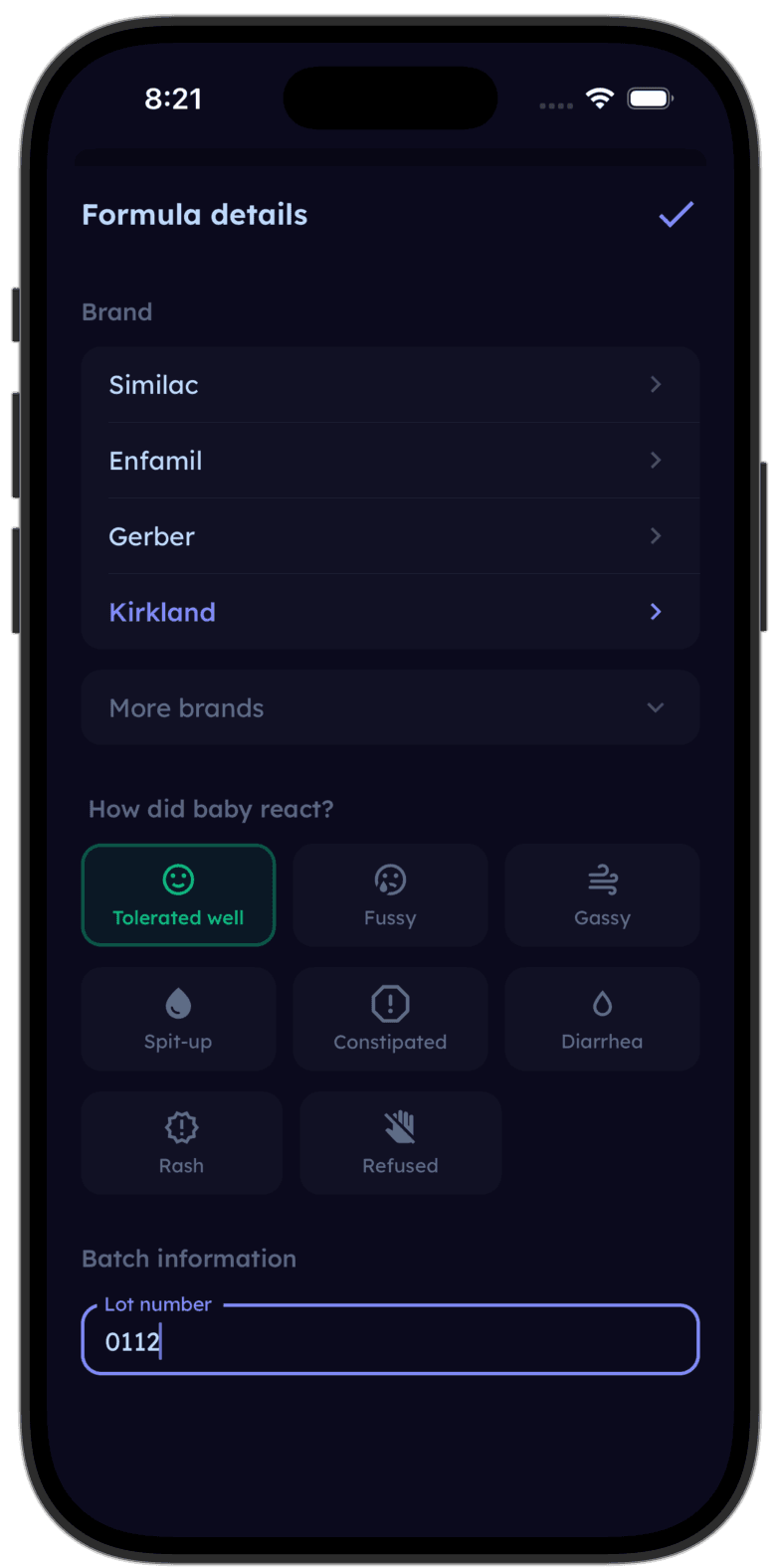
Tinylog tracks bottles so you can spot feeding patterns.
Log every bottle — amount, time, and any spit-up or fussiness. See daily and weekly trends. Bring the data to your next pediatrician visit.


| Product | Typical Price | Cost Per Fl Oz (Prepared) | Monthly Estimate |
|---|---|---|---|
| Similac 360 Total Care Powder (30.8 oz) | $38–$44 | ~$0.17–$0.19 per fl oz prepared | ~$145–$175 |
| Similac Pro-Advance Powder (30.8 oz) | $33–$39 | ~$0.15–$0.17 per fl oz prepared | ~$125–$155 |
| Similac 360 Total Care Ready-to-Feed (32 oz, 8-pk) | $52–$60 | ~$0.20–$0.23 per fl oz | ~$180–$220 |
| Similac Pro-Advance Ready-to-Feed (32 oz, 8-pk) | $46–$54 | ~$0.18–$0.21 per fl oz | ~$165–$195 |
Price: A Real but Manageable Difference
Similac 360 Total Care costs roughly $0.02–$0.04 more per prepared fluid ounce than Pro-Advance. Over a month of exclusive formula feeding, that adds up to about $15–$30 extra.
That's not trivial — over a year, you're looking at $180–$360 more for 360 Total Care. But it's also not a dramatic gap.
Ways to reduce formula costs regardless of which you choose:
- Subscribe and save. Amazon, Target, and Walmart all offer 5–15% off recurring formula deliveries.
- Use manufacturer coupons. Sign up at Similac.com for their StrongMoms program, which offers checks and rebates.
- Buy the largest container available. The cost per ounce drops significantly with bigger tubs.
- Check WIC eligibility. Both formulas are covered by many state WIC programs, though specific product availability varies by state.
If budget is tight and your baby tolerates both, Pro-Advance is the more economical choice without sacrificing nutritional completeness.
Choose Similac 360 Total Care If
- You want the broadest HMO blend available in a standard formula
- Mimicking breast milk composition as closely as possible is a priority
- Your baby tolerates it well and the extra cost fits your budget
- You're supplementing breast milk and want immune-supporting ingredients
- You prefer the most current formulation from Abbott
Choose Similac Pro-Advance If
- Your baby is already thriving on Pro-Advance and you see no reason to switch
- Budget is a primary concern — Pro-Advance costs less per ounce
- You need liquid concentrate, which isn't available in the 360 line
- Your pediatrician specifically recommended Pro-Advance
- You've found a reliable supply of Pro-Advance and don't want to risk availability issues
Where to Buy
If you want the most advanced standard Similac formula, Similac 360 Total Care (~$0.18/fl oz prepared in powder form) gives you 5 HMOs, a modern fat blend, and Abbott's latest nutritional research in one tub. The powder is the best value — buy the largest size and use a subscription discount.
If you want a proven, more affordable option from the same manufacturer, Similac Pro-Advance (~$0.16/fl oz prepared in powder form) still delivers complete nutrition with 1 HMO, the same protein blend, and the same no-palm-olein-oil commitment. It's also available in liquid concentrate if you prefer that format.
Our honest advice: if cost isn't a concern, 360 Total Care is the better formula on paper. If your baby is already happy on Pro-Advance, there's no urgent reason to switch.
Tinylog earns a small commission on purchases made through these links, at no cost to you.
Tip: check promo.new before purchasing. It's hit or miss depending on the product, but when it hits, you'll be glad you checked.
The Bottom Line
Similac 360 Total Care and Similac Pro-Advance are both quality, milk-based infant formulas from the same manufacturer. The differences are meaningful but moderate:
Similac 360 Total Care has the edge in HMO diversity (5 vs. 1), a slightly updated fat blend, and the "closest to breast milk" positioning from Abbott.
Similac Pro-Advance has the edge in price, format availability (liquid concentrate), and a long track record of healthy babies thriving on it.
Both meet all FDA nutritional requirements. Both support healthy growth and development. The "best" formula is the one your baby tolerates well, that you can consistently afford, and that you can reliably find in stock.
If you're tracking feeding amounts and patterns — which is especially helpful in the first few months — Tinylog makes it simple to log bottles and spot trends over time. Once you've picked your formula, sign up for free recall alerts so you'll know right away if it's ever recalled.
Related Guides
- Baby Feeding Chart — How much your baby should eat by age
- Baby Constipation — What's normal and when to worry
- Baby Diarrhea — Normal stool vs. when to call the pediatrician
- Baby Diaper Rash — Causes, treatment, and when to call your doctor
Sources
- Abbott Nutrition. "Similac 360 Total Care — Product Information." similac.com, 2026.
- Abbott Nutrition. "Similac Pro-Advance — Product Information." similac.com, 2026.
- Bode, L. "Human Milk Oligosaccharides: Every Baby Needs a Sugar Mama." Glycobiology, 2012.
- Marriage BJ, et al. "Infants Fed a Lower Caloric Formula With 2'-FL Show Growth and 2'-FL Uptake Like Breast-Fed Infants." Journal of Pediatric Gastroenterology and Nutrition, 2015.
- BabyFormulaExpert.com. "Similac 360 Total Care vs. Pro-Advance: Full Comparison." 2025.
- Consumer Reports. "Best Baby Formulas From Our Tests." consumerreports.org, 2026.
- FDA. "Infant Formula Requirements Under the Federal Food, Drug, and Cosmetic Act." fda.gov, 2025.
This guide is for informational purposes only and is not medical advice. Formula choice should be discussed with your pediatrician, especially if your baby has allergies, reflux, or other dietary needs. If your baby shows signs of formula intolerance (persistent vomiting, blood in stool, or failure to gain weight), contact your pediatrician immediately.
Frequently asked questions
- Is Similac 360 Total Care better than Pro-Advance?
- Similac 360 Total Care has a more advanced nutrient profile, including 5 HMOs compared to Pro-Advance's 1 HMO. It also uses a broader fat blend. However, both are nutritionally complete and meet all FDA standards. 'Better' depends on your baby's tolerance and your budget.
- Why did Similac replace Pro-Advance with 360 Total Care?
- Abbott designed 360 Total Care to more closely mimic breast milk by adding more HMOs and adjusting the fat blend. It's the evolution of their formula line, not a safety recall. Pro-Advance remains available and is still a perfectly good formula.
- Can I switch between Similac 360 Total Care and Pro-Advance?
- Yes. Both are milk-based formulas with similar protein sources. Most babies can switch without issues. If your baby has a sensitive stomach, transition gradually by mixing the two over 3–5 days. Consult your pediatrician if you notice persistent fussiness or digestive changes.
- Which Similac formula is easier on a baby's stomach?
- Neither formula is specifically designed for sensitive stomachs — both are standard milk-based formulas. Some parents report that 360 Total Care's 5 HMOs help with digestion, but individual tolerance varies. If your baby has true sensitivity, consider Similac 360 Total Care Sensitive or Similac Pro-Sensitive instead.
- Are the HMOs in Similac the same as those in breast milk?
- The HMOs in Similac formulas are structurally identical to some of the oligosaccharides found in human breast milk, but breast milk contains over 200 different HMOs. Similac 360 Total Care includes 5 of the most prevalent ones, while Pro-Advance includes 1 (2'-FL).
- Is the price difference between 360 Total Care and Pro-Advance worth it?
- 360 Total Care costs roughly $0.02–$0.04 more per ounce than Pro-Advance. Over a month, that's about $15–$30 extra. Whether the additional HMOs and updated fat blend justify the cost is a personal decision. Both formulas support healthy growth and development.