GUIDE

Doctor vs. ER

When in doubt, go. But knowing which door to walk through saves time and gets your baby the right care faster.

Not every sick baby needs the ER, and not every concern can wait until Monday morning. This guide gives you a clear framework for deciding between calling 911, going to the emergency room, calling your pediatrician, or safely managing at home — organized by the symptoms you are actually seeing.

The Three Doors: 911, ER, or Pediatrician

When your baby is sick or hurt, the hardest part is often not the illness itself — it is figuring out where to go. You are tired, scared, and trying to make a clear-headed medical decision at 2 AM while your baby screams. This guide exists so you can think through that decision before you need to.

The framework is simple. There are three levels of escalation, and each one has clear criteria:

Call 911 when there is an immediate threat to life — your baby is not breathing, is unresponsive, is having a seizure, is turning blue, or has had a serious injury. These are situations where seconds matter and your baby needs paramedics, not a car ride.

Go to the ER when your baby needs urgent medical evaluation and possible intervention that only a hospital can provide — but the situation is stable enough that you can safely drive there. Fever in a newborn, signs of significant dehydration, respiratory distress, and head injuries with altered consciousness all fall here.

Call your pediatrician when something is wrong but your baby is stable — a fever that has been going for two days, persistent vomiting without dehydration, a new rash, feeding refusal. Your pediatrician can often triage over the phone and tell you whether to come in, go to the ER, or watch and wait.

And then there is a fourth option that is easy to forget in the moment: manage at home. Many common childhood illnesses — a garden-variety cold, a mild stomach bug, a low-grade fever with normal behavior — do not need a doctor visit at all. They need fluids, rest, comfort, and a parent who is paying attention to whether things are getting better or worse.


Call 911 Immediately

  • Baby is not breathing or is gasping for air
  • Baby is turning blue or gray around the lips, tongue, or fingertips (cyanosis)
  • Baby is limp, unresponsive, or cannot be woken up
  • Baby is having a seizure (rhythmic jerking movements, eyes rolling back)
  • Severe bleeding that does not stop with firm pressure
  • Possible neck or spinal injury — do NOT move the baby
  • Signs of anaphylaxis: sudden swelling of face/throat, difficulty breathing, widespread hives after exposure to an allergen
  • Baby has been submerged in water (near-drowning), even if they seem okay afterward
  • Suspected poisoning or ingestion of a dangerous substance

Do not drive to the ER in these situations — call 911. Paramedics can begin treatment en route and alert the hospital to prepare.

Go to the Emergency Room

  • Fever of 100.4F (38C) or higher in a baby under 3 months old
  • Difficulty breathing: nasal flaring, chest retractions, grunting, or sustained fast breathing at rest
  • Signs of moderate to severe dehydration: no wet diaper for 6+ hours, sunken fontanelle, no tears, lethargic
  • Vomiting that is projectile, bile-stained (green), or bloody
  • Blood in stool that is more than a small streak
  • Inconsolable crying for more than 2 hours with no identifiable cause
  • Bulging fontanelle (soft spot) when baby is calm and upright
  • Stiff neck combined with fever and irritability (possible meningitis signs)
  • Seizure that has stopped — baby still needs evaluation even if they appear recovered
  • Significant head injury, especially with vomiting, behavior change, or loss of consciousness
  • A rash that does not blanch (fade) when you press on it — especially with fever (petechiae/purpura)
  • Fever above 104F (40C) in any age that does not respond to medication within 1 hour

If you are unsure whether something is an ER situation, call your pediatrician's after-hours line. If you cannot reach them and you are worried, go to the ER. You will never be wrong for seeking help.

Call Your Pediatrician (Same Day or Next Business Day)

  • Fever in a baby 3-6 months old that lasts more than 24 hours
  • Fever in a baby over 6 months that lasts more than 48-72 hours or exceeds 102.2F (39C)
  • Vomiting or diarrhea lasting more than 24 hours, but baby is still taking some fluids
  • Ear pulling combined with fever, fussiness, or disrupted sleep
  • New rash that is not accompanied by breathing difficulty or high fever
  • Mild croup (barky cough) without significant breathing difficulty — see the croup guide
  • Decreased appetite or refusal to feed for more than 24 hours
  • Fewer wet diapers than normal but not meeting severe dehydration criteria
  • Persistent cough lasting more than a week
  • Eye discharge, redness, or crusting (possible conjunctivitis)
  • Fall from less than 3 feet with no loss of consciousness, but you want reassurance
  • Any symptom that has you worried enough to read this guide at 2 AM

Your pediatrician's office can often triage over the phone and may be able to see your baby the same day. For more on what to expect during that call, see our when-to-call-pediatrician guide.

Triage by Symptom: Where to Go for What

The lists above give you the general framework, but real life is messier. Your baby does not present with a tidy label that says "ER" or "pediatrician." They present with a fever and a rash, or vomiting plus lethargy, or a cough that sounds like a seal barking. So here is the same information organized by what you are actually seeing.

Age is a critical modifier in every category below. A fever in a one-week-old and a fever in a one-year-old are fundamentally different clinical situations, even if the thermometer reads the same number. When in doubt about age-specific thresholds, our when to call the pediatrician guide has detailed breakdowns.

For breathing concerns specifically, our baby breathing fast guide walks you through normal respiratory rates by age and exactly what retractions, nasal flaring, and grunting look like. If you are dealing with dehydration — especially during vomiting or diarrhea illness — our dehydration guide has the complete severity scale and action steps.

Symptom-by-Symptom Triage Decision Table
Fever — under 28 days old
Recommended ActionER immediately
DetailsAny rectal temp of 100.4F+ in a newborn requires urgent evaluation. Do not give fever medicine — go now.
Fever — 1-3 months old
Recommended ActionER or call pediatrician immediately
Details100.4F+ needs same-day evaluation. Many pediatricians will direct you to the ER for lab work.
Fever — 3-6 months old
Recommended ActionCall pediatrician
DetailsUnder 102.2F with normal behavior can often be monitored. Over 102.2F or lasting 24+ hours warrants a visit.
Fever — 6-24 months
Recommended ActionCall pediatrician if over 102.2F or lasting 48+ hours
DetailsFocus on behavior, not the number. A playful baby with 101F is less concerning than a listless baby with 100.5F.
Breathing — nasal flaring, retractions, grunting
Recommended ActionER or call 911
DetailsThese are signs of respiratory distress. Do not wait. See our breathing guide for what to look for.
Breathing — barky cough, stridor at rest
Recommended ActionER
DetailsLikely croup with significant airway involvement. Cool night air on the drive may help.
Breathing — mild wheezing, congestion, no distress
Recommended ActionCall pediatrician
DetailsMay be bronchiolitis or a cold. Monitor for worsening — especially around days 3-5 of illness.
Vomiting — green (bile) or bloody
Recommended ActionER immediately
DetailsBilious vomiting can indicate a bowel obstruction. Bloody vomit needs prompt evaluation.
Vomiting — projectile in a newborn
Recommended ActionCall pediatrician urgently
DetailsProjectile vomiting in a 2-8 week old may indicate pyloric stenosis, which requires evaluation.
Vomiting — occasional, keeping some fluids down
Recommended ActionMonitor at home; call pediatrician if lasting 24+ hours
DetailsLikely a stomach bug. Focus on small, frequent fluid offerings.
Diarrhea — with dehydration signs
Recommended ActionER if moderate-severe; pediatrician if mild
DetailsTrack wet diapers carefully. See our dehydration guide for the full checklist.
Rash — non-blanching (petechiae) with fever
Recommended ActionER immediately
DetailsA rash that does not fade when pressed, combined with fever, needs urgent evaluation to rule out meningococcemia.
Rash — hives with breathing difficulty or facial swelling
Recommended ActionCall 911
DetailsThis is anaphylaxis. Administer epinephrine (EpiPen) if prescribed, then call 911.
Rash — new but baby is acting normally, no fever
Recommended ActionCall pediatrician during office hours
DetailsMost rashes in well-appearing babies are viral or benign. A photo can help the pediatrician triage by phone.
Head injury — loss of consciousness, vomiting, behavior change
Recommended ActionER
DetailsAny head injury with altered consciousness needs imaging. Even brief loss of consciousness warrants evaluation.
Head injury — minor bump, crying but then acting normally
Recommended ActionMonitor at home; call pediatrician if concerned
DetailsWatch for vomiting, excessive sleepiness, or behavior changes over the next 24 hours.
Behavioral change — unusually lethargic, limp, difficult to arouse
Recommended ActionER
DetailsA baby who is significantly more listless than usual, especially with fever or illness, needs prompt evaluation.
Behavioral change — more fussy than usual but consolable
Recommended ActionMonitor; call pediatrician if persists 24+ hours
DetailsIncreased fussiness with no other symptoms is common during growth spurts, teething, or minor illness.
This table is a starting framework, not a diagnostic tool. Symptoms often overlap and interact. When multiple concerning symptoms are present simultaneously, escalate to the higher level of care.
tinylog app showing symptom timeline with temperature, diaper, and feeding logs

Walk into the ER with real data, not guesses.

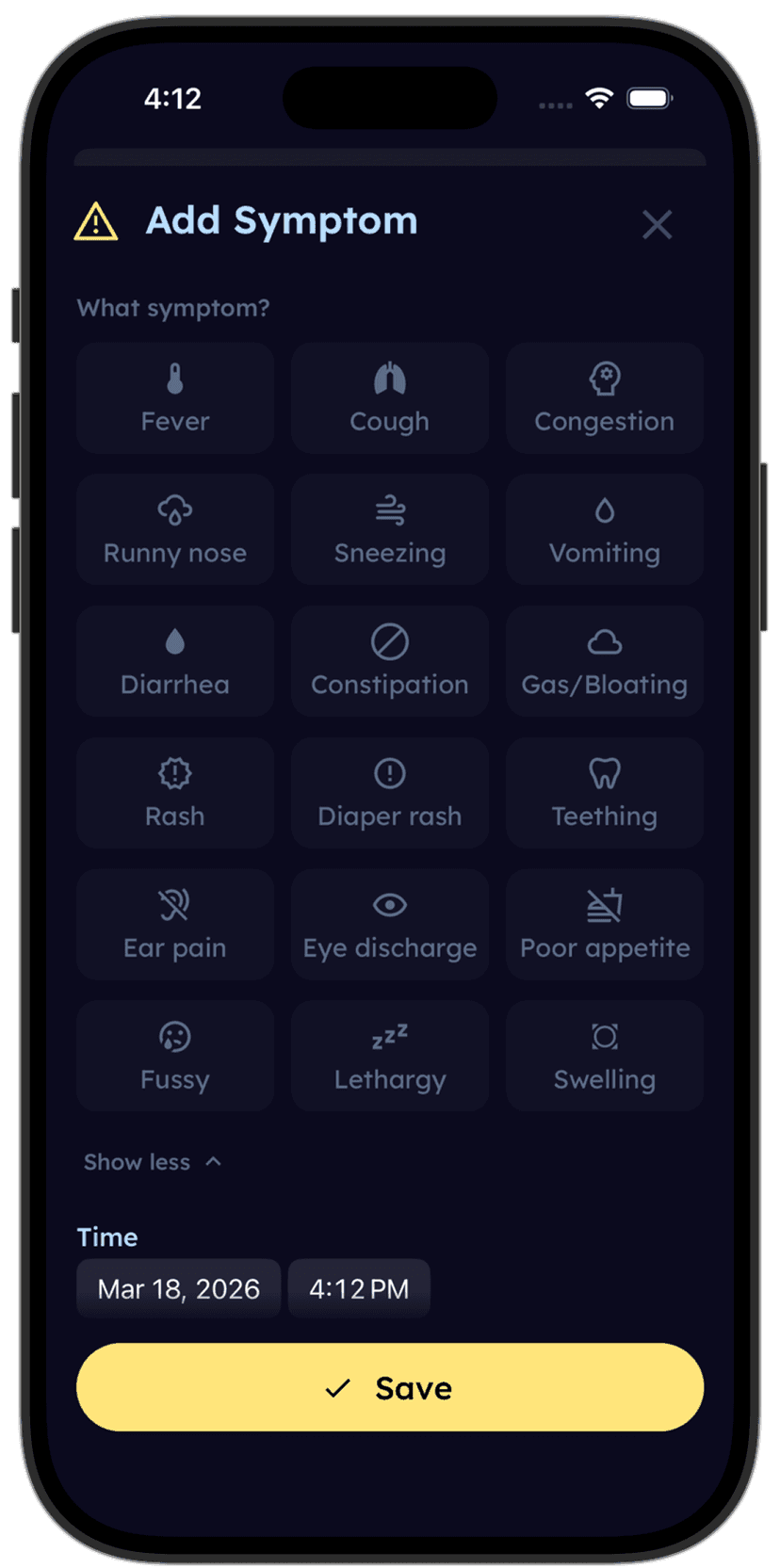
When you track feeds, diapers, sleep, and temps in tinylog, you build a symptom timeline automatically. Instead of saying 'I think he had a fever yesterday,' you can show the care team exactly when it started, how high it went, and what else changed. That kind of data helps doctors make faster, better decisions.

Download on the App StoreGet It On Google Play

What to Bring to the ER

If you have decided the ER is the right call, take 60 seconds to grab what you can from this list. You will not have everything, and that is fine — they will still treat your baby. But having this information speeds up the process and helps the medical team make better decisions.

The single most valuable thing you can bring is a symptom log. When did the fever start? What temperatures have you recorded? How many wet diapers in the last 24 hours? When did the baby last eat, and how much? What medications have you given, at what dose, and when? At 3 AM in a chaotic ER, the parent who can answer these questions clearly gives the care team an enormous head start.

ER Packing Checklist
Insurance card and ID
Why It MattersSpeeds up registration. If you do not have insurance, you will still be treated — do not let this stop you from going.
Symptom timeline
Why It MattersWhen symptoms started, what you have observed, what has changed. A written log is better than trying to remember under stress.
Temperature log
Why It MattersTimes and readings of every temperature you have taken, including the method (rectal, axillary, temporal). Trends matter more than single readings.
Diaper and feeding log
Why It MattersHow many wet diapers in the last 24 hours, when the baby last ate, how much they consumed. This is exactly the data the ER team needs.
Medication list
Why It MattersAny medications given (including acetaminophen or ibuprofen), dosages, and times. Also list any daily medications or supplements.
Immunization record
Why It MattersHelps the medical team rule out or consider vaccine-preventable illnesses. Your pediatrician's patient portal often has this.
A concerning diaper (sealed in a bag)
Why It MattersIf the issue involves stool — blood, unusual color, diarrhea — bring a sample. Doctors genuinely find this helpful.
Comfort items and supplies
Why It MattersA pacifier, a change of clothes, extra diapers, a blanket. ER waits can be long, and a familiar object helps everyone cope.
You do not need all of these to go to the ER. If your baby needs emergency care, go now and sort out the paperwork later.

After-Hours Options: What's Open When Your Pediatrician Isn't

Pediatrician's after-hours nurse line

Call your pediatrician's main office number — most practices have an after-hours answering service that connects you to a nurse or on-call provider. They can help you decide if the situation can wait until morning. This should be your first call for non-emergency concerns outside office hours.

Pediatric urgent care

If your area has a pediatric urgent care, it is an excellent middle ground between the pediatrician's office and the ER. They handle ear infections, mild respiratory illness, minor injuries, rashes, and fevers in babies over 3-6 months. Shorter waits than the ER, and the staff is pediatric-trained. Check age minimums before going.

Telehealth or virtual visits

Many pediatric practices and insurance plans offer telehealth visits for after-hours concerns. A video visit can be useful for rashes, behavioral questions, and feeding concerns. It is less useful when a physical exam is needed, but it can help you decide whether an in-person visit is necessary.

General urgent care

A standard urgent care center can handle basic pediatric issues, but the staff may not be pediatric-specialized. For babies under 12 months, pediatric urgent care or the ER is generally preferred. General urgent care is a reasonable option for older toddlers with straightforward concerns.

Emergency room

Open 24/7 and equipped for anything. The ER is the right choice when your baby needs immediate intervention, diagnostic imaging, IV fluids, or monitoring. If your gut says something is seriously wrong, skip the intermediate steps and go directly to the ER.

Age Matters: Why the Same Symptom Has Different Urgency

A fever of 100.4 degrees Fahrenheit means something very different depending on whether your baby is two weeks old or two years old. This is not intuitive — a number is a number, right? — but the underlying biology explains everything.

0 to 28 days (newborns): The immune system is profoundly immature. Newborns cannot mount an effective fever response to localize infections, which means a fever — even a low one — can indicate a serious bacterial infection like meningitis, urinary tract infection, or bacteremia. Any rectal temperature of 100.4F or higher in this age group requires immediate ER evaluation, full sepsis workup (blood cultures, urine, often a lumbar puncture), and typically admission for IV antibiotics pending results. This is not optional.

1 to 3 months: Still high-risk. The immune system is developing but remains immature. Fever of 100.4F or higher needs same-day evaluation — most pediatricians will direct you to the ER for lab work. The approach is more nuanced than the newborn period (not every baby gets a lumbar puncture), but these babies are still taken very seriously.

3 to 6 months: The calculus begins to shift. Babies who have received their first round of vaccinations have some immune protection. Fever under 102.2F with normal behavior can often be monitored at home with a call to the pediatrician. Fever over 102.2F, or any fever lasting more than 24 hours, warrants evaluation.

6 to 24 months: Fever is common and usually viral. The focus shifts from the number on the thermometer to how the baby is acting. A playful baby with a 103F fever is generally less concerning than a listless baby with a 100.5F fever. Call your pediatrician for fever over 102.2F, fever lasting more than 48 to 72 hours, or any fever where your baby's behavior worries you.

Over 24 months: Toddlers get sick frequently — six to eight illnesses per year is normal. Most fevers are viral, self-limited, and manageable at home. Seek care for fever over 104F, fever lasting more than 72 hours, or behavioral red flags. See our when to call the pediatrician guide for the full framework.

Tips for Making the Decision

Trust your gut — then verify it

No triage chart can replace parental instinct. If something feels wrong and you cannot put your finger on it, that is a valid reason to seek care. Research consistently shows that parental concern is a legitimate clinical indicator. You know your baby better than any checklist does.

Behavior matters more than numbers

A baby with a 103F fever who is playing and drinking normally is generally less concerning than a baby with a 100.5F fever who is limp, glassy-eyed, and refusing all fluids. The fever number matters for very young babies (under 3 months, it is always urgent), but for older infants and toddlers, how your baby looks and acts is the more important data point.

The 3-month cliff

Age 3 months is a critical threshold in pediatric triage. Under 3 months, the immune system is immature, fever can indicate serious bacterial infection, and the threshold for emergency evaluation is very low. After 3 months, the calculus changes — the immune system is more developed, and many illnesses can be managed with less urgency. Know which side of this line your baby is on.

Take a photo or video

Rashes disappear. Breathing patterns change. Concerning stools get thrown away. When you see something that worries you, document it with your phone. A 15-second video of your baby's breathing, a photo of the rash, a picture of the diaper — these are invaluable to the medical team, especially if symptoms have resolved by the time you are seen.

tinylog app showing comprehensive baby tracking log with feeds, diapers, and temperature readings

Your baby's data, ready when you need it most.

The ER visit you hope never happens goes better when you have real data. tinylog keeps a running log of feeds, diapers, sleep, and symptoms — so when the triage nurse asks 'when did this start?' and 'how many wet diapers today?', you have answers, not guesses.

Download on the App StoreGet It On Google Play

Related Guides

Sources

  • American Academy of Pediatrics (AAP). (2024). Fever in Babies and Children. HealthyChildren.org.
  • American College of Emergency Physicians. (2024). When to Go to the Emergency Department. ACEP.org.
  • Baraff, L. J. (2008). Management of Infants and Young Children with Fever without Source. Pediatric Annals, 37(10), 673-679.
  • Pantell, R. H., et al. (2021). Evaluation and Management of Well-Appearing Febrile Infants 8 to 60 Days Old. Pediatrics, 148(2), e2021052228. (AAP Clinical Practice Guideline)
  • National Institute for Health and Care Excellence (NICE). (2023). Fever in Under 5s: Assessment and Initial Management. NICE Guideline NG143.

Medical Disclaimer

This guide is for informational purposes only and is NOT a substitute for professional medical advice. When in doubt, always call your pediatrician. If your baby is under 3 months with a fever, having difficulty breathing, showing signs of dehydration, or seems seriously unwell, seek immediate medical attention.

Get this guide in your inbox.
We'll email you the triage framework so you have it ready the moment you need it — no searching required.
Bring real data to every medical visit.
Download tinylog free — track feeds, diapers, sleep, and symptoms in one place.
Download on the App StoreGet It On Google Play