GUIDE

Amber Teething Necklaces

No evidence they work. Real evidence they are dangerous. The AAP and CPSC both advise against them.

The marketing is appealing — a natural remedy that relieves teething pain just by wearing it. The reality is that amber necklaces have no proven mechanism of action and pose genuine strangulation and choking hazards.

The Claims vs. the Science

Amber teething necklaces are marketed with a specific claim: that body heat causes the Baltic amber to release succinic acid, which is then absorbed through the baby's skin and provides anti-inflammatory and analgesic (pain-relieving) effects. This sounds plausible enough that millions of parents have bought them. But every step of this chain falls apart under scrutiny.

Amber does not release succinic acid at body temperature. Amber is fossilized tree resin that is millions of years old and chemically stable. To decompose amber and release its constituent compounds requires temperatures far above what the human body produces. At 37°C (body temperature), amber does nothing.

Even if it did, succinic acid is not a meaningful anti-inflammatory at trace levels. Succinic acid is a normal metabolic intermediate — your baby's own cells already produce it as part of cellular energy metabolism. The amount that could theoretically be released from a tiny amber bead through skin contact is negligible compared to what the body already manufactures.

No study has ever shown amber necklaces reduce teething symptoms. There are no randomized controlled trials, no blinded studies, no credible research of any kind demonstrating efficacy. The evidence consists entirely of parent testimonials, which are subject to placebo effect and confirmation bias.

What there IS evidence for is harm. Strangulation incidents. Choking on beads. Emergency room visits. These are documented, not theoretical.


Marketing Claims vs. Scientific Evidence
Body heat releases succinic acid from the amber
What the Evidence ShowsAmber requires temperatures of 200°C+ (392°F) to release compounds. Body temperature (37°C / 98.6°F) does not cause amber to release succinic acid.
SourceBasic chemistry — amber is a fossilized resin that is chemically stable at body temperature
Succinic acid has anti-inflammatory properties
What the Evidence ShowsSuccinic acid is a normal metabolic intermediate in human cells. Even if it were released from amber (it is not), the amounts would be negligible compared to what the body already produces. No study has shown anti-inflammatory effects from topical succinic acid at these levels.
SourceNo controlled studies demonstrating this mechanism
Amber necklaces reduce teething pain
What the Evidence ShowsNo randomized controlled trial has ever demonstrated that amber necklaces reduce teething symptoms. Parent reports of effectiveness are subject to placebo effect and confirmation bias.
SourceMacknin (2014); systematic reviews find no evidence of efficacy
The necklaces are safe because they have breakaway clasps
What the Evidence ShowsBreakaway clasps reduce but do not eliminate strangulation risk. If the clasp breaks, individual beads become a choking hazard. The 'safety features' introduce a different danger.
SourceCPSC, AAP
Every claim made by amber necklace manufacturers fails to hold up under scientific scrutiny. The product has no proven benefit and documented risks.

Safety Risks of Amber Teething Necklaces

  • Strangulation — a necklace around an infant's neck can catch on crib parts, car seats, clothing, or other objects
  • Choking — individual beads can detach and be swallowed or aspirated (inhaled into the airway)
  • Strangulation during sleep — the highest-risk period, when the baby is unsupervised and the necklace can twist or catch
  • Aspiration of small beads — can lodge in the airway, requiring emergency medical intervention
  • False sense of security — parents may rely on the necklace instead of using proven remedies, leaving pain unmanaged

The AAP, CPSC, Health Canada, and multiple European health authorities all advise against amber teething necklaces for infants and young children.

Safe Alternatives That Actually Work
Chilled teething rings
How It WorksCold reduces inflammation. Pressure provides counter-pressure relief.
SafetySafe — no choking or strangulation risk
Cold washcloth
How It WorksTemperature and texture provide dual gum relief.
SafetySafe — supervise use
Acetaminophen or ibuprofen
How It WorksSystemic pain relief that addresses the pain at its source.
SafetySafe when dosed by weight per pediatrician guidance
Silicone teething jewelry (for parent to wear)
How It WorksBaby can chew on safe, food-grade silicone. Baby does not wear it.
SafetySafe — designed for baby to chew while parent wears it. No strangulation risk to baby.
Cold foods in a mesh feeder
How It WorksCold temperature plus nutrition. Counter-pressure from chewing.
SafetySafe for 6+ months. No choking risk with mesh.
All of these alternatives have either evidence of efficacy (cold, pressure, medication) or are designed with infant safety as the primary consideration (silicone teething jewelry for parents).
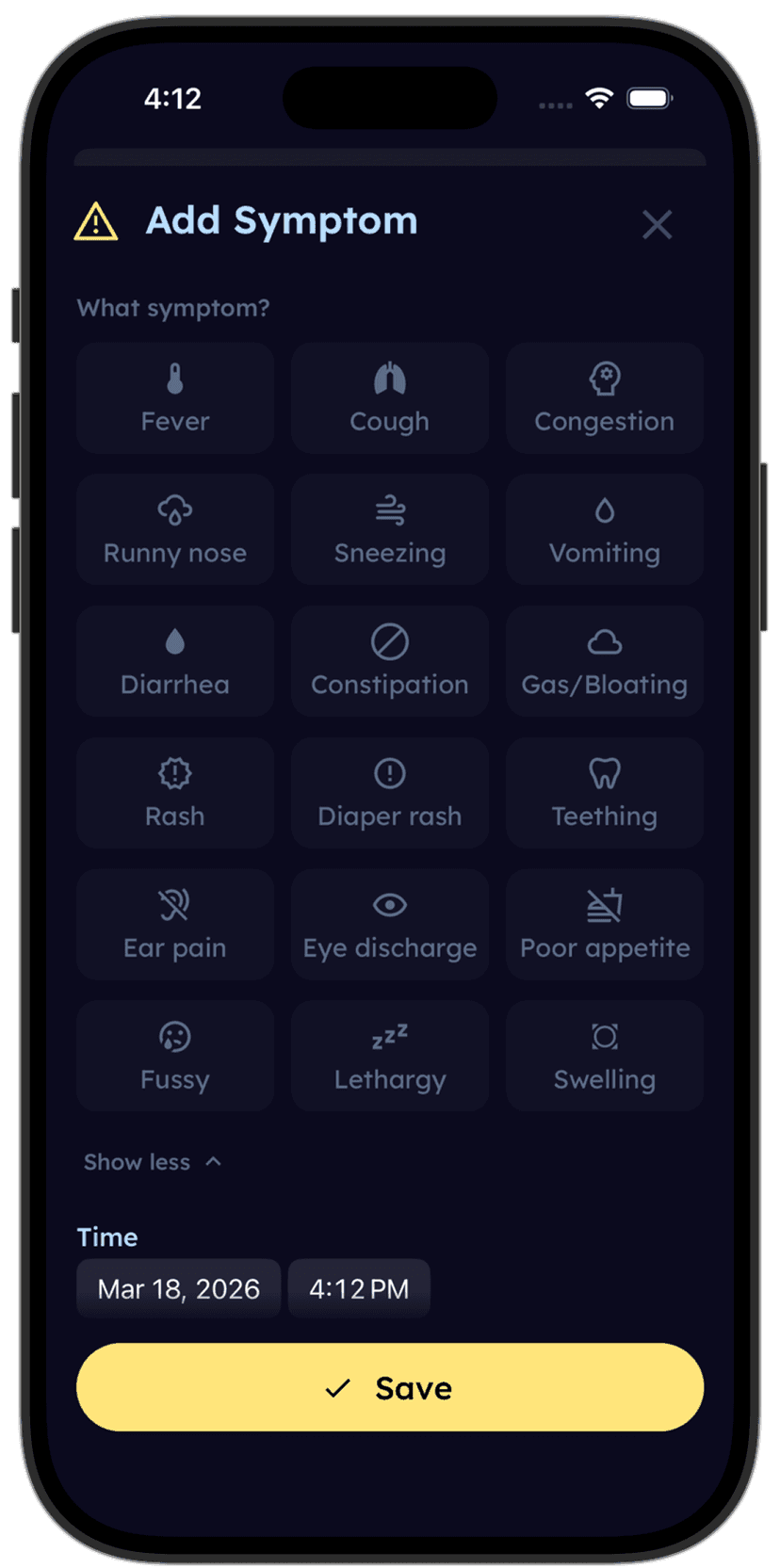
tinylog milestone and symptom tracking screen

Track what actually helps your baby — build a teething playbook.

Instead of relying on products with no evidence, try the evidence-based remedies and log what works in tinylog. Cold washcloth? Ibuprofen at bedtime? Frozen banana in a mesh feeder? Track it, and you will know exactly what to reach for when the next tooth arrives.

Download on the App StoreGet It On Google Play

What Your Pediatrician Wants You to Know

There is no safe way to use an amber teething necklace. Breakaway clasps reduce strangulation risk but create a choking hazard. Wearing it on the ankle reduces neck strangulation risk but beads can still break off. There is no configuration that eliminates the dangers while a product that has no proven benefit.

Remove it during sleep — or better yet, remove it permanently. If you choose to keep an amber necklace despite the recommendations, it must absolutely never be worn during sleep or unsupervised time. But since the necklace has no proven benefit, the simplest approach is to remove it entirely.

Evidence-based remedies work. Cold, pressure, and appropriate pain relief are effective, safe, and recommended by every major pediatric organization. Your baby does not need jewelry to manage teething pain.

Practical Tips

The placebo effect is powerful

Many parents report that their baby seemed calmer after putting on an amber necklace. This is likely the placebo effect — the parent expects it to work, interprets normal fluctuations in the baby's mood as improvement, and confirms their belief. Teething discomfort naturally comes and goes, so any change (positive or negative) after putting on a necklace is most likely coincidence.

Remove it — even if it seems to be helping

Even if you believe the necklace is helping, the safety risks are real and documented. A baby does not need to be wearing a necklace when evidence-based remedies (cold, pressure, medication) are available and effective. The perceived benefit is not worth the risk of strangulation or choking.

If you want wearable teething relief, wear it yourself

Silicone teething necklaces and bracelets designed for parents to wear are a safe alternative. Your baby can chew on them while you hold them, without any jewelry on the baby's body. These are made of food-grade silicone, designed for chewing, and do not pose strangulation risk to the baby.

Have the conversation compassionately

If a well-meaning family member gave you an amber necklace, or if another parent swears by them, approach the conversation with empathy. Most people recommending amber necklaces genuinely believe they work and genuinely care about the baby. Share the safety information calmly and suggest evidence-based alternatives.

Related Guides

Sources

  • American Academy of Pediatrics (AAP). Amber teething necklaces: safety warning. HealthyChildren.org.
  • Consumer Product Safety Commission (CPSC). Jewelry and bead hazards for children.
  • Health Canada. (2014). Advisory on amber teething necklaces.
  • Cox, C., et al. (2017). Amber teething necklaces — an evidence review. Pediatric Emergency Care.
  • Soudek, L., & McLaughlin, R. (2018). Fad over science: Systematic review of the evidence behind amber teething necklaces. Canadian Family Physician, 64(1), e8-e10.

Medical Disclaimer

This guide is for informational purposes only and is not a substitute for professional medical advice. If your baby has a fever of 100.4°F (38°C) or higher, is refusing to eat, or seems unusually unwell, contact your pediatrician — these symptoms are not typical of teething alone.

Get this guide in your inbox.
We'll email you this guide with the evidence and safe alternatives.
Track teething milestones and what remedies actually help.
Download tinylog free — log milestones and symptoms in seconds.
Download on the App StoreGet It On Google Play