GUIDE

2-Month-Old Baby Development

Your baby is waking up to the world. The smiles are real, the coos are intentional, and it's starting to get good.

Two months is when a lot of parents feel the first glimmer of 'okay, I can do this.' The worst fussiness has peaked, sleep is slightly better, and your baby is starting to interact with you in ways that feel like actual communication.

Physical and Motor Development

At two months, your baby's body is getting noticeably stronger. Head control is the headline — many can lift their head to 45 degrees during tummy time and hold it steadily. When held upright, their head bobs less. Pathways.org recommends working toward 15–30 minutes of total tummy time per day (broken into short sessions).

Arm and leg movements are smoother and more symmetrical. Hands are opening more — the grasp reflex is fading, which is actually progress. Voluntary grasping will develop over the next couple of months. The involuntary reflex has to fade first to make room for intentional control.

Milestones to Watch For

  • Head steady at 45 degrees during tummy time — some push up even higher
  • Social smile in full swing — smiles at familiar faces
  • Cooing with increasing variety of vowel sounds
  • Follows objects through a full 180-degree arc
  • Hands opening more — beginning to discover their own hands
  • Can be calmed by your voice or presence
  • Shows signs of boredom (fusses when activity doesn't change)

The CDC's updated 2022 milestones for 2 months include watching you as you move, looking at a toy for several seconds, and showing signs of being calmed by your presence.

Cognitive, Sensory, and Social Development

Visual tracking is much smoother — your baby can follow an object through a full 180-degree arc. They're beginning to anticipate routines and can actually get bored, which is a cognitive milestone. Boredom means they've habituated to their current stimulus and want something new.

The social smile is in full swing. Your baby smiles at familiar faces, at themselves in a mirror, and during "conversations." According to Zero to Three, self-soothing is developing — your baby brings their hand to their mouth more reliably, which is the beginning of emotional regulation. Stranger awareness is beginning to emerge subtly.

Cooing has hit its stride. When your baby coos and you respond, you're engaging in "serve and return" — the back-and-forth that literally builds neural architecture for language and social communication. Crying has evolved too — you can often tell your baby's mood just by the sounds they make.


Feeding and Sleep

Most two-month-olds eat 6–8 times per day, with sessions that are faster and less chaotic than the early weeks. A growth spurt around 2–3 months can temporarily increase feeding frequency. For breastfeeding parents, you might notice your supply has regulated — breasts don't feel as full, which is normal.

Sleep is hopefully consolidating. Many two-month-olds produce one longer stretch at night (4–6 hours). Daytime naps are still irregular but may start to show a loose pattern — many babies nap 3–5 times per day. The AAP recommends safe sleep practices: alone, on their back, on a firm flat surface.

tinylog sleep tracking showing pattern emergence at two months

If you're tracking sleep, this is when the data starts to get interesting.

You might see a clear "longest stretch" emerging at night, or a predictable fussy window. tinylog's sleep tracking can help you spot patterns — sometimes the trend is there but you're too tired to see it.

Download on the App StoreGet It On Google Play

What You Might Not Expect

The 2-month vaccines can throw off routine for a day or two

Mild fever, extra fussiness, and more sleep are common reactions. Your pediatrician will give guidance on fever management. The disruption is temporary and much less concerning than the diseases they prevent.

Your baby might discover their hands

Watch for the moment your baby stares at their own hand like they've discovered an alien artifact. This hand-gazing is a legitimate cognitive milestone — they're realizing this thing is attached to them and they can control it.

You are the best developmental toy your baby has

Pinterest is full of elaborate sensory activities for two-month-olds. What your baby actually needs: your face, your voice, some tummy time, and the occasional change of scenery. That's it.

When to Talk to Your Pediatrician

  • Doesn't respond to loud sounds
  • Doesn't watch things as they move
  • Doesn't smile at people
  • Doesn't bring hands to mouth
  • Can't hold head up when pushing up during tummy time

These aren't pass/fail tests — they're conversation starters with your pediatrician. Development happens on a spectrum.

Related Guides

Want this guide in your inbox?
We'll send it so you can reference it before your 2-month checkup — or at 3 AM, whichever comes first.
Two months of showing up. That's the whole job.
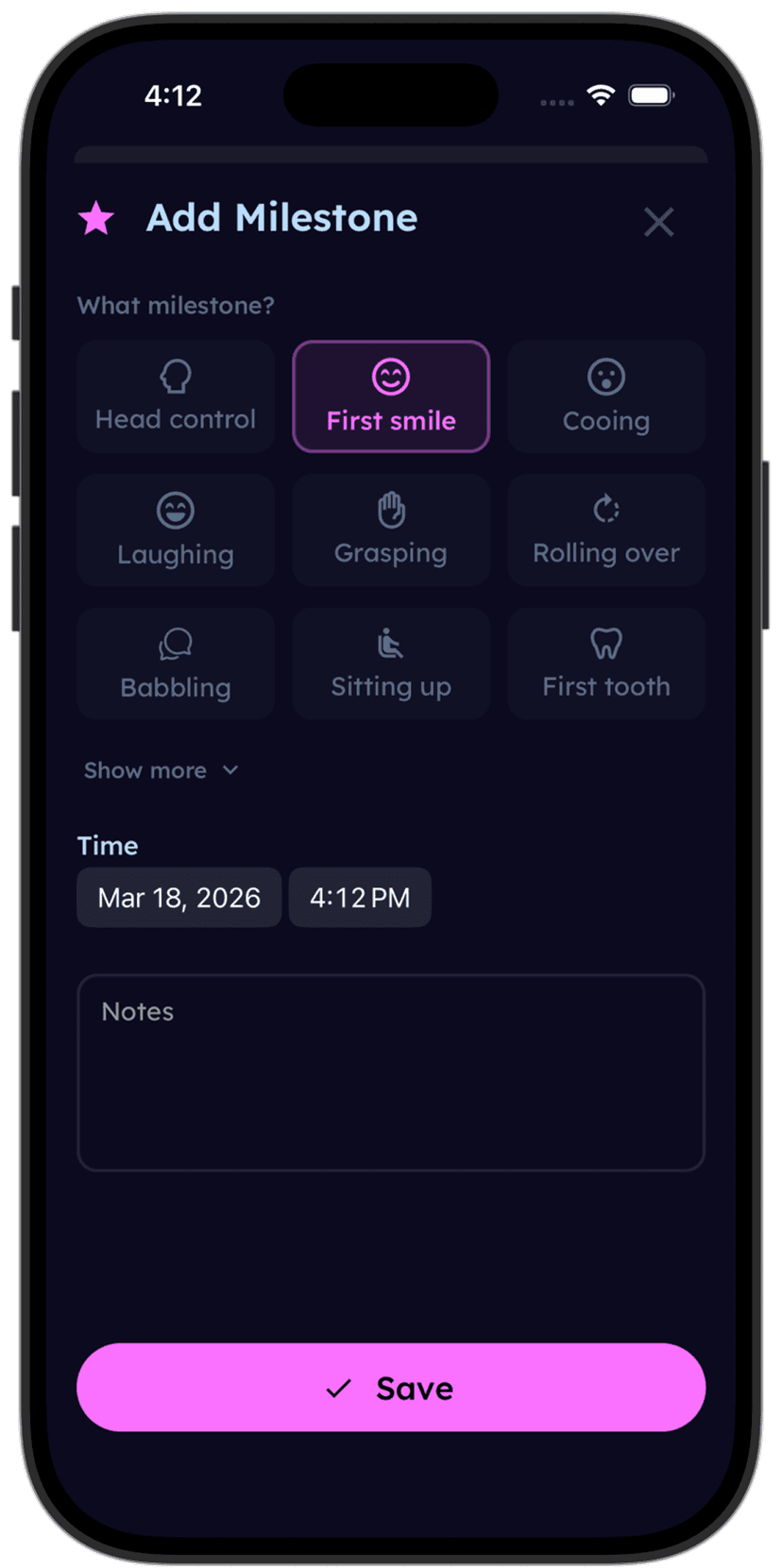
Download tinylog free — log milestones as they happen so you never forget the firsts.
Download on the App StoreGet It On Google Play